
PODCAST · society
Bhagavad Gita (English) - Slokas with Meaning
by Pundlik Kuvalkar
I am the creator and curator of bhagavad Gita, presenting diverse verses along with interpretations from respected scholars and authors. Hosted on Acast. See acast.com/privacy for more information.
-
18
Bhagavad Gita – Chapter 18: Yoga of Liberation & Renunciation
Chapter 18 of the Bhagavad Gita concludes the divine discourse with a comprehensive summary of all teachings. Lord Kṛṣṇa defines true renunciation, classifies duties by varṇa and āśrama, and emphasizes selfless action, knowledge, and devotion as paths to liberation. He urges complete surrender to Him alone, promising protection from all sins and attainment of the supreme abode for those who follow His words with faith. Hosted on Acast. See acast.com/privacy for more information.
-
17
Bhagavad Gita – Chapter 17: Yoga of the Threefold Faith
Chapter 17 of the Bhagavad Gita classifies faith, food, sacrifice, austerity, and charity according to the three modes of nature—sattva (goodness), rajas (passion), and tamas (ignorance). Lord Kṛṣṇa teaches that actions performed with pure sattvic faith, dedicated to Him without attachment, lead to spiritual growth. The chapter concludes with the sacred syllable Om Tat Sat, representing the eternal truth behind all true spiritual practices. Hosted on Acast. See acast.com/privacy for more information.
-
16
Bhagavad Gita – Chapter 16: Yoga of Divine & Demonic Qualities
Chapter 16 of the Bhagavad Gita contrasts divine qualities (fearlessness, purity, charity, austerity, non-violence) with demonic qualities (hypocrisy, arrogance, anger, ignorance). Lord Kṛṣṇa explains how divine traits lead to liberation, while demonic ones bind the soul to suffering and rebirth. By cultivating godly virtues and avoiding the lower nature, one aligns with dharma and attains the Supreme. Hosted on Acast. See acast.com/privacy for more information.
-
15
Bhagavad Gita – Chapter 15: Yoga of the Supreme Person
Chapter 15 of the Bhagavad Gita describes the world as an inverted aśvattha tree, with roots in the spiritual realm and branches in the material world. Lord Kṛṣṇa reveals Himself as the Supreme Person (Puruṣottama), beyond the perishable and imperishable, who sustains all creation. By cutting the tree's roots through detachment and devotion, one attains His eternal abode, free from rebirth. Hosted on Acast. See acast.com/privacy for more information.
-
14
Bhagavad Gita – Chapter 14: Yoga of the Three Gunas
Chapter 14 of the Bhagavad Gita explains the three modes of nature—sattva (goodness), rajas (passion), and tamas (ignorance)—that bind the soul to the material world. Lord Kṛṣṇa describes how each mode influences thoughts, actions, and bondage, and reveals how transcending them through devotion leads to liberation. The wise rise above these forces, attaining unshakeable peace and freedom from rebirth. Hosted on Acast. See acast.com/privacy for more information.
-
13
Bhagavad Gita – Chapter 13: Yoga of the Field & Knower
Chapter 13 of the Bhagavad Gita distinguishes the field (body, mind, senses, and material nature) from the knower of the field (eternal soul). Lord Kṛṣṇa explains true knowledge as understanding this distinction, the 24 elements of creation, and the three modes of material nature. By realizing the soul's purity beyond the body, one transcends suffering and attains liberation through discriminative wisdom. Hosted on Acast. See acast.com/privacy for more information.
-
12
Bhagavad Gita – Chapter 12: Yoga of Devotion
Chapter 12 of the Bhagavad Gita glorifies Bhakti Yoga, the path of loving devotion to Lord Kṛṣṇa. He describes the qualities of a true devotee—humble, compassionate, steady-minded, and free from ego. Kṛṣṇa assures that devotion is the easiest and most direct path to Him, surpassing even knowledge or meditation for those who surrender with pure love. This chapter reveals bhakti as the supreme way to realize the Divine. Hosted on Acast. See acast.com/privacy for more information.
-
11
Bhagavad Gita – Chapter 11: Yoga of the Universal Form
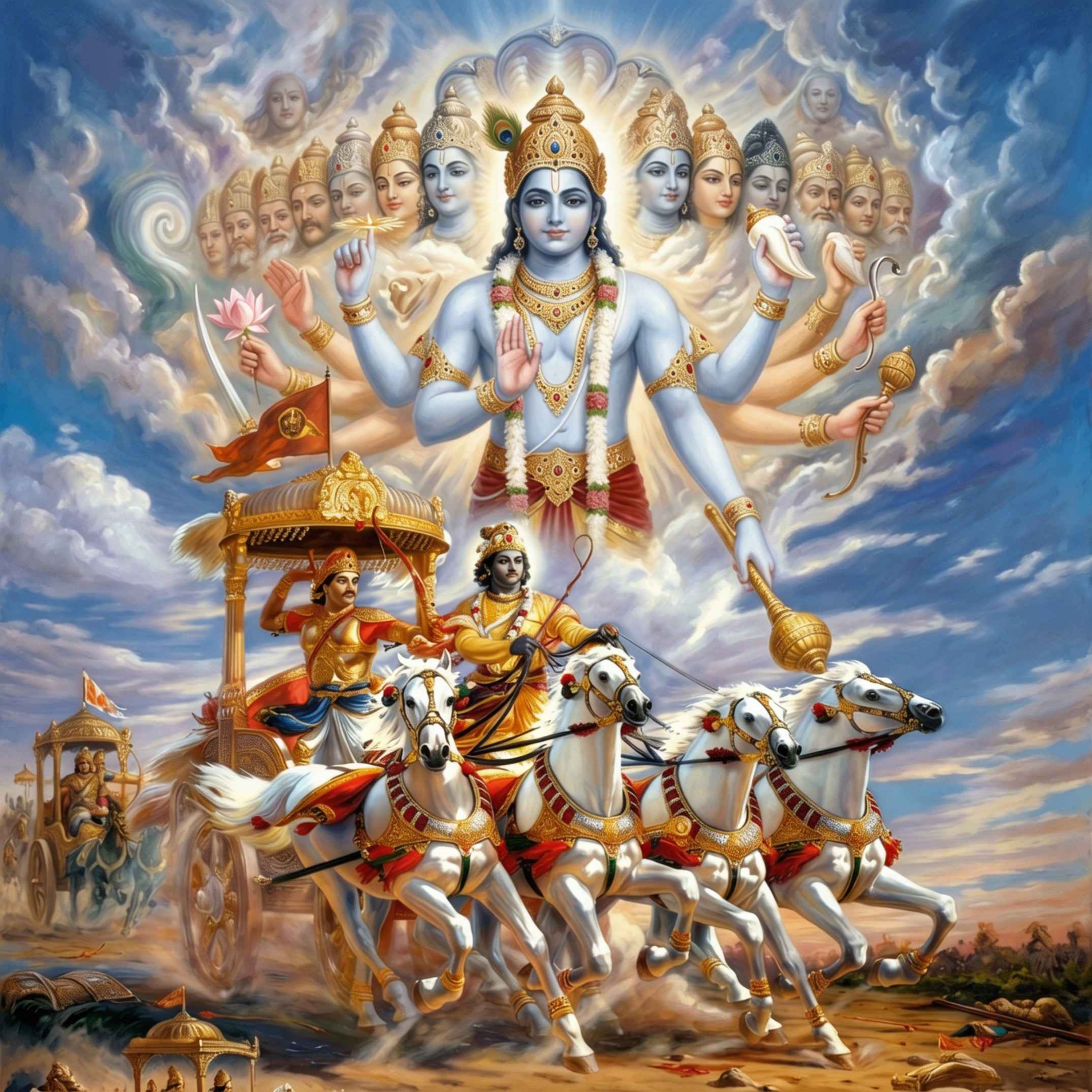
Chapter 11 of the Bhagavad Gita unveils Lord Kṛṣṇa's Universal Form (Viśvarūpa). At Arjuna's request, Kṛṣṇa reveals His cosmic vision—containing all universes, gods, and beings in one infinite, terrifying, yet awe-inspiring manifestation. Arjuna witnesses time, destruction, and creation within Him, trembling in fear and wonder. This chapter culminates in Arjuna's complete surrender, recognizing Kṛṣṇa as the Supreme Lord beyond all forms. Hosted on Acast. See acast.com/privacy for more information.
-
10
Bhagavad Gita – Chapter 10: Yoga of Divine Glories
Chapter 10 of the Bhagavad Gita reveals Lord Kṛṣṇa's divine opulences (vibhūtis). He describes Himself as the source of all greatness—the splendor of the sun, strength of mountains, brilliance of heroes, and essence of everything supreme. Arjuna learns to see the Divine in all creation's glories. This chapter inspires awe and devotion by glorifying Kṛṣṇa's infinite manifestations throughout the universe. Hosted on Acast. See acast.com/privacy for more information.
-
9
Bhagavad Gita – Chapter 9: Yoga of Royal Knowledge & Secret
Chapter 9 of the Bhagavad Gita reveals the most confidential knowledge of devotion (bhakti-yoga). Lord Kṛṣṇa declares that pure, selfless love for Him transcends all other paths and purifies the soul instantly. He assures that anyone—regardless of birth, status, or past—who offers even a leaf, flower, or water with devotion receives His grace. This chapter emphasizes surrender and loving service as the simplest way to attain the Supreme. Hosted on Acast. See acast.com/privacy for more information.
-
8
Bhagavad Gita – Chapter 8: Yoga of the Imperishable Brahman
Chapter 8 of the Bhagavad Gita focuses on remembering the Divine at the time of death to attain liberation. Lord Kṛṣṇa explains the paths of light (for yogis) and darkness (for others), emphasizing constant meditation on Him, righteous living, and faith. By fixing the mind and intellect on the Supreme, one transcends death and reaches the eternal abode, free from rebirth. Hosted on Acast. See acast.com/privacy for more information.
-
7
Bhagavad Gita – Chapter 7: Yoga of Knowledge & Realization
chapter 7 of the Bhagavad Gita reveals Jñāna-vijñāna-yoga, the yoga of knowledge and realization. Lord Kṛṣṇa explains His two-fold nature—lower material energy and higher spiritual energy—and how everything in creation rests on Him. Only a small fraction of people truly know the Supreme through devotion, while others remain deluded by illusion (māyā). This chapter shows how surrender and pure love lead to knowing God completely. Hosted on Acast. See acast.com/privacy for more information.
-
6
Bhagavad Gita – Chapter 6: Yoga of Meditation
Chapter 6 of the Bhagavad Gita describes Dhyāna Yoga, the practice of meditation. Lord Kṛṣṇa explains how to control the mind, body, and senses through disciplined practice and detachment. A true yogi remains equipoised in success and failure, sees the Self in all beings, and attains unbreakable inner peace. This chapter emphasizes moderation in eating, sleeping, and working as the foundation for mastering the mind and realizing the Supreme. Hosted on Acast. See acast.com/privacy for more information.
-
5
Bhagavad Gita – Chapter 5: Yoga of Renunciation
Chapter 5 of the Bhagavad Gita reconciles action and renunciation. Lord Kṛṣṇa teaches that both selfless action (Karma Yoga) and renunciation lead to the same goal—liberation—when performed with true knowledge and detachment. The true renunciant sees the Self in all beings, remains equipoised in pleasure and pain, and attains inner peace. This chapter shows that one can live in the world while transcending it through equanimity and divine vision. Hosted on Acast. See acast.com/privacy for more information.
-
4
Bhagavad Gita – Chapter 4: Yoga of Knowledge & Renunciation
Bhagavad Gita Chapter 4, titled “Jñāna‑yoga – The Yoga of Knowledge,” reveals the path of wisdom and self‑realization. Lord Kṛṣṇa explains that true knowledge destroys ignorance, purifies the heart, and leads to liberation from the cycle of birth and death. He teaches that when actions are performed with spiritual understanding and devotion, they become a means to realize the Supreme Self. This chapter emphasizes inner wisdom, the eternal nature of the soul, and how knowledge, combined with devotion, frees a person from bondage. Hosted on Acast. See acast.com/privacy for more information.
-
3
Bhagavad Gita – Chapter 3: Yoga of Action
Chapter 3 of the Bhagavad Gita explains Karma Yoga, the path of selfless action. Lord Kṛṣṇa teaches Arjuna that performing one’s prescribed duties without attachment to the results purifies the mind and leads to spiritual progress. He emphasizes that action is superior to inaction, that everyone must act according to their nature, and that when actions are offered to the Divine, they become a form of worship. This chapter establishes Karma Yoga as a practical way to live in the world while remaining spiritually focused Hosted on Acast. See acast.com/privacy for more information.
-
2
Bhagavad Gita – Chapter 2: Yoga of Knowledge
Chapter 2 of the Bhagavad Gita, titled “Contents of the Gītā Summarized”, marks the beginning of Lord Kṛṣṇa’s direct teachings to Arjuna. Kṛṣṇa explains the eternal nature of the soul, the difference between the body and the self, and the importance of performing one’s duty without attachment to results. He introduces the concepts of karma‑yoga (action in devotion), fearlessness, steadiness of mind, and detachment. This chapter lays the foundation for the entire Gītā by summarizing its core message: act according to your dharma, remain steady in success and failure, and dedicate all actions to the Supreme. Hosted on Acast. See acast.com/privacy for more information.
-
1
Bhagavad Gita – Chapter 1: Yoga of Arjuna's Despondency
Bhagavad Gita Chapter 1, titled “Observing the Armies on the Battlefield of Kurukṣetra”, sets the scene of the great war at Kurukṣetra. Arjuna, filled with doubt and sorrow at seeing his relatives and teachers on the battlefield, questions the purpose of fighting and drops his weapons. His inner conflict and moral confusion create the perfect opportunity for Lord Kṛṣṇa to begin His divine teachings in the chapters that follow. Hosted on Acast. See acast.com/privacy for more information.
We're indexing this podcast's transcripts for the first time — this can take a minute or two. We'll show results as soon as they're ready.
No matches for "" in this podcast's transcripts.
No topics indexed yet for this podcast.
Loading reviews...
ABOUT THIS SHOW
I am the creator and curator of bhagavad Gita, presenting diverse verses along with interpretations from respected scholars and authors. Hosted on Acast. See acast.com/privacy for more information.
HOSTED BY
Pundlik Kuvalkar
CATEGORIES
Loading similar podcasts...
Frequently Asked Questions
How many episodes does Bhagavad Gita (English) - Slokas with Meaning have?
Bhagavad Gita (English) - Slokas with Meaning currently has 18 episodes available on PodParley. New episodes are automatically indexed when they're published to the podcast feed.
What is Bhagavad Gita (English) - Slokas with Meaning about?
I am the creator and curator of bhagavad Gita, presenting diverse verses along with interpretations from respected scholars and authors. Hosted on Acast. See acast.com/privacy for more information.
How often does Bhagavad Gita (English) - Slokas with Meaning release new episodes?
Bhagavad Gita (English) - Slokas with Meaning has 18 episodes. Check the episode list to see recent publication dates and frequency.
Where can I listen to Bhagavad Gita (English) - Slokas with Meaning?
You can listen to Bhagavad Gita (English) - Slokas with Meaning on PodParley by clicking any episode. We provide an embedded audio player for direct listening, and you can also subscribe via your preferred podcast app using the RSS feed.
Who hosts Bhagavad Gita (English) - Slokas with Meaning?
Bhagavad Gita (English) - Slokas with Meaning is created and hosted by Pundlik Kuvalkar.
URL copied to clipboard!