
PODCAST · religion
Echoes of Heresy
by Andy Altschuler
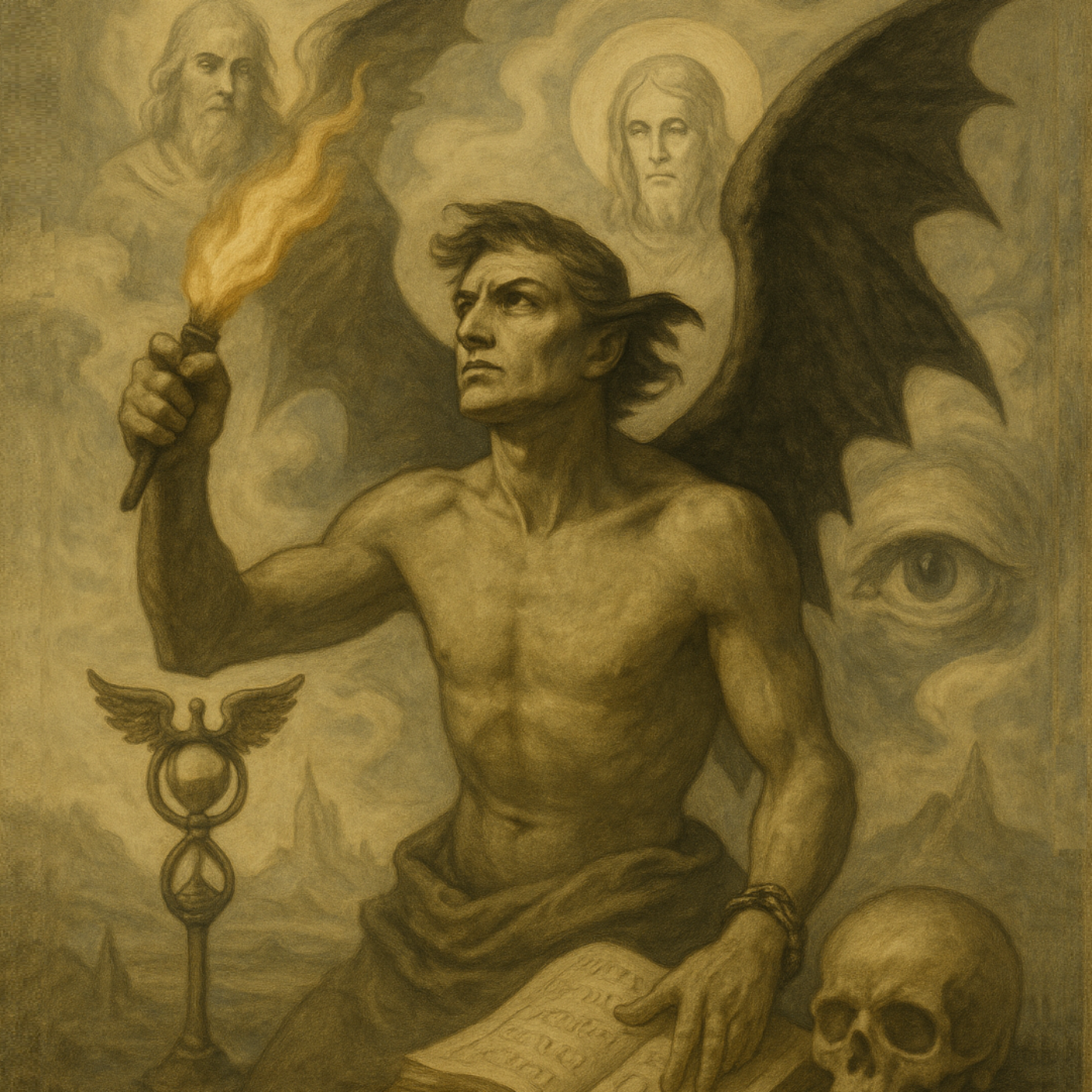
Echoes of Heresy – a podcast about spiritual dissent, divergent beliefs and doctrinal conflict across time and tradition.In each episode the host, Andy Altschuler, looks into the stories of heterodox thinkers, movements or systems from various places, epochs and traditions. He also explores doctrinally problematic, controversial or insufficiently defined theological concepts and ritual practices within the mainstream religious frameworks.From visionary cosmologies and mystical dissidents to folk saints, philosophical provocateurs, and long-buried sects, each episode dives into a story of a particular movement or sect, theological concept or trend, heterodox thinker or strain of thinkers, with references to primary and secondary sources, highlighting curious facts and crucial details.It’s not strictly academic, but grounded in scholarship. Not esoteric, not sensationalist, not pushing any ideology — just curious, evidence-based e
-
8
Folk Saints of Latin America
The final episode of the first season. A glimpse into a phenomenon of Latin American Folk Saints.Folk saint veneration is far from being a uniquely Latin American thing, but in Latin America, this phenomenon feels especially vivid – more public that elsewhere, more embodied, and woven deeply into everyday life. Rooted in a long history of Catholic tradition, Indigenous cosmology, Afro-Caribbean spiritual practices, and mestizo cultural memory, the popular religiosity of the region creates fertile ground for unofficial saints. In fact, the Church often finds itself playing catch-up – cautiously acknowledging some folk cults, while condemning others as superstition or even heresy.Folk saints often emerge in spaces where institutional religion seems distant: borderlands, rural villages, prisons, inner cities. They fill gaps the Church can’t or won’t reach. Still, the line between folk devotion and Church orthodoxy is not always a battleground. In fact, more often than not, it’s a negotiation...
-
7
The Gospel of Leo Tolstoy
One of the greatest literary figures in Russian history — and, perhaps, the most recognizable Russian author in the world...Tolstoy was celebrated during his lifetime. He was a cultural monument in his own time — read not only by the Russian intelligentsia, but by factory workers, schoolteachers, revolutionaries, and monarchists alike.Unlike so many Russian thinkers and artists, he was never imprisoned, never exiled, never formally repressed by the state. His writings generally were not banned – neither by the Tsarist regime, nor by the Soviets who followed. In fact, both systems found ways to celebrate him.In the Soviet Union, he was often presented as a proto-socialist critic, a moral voice who condemned inequality and imperial hypocrisy. In the West, he was embraced as a literary genius, a prophet of nonviolence, a spiritual humanist. Across cultures and ideologies, Tolstoy has remained, in many ways, untouchable.Yet there is another side to Tolstoy. A side that is far more controversial, and far less publicized.A man who delved into theology with relentless passion. Who challenged the foundations of Orthodox dogma. Who called the Church a distortion of Christ’s teachings. Who rejected the sacraments, denied the resurrection, and saw the cross not as a symbol of salvation, but as an emblem of cruelty.What led Tolstoy, the literary saint of Russia, to this final spiritual rebellion? And why did the Church respond not with debate, but with excommunication?
-
6
Sarmad - The Naked Saint of Mughal India
A poet for whom the boundaries between creeds were illusionary. A mystic for whom non-dualism and apophatic vision weren’t just poetic metaphors — they were his lived reality. All his life represents a bridge between the Abrahamic and Dharmic worlds. Who was Sarmad Kashani? What was his formation in Iran? And what was his role in Mughal India? What is his legacy - spiritual, literary, social? For those today who are suspicious of religious certainty and drawn to spiritual experimentation, he remains a startling, beautiful, and uncompromising presence.
-
5
The Khurramites: Religion, Revolt, and Memory. Part II.
Episode number 5 continues the exploration of the story of the Khurramites, a religious movement in Medieval Iran. The movement was nativist in nature, but had features of a syncretic cult. Neither fully Zoroastrian, nor Islamic, however rooted in the long history of Iranic religious traditions.In part II, we focus on the Khurramite rebellion against the Abbasid Caliphate, under the leadership of Babak Khorramdin. We delve into the history of the movement after Babak's defeat, including the intricate relations between the Khurramites and the Byzantine Empire, as well as their likely influence on various heterodox currents across the Persianate world. We then have a glimpse into how the image of Babak has been used in literature and art of modern Iran and Azerbaijan to shape divergent political and cultural narratives. We also attempt to grasp the role of Babak and the Khurramites in modern Kurdish and Talysh discourses. What makes Babak's story so compelling for modern artists and political activists?
-
4
The Khurramites: Religion, Revolt, and Memory. Part I.
The fall of the Sasanian Empire in the mid-7th century CE marked not just a political upheaval, but a profound transformation of Iranian society. The Islamic conquests introduced new religious paradigms, administrative structures, and social hierarchies. While Islam became the dominant faith, the process of Islamization was neither immediate nor uniform.Khurramism was, perhaps, one of the most notable movements in Early Islamic Iran. Neither fully Zoroastrian nor Islamic, they drew from deep wells of Persian religion, folk messianism, and anti-imperial rage.The episode no. 4 unfolds in two parts. The first part is focused on the historical context where the movement emerged, available sources about the Khurramites, their belief system and rituals, as well as the personality of their most famous leader - Babak Khorramdin.
-
3
Bardesan: Humanist Before Humanism
Before Renaissance philosophers proclaimed the ideal of man as free, rational, and divine— the Christian world had already known such a voice.Not from Florence or Padua, but from the banks of the Euphrates. Not at the high noon of humanism, but in the first light of Christian civilization.Before universities, before scholasticism, before creeds had hardened or canon closed— there, in the second century, lived a man named Bardaisan.Philosopher, poet, astrologer, theologian. A polymath... In another age, Bardaisan might have been remembered as a sage or a universal historian. It was only the narrowing margins of orthodoxy that cast him instead as a heretic...
-
2
Hypsistarians: Pagan Monotheists at the Threshold
There’s a tendency in religious history to draw hard lines — between gods and idols, orthodoxy and error, insiders and others. But in reality, belief is often fluid, and not always easy to categorise.In the eastern provinces of the Roman Empire, particularly around Asia Minor and the Black Sea, inscriptions and writings reveal a fascinating phenomenon. People — perhaps Gentile sympathizers with Judaism, or disillusioned pagans influenced by Stoic and Platonic thought — began to worship a singular, supreme deity. They rejected idols, observed Sabbath-like customs, and honored dietary restrictions, yet never underwent circumcision or adopted Jewish law. Nor did they convert to Christianity...Who were these worshipers of the Most High ("Hypsistos")? What did they believe — and why did their faith vanish into obscurity?
-
1
Introductory Episode: Why Heresy?
Welcome to the inaugural episode of Echoes of Heresy – a podcast about spiritual dissent, divergent beliefs and doctrinal conflict across time and tradition.In this first episode I introduce the project as such and as a whole. I have attempted to lay out the vision behind the podcast series, its overall concept, scope, angle and a range of topics to expect in the future.I also tried to explore briefly the phenomenon of heterodoxy, from various perspectives: philosophy, psychology, social anthropology, history.Since the dawn of organized religion, humans have tried to define and defend the sacred. And yet, history reveals that the sacred resists confinement. Even in the most regulated societies, belief has overflowed its borders.Why do people stray beyond the sanctioned path? Who defines orthodoxy? Why and how?Social media: X (Twitter): @echoesofheresy Reddit: r/EchoesofHeresy Support: https://www.paypal.com/paypalme/echoesofheresy https://ko-fi.com/echoesofheresy# Intro & outro theme: “Gates of the Mystery” by Festa Martyria. Originally released for free distribution. Used with permission.
We're indexing this podcast's transcripts for the first time — this can take a minute or two. We'll show results as soon as they're ready.
No matches for "" in this podcast's transcripts.
No topics indexed yet for this podcast.
Loading reviews...
ABOUT THIS SHOW
Echoes of Heresy – a podcast about spiritual dissent, divergent beliefs and doctrinal conflict across time and tradition.In each episode the host, Andy Altschuler, looks into the stories of heterodox thinkers, movements or systems from various places, epochs and traditions. He also explores doctrinally problematic, controversial or insufficiently defined theological concepts and ritual practices within the mainstream religious frameworks.From visionary cosmologies and mystical dissidents to folk saints, philosophical provocateurs, and long-buried sects, each episode dives into a story of a particular movement or sect, theological concept or trend, heterodox thinker or strain of thinkers, with references to primary and secondary sources, highlighting curious facts and crucial details.It’s not strictly academic, but grounded in scholarship. Not esoteric, not sensationalist, not pushing any ideology — just curious, evidence-based e
HOSTED BY
Andy Altschuler
CATEGORIES
Loading similar podcasts...
Frequently Asked Questions
How many episodes does Echoes of Heresy have?
Echoes of Heresy currently has 8 episodes available on PodParley. New episodes are automatically indexed when they're published to the podcast feed.
What is Echoes of Heresy about?
Echoes of Heresy – a podcast about spiritual dissent, divergent beliefs and doctrinal conflict across time and tradition.In each episode the host, Andy Altschuler, looks into the stories of heterodox thinkers, movements or systems from various places, epochs and traditions. He also explores...
How often does Echoes of Heresy release new episodes?
Echoes of Heresy has 8 episodes. Check the episode list to see recent publication dates and frequency.
Where can I listen to Echoes of Heresy?
You can listen to Echoes of Heresy on PodParley by clicking any episode. We provide an embedded audio player for direct listening, and you can also subscribe via your preferred podcast app using the RSS feed.
Who hosts Echoes of Heresy?
Echoes of Heresy is created and hosted by Andy Altschuler.
URL copied to clipboard!