
PODCAST · religion
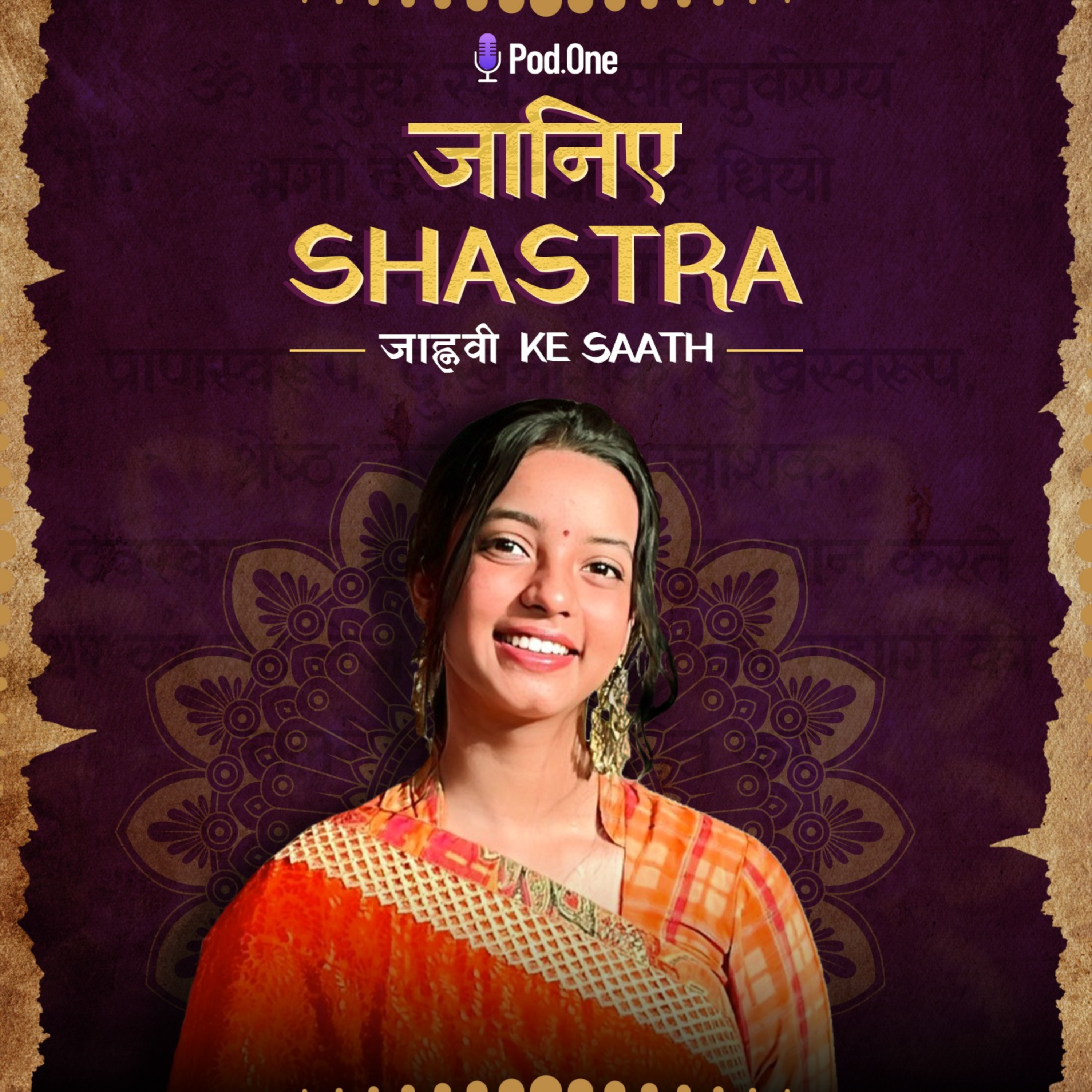
Jaaniye Shastra Janhvi Ke Saath
by Janhvi Singh
जानिए Shastra जाह्नवी के Saath is a podcast of a 20-year-old Gen-z Content Creator who is on a mission to decode the Science, Significance & Stories behind our Ved, Upnishads, Shastra, Mahabharat & Ramayan.No matter what field you're from, your profession, age, or anything else doesn't matter. Ithihaas has key solutions and practical applications to your family life, social life, love life, business, marketing, friendship, and everything you name it, and the Ved, Shastra, Upanishads, and Ithihaas have an answer to it
-
5
IshaUpnishad : 01 | Mantra 02 : Jaaniye Shastra Janhvi Ke Saath
The Isha Upnishad : Mantra 02 : कुर्वन्नेवेह कर्माणि जिजीविषेच्छतं समाः । एवं त्वयि नान्यथेतोऽस्ति न कर्म लिप्यते नरे ॥ The mantra states:"Kurvanneveha karmāṇi jijīviṣet śataṁ samāḥEvaṁ tvayi nānyatheto'sti na karma lipyate nare." Importance of Action (Karma): It emphasizes that performing one's duties and actions (karma) is essential for a meaningful life. He asserts that living a life of a hundred years, engaged in righteous deeds, is desirable and fulfilling. 2. Living with Purpose: The commentary highlights that life should be lived with a sense of purpose and commitment to one's responsibilities. This dedication to duty helps in achieving both material and spiritual goals. 3. Detachment from Results: It stresses that while actions are crucial, one should remain detached from the results. This detachment prevents the bondage of karma, allowing individuals to perform their duties selflessly. 4. Pursuit of Knowledge and Wisdom: The mantra also underlines the pursuit of knowledge and wisdom alongside performing actions. It encourages a balanced approach, where one seeks enlightenment while fulfilling worldly responsibilities. 5. Avoiding Sinful Actions: Also, warns against indulging in sinful or unethical actions. He believes that adhering to dharma (righteousness) is vital for spiritual growth and liberation. 6. Integration of Spiritual and Practical Life: The mantra suggests that spiritual practices and practical life should not be seen as separate. Engaging in everyday activities with a spiritual mindset leads to holistic growth. The Mantra 02 of the Isha Upanishad advocates for a life of active engagement in righteous deeds, balanced with spiritual pursuit and detachment from outcomes. It serves as a guide for living a life that is both fulfilling and aligned with higher spiritual principles.
-
4
IshaUpnishad : 01 | Mantra 01 : Jaaniye Shastra Janhvi Ke Saath
The Isha Upnishad : Mantra 01 : ईशा वा॒स्य॒मिदसर्वं यत्किञ्च॒ जग॑त्या॒ जग॑त् । तेन॑ त्य॒क्तेन॑ भुञ्जीथा मा ग॑धः कस्य॑ स्विद्धन॑म् The Isha Upanishad, one of the shortest Upanishads consisting of only 18 verses, opens with the profound Mantra 1. This mantra encapsulates the essence of Vedantic philosophy, emphasizing the immanence of the divine in every aspect of the universe. It reads: *"īśāvāsyam idam sarvaṃ yat kiñca jagatyāṃ jagat | tena tyaktena bhuñjīthā mā gṛdhaḥ kasya svid dhanam ||"* Translated, it means: *"Everything in this moving universe is pervaded by the Lord. Therefore, enjoy with renunciation. Do not covet anyone’s wealth."* This mantra asserts that the entire cosmos is enveloped by the divine presence, indicating the omnipresence of the Supreme Being, Isha. It stresses that God is inherent in all creation, living and non-living. By recognizing this divine pervasiveness, one is guided to live a life of detachment and renunciation. The phrase "tena tyaktena bhuñjīthā" encourages individuals to enjoy the world without attachment, suggesting that one should consume and use resources responsibly and without greed. Furthermore, the mantra advises against covetousness or desiring others' wealth, promoting contentment and ethical living. It implies that everything belongs to the divine, and thus, human beings should refrain from selfish desires and unethical acquisition of material possessions. Mantra 1 of the Isha Upanishad provides a foundational perspective on how to live harmoniously in the world. It calls for a balanced life of enjoyment tempered with detachment, urging individuals to recognize the divine essence in all things, and to adopt a mindset of stewardship rather than ownership. By internalizing these teachings, one can achieve a state of inner peace and alignment with the cosmic order, ultimately leading to spiritual liberation.
-
3
Episode 02 : The "Sequence of Upnishads"
Upanishad is that eternal lamp of knowledge which has been giving light since the beginning of creation and will continue to give light till the end. Upanishad is that spiritual ocean, by taking bath in which the distressed and distressed souls of the world get peace. The direct and simple way in which spiritual knowledge has been described in the Upanishads is rare to find anywhere else. The glory and majesty of the Upanishads is clear from the fact that Maharishi Ved Vyaas had to create a complete philosophy - Vedanta Darshan - to coordinate their sentences. Not only the Eastern scholars following the Vedic Culture are aware of the importance of Upanishadic knowledge, but other religions and Western scholars have also been greatly influenced by its teachings. Mansur Anhalak passed away while proclaiming 'Aham Brahmasmi' - I am Brahma - passed away. Aurangzeb's daughter Zebunnisa heard the secrets of the Upanishads from her uncle. The color of Upanishads was added to it also. Zebunnisan had a Chinese mirror, very beautiful, which a merchant had gifted to Aurangzeb. One day Zebunnisa was sitting on the terrace drying her hair when she remembered the mirror. She ordered her maid to bring the mirror, The maid picked up the mirror and walked away. She had just gone a short distance when the glass fell from her hand and shattered. The ground beneath the maid's feet disappeared, her face turned pale and her heart started pounding. She stood there frightened. When he had been standing for a long time, Jebunnisan called out. The frightened and nervous maid went before her and said in a trembling voice: अज़ क़ज़ा आइनाये चीना शिकस्त : हे राजकुमारी। मेरे दुर्भाग्य से वह शीशा गिरकर टुकड़े-टुकड़े हो गया। Hearing this, Jebunnisan did not get angry. She smiled and said : खूब शुद कि सामाने खुदबीनी शिकस्त : It is very clear that I have suffered a self-inflicted defeat. Well, it's good that the luxuries are gone. I felt proud when I saw her every day. Now I will neither feel egoistic nor arogant Now a question also arises that when did the Upnishad come, what is its creation period, when was it written? Many learned people used to try to decide the time period of all the Indian books, for Upnishads : Mr. Macdonald says : Upnishads are 600 years old, they were written earlier, this belief of his is very far from the truth : Upnishads were created in different times, but no authentic Upnishad was created after Mahabharata and Mahabharata is at least 5000 years old years / year ago It is mentioned in Mahabharata that Maharishi Ved Vyas Ji had knowledge of Katho Upnishadas, so it is proved that these Upnishadas are even older than this period. Lokmanya Shri Gangadhar Tilak Ji considered this to be a period, 1880 to 1680 years, but this too is extremely inconsistent. It is completely wrong to say that the Upanishads, the pinnacle of Vedic literature, were written only 1880-1680 years before Christ. Yes, if the western Christian writers, who believe that the age of creation according to the Bible is only 5-6 thousand years, determine the period of composition of the Upanishads to be 600 years before Christ, then what is surprising in this? The period of the Upanishads, the pinnacle of Vedic literature, cannot be counted in centuries. The Upanishads were compiled before Maharishi Manu. While instructing the duties of Vanaprasthis, Maharishi Manu has ordered them to study the Upanishads. Coming up to the sequence of Upnishads, we will be following : Isha Upnishad Ken Upanishad Katho Upnishad Prashna Upnishad Manduk Upnishad Mundak Upnishad Aitteriya Upnishad Tattaria Upnishad Chandogya Upnishad Brihandayak Upnishad Svetasvatar Upnishad
-
2
Episode 01 : The "Meaning of Upnishads"
Just as Gita is a part of Mahabharata, just like it is Upnishad, these Upnishads are based on our Vedic tradition which our ancient sages have given to us, which are mainly 11 Upnishads Out of these 108 Upanishads, the major 11 Upanishads only. Ish, Ken, Kath, Prashna, Mundak, Mandukya, Aitareya, Taittiriya, Chandogya, Brihadaranyaka and Shwetashvatara The Upnishads talks about Ishwar, Jeev and Prakriti in detail and is a path and a journey itself to follow in life The Episode 01 is all about : The origin of Upnishads The numbers of Upnishads The core of Upnishads The meaning of Upnishads The understanding of Upnishads
-
1
Introduction - What are Upnishads?
What is the meaning of Upnishad? How many Upnishads are there in Indian Shastra? This podcast links the materialistic world & desires and your inner calling. The host being a GenZ will de-code them for you in an elementary language.
We're indexing this podcast's transcripts for the first time — this can take a minute or two. We'll show results as soon as they're ready.
No matches for "" in this podcast's transcripts.
No topics indexed yet for this podcast.
Loading reviews...
ABOUT THIS SHOW
जानिए Shastra जाह्नवी के Saath is a podcast of a 20-year-old Gen-z Content Creator who is on a mission to decode the Science, Significance & Stories behind our Ved, Upnishads, Shastra, Mahabharat & Ramayan.No matter what field you're from, your profession, age, or anything else doesn't matter. Ithihaas has key solutions and practical applications to your family life, social life, love life, business, marketing, friendship, and everything you name it, and the Ved, Shastra, Upanishads, and Ithihaas have an answer to it
HOSTED BY
Janhvi Singh
CATEGORIES
Loading similar podcasts...
Frequently Asked Questions
How many episodes does Jaaniye Shastra Janhvi Ke Saath have?
Jaaniye Shastra Janhvi Ke Saath currently has 5 episodes available on PodParley. New episodes are automatically indexed when they're published to the podcast feed.
What is Jaaniye Shastra Janhvi Ke Saath about?
जानिए Shastra जाह्नवी के Saath is a podcast of a 20-year-old Gen-z Content Creator who is on a mission to decode the Science, Significance & Stories behind our Ved, Upnishads, Shastra, Mahabharat & Ramayan.No matter what field you're from, your profession, age, or anything else doesn't matter....
How often does Jaaniye Shastra Janhvi Ke Saath release new episodes?
Jaaniye Shastra Janhvi Ke Saath has 5 episodes. Check the episode list to see recent publication dates and frequency.
Where can I listen to Jaaniye Shastra Janhvi Ke Saath?
You can listen to Jaaniye Shastra Janhvi Ke Saath on PodParley by clicking any episode. We provide an embedded audio player for direct listening, and you can also subscribe via your preferred podcast app using the RSS feed.
Who hosts Jaaniye Shastra Janhvi Ke Saath?
Jaaniye Shastra Janhvi Ke Saath is created and hosted by Janhvi Singh.
URL copied to clipboard!