
PODCAST · society
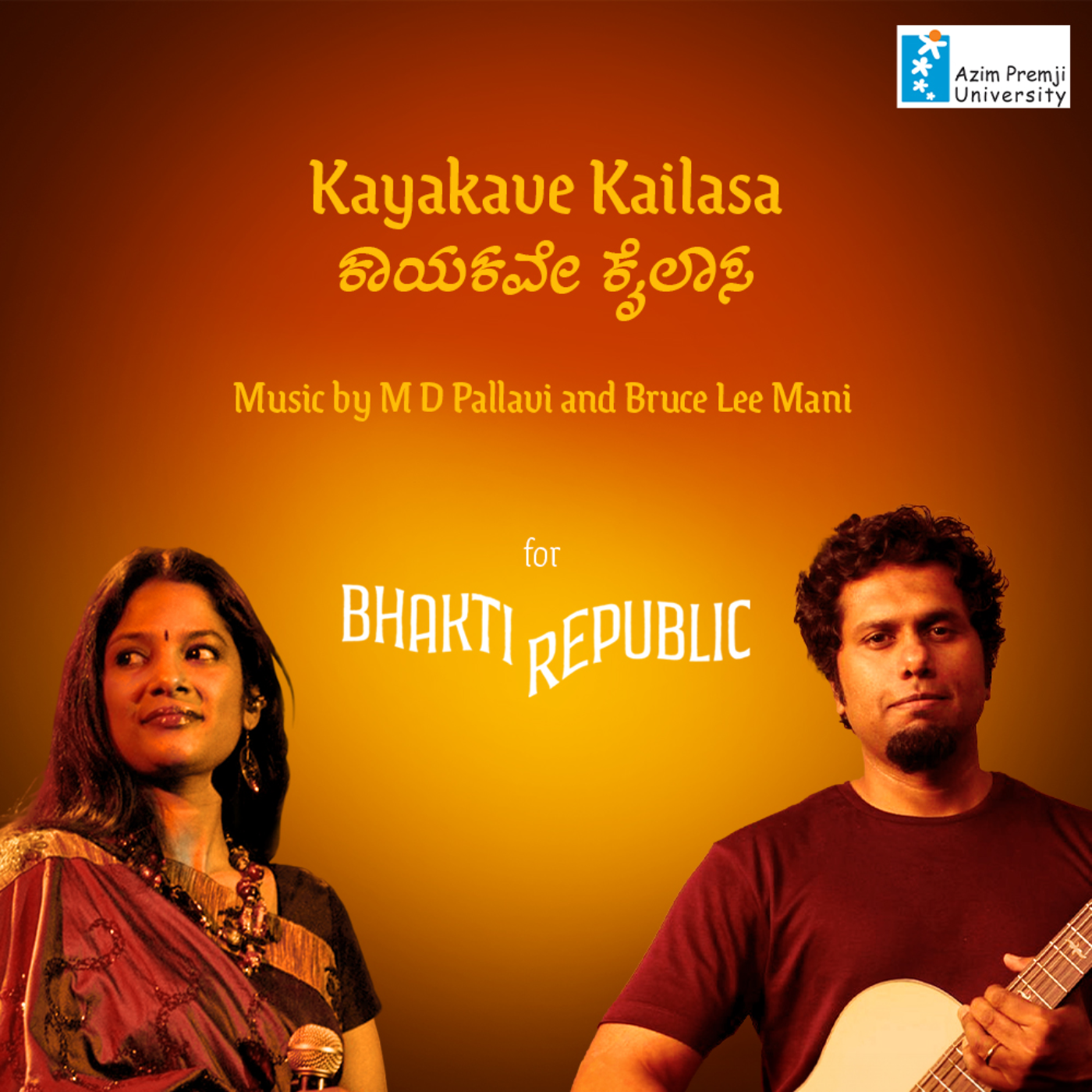
Kayakave Kailasa | Bhakti Republic OST | M. D. Pallavi and Bruce Lee Mani
by Radio Azim Premji University
Vachana Sahitya, a rhythmic form of writing of Bhakti poets in Kannada, emerged in the 11th century and reached its zenith in the 12th century. Comprising prose-like compositions known as Vachanas, this literary tradition conveys profound philosophical and spiritual messages. Rooted in the Sharana tradition centered around Kalyana or Kalyani in modern-day northern Karnataka, it gave rise to devoted saints including influential figures like Basavanna, Allama Prabhu, and Akka Mahadevi.Bhakti Republic with Amit Basole, in its third episode Kayakave Kailasa, elucidates the poetry of the vachanakaras. Radio Azim Premji University presents a selection of eleven vachanas by Akka Mahadevi, Allama Prabhu, Ayadakki Marayya, Basavanna, Devara Dasimayya, Kalavve, Madara Chennaiah, Maritande, and Sule Sankavva. They are rendered by singer M. D. Pallavi, with musician Bruce Lee Mani accompanying her on guitar. These spontaneous performances were improvised and recorded in an informa
-
12
Acha Shiva Aikyange | Kayakave Kailasa - Bhakti Republic OST | M. D. Pallavi and Bruce Lee Mani
Poet: Devara DasimayyaTranslator: A. K. RamanujanSource: Speaking of Siva, Penguin ClassicsPerformed by M. D. Pallavi and Bruce Lee ManiFor Bhakti Republic with Amit BasoleRadio Azim Premji University, 2023____________________________________________________To the utterly at-one with Sivathere’s no dawn,no new moon,no noonday,nor equinoxes,nor sunsets,nor full moons;his front yardis the true Banaras,O Ramanatha.______________________________________________________Devara Dasimayya, also known as Jedara Dasimayya, was a prominent figure in Vachana literature, hailing from the village of Mudanuru in Karnataka. He worked as a weaver and lived during the rule of the Kalyani Chalukyan ruler Jayasimha II. Basaveshwara, among the most prominent of the Veerashaiva poets, praised Dasimayya and his wife Duggale in several of his vachanas. Composed approximately 100 to 150 years before Basaveshwara, Dasimayya's 176 vachanas are noteworthy for expressing profound philosophical ideas in a concise form. Dasimayya's vachanas touch upon themes of conjugal discipline, gender equality, and the significance of charity. Dedicated to Ramanatha (Shiva), these vachanas have earned him admiration from the Devanga community, a widespread group of weavers in southern India who consider him an avatara purusha, an incarnation of the divine.
-
11
Adi Adharavilladandu | Kayakave Kailasa - Bhakti Republic OST | M. D. Pallavi and Bruce Lee Mani
Poet: Allama PrabhuTranslator: S.C. Nandimath, Armando Menzes, and R.C. HiremathSource: Sunya Sampadane Volume 1, Karnataka University, DharwadPerformed by M. D. Pallavi and Bruce Lee ManiFor Bhakti Republic with Amit BasoleRadio Azim Premji University, 2023______________________________________________________When neither Source nor Substance was,When neither I nor mine,When neither Form nor Formless was,When neither Void was nor non-Void,Nor that which moves or moves not,Then was Guhesvara's votary born._________________________________________________________Allama Prabhu, a revered poet and the patron saint of the Sharana movement in medieval Karnataka, was born in the 12th century in Shivamogga district of Karnataka. He played a pivotal role in reshaping both society and Kannada literature. Recognized as part of the "Trinity of Lingayatism" alongside Basavanna and Akka Mahadevi, Allama Prabhu channeled poetry to critique rituals, challenge social norms, and promote moral values, particularly emphasizing devotional worship of Shiva. Details of his early life are a mix of historical accounts and legendary tales. Allama Prabhu, known for his mystic and cryptic style, composed over 1,300 hymns, spreading his transformative message through spontaneous vernacular songs and Sandhya Bhasha, a coded language rooted in Vedic and Upanishadic traditions. His Ankita, or the signature he used for himself in verses, was Guhesvara, and his poetic expression staunchly opposed symbolism, occult powers, temple worship, and ritualistic practices.
-
10
Savillada Kedillada | Kayakave Kailasa - Bhakti Republic OST | M. D. Pallavi and Bruce Lee Mani
Poet: Akka MahadeviTranslator: H.S. ShivaprakashSource: I Keep Vigil of Rudra, Penguin ClassicsPerformed by M. D. Pallavi and Bruce Lee ManiFor Bhakti Republic with Amit BasoleRadio Azim Premji University, 2023__________________________________________________________To him with no death,No decayNo formTo the Beautiful OneI have given myself, O MotherTo him with no placeNo endNo spaceNo signsTo the Beautiful OneI have given myself, O MotherTo him with no clanNo country,To the peerlessHandsome OneI have given myself, O MotherFor this reasonChannamallikarjuna, the Handsome OneIs the man for me.These wasting, dying men —Take them awayThrow them into the oven!__________________________________________________________Born in Udutadi near Shivamogga around 1130, Akka Mahadevi, the prominent female Vachanakara, left an indelible mark on Kannada literature with her 430 Vachana poems, alongside two short writings, Mantrogopya and Yogangatrividh. While she composed fewer poems compared to other saints of the movement, her contributions are highly regarded. Acknowledging Shiva, whom she addressed as 'Chenna Mallikarjuna,' as her husband in the 'madhura bhava' or 'madhurya' form of devotion, Akka Mahadevi asserted her identity as a woman only in name, dedicating her mind, body, and soul entirely to Shiva. Her pursuit of enlightenment is documented in simple yet intellectually rigorous poems. Her verses delve into the renunciation of mortal love in favor of an enduring love for God, and she imparts insights into the demanding methods of the path to enlightenment, advocating for practices such as overcoming the 'I,' conquering desires, and mastering the senses.
-
9
Kattaleyalli | Kayakave Kailasa - Bhakti Republic OST | M. D. Pallavi and Bruce Lee Mani
Poet: MaritandeTranslator: H.S. ShivaprakashSource: I Keep Vigil of Rudra, Penguin ClassicsPerformed by M. D. Pallavi and Bruce Lee ManiFor Bhakti Republic with Amit BasoleRadio Azim Premji University, 2023_________________________________________________________If I am a thief at nightThat would be a shameTo the master who gave me the picklockIf I enter housesWhen people are forgetfulThat would be a shameTo my expertise.I wake up the forgetful,Show them their richesThen bring out my own riches, O FatherLord of Mara, the love godFoe of Mara._________________________________________________________Maritande, a professional burglar known for targeting the houses of the affluent, sustained his livelihood by pilfering and spending the loot until he was apprehended by Bijjala's security guards. Around 1160 AD, during the time of Basavanna, the transformative figure in Maritande's life, Basavanna advocated for leniency on his behalf. This plea led to a change in Maritande's life as he transitioned from a burglar to a devoted Sharana. Influenced by this attitudinal shift, Maritande began writing vachanas, with only a few properly attributed to him. Notably, his vachanas drew on the imagery of his former profession, freely incorporating elements of burglary into his poetic expression.
-
8
Kayakadalli | Kayakave Kailasa - Bhakti Republic OST | M. D. Pallavi and Bruce Lee Mani
Poet: Ayadakki MarayyaTranslator: S.S. Bhoosnurmath and Armando MenezesSource: Sunya Sampadane Volume 4, Karnataka University, DharwadPerformed by M. D. Pallavi and Bruce Lee ManiFor Bhakti Republic with Amit BasoleRadio Azim Premji University, 2023________________________________________________________________One who's engaged in workMust even forget the Guru's sight ;The Linga-worship he must forget ...Even if the Jangama stand in front,The obligation must be snapped.Since such work is as good as Heaven,Amaresvaralinga HimselfMust do it._________________________________________________________________Ayadakki Marayya, a contemporary of Basavanna, had the humble responsibility of gathering spilled rice outside Basavanna's house. Legend holds that Marayya and his wife, Mahadeviyamma, a Dalit couple from Maharashtra, arrived in medieval Karnataka, influenced by Basavanna's teachings. The stories chronicled in the Sunya Sampadane emphasize the deep spiritual bond between Marayya and Mahadeviyamma, a recurring theme in this tradition. Research has uncovered 809 Vachanas authored by Marayya and 69 Vachanas by Mahadeviyamma. Revered among devotees dedicated to Kayaka (service) and Daasoha (charity), Marayya epitomized the belief that work is akin to heaven. Writing under the signature Amareshwaralinga, his 32 vachanas delve into the philosophy of Kayaka, underscoring the importance of dedicated service in his life's principles.
-
7
Kuri Koli | Kayakave Kailasa - Bhakti Republic OST | M. D. Pallavi and Bruce Lee Mani
Poet: KalavveTranslator: H. S. ShivaprakashSource: I Keep Vigil of Rudra, Penguin ClassicsPerformed by M. D. Pallavi and Bruce Lee ManiFor Bhakti Republic with Amit BasoleRadio Azim Premji University, 2023____________________________________________________________They say –All those are high bornWho eat sheep, fowl and tiny fish,They say –All those are low bornWho eat the cow that rains on ShivaSacred milk sanctified five times.What the Brahmins had eaten adorned the grassAnd a dog licked it up and went away.What the cobblers had eaten adorned the grass –Now the Brahmin’s ornamentIn other wordsBags are made of cow’s hideFor ghee and for water.Senseless Brahmins who drinkGhee and water from such leather bagsThinking it sacredThey can’t escape utmost perdition.The master of UrilingapeddiDoesn’t approve of such men.__________________________________________________________Kalavve, among the earliest Dalit women poets in Kannada, firmly stood for the principles of Kayaka Siddhanta, emphasizing selfless work over selfishness and greed in her verses. Her poetic expression strongly condemned practices like animal sacrifice under the guise of pleasing the gods and spoke out against casteism. Vrata, or religious observance, held significant importance in her compositions. Although only 12 of her verses are extant, they encapsulate her staunch stance against societal injustices and her advocacy for selfless devotion through righteous actions.
-
6
Voteyya Hididu | Kayakave Kailasa - Bhakti Republic OST | M. D. Pallavi and Bruce Lee Mani
Poet: Sule SankavvaTranslator: Susan DanielSource: Women Writing in India, edited by Susie Tharu and K. Lalitha, Oxford University PressPerformed by M. D. Pallavi and Bruce Lee ManiFor Bhakti Republic with Amit BasoleRadio Azim Premji University, 2023______________________________________________________________In my harlot’s tradeHaving taken one man’s moneyI daren’t accept a second man’s, sir.And if I do,They’ll stand me naked andkill me, sir.And if I cohabitwith the polluted,My hands nose earsthey’ll cut offwith a red hot knife, sir.Ah, never, no.Knowing you I will not.My word on it,O Nirlajjeshwara______________________________________________________________Sule Sankavva, a distinctive figure among the Kannada vachanakaras, represents the sole recorded instance in this tradition of a sex worker who embraces the Bhakti path. She transcends her experiences in her profession, using them to convey transcendental mysticism through the lens of her worldly endeavors. Sule Sankara is recognized by her vachana signature in which she addresses Shiva as "Nirlajjesvara", the Lord Who Is Without Shame. Stressing the significance of loyalty to one's Kayaka (vocation) and vows, she places their importance on par with other moral principles. Emphasizing honesty as a crucial virtue, Sankavva advocates for the pursuit of one's Kayaka, irrespective of societal judgments, with an unwavering commitment driven by purity of heart and mind, free from fear and doubt.
-
5
Tala Mana | Kayakave Kailasa - Bhakti Republic OST | M. D. Pallavi and Bruce Lee Mani
Poet: BasavannaTranslator: A K RamanujanSource: Speaking of Siva, Penguin ClassicsPerformed by M. D. Pallavi and Bruce Lee ManiFor Bhakti Republic with Amit BasoleRadio Azim Premji University, 2023___________________________________________________________I don’t know anything like time-beats and metrenor the arithmetic of strings and drums;I don’t know the count of iamb and dactyl.KuDalsangamadeva, as nothing will hurt youI’ll sing as I love.___________________________________________________________Basava, also known as Basaveshwara and Basavanna, played a pivotal role in Vachana Sahitya during the Kalyani Chalukya and Kalachuri dynasties in 12th century Karnataka. Despite his Brahmin caste background, he vehemently opposed gender and social discrimination, superstitions, and rituals. Basava introduced the Ishtalinga necklace for all, promoting devotion to Shiva regardless of birth. As finance minister under King Bijjala II, he utilized the state treasury for social and religious reform. He established Anubhava Mantapa, a ‘parliament’ for individuals from diverse backgrounds to engage in spiritual and existential discussions, emphasizing his philosophy centered on valuing the living human experience over static structures like temples. Basava's sharana philosophy emphasizes the body as a temple (Kayakave Kailasa) and as an instrument for honoring the divine.
-
4
Sthula Sukshma | Kayakave Kailasa - Bhakti Republic OST | M. D. Pallavi and Bruce Lee Mani
Poet - Madara ChennaiahTranslator: H.S. ShivaprakashSource: I Keep Vigil of Rudra, Penguin ClassicsPerformed by M. D. Pallavi and Bruce Lee ManiFor Bhakti Republic with Amit BasoleRadio Azim Premji University, 2023_______________________________________________After erecting three pillarsThe gross, the subtle, and the causal bodiesAfter beating the buffaloes’ rough hideAfter removing the fleshWith the staff of the manifest and the hiddenAfter tanning the hide with the fire of dualismAfter pouring the caustic juice of quintessenceInto the hide-pouch of awarenessThe blemishes of soul thus destroyedI have come to take the sandals to his feet.Take care,Not of the ground below,But of the path your feet and sandals take.Do not be enslavedBy the hand-awl, blade, or pegBut realiseRamarama, your own true self, the joy of joys!_________________________________________Madara Chennaiah, a renowned vachana poet from the 11th century, earned recognition during the era of the Western Chalukyas in southern India. Despite working as a cobbler and being affiliated with the Madiga caste, he left a legacy through his vachanas, which he signed under the pseudonym ‘Nijaatmaraama Raamana,’ though only ten have endured over time. His poetry delved into the injustice of feeling superior due to one's caste, advocating for equality by highlighting that everyone shares the same origins and physical composition. Chennaiah asserted that an individual's value stems from their ethical conduct rather than their caste, dividing people into two categories based on their actions: those who perform good deeds and those who engage in wrongdoing. Additionally, his poems addressed a significant theological debate regarding the duality or unity of existence. His powerful and meaningful vachanas emerged from the fusion of metaphors drawn from his cobbler trade, interwoven with profound theological concepts.
-
3
Ullavaru Shivalaya Maduvaru | Kayakave Kailasa - Bhakti Republic OST | M. D. Pallavi and Bruce Lee Mani
Poet: BasavannaEnglish translation by A K Ramanujan | Speaking of Siva, Penguin ClassicsPerformed by M. D. Pallavi and Bruce Lee ManiFor Bhakti Republic with Amit BasoleRadio Azim Premji University, 2023___________________________________________________The richwill make temples for Siva.What shall I,a poor man,do?My legs are pillars,the body the shrinethe head a cupolaof gold.Listen, O Kudalsangamadeva,things standing shall fall,but the moving ever shall stay._____________________________________________________Basava, also known as Basaveshwara and Basavanna, played a pivotal role in Vachana Sahitya during the Kalyani Chalukya and Kalachuri dynasties in 12th century Karnataka. Despite his Brahmin caste background, he vehemently opposed gender and social discrimination, superstitions, and rituals. Basava introduced the Ishtalinga necklace for all, promoting devotion to Shiva regardless of birth. As finance minister under King Bijjala II, he utilized the state treasury for social and religious reform. He established Anubhava Mantapa, a ‘parliament’ for individuals from diverse backgrounds to engage in spiritual and existential discussions, emphasizing his philosophy centered on valuing the living human experience over static structures like temples. Basava's sharana philosophy emphasizes the body as a temple (Kayakave Kailasa) and as an instrument for honoring the divine.
-
2
Yenna Kayavige | Kayakave Kailasa - Bhakti Republic OST | M. D. Pallavi and Bruce Lee Mani
Poet: BasavannaTranslator: A. K. RamanujanSource: Speaking of Siva, Penguin ClassicsPerformed by M. D. Pallavi and Bruce Lee ManiFor Bhakti Republic with Amit BasoleRadio Azim Premji University, 2023____________________________________________________________Make of my body the beam of a luteof my head the sounding gourdof my nerves the stringsof my fingers the plucking rodsClutch me closeand play your thirty-two songsKuDalasangamadeva!____________________________________________________________Basava, also known as Basaveshwara and Basavanna, played a pivotal role in Vachana Sahitya during the Kalyani Chalukya and Kalachuri dynasties in 12th century Karnataka. Despite his Brahmin caste background, he vehemently opposed gender and social discrimination, superstitions, and rituals. Basava introduced the Ishtalinga necklace for all, promoting devotion to Shiva regardless of birth. As finance minister under King Bijjala II, he utilized the state treasury for social and religious reform. He established Anubhava Mantapa, a ‘parliament’ for individuals from diverse backgrounds to engage in spiritual and existential discussions, emphasizing his philosophy centered on valuing the living human experience over static structures like temples. Basava's sharana philosophy emphasizes the body as a temple (Kayakave Kailasa) and as an instrument for honoring the divine.
-
1
Trailer - Kayakave Kailasa | Bhakti Republic OST | M. D. Pallavi and Bruce Lee Mani
Bhakti Republic with Amit Basole, in its third episode Kayakave Kailasa, elucidates the poetry of the vachanakaras. Radio Azim Premji University presents a selection of eleven vachanas by Akka Mahadevi, Allama Prabhu, Ayadakki Marayya, Basavanna, Devara Dasimayya, Kalavve, Madara Chennaiah, Maritande, and Sule Sankavva. They are rendered by singer M. D. Pallavi, with musician Bruce Lee Mani accompanying on guitar. These spontaneous performances were improvised and recorded in an informal set-up as a soundtrack to the episode. Performed by M. D. Pallavi and Bruce Lee ManiPoems selected by Amit Basole Supported by: Akshay Ramuhalli, Arjun Jayadev, Bijoy Venugopal, Kripa Gowrishankar, Narayan Krishnaswamy, Prashant Vasudevan, Seema Seth, Shraddha Gautam, Supriya Joshi and Velu ShankarProduced for Radio Azim Premji UniversityListen to Bhakti Republic on Radio Azim Premji University on a podcast platform of your choice. Read more: https://azimpremjiuniversity.edu.in/bhakti-republic-with-amit-basole-radio-azim-premji-university
We're indexing this podcast's transcripts for the first time — this can take a minute or two. We'll show results as soon as they're ready.
No matches for "" in this podcast's transcripts.
No topics indexed yet for this podcast.
Loading reviews...
ABOUT THIS SHOW
Vachana Sahitya, a rhythmic form of writing of Bhakti poets in Kannada, emerged in the 11th century and reached its zenith in the 12th century. Comprising prose-like compositions known as Vachanas, this literary tradition conveys profound philosophical and spiritual messages. Rooted in the Sharana tradition centered around Kalyana or Kalyani in modern-day northern Karnataka, it gave rise to devoted saints including influential figures like Basavanna, Allama Prabhu, and Akka Mahadevi.Bhakti Republic with Amit Basole, in its third episode Kayakave Kailasa, elucidates the poetry of the vachanakaras. Radio Azim Premji University presents a selection of eleven vachanas by Akka Mahadevi, Allama Prabhu, Ayadakki Marayya, Basavanna, Devara Dasimayya, Kalavve, Madara Chennaiah, Maritande, and Sule Sankavva. They are rendered by singer M. D. Pallavi, with musician Bruce Lee Mani accompanying her on guitar. These spontaneous performances were improvised and recorded in an informa
HOSTED BY
Radio Azim Premji University
CATEGORIES
Loading similar podcasts...
Frequently Asked Questions
How many episodes does Kayakave Kailasa | Bhakti Republic OST | M. D. Pallavi and Bruce Lee Mani have?
Kayakave Kailasa | Bhakti Republic OST | M. D. Pallavi and Bruce Lee Mani currently has 12 episodes available on PodParley. New episodes are automatically indexed when they're published to the podcast feed.
What is Kayakave Kailasa | Bhakti Republic OST | M. D. Pallavi and Bruce Lee Mani about?
Vachana Sahitya, a rhythmic form of writing of Bhakti poets in Kannada, emerged in the 11th century and reached its zenith in the 12th century. Comprising prose-like compositions known as Vachanas, this literary tradition conveys profound philosophical and spiritual messages. Rooted in the Sharana...
How often does Kayakave Kailasa | Bhakti Republic OST | M. D. Pallavi and Bruce Lee Mani release new episodes?
Kayakave Kailasa | Bhakti Republic OST | M. D. Pallavi and Bruce Lee Mani has 12 episodes. Check the episode list to see recent publication dates and frequency.
Where can I listen to Kayakave Kailasa | Bhakti Republic OST | M. D. Pallavi and Bruce Lee Mani?
You can listen to Kayakave Kailasa | Bhakti Republic OST | M. D. Pallavi and Bruce Lee Mani on PodParley by clicking any episode. We provide an embedded audio player for direct listening, and you can also subscribe via your preferred podcast app using the RSS feed.
Who hosts Kayakave Kailasa | Bhakti Republic OST | M. D. Pallavi and Bruce Lee Mani?
Kayakave Kailasa | Bhakti Republic OST | M. D. Pallavi and Bruce Lee Mani is created and hosted by Radio Azim Premji University.
URL copied to clipboard!