
PODCAST · education
Nursing Compass: Navigating Concepts
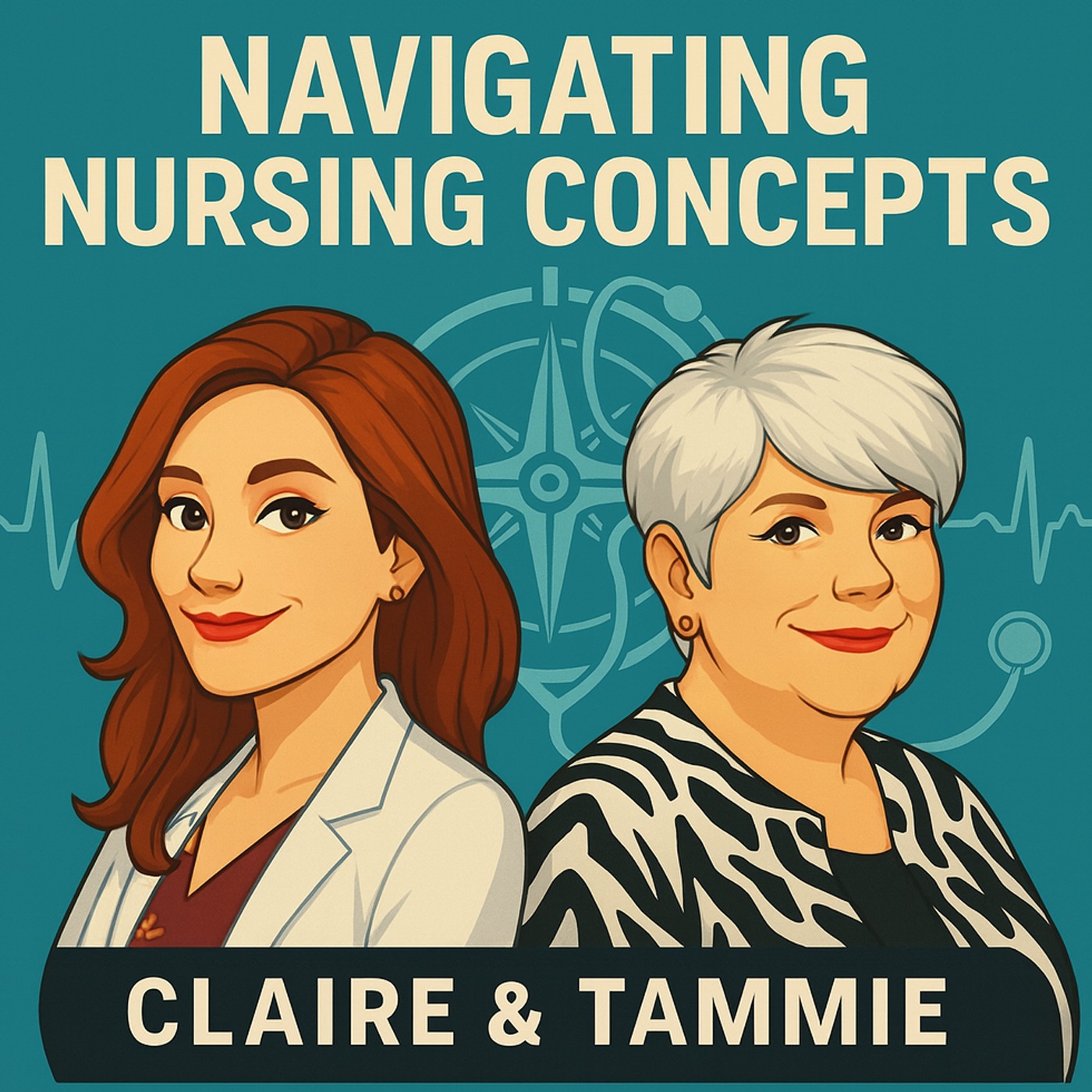
by Claire Gammon MSN, RN & Tammie Wilson MS, RN
This series provides clear, practical lectures for *Practical Nursing (LPN) students* learning in a *concept-based curriculum*. While focused on the LPN role, the content supports all nursing students who want to strengthen their understanding of core concepts.Each session covers essential areas of nursing practice—such as *safety, communication, professional identity, perfusion, gas exchange, metabolism, elimination, tissue integrity, and more* —with explanations that connect theory to real-world clinical care. Content is aligned to NCLEX-PN preparation and emphasizes the knowledge and skills needed for success in both classroom learning and clinical practice.*Designed to simplify complex concepts, reinforce critical thinking, and build confidence, these lectures help nursing students move from learning to application at the bedside.*
-
11
Where Sodium Goes, Water Flows!
Ever wonder where all that fluid actually goes when a patient gets a “water pill”? In this Meds in Minutes episode of Navigating Nursing Concepts, Claire and Tammie break down diuretics in a way that finally makes kidney physiology click.We walk through how loop, thiazide, and potassium-sparing diuretics work in different parts of the nephron—and why sodium loss always means water follows. You’ll learn key nursing safety checks before administration, common electrolyte complications, high-yield drug interactions (hello digoxin, ACE inhibitors, and NSAIDs), and why urine output, daily weights, and labs never lie.This episode also connects fluid balance to thermoregulation, showing how dehydration and overload can even affect body temperature. Packed with NCLEX-style thinking, real-world nursing judgment, and patient-teaching pearls, this episode helps nurses move from “water pill” to cause, effect, and safe action.Keywords: diuretics, nursing pharmacology, furosemide, spironolactone, thiazides, fluid balance, electrolytes, hypokalemia, hyperkalemia, NCLEX, nursing students, medication safety
-
10
Metabolism, Medications, and Why Timing Is the Teaching
Medications don’t work in isolation—they work inside a living, changing body. In this episode of Navigating Nursing Concepts, Claire and Tammie break down metabolism as the reason medications either stabilize patients or push them into danger.Using insulin, metformin, and thyroid medications as real clinical examples, we explore how onset, peak, duration, absorption, and organ function directly affect patient safety. You’ll hear why hypoglycemia is a physiologic response—not just a number—why metformin is held for contrast studies, and how patient education must translate physiology into everyday decisions.This episode is essential listening for nursing students and bedside nurses who want to move beyond memorization and toward true clinical judgment, medication timing, and patient-centered education.Keywords: nursing education, metabolism, insulin timing, hypoglycemia, metformin, patient education, pharmacology, clinical judgment, nursing students, medication safety
-
9
Pharmacology in 15: Feed or Hold
Medications don’t work just because they’re ordered. They work only if the body can absorb them, distribute them, and eliminate them safely.In this Pharmacology in 15 episode, Claire and Tammie walk through real bedside scenarios that force nurses to decide: Is this a safe pass, or does this medication need to be held?Using clinical examples like vomiting, diarrhea, NG suction, tube feeding, kidney impairment, and benzodiazepine use, this episode connects pharmacokinetics and pharmacodynamics to everyday nursing judgment. Learn how absorption failures, medication accumulation, and exaggerated drug effects increase risks for breathing, falls, and organ injury—and why nurses often recognize these dangers before labs change.This episode is designed for nursing students and practicing nurses who want pharmacology that actually makes sense at the bedside.
-
8
Red Flags or Safe Pass
Pharmacology in 15 with Tammie & Claire. Before you memorize drug names or doses, you need to learn how nurses decide whether a medication is safe to give.In this episode, Tammie and Claire break down how nurses think through medication administration using clinical judgment, not memorization. You’ll learn how to recognize red flags, determine a safe pass, and apply the ABC → FOB framework to protect your patient before you ever push a pill.This episode lays the foundation for pharmacology success in class, on NCLEX, and in real nursing practice.
-
7
Brains, Guts, and Good Calls: Clinical Judgment Explained
Clinical judgment isn’t just buzzwords—it’s the gutsy, brain-powered skill that keeps clients safe in complex, fast-changing situations. In this episode, Tammie and Claire cut through the jargon to define what clinical judgment really means, how it differs from critical thinking and clinical reasoning, and why it matters more than ever.We’ll walk through the three big frameworks—Nursing Process, Tanner’s Model, and the NCJMM—and show how each serves a unique role in planning care, describing thought processes, and testing competence. Along the way, you’ll see how evidence-based practice, safety, and professionalism shape good calls at the bedside.With simple scenarios from choking emergencies to post-op ambulation, you’ll learn how to apply the six NCJMM steps, practice SMART goals, and reflect like a pro. Whether you’re prepping for NCLEX or heading into your first clinical rotation, this episode gives you the brains, guts, and tools to make sound judgments when it matters most.
-
6
Because Evidence Says So!
Tammie and Claire break down the backbone of safe nursing: evidence-based practice. From handwashing to pressure injury prevention, evidence isn’t just theory—it’s woven into every shift you work. Together, they uncover the recipe for EBP (research + nurse expertise + client preferences), explore where policies really come from, and show how models like PET and Iowa guide safe care.Along the way, you’ll get NCLEX-style checkpoints, a practical SBAR drill, and micro-skills you can use on your very next shift. Whether you’re prepping for boards or learning the ropes at the bedside, this episode will remind you why the safest answer is always: Because evidence said so!
-
5
Clean Hands, Safe Moves
From germ control to back safety, this episode covers the foundations of safe nursing practice. Claire and Tammie break down the Joint Commission’s National Patient Safety Goals with a focus on infection prevention, hand hygiene, and creating a culture of safety where even nursing students can—and should—speak up.Learn the difference between medical and surgical asepsis, master hand hygiene mnemonics (WASH and “I Really Eat Moldy Pickles Sometimes”), and review how to don and doff PPE without a hitch. We’ll also walk through sterile field rules, standard vs. transmission-based precautions, and an NCLEX-style check on tuberculosis.But safety isn’t just about bugs—it's about protecting your own body and your clients. We’ll cover ergonomics, safe lifting rules, bed height tricks, and fall prevention strategies that keep everyone in one piece. And yes, you’ll get some unforgettable lines along the way: “Tammie, don’t bend—and clients don’t bounce.”Whether you’re prepping for your Fundamentals exam or day one of clinicals, this episode will help you build habits that protect clients, protect your license, and protect your spine.
-
4
Caring: The Heartbeat of Nursing
In this episode, Tammie and Claire dive deep into one of the most essential threads that ties nursing together—caring. But this isn’t just about being polite or kind. It’s about the professional, ethical, and human responsibility of centering patients in their own care.Together, they explore how values and preferences shape patient experiences, why therapeutic relationships require trust and boundaries, and how empathy and holistic care turn treatment into true healing. From protecting dignity and autonomy to navigating family dynamics, advocacy, and diversity, this conversation highlights what it really means to keep the patient’s voice at the center.Tammie and Claire also take listeners through the lifespan—discussing what caring looks like for infants, children, teens, adults, and older adults—while weaving in real-world examples of boundary setting, cultural respect, and caregiver support. They wrap up with a powerful reminder: caring is not one skill among many—it’s the skill that runs through every concept in nursing practice.Whether you’re a student nurse finding your professional identity or a seasoned nurse reflecting on your practice, this episode will help you reconnect with the heartbeat of nursing: caring built on dignity, autonomy, trust, and respect.
-
3
It’s Not Just Words: Communication That Heals, Protects, and Connects
In nursing, your most powerful skill isn’t a procedure or a piece of equipment—it’s communication. In this episode, Claire & Tammie dive into the ways words (and silence) can heal, protect, and connect. From patient safety to trust-building, therapeutic interactions to professional teamwork, we’ll unpack why communication is more than small talk—it’s clinical care.You’ll learn:Why miscommunication is one of the top causes of medical errors—and how to prevent it.The toolbox of communication styles every nurse must master: verbal, nonverbal, electronic, symbolic, and metacommunication.How to use structured tools like ISBAR-R, teach-back, and clarifying techniques to advocate for your clients and protect your license.What not to say—false reassurance, minimizing feelings, or charting errors that can turn into courtroom nightmares.How culture, development, and professionalism shape every interaction from bedside to boardroom.Packed with real-world examples, NCLEX prep, and even a few charting bloopers that will make you laugh out loud, this episode proves that communication isn’t an “extra” skill—it’s the foundation of safe, effective, and compassionate nursing practice.Because in nursing, it’s not just words—it’s clinical care.
-
2
Care Coordination: Connecting the Dots and Putting the Puzzle Together
In this insightful episode, "Care Coordination: Connecting the Dots for Patient Safety," Claire & Tammie effectively break down the complex concept of care coordination in healthcare. They liken it to a successful sports team, where every player works together towards a common goal: the patient. Care coordination is not a "cookie-cutter plan" but rather the deliberate organization of patient care activities that are efficient, patient-centered, and tailored to unique patient needs and preferences.The episode emphasizes that care coordination is not a "nice extra" but a "game changer" crucial for patient safety, preventing medical errors, avoiding duplicated tests, and ultimately saving lives and money. It aims for the "Triple Aim" of safe, effective, patient-centered care, ensuring the "right care happens at the right time from the right person" without unnecessary steps or gaps. This approach aligns perfectly with value-based care, prioritizing "quality over quantity" in services provided
-
1
Professionalism: Becoming the Nurse YOU Want to Be!
In this episode of Navigating Nursing Concepts, we dive into Professionalism in Nursing—a core concept for every student nurse. While this discussion is tailored to the Practical Nursing (LPN) role, the principles and examples apply across all levels of nursing education, including RN programs.We’ll explore what professionalism looks like in practice: from appearance and communication to ethical practice, accountability, and resilience. You’ll hear how professionalism shapes not just the way we present ourselves, but the way we deliver safe, compassionate, and effective care.Whether you’re an LPN student building your foundation or an RN student reinforcing your professional identity, this episode will give you the tools and insight to connect classroom learning to real-world nursing practice.
We're indexing this podcast's transcripts for the first time — this can take a minute or two. We'll show results as soon as they're ready.
No matches for "" in this podcast's transcripts.
No topics indexed yet for this podcast.
Loading reviews...
ABOUT THIS SHOW
This series provides clear, practical lectures for *Practical Nursing (LPN) students* learning in a *concept-based curriculum*. While focused on the LPN role, the content supports all nursing students who want to strengthen their understanding of core concepts.Each session covers essential areas of nursing practice—such as *safety, communication, professional identity, perfusion, gas exchange, metabolism, elimination, tissue integrity, and more* —with explanations that connect theory to real-world clinical care. Content is aligned to NCLEX-PN preparation and emphasizes the knowledge and skills needed for success in both classroom learning and clinical practice.*Designed to simplify complex concepts, reinforce critical thinking, and build confidence, these lectures help nursing students move from learning to application at the bedside.*
HOSTED BY
Claire Gammon MSN, RN & Tammie Wilson MS, RN
Loading similar podcasts...
URL copied to clipboard!