
PODCAST · kids
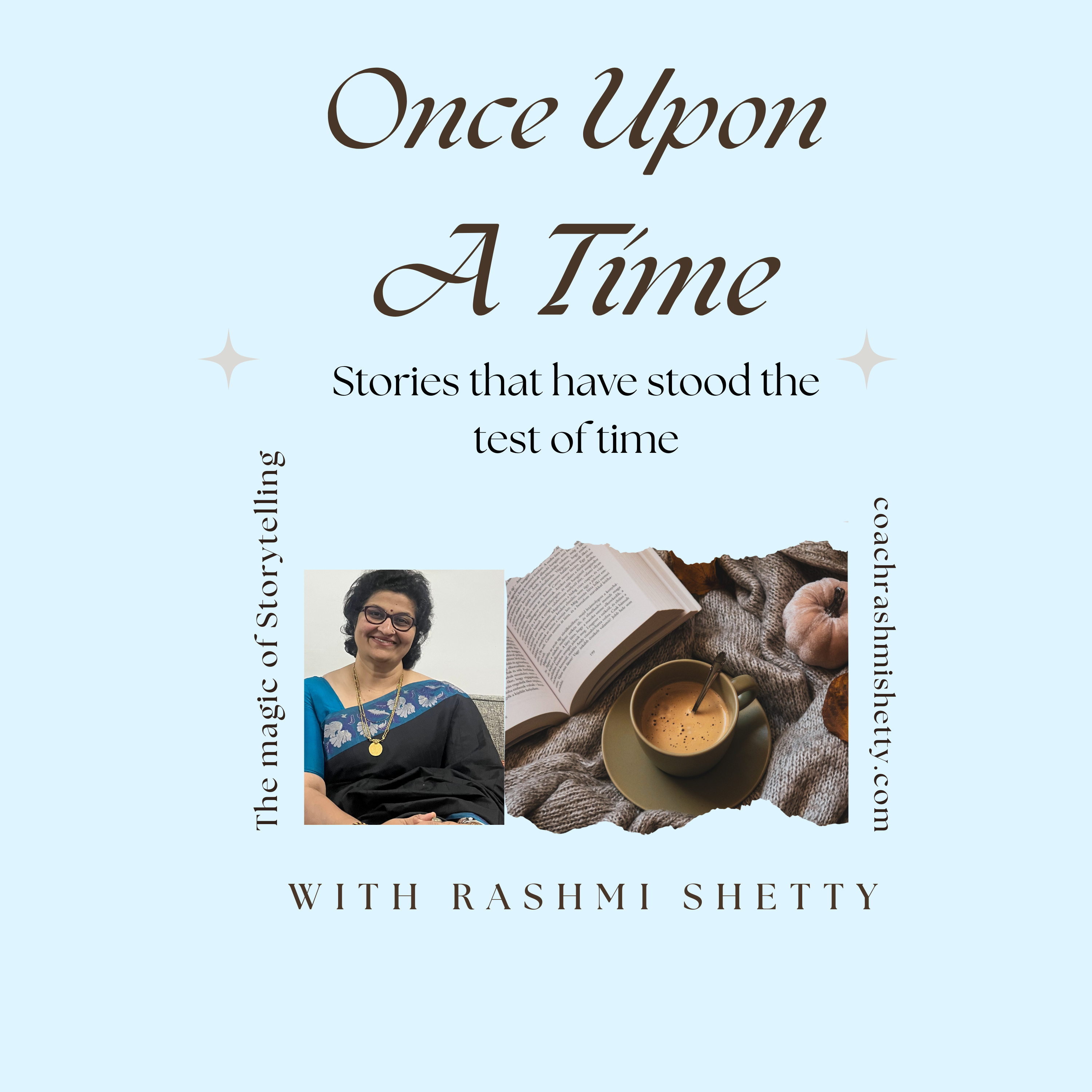
Once Upon A Time - Stories that have stood the test of time
by Rashmi Shetty
This is an audio Podcast where we revisit stories that have stood the test of time. Fables, legends, and human truths that shaped our ancestors and can guide us today. For years, I’ve explored the power of the human voice, from the radio studio to the leadership stage. And I’ve realised that today’s generation is missing out on the oldest, most powerful 'Wi-Fi' signal we have... the Art of Storytelling.We aren't just listening to stories; we are co-creating them. We are building the 'Human Library,' one heartbeat at a time.
-
6
Once Upon A Time - The Story of Buddha
The story of Siddhartha Gautama is a journey from the peak of worldly luxury to the height of spiritual liberation. It is the narrative of a man who realized that true peace is found not by changing one’s external environment, but by mastering one’s internal state.Born in the 6th century BCE in Lumbini, Siddhartha was a prince of the Shakya clan. Upon his birth, sages predicted he would become either a world-conquering king or a world-renouncing spiritual leader. His father, King Suddhodana, desperate for Siddhartha to succeed him on the throne, designed a life of absolute sensory indulgence for his son.Within the palace walls, aging, sickness, and death were forbidden concepts. Siddhartha was surrounded by music, gardens, and the finest comforts, eventually marrying and having a son, Rahula. Yet, despite the opulence, a restless curiosity grew within him.In his late twenties, Siddhartha finally ventured outside the palace. During four separate trips, he encountered reality for the first time:An old man, bent and frail.A sick man, suffering in pain.A corpse, being carried to the cremation grounds.A serene ascetic, who owned nothing but possessed a profound sense of peace.These "Four Sights" shattered his worldview. He realized that no amount of royal power could protect him or his loved ones from the inevitability of decay. At the age of 29, he walked away from his life as a prince—a moment known as the Great Renunciation—to find a permanent solution to human suffering.For six years, Siddhartha wandered. He studied under the greatest philosophers of his time and then practiced extreme asceticism, living on a single grain of rice a day until he was a skeleton. He eventually realized that a body starved of energy could not support a mind seeking clarity.He accepted a bowl of milk rice from a village girl named Sujata and formulated the concept of the Middle Way: a path that avoids both the indulgence of the palace and the self-torture of the forest.Siddhartha sat beneath a Pipal tree in Bodh Gaya, vowing not to rise until he found the truth. After a night of deep meditation, he broke through the veils of ignorance and became the Buddha (The Awakened One).He realized that suffering is caused by our internal attachments and cravings. To help others achieve this same clarity, he formulated a "map" for living known as the Noble Eightfold Path, which he shared in his first sermon:Wisdom: Developing Right View (understanding reality) and Right Resolve (committing to harm-free living).Ethical Conduct: Practicing Right Speech (truthful and kind communication), Right Action (non-violence), and Right Livelihood (ethical work).Mental Discipline: Mastering the mind through Right Effort, Right Mindfulness (awareness of the present), and Right Concentration (meditative focus).The Buddha spent the next 45 years traveling across India, teaching that enlightenment was not a divine gift, but a state of being accessible to anyone. He taught leaders and laborers alike that by aligning their "inner frequency" with these eight principles, they could find a sense of equilibrium that remains unshaken by the storms of life.By integrating these takeaways, one moves beyond just "knowing" a story and begins to live with the intentionality that the Buddha modeled—balancing wisdom, ethics, and a disciplined mind.To pull these threads together, we look to Buddha Purnima (also known as Vesak)—the most sacred day in the Buddhist calendar. It is a unique festival because it commemorates three major milestones in the Buddha’s life: his birth, his enlightenment, and his passing (Nirvana).By celebrating all three on a single full-moon day, Buddha Purnima serves as a powerful metaphor for the complete "arc" of a purposeful life.
-
5
Once upon a Time - Raja Ravi Varma- India's First Celebrity
On this day, April 29th, we celebrate the birth of a man who changed the way an entire nation visualizes its own soul. Born in 1848 in Kilimanoor, Kerala, Raja Ravi Varma’s life was more than just a collection of masterpieces; it was a masterclass in breaking barriers and democratizing excellence. He is known as the Father of Modern Indian Art— was a commoner within the palace ecosystem, a gifted boy who was once scolded for "defacing" the pristine white walls of the estate with charcoal sketches of animals and people.gifted boy who was once scolded for "defacing" the pristine white walls of the estate with charcoal sketches of animals and people.In his youth, Ravi Varma faced a locked door. The court painters of the time were fiercely protective of their craft, refusing to teach him the secrets of oil painting. Instead of complaining about a lack of mentorship, Ravi Varma turned to the power of The Silent Observe. He watched the visiting Dutch artist Theodore Jensen from the shadows, decoding the play of light and shadow with his eyes.You can learn almost anything by being a silent, focused observer of those who are already masters.For years, Ravi Varma’s work was the exclusive property of the elite. But he realized that as long as his "gods" stayed in palaces, they belonged only to the few. In 1894, he took a massive risk by setting up a lithographic press in Lonavala. He moved art from the "Gilded Frame" to the "Common Home."He showed us that When you find something beautiful or helpful, don't keep it to yourself. The more you share your talents, the bigger your world becomes.Varma was often criticized for making his subjects look "too real." But that was his genius. In his masterpiece, Yashoda and Krishna, he didn't just paint a deity; he painted the universal frequency of a mother’s love and exhaustion. This is why, in April 2026, his work continues to break auction records, recently reaching ₹167.2 crore. People don't buy "art"; they buy "resonance."You don't have to be perfect to be special. Even the heroes in stories have feelings just like you.As his fame grew, Varma made a choice that would change India forever. He realized that as long as his paintings stayed in palaces, the "gods" belonged only to the rich. In 1894, he moved to Lonavala and set up a lithographic printing press.It allowed people from marginalized communities, who were often barred from entering temples, to have the divine in their own homes. A farmer in a remote village could own the same image of Goddess Lakshmi as a Maharaja. This "democratization of the divine" turned him into a national hero. He became India’s first true celebrity; the sheer volume of letters from fans, orders for prints, and notes of gratitude was so overwhelming that the government had to establish a dedicated post office just to handle his mail.Perhaps the most powerful fact of his life is that the title "Raja" was not an inheritance. It was a recognition bestowed upon him in 1904. He wasn't born a king; he earned the crown through the stroke of a brush. He proved that excellence is a "Self-Made" territory.You don't need a title to lead. You lead by doing what you love with all your heart.Raja Ravi Varma passed away on October 2, 1906, but he never truly left. Every time you see a calendar with a deity, a scene in an Indian mythological film, or a classic comic book, you are looking at his vision.He proved that you don't need a crown to be a king. By merging the techniques of the West with the soul of the East, he became the King of Modern Indian Art—a title earned not by bloodline, but by the enduring frequency of his creative spirit.
-
4
Once Upon A time - Narasimha & Prahlada
The story of Prahlada is an epic saga from the Bhagavata Purana that explores the tension between temporal power and spiritual conviction. It is a narrative defined by the "impossible" conditions of a cosmic contract and the resilience of a child’s faith.The story begins with the demon king Hiranyakashipu, who was consumed by a desire for revenge against Lord Vishnu (who had killed his brother, Hiranyaksha). To become invincible, he performed intense penance to please Lord Brahma. When granted a boon, he asked for a clever set of protections to bypass death:He could not be killed by any living being created by Brahma.He could not be killed inside or outside any residence.He could not be killed during the day or at night.He could not be killed on the ground or in the sky.He could not be killed by any weapon (astra or shastra).With these conditions met, he declared himself the supreme ruler of the three worlds and forbade the worship of any god but himself.While Hiranyakashipu was away performing penance, his wife Kayadhu stayed in the ashram of the sage Narada. While Prahlada was still in the womb, he heard Narada’s chants and teachings about Lord Vishnu. Consequently, he was born a "Nisarga Bhakta"—a natural devotee.As Prahlada grew, he refused to acknowledge his father as God. When sent to school, he famously converted his classmates, teaching them that the power of the divine was more permanent than his father’s earthly kingdom.Hiranyakashipu viewed his son’s devotion as a personal betrayal and a threat to his sovereignty. He ordered his soldiers to kill the boy through increasingly creative and cruel methods:Poison: Prahlada drank lethal venom, but it turned to nectar.Elephants: He was placed under the feet of wild elephants, but they refused to step on him.The Cliff: He was thrown from a mountain, but Lord Vishnu caught him in his arms.The Fire: This led to the legend of Holika. Hiranyakashipu’s sister, Holika, had a shawl that protected her from fire. She sat in a bonfire with Prahlada on her lap, intending to burn him. However, the wind shifted the shawl onto Prahalad; Holika perished, and the boy emerged unscathed.Finally, reaching a breaking point, Hiranyakashipu dragged Prahlada to the center of his palace. He kicked a massive stone pillar and sneered, "If your God is everywhere, is he in this pillar?"Prahlada calmly replied, "He is."As the King shattered the pillar with his mace, Lord Vishnu manifested as Narasimha—a terrifying avatar with the body of a man and the head of a lion. Narasimha fulfilled every condition of the boon to end the tyrant's reign:Entity: He was half-man, half-beast (not a creature created by Brahma).Location: He pulled the King to the threshold of the palace (neither inside nor outside).Time: It was twilight (neither day nor night).Position: He placed the King on his thighs (neither on the ground nor in the sky).Weapon: He used his fingernails (not a conventional weapon).The tale remains a powerful metaphor for Vulnerability and Strength: Prahlada had no physical armor, yet his internal alignment made him invincible against the most powerful force in the universe.
-
3
Once Upon A time - Shravan Kumar
The story of Shravan Kumar is one of the most enduring symbols of parental love and selfless devotion in Indian mythology. While often remembered as a tragic precursor to the events of the Ramayana, his life serves as a profound study in commitment, the weight of unintended consequences, and the resonance of duty.Shravana Kumara's parents, Shantanu and Gyanvanti (Malaya), were hermits. They were both blind. When they became aged, Shravana wanted to take them to the four most sacred places of Hindu pilgrimage to purify the soul. Since Shravana Kumara could not afford the transport, he decided to design a Kavadi—a sturdy bamboo pole balanced across his shoulders with two large woven baskets tied to either end. He placed his mother in one and his father in the other, literally carrying the weight of his world across the subcontinent on foot.During their long journey, the family reached the dense forests near the banks of the Sarayu River in the kingdom of Kosala. It was dusk, and Shravan’s parents were parched. Leaving them to rest under a tree, Shravan took a brass pitcher and headed toward the riverbank.At that same moment, a young Prince Dasharatha of Ayodhya was hunting in the forest. Dasharatha was a master of Shabda-vedhi, a legendary skill that allowed an archer to strike a target accurately based purely on sound, without seeing it. As Shravan dipped his pitcher into the river, the air escaping the vessel created a distinct gurgling sound. To Dasharatha’s trained ear, it sounded exactly like a wild elephant or deer drinking at the bank. He shot a fatal arrow toward the noise.Instead of the cry of an animal, Dasharatha heard a human scream. He rushed to the bank to find a young ascetic clutching an arrow in his chest.Even as his life ebbed away, Shravan’s concern was not for himself. He told the horrified Prince where his thirsty, blind parents were waiting and begged him to take the water to them. Only after Dasharatha promised to fulfill this final duty did Shravan breathe his last.When Dasharatha tremblingly approached the elderly couple and informed them of the tragedy, their grief was absolute. Unable to bear the loss of their only son—who had been their eyes, their hands, and their heart—they prepared to give up their own lives.Before they passed, the father placed a powerful curse upon Dasharatha: just as they were dying from the agony of separation from their son, Dasharatha, too, would one day face a lonely death caused by the intense pain of separation from his own child.This story is crucial because it creates the karmic architecture for the Ramayana. Years later, when King Dasharatha is forced to exile his beloved son Rama for 14 years, the weight of the old curse manifests. Dasharatha dies not of physical illness, but of a broken heart—a direct echo of the silence he had once inflicted upon Shravan Kumar's parents.
-
2
Once Upon A Time - Raja Harishchandra
The story begins in the heavens. The sage Vishwamitra challenges the sage Vashistha over Harishchandra’s reputation as the most truthful king on Earth. Vishwamitra believes that any man will lie under enough pressure, while Vashistha maintains that Harishchandra is unshakeable. To test him, Vishwamitra descends to Earth.Vishwamitra approaches the King and asks for a massive "Dakshina" (donation). Harishchandra, known for his generosity, agrees. Through a series of clever maneuvers and tests, Vishwamitra leads the King to donate his entire kingdom, his wealth, and all his possessions.To fulfill his remaining debt to the sage, Harishchandra leaves his palace with his wife, Taramati, and their young son, Rohitashwa, heading to the holy city of Kashi.In Kashi, to pay the final amount owed to Vishwamitra:The Queen is sold: Harishchandra sells his wife and son into domestic labour.The King is sold: Harishchandra sells himself to a Chandala (an executioner/cremator) who works at the burning ghats.Harishchandra’s job is to collect a fee from anyone who wishes to cremate their dead. He lives a life of extreme poverty and hardship, never once wavering from his principles or complaining about his fate.The climax of the story is heart-wrenching. His son, Rohitashwa, dies from a snake bite while gathering flowers. Taramati carries the body of their child to the cremation grounds.Harishchandra recognizes his wife and dead son but refuses to cremate the boy without the required fee. Taramati has no money, only her old sari. Even in this moment of peak agony, Harishchandra insists he cannot break the law of his master or the path of truth. He asks her to give a piece of her clothing as the tax.Just as Taramati prepares to tear her clothing and Harishchandra prepares to perform his duty, the gods (led by Vishnu and Indra) and Sage Vishwamitra appear.They reveal that the entire series of tragedies was a divine test of his character. Because he never uttered a lie or abandoned his duty even in the face of his son’s death, the gods:Restored his son to life.Returned his kingdom to him.Granted him and his subjects a place in heaven.What sets the story of Raja Harishchandra apart from many other mythological epics is its singular, unrelenting focus on the human will. The story highlights that true presence and impact aren't about the titles we hold (King) but about the alignment of our internal values and external actions. Even when stripped of his power as a ruler, Harishchandra's commitment to truth remained unshakable.As a King, he gave up the throne.As a Father/Husband, he allowed his family to be sold into servitude.Though born as king he did not hesitate to work as a graveyard watchman (a Chandala).By letting go of these "masks," he proved that his honesty wasn't tied to his position; it was tied to his soul.The story serves as a reminder that while circumstances change, a person’s integrity can remain an unshakeable anchor.
-
1
Once upon A Time - Mahishasura Mardini
Mahishasura was a powerful demon born of the union between Rambha (a king of demons) and a princess who took the form of a water buffalo (Mahishi). This lineage granted him the ability to shift his shape at will, alternating between a human and a buffalo.The demon Mahishasura was a shapeshifter who held a deep contempt for what he perceived as "weakness." After years of penance, he secured a boon that protected him from all men and gods. In his arrogance, he completely discounted the power of the feminine, believing no woman could ever pose a threat. Armed with this loophole, he conquered the heavens and the earth, creating a state of chaos and displacement for the divine forces.When the gods realized they could not defeat him individually, they gathered on the banks of the river Ganga. In a moment of absolute focus, they projected their inner radiance (Tejas). This was not a physical weapon, but a merging of energies:From the light of Shiva emerged her face.From Vishnu came her arms.From Brahma came her feet.This collective energy manifested as Durga. She was endowed with eighteen arms, each holding a tool of power gifted by the gods—a trident, a discus, a bow, and a bell—representing a complete spectrum of capabilities.The battle lasted for nine days, a period symbolizing the journey through different layers of consciousness. Mahishasura tried to deceive her by constantly changing his form:He became a Buffalo, charging with brute force.He transformed into a Lion, attacking with ferocity.He shifted into a Man with a sword, trying to use logic and skill.He became an Elephant, using massive weight and reach.Throughout the chaos, the Goddess remained centered. She did not react to his frantic changes; she responded with a steady, rhythmic pressure.On the tenth day, as Mahishasura was in the middle of transitioning from a buffalo back into a human form, he was at his most vulnerable—caught between identities. In that precise moment of transition, the Goddess pinned him down and struck. This victory, known as Vijayadashami, represents the triumph of internal alignment over external mask-wearing.The narrative offers several insights into personal and professional mastery:ust as Durga was formed from the best traits of all the gods, true leadership often involves synthesizing diverse strengths into a single, focused vision. Mahishasura’s shapeshifting mirrors the ego’s tendency to change its "frequency" to avoid being caught. The Goddess represents the "Inner Frequency" that remains constant regardless of external noise.Many versions of the story highlight that the Goddess paused to sip from a cup of divine nectar (or wine) during the battle. This "pause" symbolizes the ability to remain calm and nourished even in the heat of a monumental task.
-
0
Once Upon A Time- The Blessed Lord Hanuman
Today is Hanuman Jayanti & here is the story of the Blessed Lord Hanuman.The birth of Hanuman, the Vanara God known for his strength and devotion, is a story rich with divine intervention and the intersection of several powerful forces in ancient mythology.Hanuman was born to Anjana, an apsara, who was living on Earth under a curse, and Kesari, a powerful vanara chief. However, he is also widely known as Pavanaputra (the son of the Wind) because of the vital role the Wind God, Vayu, played in his birth.Listen to his interesting story.
-
-1
Once Upon a Time - The Birth of Rama
In this episode we listen to the story of Rama’s birth, known as the Rama Avatara. This is the central narrative in the Ramayana. It is a tale of divine intervention, a king's longing for an heir, and the cosmic necessity to restore balance to the world.
-
-2
Once upon a Time - Shakuntala
Starting off with the story of Shakuntala & King Dushyanta and their connection to the the 5000 year Indian epic 'The Mahabharata'
-
-3
Once upon a Time- an Introduction
This is an introduction For years, I’ve explored the power of the human voice—from the radio studio to the leadership stage. And I’ve realized something: Today’s generation is missing out on the oldest, most powerful 'Wi-Fi' signal we have... the Art of Storytelling.Exploring the magic of the phrase "Once Upon a Time" Revisiting timeless stories
We're indexing this podcast's transcripts for the first time — this can take a minute or two. We'll show results as soon as they're ready.
No matches for "" in this podcast's transcripts.
No topics indexed yet for this podcast.
Loading reviews...
ABOUT THIS SHOW
This is an audio Podcast where we revisit stories that have stood the test of time. Fables, legends, and human truths that shaped our ancestors and can guide us today. For years, I’ve explored the power of the human voice, from the radio studio to the leadership stage. And I’ve realised that today’s generation is missing out on the oldest, most powerful 'Wi-Fi' signal we have... the Art of Storytelling.We aren't just listening to stories; we are co-creating them. We are building the 'Human Library,' one heartbeat at a time.
HOSTED BY
Rashmi Shetty
Loading similar podcasts...
Frequently Asked Questions
How many episodes does Once Upon A Time - Stories that have stood the test of time have?
Once Upon A Time - Stories that have stood the test of time currently has 10 episodes available on PodParley. New episodes are automatically indexed when they're published to the podcast feed.
What is Once Upon A Time - Stories that have stood the test of time about?
This is an audio Podcast where we revisit stories that have stood the test of time. Fables, legends, and human truths that shaped our ancestors and can guide us today. For years, I’ve explored the power of the human voice, from the radio studio to the leadership stage. And I’ve realised that...
How often does Once Upon A Time - Stories that have stood the test of time release new episodes?
Once Upon A Time - Stories that have stood the test of time has 10 episodes. Check the episode list to see recent publication dates and frequency.
Where can I listen to Once Upon A Time - Stories that have stood the test of time?
You can listen to Once Upon A Time - Stories that have stood the test of time on PodParley by clicking any episode. We provide an embedded audio player for direct listening, and you can also subscribe via your preferred podcast app using the RSS feed.
Who hosts Once Upon A Time - Stories that have stood the test of time?
Once Upon A Time - Stories that have stood the test of time is created and hosted by Rashmi Shetty.
URL copied to clipboard!