
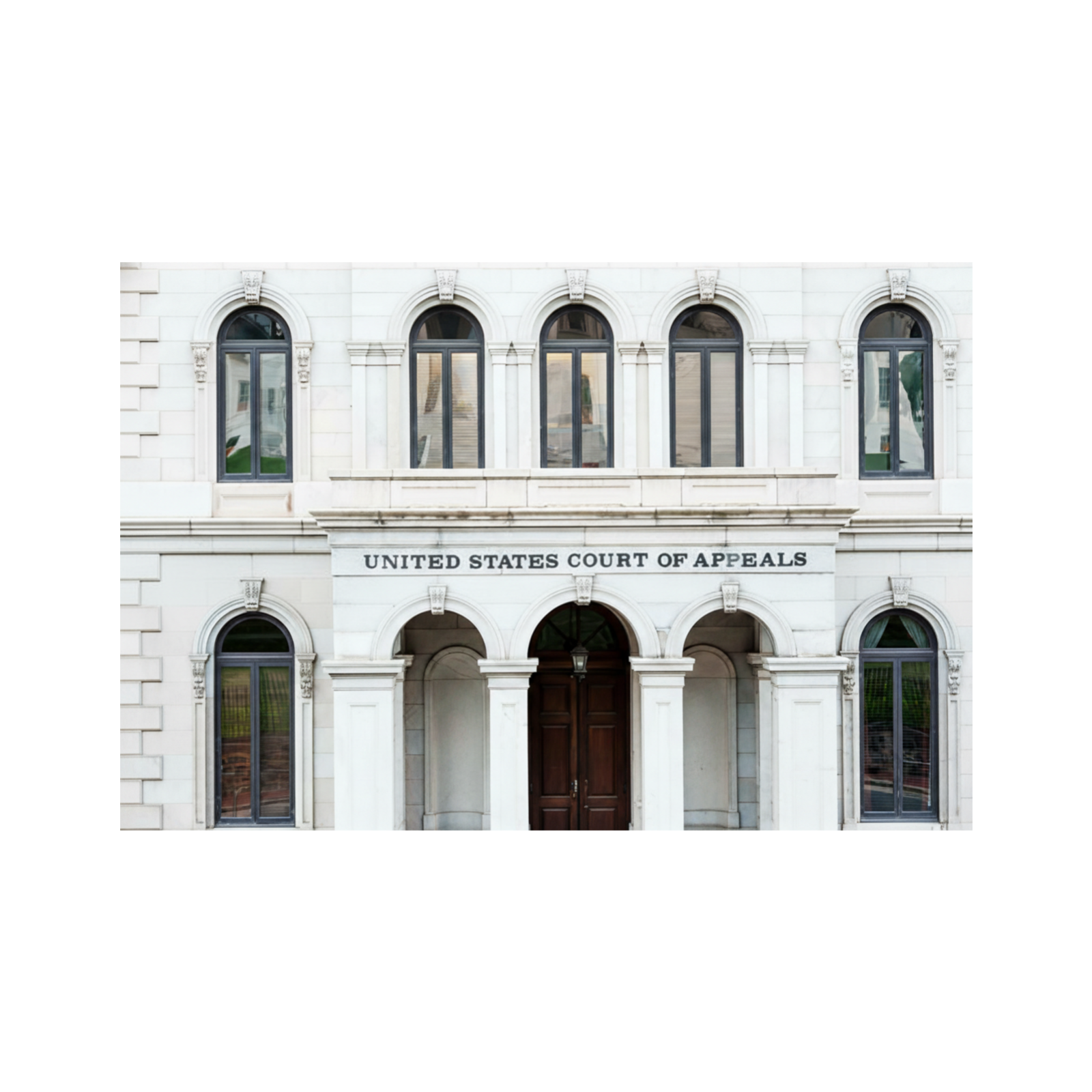
PODCAST · government
Oral Arguments from the U.S. Court of Appeals
by Charles Usen
This podcast brings you inside real federal appellate courtrooms, where lawyers present live, time-limited arguments and judges test the strength of each side’s case. Each episode features unedited audio of arguments that supplement written briefs, giving listeners a front-row seat to how panels question counsel, clarify contested legal issues, and shape the law in areas ranging from civil rights to business disputes and criminal appeals.
-
97
Yinnv Liu v. Monthly: Date Argued: February 20th, 2026; Docket Number: 25-2074
Case Summary:In the case of Yinnv Liu v. Monthly (Docket No. 25-2074), argued before the U.S. Court of Appeals for the Seventh Circuit on February 20, 2026, the relevant facts are as follows:Fact SummaryThe litigation is a complex commercial and intellectual property dispute involving Yinnv Liu (the plaintiff/appellant) and the defendant company Monthly (associated with Monthly.com), along with several other entities including Joybuy.The core factual conflict centers on a breach of contract and copyright infringement claim related to online educational content and digital assets. Monthly operates a platform that hosts creative classes and "learning experiences" taught by high-profile instructors.A primary issue in the record involves the ownership and distribution rights of specific instructional materials. The plaintiff alleges that Monthly and its partner entities, such as Joybuy, exceeded the scope of their licensing agreements by sub-licensing or distributing her proprietary content across international markets without proper authorization or compensation.The factual background includes a dispute over digital rights management (DRM) and the "terms of service" that govern how independent creators interact with the Monthly platform. Monthly contends that the plaintiff voluntarily entered into a broad "Master Services Agreement" that granted the company extensive rights to adapt and monetize the content in exchange for a percentage of subscription revenue.In early 2025, a district court granted a partial summary judgment in favor of the defendants, ruling that the plain language of the electronic contracts signed by the plaintiff shielded the companies from the majority of the claims regarding unauthorized international distribution.The current appeal, docketed as 25-2074, challenges that interpretation. The appellant argues that the contracts were unconscionable adhesion contracts—meaning they were presented on a "take-it-or-leave-it" basis with grossly one-sided terms that a reasonable creator would not have knowingly accepted.The appellate record also scrutinizes whether the defendants provided an accurate accounting of the revenues generated from the plaintiff's specific content modules, a factual point that underpins the plaintiff’s claim for damages.During the oral arguments on February 20, 2026, the Seventh Circuit panel focused on the "clickwrap" nature of the agreement and whether the specific clauses allowing for "global sub-licensing" were sufficiently conspicuous to be enforceable under Illinois and federal law.
-
96
Dickerson v. BPP PCV Owners LLC: Date Argued: February 20th, 2026; Docket Number: 24-3147
In the case of Dickerson v. BPP PCV Owners LLC (Docket No. 24-3147), argued before the U.S. Court of Appeals for the Second Circuit on February 20, 2026, the relevant facts are as follows:The litigation was initiated by Gloria D. Dickerson, a pro se plaintiff and resident of Peter Cooper Village (PCV) in Manhattan, against the property owner, BPP PCV Owners LLC (a joint venture involving Blackstone and Ivanhoé Cambridge).The core of the factual dispute involves allegations of housing discrimination, harassment, and retaliation related to the plaintiff's tenancy. Dickerson, a long-term resident, alleged that the management company engaged in discriminatory practices that affected her right to quiet enjoyment and equal access to housing services.A significant portion of the lower court record focused on procedural hurdles; the defendant moved to dismiss the case on the grounds that the plaintiff's First Amended Complaint failed to state a claim upon which relief could be granted and was "vague and conclusory" regarding specific civil rights violations.In early 2024, the district court granted the motion to dismiss but gave the plaintiff leave to file a Second Amended Complaint. A factual "comedy of errors" ensued when the pro se plaintiff attempted to file the new complaint at the wrong physical address in Manhattan (80 Worth Street), leading the court to provide additional time and guidance on proper filing procedures.The case was eventually dismissed with prejudice by the District Court for the Southern District of New York after it found that the plaintiff’s subsequent filings still failed to satisfy the federal pleading standards, particularly the "Five Ws" (who, what, where, when, and why) required to establish a plausible claim of discrimination.The current appeal, docketed as 24-3147, challenges that final dismissal. The plaintiff argues that the trial court applied an overly stringent standard to her pro se filings and ignored the substantive evidence of harassment she provided.During the oral arguments on February 20, 2026, the Second Circuit panel examined whether the district court abused its discretion in denying the plaintiff further opportunities to amend her complaint and whether the existing record contained sufficient factual "nuggets" to warrant a trial on the merits.The defense maintained that BPP PCV Owners LLC acted within its rights as a landlord and that the plaintiff's grievances did not rise to the level of federal civil rights violations or actionable breaches of the lease agreement.
-
95
Immanuel Baptist Church v. City of Chicago:Date Argued: February 20th, 2026; Docket Number: 25-1951
In the case of Immanuel Baptist Church v. City of Chicago (Docket No. 25-1951), argued before the U.S. Court of Appeals for the Seventh Circuit on February 20, 2026, the relevant facts are as follows:The litigation was initiated by Immanuel Baptist Church, a small congregation that had been leasing property at 1443 West Roosevelt Road in Chicago since 2011.The dispute began in 2016 when the church attempted to purchase the leased property, but its lender required confirmation from the City that the building complied with local zoning and parking ordinances.Under the Chicago Zoning Ordinance, religious assemblies were classified under a "Parking Group" requiring one off-street parking space for every eight seats of occupancy, which meant the church needed 19 dedicated spaces it did not possess.The church alleged that the City’s enforcement was discriminatory because other secular assembly uses, such as public libraries and live theater venues of similar size, were exempt from these specific off-street parking requirements.The factual record shows that after the church filed suit, the City passed a new ordinance in 2019 that reduced the church's specific parking requirement to zero, but the church argued the damage had already been done.The church contended that the City’s initial refusal and the resulting two-year delay caused it to lose the opportunity to purchase an adjacent building and forced it to pay higher prices and insurance premiums, constituting a "substantial burden" on its religious exercise.In late 2023, a district court ruled in favor of the church on the substantial burden claim under RLUIPA (Religious Land Use and Institutionalized Persons Act) but limited the damages to approximately $14,590 for specific out-of-pocket expenses.The current appeal, docketed as 25-1951, involves a challenge to the district court's final judgment, specifically regarding the calculation of damages and the dismissal of the church's "equal terms" claims.During the oral arguments on February 20, 2026, the Seventh Circuit panel examined whether the City’s application of "subjective" criteria during the zoning review process triggered the individualized assessment protections of federal law.
-
94
Damri v. LivePerson, Inc.: Date Argued: February 20th, 2026; Docket Number: 25-964
Case Summary: Gemini saidIn the case of Damri v. LivePerson, Inc. (Docket No. 25-964), argued before the U.S. Court of Appeals for the Second Circuit on February 20, 2026, the relevant facts are as follows:Fact SummaryThe litigation is a federal securities class action brought on behalf of investors who purchased shares of LivePerson, Inc., a conversational AI company, between May 2022 and early 2024.The core factual dispute involves the company’s February 2022 acquisition of WildHealth, a precision medicine startup, for approximately $150 million.Plaintiffs allege that LivePerson and its executives made false and misleading statements regarding the financial health and growth prospects of WildHealth while simultaneously implementing significant capital cuts and layoffs that hindered the subsidiary's ability to generate revenue.A central factual element of the complaint is the disclosure in early 2023 that Medicare reimbursements for a discontinued WildHealth COVID-19 testing program had been suspended, an event plaintiffs claim was known but withheld from investors to artificially inflate the stock price.The factual record highlights a massive decline in LivePerson's market value, with the share price falling over 57% on March 16, 2023, following the company's admission of "material weaknesses" in its internal controls over financial reporting.In March 2025, the district court dismissed the lawsuit with prejudice, finding that the plaintiffs failed to provide specific facts demonstrating "scienter"—the intent to deceive—or that the executives’ upbeat statements about WildHealth lacked a reasonable basis at the time they were made.The appeal, docketed as 25-964, challenges this dismissal, with the appellant arguing that the trial court ignored testimony from confidential witnesses who alleged that the company’s internal metrics directly contradicted its public "business as usual" narrative.During the oral arguments on February 20, 2026, the Second Circuit panel examined whether the company had a duty to disclose the Medicare suspension earlier and whether the executives' stock sales during the class period provided a sufficient motive for the alleged fraud.The court also scrutinized whether the "material weakness" in internal controls, once admitted, provided retroactive evidence that the company's previous financial statements were factually unreliable.
-
93
-
92
David McDonald v. Trustees of Indiana University: Date Argued: February 19th, 2026; Docket Number: 25-2366
Case Summary:In the case of David McDonald v. Trustees of Indiana University (Docket No. 25-2366), argued before the U.S. Court of Appeals for the Seventh Circuit on February 19, 2026, the relevant facts are as follows:The litigation is a constitutional challenge brought by several tenured faculty members, including lead plaintiff David McDonald, an associate professor at Indiana University Bloomington, against the Trustees of Indiana University and Purdue University.The core factual dispute centers on the enforcement of Indiana Senate Enrolled Act 202 (SEA 202), a state law effective July 1, 2024, which mandates that public universities implement policies to promote "intellectual diversity" and "free inquiry" among faculty.The statute specifically requires that faculty members be denied tenure or promotion if they are deemed "unlikely to foster a culture of free inquiry" or "unlikely to expose students to scholarly works from a variety of political or ideological frameworks."The factual record includes a new "post-tenure review" process established by the Act, requiring tenured professors to undergo formal re-evaluation every five years to ensure they are meeting these new ideological diversity standards.Plaintiffs allege that the law is unconstitutionally vague and creates a "chilling effect" on academic freedom, as the statute does not define key terms like "intellectual diversity," leaving faculty unable to discern what pedagogical choices might lead to disciplinary action, including termination.In July 2025, the district court dismissed the lawsuit on procedural grounds, finding that the plaintiffs lacked standing because they had not yet suffered a concrete injury, such as a formal reprimand or denial of promotion, under the new law.The appeal, docketed as 25-2366, challenges that dismissal, with the plaintiffs arguing that the "chilling" of their classroom speech and the immediate requirement to alter their curricula to comply with the law constitute an "injury-in-fact" sufficient for federal court jurisdiction.The factual background is further complicated by the lead plaintiff’s personal history; David McDonald was previously arrested and temporarily banned from campus during 2024 protests, an event he cites as evidence of the university administration's willingness to use punitive measures against faculty for expressive activity.During the oral arguments on February 19, 2026, the Seventh Circuit panel focused on whether the plaintiffs' fear of future discipline is "objectively reasonable" and whether the state’s interest in regulating the curriculum of public employees overrides the First Amendment rights of university professors.
-
91
Kenithia Alston v. DC: Date Argued: February 19th, 2026; Docket Number: 25-7056
Case Summary:In the case of Kenithia Alston v. District of Columbia (Docket No. 25-7056), argued before the U.S. Court of Appeals for the District of Columbia Circuit on February 19, 2026, the relevant facts are as follows:The litigation was brought by Kenithia Alston, acting as the special administrator of the estate of her 22-year-old son, Marqueese Alston, who was fatally shot by D.C. Metropolitan Police Department (MPD) officers on June 12, 2018.The incident began when MPD officers approached a group of individuals in the Ward 8 neighborhood of Southeast D.C., allegedly utilizing a controversial "jump-out" tactic intended to surprise and search suspects for illegal firearms.A central factual dispute involves the pursuit into an alleyway, where officers claim they saw the outline of a gun through the decedent's pants and that he subsequently fired a weapon at them during the chase.In contrast, the plaintiff cites witness accounts and video evidence suggesting that Marqueese Alston was unarmed, was carrying only a cell phone, and was shot between 12 and 18 times, including multiple wounds to his back.The factual record highlights a controversy regarding the body-worn camera (BWC) footage, which the plaintiff alleges was withheld for years and, when finally shown privately, appeared to be heavily edited and inconsistent with the official police narrative.Following the shooting, a firearm was recovered from a bush yards away from the decedent's body; however, the plaintiff contends the weapon was placed there by officers to justify the use of deadly force.In March 2025, a district court judge denied the officers' motion to dismiss several claims, ruling that qualified immunity could not be granted at the pleading stage because the facts, as alleged, suggested a violation of the Fourth Amendment.The current appeal, docketed as 25-7056, focuses on whether the District of Columbia and the individual officers can be held liable for excessive force and municipal liability based on the "jump-out" practices and the subsequent handling of the investigation.During the oral arguments on February 19, 2026, the D.C. Circuit panel examined whether the district court erred in allowing the case to proceed to discovery despite the officers' claims of immunity and the government's defense of its tactical operations.
-
90
Norton Outdoor Advertising Inc v. Village of St Bernard OH: Date Argued: February 18th, 2026; Docket Number: 25-3265
Case Summary:In the case of Norton Outdoor Advertising, Inc. v. Village of St. Bernard, OH (Docket No. 25-3265), argued before the U.S. Court of Appeals for the Sixth Circuit on February 18, 2026, the relevant facts are as follows:The litigation centers on a First Amendment challenge by Norton Outdoor Advertising, which has operated billboards in the Village of St. Bernard for decades.The dispute was triggered when the Village revoked a permit for two billboards located at 130 West Ross Avenue after Norton converted them from static displays to variable-message LED signs.The Village justified the revocation by citing a specific section of its municipal code that prohibits "multiple-message or variable-message" displays for off-premises advertising signs.Norton filed a federal lawsuit alleging that the Village's sign ordinance was unconstitutional because it treated "on-premises" signs more favorably than "off-premises" signs and contained content-based exemptions.In a prior phase of the case, the Sixth Circuit determined that while on/off-premises distinctions are generally content-neutral, the Village’s ordinance included a "public service" exemption that required officials to examine the content of a sign to determine its legality.The appellate court previously ruled that this specific exemption rendered the ordinance content-based, thus triggering strict scrutiny, the highest level of judicial review for speech restrictions.The current appeal, docketed as 25-3265, follows a remand to the district court to determine whether the unconstitutional "public service" exemption can be severed from the rest of the sign code.The factual record involves a debate over legislative intent: the Village argues the code should remain enforceable without the exemption, while Norton contends the entire regulatory scheme is so intertwined with content-based distinctions that it must be struck down in its entirety.During the oral arguments on February 18, 2026, the Sixth Circuit panel examined whether severing the exemption would fundamentally alter the Village's original goal of balancing traffic safety and aesthetics with free speech rights.The court also scrutinized whether the remaining ban on digital billboards can stand independently if the underlying definitions used to categorize those signs are found to be constitutionally flawed.
-
89
Abadi v. Greyhound Lines, Inc.: Date Argued: February 18th, 2026; Docket Number: 25-38
Case Summary:In the case of Abadi v. Greyhound Lines, Inc. (Docket No. 25-38), argued before the U.S. Court of Appeals for the Second Circuit on February 18, 2026, the relevant facts are as follows:The litigation was initiated by Aaron Abadi, a pro se plaintiff with a sensory processing disorder, against Greyhound Lines, Inc., following his inability to travel on the company’s buses during the federal COVID-19 mask mandate.The core factual dispute involves the plaintiff’s request for a reasonable accommodation to travel without a face mask, for which he provided a medical note documenting his condition.Greyhound’s response to the request required the plaintiff to adhere to a specific exemption procedure, which included providing current medical documentation and a recent negative COVID-19 test result.The plaintiff alleges that he was unable to complete these requirements and was subsequently denied boarding, which he contends constituted a violation of the Americans with Disabilities Act (ADA) and the Rehabilitation Act.A primary legal and factual issue in the record is whether the plaintiff has standing to seek injunctive relief, given that the federal mask mandate expired before the case reached a final adjudication in the lower court.In December 2024, the district court dismissed the complaint in its entirety, finding that the plaintiff failed to demonstrate a "continuing or imminent harm" necessary to maintain a claim for future relief.The appeal, docketed as 25-38, challenges this dismissal, with the plaintiff arguing that Greyhound’s internal policies remain discriminatory and that his past exclusion created a cognizable injury that the court must address.During the oral arguments on February 18, 2026, the Second Circuit panel examined whether the case had become moot following the expiration of the government mandate or if the plaintiff's claims under state and city human rights laws provided an independent basis for the suit to continue.The court also scrutinized the "intracorporate bar" doctrine in relation to the plaintiff’s allegations that Greyhound conspired with government and industry entities to enforce the mask protocols against disabled individuals.
-
88
Reginald Chapman v. Eileen O'Neill Burke: Date Argued: February 18th, 2026; Docket Number: 25-1311
Case Summary:In the case of Reginald Chapman v. Eileen O'Neill Burke (Docket No. 25-1311), argued before the U.S. Court of Appeals for the Seventh Circuit on February 18, 2026, the relevant facts are as follows:The litigation is a civil rights action brought by Reginald Chapman against Eileen O'Neill Burke in her official capacity as the Cook County State’s Attorney (having succeeded Kim Foxx).The case centers on the fallout from the plaintiff’s prior criminal conviction and subsequent exoneration, with Chapman alleging that his constitutional rights were violated during the original prosecution and subsequent post-conviction proceedings.A primary factual issue involves the "wrongful conviction" framework, specifically whether the State’s Attorney's Office maintained a policy or custom of withholding exculpatory evidence or failing to investigate credible leads that would have proven the plaintiff’s innocence years earlier.The defendant, Eileen O'Neill Burke, moved to dismiss the claims based on prosecutorial immunity, arguing that the actions taken by her office—even if allegedly improper—were performed as part of the judicial process and are therefore shielded from civil liability.The factual record explores the distinction between "administrative" actions and "prosecutorial" functions; the plaintiff contends that the withholding of evidence occurred during the investigative phase, where immunity is more limited.In early 2025, a district court judge granted a motion to dismiss several of the plaintiff’s claims but allowed the central cause of action regarding the office's "disclosure policies" to proceed to the appellate level for clarification.The appeal, docketed as 25-1311, focuses on whether the State’s Attorney’s Office can be held liable under Monell v. Department of Social Services for systemic failures in its Brady disclosure protocols that allegedly led to Chapman's prolonged and wrongful incarceration.During the oral arguments on February 18, 2026, the Seventh Circuit panel examined whether the newly elected State’s Attorney can be substituted as a defendant in a way that maintains the plaintiff’s claims against the office as a whole.The court also scrutinized whether the plaintiff’s allegations met the "plausibility" standard required to survive a motion to dismiss, specifically regarding the existence of a widespread pattern of misconduct within the Cook County State's Attorney's Office.
-
87
Jewel Sanitary Napkins, LLC v. Busy Beaver Publications, LLC: Date Argued: February 17th, 2026; Docket Number: 25-1905
Case Summary:In the case of Jewel Sanitary Napkins, LLC v. Busy Beaver Publications, LLC (Docket No. 25-1905), argued before the U.S. Court of Appeals for the Seventh Circuit on February 17, 2026, the relevant facts are as follows:The litigation centers on a defamation and trade libel claim brought by Jewel Sanitary Napkins, LLC, a company that manufactures "Reign" brand sanitary pads containing a layer of graphene marketed for wellness and anti-bacterial benefits.The dispute arose after the defendant, Busy Beaver Publications, which serves a substantial Amish and Mennonite readership, published a reader-submitted advertisement known as the "Concerned Sister" ad.The advertisement in question raised public health concerns about Jewel’s products, allegedly suggesting that the graphene layer was being used to covertly and illegally administer vaccines to women without their consent.Jewel contends that the publication of these "anonymous and disparaging" claims directly caused a collapse in sales among the Amish community, resulting in lost profits exceeding $100,000 per month.The factual record explores whether Busy Beaver acted with "actual malice," with the plaintiff arguing that the publisher was "willfully blind" to the obvious falsity of the health claims regarding graphene and vaccines.Busy Beaver maintains that as a small publication, it does not have a legal duty to independently verify the scientific accuracy of every reader-submitted letter or health-related advertisement it prints.In early 2025, a district court granted summary judgment for the publisher, finding that Jewel failed to prove the defendant entertained "serious doubts" as to the truth of the ad, a necessary threshold for a defamation claim involving a public issue.The appeal, docketed as 25-1905, challenges the trial court's application of the "limited-purpose public figure" status to Jewel and questions whether the anonymous nature of the ad should have triggered a higher duty of investigation by the publisher.During the oral arguments on February 17, 2026, the Seventh Circuit panel examined whether the publication’s reliance on routine advertising policies provided a sufficient defense against claims of reckless disregard for the truth.
-
86
Kimberly Ballard v. Ameren Illinois Company: Date Argued: February 17th, 2026; Docket Number: 25-1562
Case Summary:Gemini saidIn the case of Kimberly Ballard v. Ameren Illinois Company (Docket No. 25-1562), argued before the U.S. Court of Appeals for the Seventh Circuit on February 17, 2026, the relevant facts are as follows:The plaintiff, Kimberly Ballard, was hired by Ameren Illinois in August 2013 to serve as an energy efficiency advisor.In February 2015, while attending a work-related conference, the plaintiff suffered a fall that resulted in a serious wrist injury requiring multiple surgeries.The plaintiff alleges that following her injury, she was subjected to ongoing disability discrimination and harassment by management, which persisted despite her internal reports of the conduct.The dispute culminated in the plaintiff’s termination from Ameren on February 26, 2018, an action she contends was retaliatory for her complaints regarding her treatment and disability status.Following her discharge, the plaintiff submitted a Complainant Information Sheet (CIS) to the Illinois Department of Human Rights (IDHR) in August 2018, requesting an investigation and a cross-filing of her claims with the EEOC.A critical factual and procedural issue in the litigation is whether the filing of this information sheet constituted a formal "charge" of discrimination under the Americans with Disabilities Act (ADA).In January 2025, the district court dismissed the complaint with prejudice, ruling that the plaintiff had failed to timely exhaust her administrative remedies because her formal EEOC charge was filed more than 300 days after her termination.The current appeal, docketed as 25-1562, challenges the trial court's reliance on Seventh Circuit precedent (Carlson v. Christian Bros. Servs.) to determine that the initial information sheet did not satisfy the filing requirements.During the oral arguments on February 17, 2026, the Seventh Circuit panel examined whether the plaintiff’s intent to initiate an investigation through the IDHR information sheet was sufficient to toll the statute of limitations for her federal claims.
-
85
Oldnar Corp v. Sanyo NA Corp: Date Argued: February 17th, 2026; Docket Number: 25-1336
Case Summary:In the case of Oldnar Corp v. Sanyo North America Corp (Docket No. 25-1336), argued before the U.S. Court of Appeals for the Sixth Circuit on February 17, 2026, the relevant facts are as follows:The litigation involves a long-standing intellectual property and contract dispute between Oldnar Corp (formerly known as Nartron Corporation) and Sanyo North America Corporation (along with its successor, Panasonic) concerning capacitive touchscreen technology developed for vehicle dashboards.The factual background dates back to 2008 when Sanyo approached Nartron to assist in developing a "Smart Touch" prototype to win a major supplier contract with General Motors (GM) for the Cadillac User Experience (CUE) system.The parties operated under a Development Services Agreement (DSA) which stipulated that if Sanyo used Nartron’s "Existing Property Rights" or "know-how" in a final product, it was required to execute a separate license agreement and pay royalties.A central factual finding by the district court was that Nartron provided the "core idea" and technical know-how—specifically relating to charge-transfer sensing—that allowed Sanyo to successfully pass the "proof-of-concept" and feasibility phases with GM.Despite using this technical assistance to secure the GM project, Sanyo never executed a final "Product Agreement" or paid royalties to Nartron, leading to a breach of contract claim based on the unauthorized use of intellectual property under Section 9.3 of the DSA.The case has seen over a decade of litigation, including a prior 2019 appellate ruling that remanded the case for a specific determination of what "know-how" was used and how damages should be calculated.In the most recent phase of the litigation, the district court held an evidentiary hearing and concluded that Sanyo did indeed use Nartron's unauthorized know-how through November 2009, but it faced complex factual questions regarding the measure of damages for that specific window of time.The appeal argued on February 17, 2026, challenges the district court’s final assessment of damages, with Oldnar Corp contending that the court undervalued its intellectual property contributions and improperly dismissed its claims for unjust enrichment for the period following the contract's expiration.During the oral arguments, the Sixth Circuit panel scrutinized whether the district court's "reasonable royalty" calculation properly accounted for the market value of the technical "head start" Nartron provided to Sanyo in the competitive GM bidding process.
-
84
Schwetz v. The Board of Cooperative Educational Services of Nassau County: Date Argued: February 13th, 2026; Docket Number: 24-2957
Case Summary:In the case of Schwetz v. The Board of Cooperative Educational Services (BOCES) of Nassau County (Docket No. 24-2957), argued before the U.S. Court of Appeals for the Second Circuit on February 13, 2026, the relevant facts are as follows:The plaintiff, Patricia Schwetz, was a long-time employee of Nassau BOCES who was promoted to the position of Executive Director of Special Education in September 2018.The litigation centers on allegations of gender discrimination and retaliation under Title VII of the Civil Rights Act and the New York State Human Rights Law.A primary factual dispute involves a 2019 directive from the BOCES District Superintendent, Dr. Robert Dillon, for Schwetz to rescind an employment offer made to a job candidate whom the Superintendent deemed unqualified.Schwetz alleges that after she expressed concerns that rescinding the offer was discriminatory, the Superintendent began challenging her own professional qualifications and performance for the first time in her tenure.The factual record also includes an incident involving an error in data submission to the New York State Education Department, for which Schwetz claims she was unfairly disciplined after opposing a proposal to submit incorrect data.In September 2024, the district court granted summary judgment in favor of BOCES, finding that the plaintiff failed to establish that the adverse employment actions were motivated by discriminatory or retaliatory intent rather than legitimate business reasons.The current appeal, docketed as 24-2957, challenges the dismissal of the suit, with the plaintiff arguing that the trial court ignored material evidence of a "pretextual" campaign to undermine her authority following her protected complaints.During the oral arguments on February 13, 2026, the Second Circuit panel examined whether the temporal proximity between Schwetz’s internal complaints and the subsequent scrutiny of her performance was sufficient to warrant a jury trial.
-
83
United States v. Shaquiel Mendez: Date Argued: February 13th, 2026; Docket Number: 25-2127
Case Summary:Gemini saidIn the case of United States v. Shaquiel Mendez (Docket No. 25-2127), argued before the U.S. Court of Appeals for the Eighth Circuit on February 13, 2026, the relevant facts are as follows:The defendant, Shaquiel Anthony Mendez, was convicted in December 2024 following a four-day jury trial in the U.S. District Court for the District of North Dakota.The jury found the defendant guilty of conspiracy to tamper with a federal witness, an offense linked to an underlying investigation into a 2020 drug-related murder in Fargo.According to the factual record, while detained in the Cass County Jail, the defendant conspired with other inmates to assault a witness to prevent them from providing information to law enforcement or testifying in a homicide proceeding.The prosecution presented evidence that the defendant coordinated an attack in which the witness was stabbed with a pencil by two other inmates acting under his direction.In April 2025, the district court sentenced the defendant to a significant term of federal imprisonment based on the violent nature of the obstruction and his role as a leader in the conspiracy.The current appeal, docketed as 25-2127, challenges the sufficiency of the evidence used to establish the defendant’s participation in the conspiracy and the legality of the sentencing enhancements applied by the trial judge.During the oral arguments on February 13, 2026, the Eighth Circuit panel examined whether the testimony of the co-conspiring inmates was sufficiently corroborated to support a criminal conviction for witness tampering.The court also scrutinized whether the district court properly calculated the sentencing guidelines regarding the "threat of physical force" used to obstruct justice.
-
82
Cornett v. Banks: Date Argued: February 13th, 2026; Docket Number: 25-830
Case Summary:In the case of Cornett v. Banks (Docket No. 25-830), which was argued before the U.S. Court of Appeals for the Second Circuit on February 13, 2026, the relevant facts are as follows:The litigation was initiated by the parents of J.B., a student with multiple severe disabilities including traumatic brain injury and cerebral palsy, against the New York City Department of Education (DOE) and its Chancellor.The plaintiffs allege that the DOE failed to provide J.B. with a Free and Appropriate Public Education (FAPE) for the 2022–2023 school year as required by the Individuals with Disabilities Education Act (IDEA).A central factual dispute in the record is the appropriateness of the Individualized Education Program (IEP) developed by the DOE, which recommended placing the student in a specialized public school (P.S. Q256).The parents rejected the public placement and unilaterally enrolled J.B. in iBRAIN, a private school specializing in brain injuries, and subsequently sought tuition reimbursement from the city.In the initial administrative hearing, an Impartial Hearing Officer (IHO) found that the DOE failed to provide a FAPE because the proposed public school could not actually implement the specific medical and educational supports required by J.B.’s IEP.However, a State Review Officer (SRO) later reversed that decision, concluding that the IHO’s findings regarding the public school's inability to implement the IEP were "impermissibly speculative."In early 2025, a federal district court granted summary judgment in favor of the DOE, upholding the SRO's determination that a FAPE had been offered and denying the parents' claim for tuition reimbursement.The current appeal, docketed as 25-830, challenges that ruling, with the plaintiffs arguing that the district court failed to give due weight to the factual evidence regarding the public school's lack of necessary medical facilities and trained staff.During the oral arguments on February 13, 2026, the Second Circuit panel examined whether the DOE is required to prove a school's capacity to implement an IEP before a student actually attends, or if such challenges remain premature until a failure to implement occurs.
-
81
Laura Revolinsky v. Bayer Corporation: Date Argued: February 13th, 2026; Docket Number: 25-2401
Case Summary:In the case of Laura Revolinsky v. Bayer Corporation (Docket No. 25-2401), argued before the U.S. Court of Appeals for the Seventh Circuit on February 13, 2026, the relevant facts are as follows:The litigation is a class action lawsuit involving allegations that Seresto flea and tick collars, developed by Bayer and sold by Elanco Animal Health, were defectively designed and caused significant harm or death to thousands of pets.The plaintiff, Laura Revolinsky, is one of the lead representatives for a certified class of consumers who purchased the collars based on representations that the product was safe for dogs and cats.A central factual element of the case is the combination of two pesticides, imidacloprid and flumethrin, which the plaintiffs allege create a toxic effect that was not adequately disclosed to consumers or regulators.The factual record includes more than 75,000 incident reports submitted to the EPA since 2012, including approximately 1,700 reported pet deaths and nearly 1,000 reports of human harm, such as skin rashes and neurological symptoms.The defendants maintain that the collars are safe when used as directed and that the reported incidents do not establish a scientific causal link between the product and the alleged injuries.The case follows a $15 million class action settlement that was preliminarily approved in 2024; however, the current appeal focuses on a July 25, 2025, district court order regarding the scope of the class or the fairness of the final distribution.The appellate record examines whether the district court erred in its certification of the class or in its handling of objections from class members who claimed the settlement amount was insufficient given the scale of the alleged veterinary expenses.During the oral arguments on February 13, 2026, the Seventh Circuit panel scrutinized whether the district court properly applied the standards for "adequacy of representation" for the diverse group of pet owners included in the settlement.
-
80
Gary Betts v. Boone County, Illinois: Date Argued: February 13th, 2026; Docket Number: 25-1685
Case Summary:In the case of Gary Betts v. Boone County, Illinois (Docket No. 25-1685), argued before the U.S. Court of Appeals for the Seventh Circuit on February 13, 2026, the relevant facts are as follows:The litigation stems from the 1977 murder of Louise Betts, whose remains were believed by her family to have been handled and buried intact by the then-Boone County Coroner, Wesley Hyland.In November 2022, forty-four years after the burial, the Boone County Coroner’s Office revealed that the late Coroner Hyland had secretly and illegally retained Louise Betts' skull, along with the remains of other individuals, in his private possession.Upon learning of this discovery, the plaintiffs, Gary and Earl Betts, were forced to disinter their sister's remains to reunite them with the recovered skull and provide her with a complete and proper burial.The plaintiffs filed a federal civil rights lawsuit under 42 U.S.C. § 1983 against Boone County and the current Coroner, alleging that the unauthorized retention of the remains constituted an unconstitutional deprivation of property without due process under the Fourteenth Amendment.A primary factual and legal issue at the trial level was whether Illinois law recognizes a "property interest" in a dead body sufficient to trigger federal constitutional protections.The district court initially found that while Illinois law treats a dead body as "quasi-property" for the purpose of burial rights, the plaintiffs had standing to sue because the injury—the interference with their right to possess the remains—accrued only upon the discovery of the coroner's secret misconduct.In March 2025, however, the district court dismissed the case with prejudice, concluding that the plaintiffs failed to establish Monell liability because the late coroner’s secret, illegal actions did not constitute an "official policy or widespread custom" of Boone County.The court reasoned that because Hyland’s actions were hidden and would have resulted in his immediate removal if known, his conduct was a "departure from policy" rather than an implementation of one.The current appeal, docketed as 25-1685, challenges this dismissal, with the plaintiffs arguing that as the elected Coroner, Hyland was the final policymaker for the county regarding the disposition of human remains, making his actions attributable to the municipality.During the oral arguments on February 13, 2026, the Seventh Circuit panel focused on whether a single official's "discretionary decision" to break the law can ever establish municipal liability if that official is the highest-ranking authority in their specific department.
-
79
C.B. v. Blue Cross and Blue Shield: Date Argued: February 12th, 2026; Docket Number: 25-1323
Case Summary:In the case of C.B. v. Blue Cross and Blue Shield of Illinois (Docket No. 25-1323), argued before the U.S. Court of Appeals for the Seventh Circuit on February 12, 2026, the relevant facts are as follows:The litigation is a class action lawsuit brought on behalf of transgender individuals who were denied coverage for gender-affirming medical care under health insurance plans administered by Blue Cross and Blue Shield of Illinois (BCBSIL).The lead plaintiff, C.B. (represented by their parents), is a transgender minor whose employer-sponsored health plan contained a categorical exclusion for all "services or supplies for, or leading to, gender reassignment surgery" and related treatments.A central factual element of the case is BCBSIL’s role as a Third-Party Administrator (TPA), meaning it processes claims and manages benefits for self-funded insurance plans designed and owned by private employers.The plaintiffs allege that BCBSIL violated Section 1557 of the Affordable Care Act, which prohibits sex-based discrimination in any "health program or activity" that receives federal financial assistance.The factual record shows that while BCBSIL's fully insured plans typically cover gender-affirming care, the company provided "standard language" and administrative tools that allowed roughly 400 self-funded employers to opt for categorical exclusions of those same services.The defense maintains that as a TPA, it is legally and contractually obligated under ERISA (the Employee Retirement Income Security Act) to follow the specific plan terms dictated by the employer, regardless of whether those terms would be discriminatory if applied by the insurer itself.In a prior district court ruling, the judge found that BCBSIL is a covered entity under the ACA and cannot "shield itself" from non-discrimination laws by claiming it was merely following a client's instructions.During the oral arguments on February 12, 2026, the Seventh Circuit panel examined the impact of the Supreme Court's decision in United States v. Skrmetti (2025), specifically whether a plan-wide exclusion for gender-dysphoria treatment constitutes "facial" sex discrimination or is a permissible medical-based classification.The court also scrutinized whether BCBSIL's receipt of federal funds for its own insurance products triggers a "cross-program" duty to ensure that the third-party plans it administers for others also comply with federal civil rights standards.
-
78
Montana-Dakota Utilities Co. v. FERC: Date Argued: February 12th, 2026; Docket Number: 25-1007
Case Summary:Gemini saidIn the case of Montana-Dakota Utilities Co. v. FERC (Docket No. 25-1007), argued before the U.S. Court of Appeals for the Eighth Circuit on February 12, 2026, the relevant facts are as follows:The litigation centers on a dispute between Montana-Dakota Utilities Co. (MDU) and the Federal Energy Regulatory Commission (FERC) regarding the management of power grid congestion at the "Charlie Creek to Watford City" flowgate (Flowgate 5717) located in North Dakota.The factual conflict began in April 2023 when the Southwest Power Pool (SPP) initiated "Market-to-Market" (M2M) coordination with the Midcontinent Independent System Operator (MISO) to manage congestion on this specific transmission line.MDU, which operates generation facilities in the region, filed a formal complaint alleging that this coordination was unauthorized because the congestion was a "wholly local" constraint that did not meet the necessary regional impact criteria defined in the Joint Operating Agreement between MISO and SPP.The utility company contended that the M2M coordination resulted in "duplicative" and "unwarranted" payments that were ultimately passed down to its customers without providing a corresponding regional benefit.FERC issued a series of orders in 2024 and 2025 (188 FERC ¶ 61,168 and 190 FERC ¶ 61,162) denying MDU's complaint and subsequent requests for rehearing, finding that the coordination was consistent with established technical protocols and "shift factor" sensitivity studies.MDU's appeal, docketed as 25-1007, challenges the agency’s reliance on these technical studies, arguing that the Commission failed to address MDU’s evidence that no MISO-side generation was actually available to relieve the local constraint.The central factual question before the court is whether the administrative record supports FERC's conclusion that the congestion on Flowgate 5717 possessed a "significant" enough impact on the adjacent market to justify the inter-regional coordination charges.During the oral arguments on February 12, 2026, the Eighth Circuit panel examined whether FERC's refusal to order refunds for the contested payments was based on a "reasonable explanation" or if the agency ignored material evidence regarding the local nature of the grid constraint.
-
77
BLST Northstar, LLC v. Santander Consumer USA, Inc.: Date Argued: February 12th, 2026, Docket Number: 24-3597
Case Summary: In the case of BLST Northstar, LLC v. Santander Consumer USA, Inc. (Docket No. 24-3597), argued before the U.S. Court of Appeals for the Eighth Circuit on February 12, 2026, the relevant facts are as follows:The litigation arose from a multi-year commercial financing relationship between the plaintiffs (collectively Bluestem) and Santander Consumer USA, where Santander provided the liquidity to fund Bluestem’s consumer credit program by purchasing its accounts receivable.Bluestem alleged that their underlying contracts provided them with a right of first refusal to repurchase these receivables—valued at over $1 billion—in the event that Santander decided to exit the program or the contracts were not renewed.The factual dispute centered on Santander’s decision in March 2021 to sell and assign the entire portfolio of receivables to a third party (BB Allium) without first allowing Bluestem to exercise its purported buy-back rights.Bluestem contended that Santander not only breached the contract but also violated the Defend Trade Secrets Act (DTSA) by disclosing sensitive financial performance data and future business plans to the third-party buyer to facilitate the sale.Santander maintained that the written agreements granted them an express and absolute right to sell or transfer their ownership interest in the receivables at any time and that no "right of first refusal" was explicitly mentioned in the final signed documents.In November 2024, a district court granted summary judgment in favor of Santander, ruling that the contracts were unambiguous and that Bluestem could not use "intent" or extrinsic evidence to contradict the plain language of the agreements.The current appeal, docketed as 24-3597, challenges that ruling, with Bluestem arguing that the trial court ignored industry-standard interpretations of terms like "encumber" and "securitization" that they claim restricted Santander's ability to sell to a competitor.During the oral arguments on February 12, 2026, the Eighth Circuit panel examined whether the "merger clause" in the parties' contract legally barred the consideration of pre-agreement negotiations that Bluestem claimed established the buy-back right.
-
76
ColonialWebb Contractors Company v. Hill Phoenix, Inc.: Date Argued: February 12th, 2026; Docket Number: 24-1237
Case Summary:In the case of ColonialWebb Contractors Company v. Hill Phoenix, Inc. (Docket No. 24-1237), argued before the U.S. Court of Appeals for the Fourth Circuit on February 12, 2026, the relevant facts are as follows:The litigation began as a commercial contract dispute between ColonialWebb Contractors Company, a Richmond-based mechanical contractor, and Hill Phoenix, Inc., a manufacturer of commercial refrigeration systems.The underlying conflict involves two separate lawsuits originally filed in state court regarding performance issues and payment disputes related to a large-scale construction or refrigeration project.Hill Phoenix sought to remove the litigation to federal court, but in doing so, it consolidated the two distinct state cases into a single federal filing.The district court subsequently issued an order to remand the action back to state court, concluding that Hill Phoenix had improperly consolidated the two cases during the removal process.The primary legal issue on appeal is whether the Fourth Circuit has the jurisdiction to review a district court’s remand order when that order is based on a finding of improper consolidation rather than a lack of subject-matter jurisdiction.The factual record includes arguments regarding the "voluntary-involuntary" rule, which governs when a case becomes removable to federal court based on the actions of the plaintiff versus the defendant.ColonialWebb contends that the remand is not reviewable under 28 U.S.C. § 1447(d), which generally bars appellate review of remand orders to prevent lengthy delays in reaching a trial on the merits.During the oral arguments on February 12, 2026, held at the University of Virginia School of Law, the appellate panel focused on whether the procedural "defect" of improper consolidation falls under the statutory exceptions that allow for federal appellate intervention.
-
75
Trevor Kitchen v. CFTC: Date Argued: February 11th, 2026; Docket Number: 25-1098
Case Summary:In the case of Trevor Kitchen v. Commodity Futures Trading Commission (CFTC) (Docket No. 25-1098), argued before the U.S. Court of Appeals for the District of Columbia Circuit on February 11, 2026, the relevant facts are as follows:The case originated as an appeal by Trevor Kitchen, a financial whistleblower and market participant, against a final order or decision issued by the Commodity Futures Trading Commission (CFTC) in early 2025.The petitioner, a former foreign exchange trader, previously provided information to the CFTC regarding alleged market manipulation and "spoofing" activities within major financial institutions.A central factual issue in the litigation involves the CFTC’s Whistleblower Program and whether the agency improperly denied or undervalued a reward claim submitted by Kitchen for his role in a high-profile enforcement action.The petitioner alleges that the CFTC failed to adhere to the statutory requirements of the Commodity Exchange Act, which mandates specific award percentages for original information that leads to successful judicial or administrative sanctions exceeding $1 million.The factual record includes a dispute over whether the information provided by the petitioner was "original" or if the agency already possessed the relevant data through its own independent market surveillance.Kitchen contends that the agency's internal review process was "arbitrary and capricious" because it relied on redacted internal memos that the petitioner was initially prevented from reviewing during the administrative phase.The case also examines the extent of the CFTC's jurisdiction over foreign nationals who provide information regarding offshore trading activities that have a substantial effect on U.S. interstate commerce.During the oral arguments on February 11, 2026, the D.C. Circuit panel focused on the agency's "final agency action" and whether the CFTC provided a sufficiently reasoned explanation for its determination of the petitioner's award eligibility.
-
74
LeadingAge Minnesota v. Nicole Blissenbach: Date Argued: February 11th, 2026; Docket Number: 25-2252
Case Summary:In the case of LeadingAge Minnesota v. Nicole Blissenbach (Docket No. 25-2252), argued before the U.S. Court of Appeals for the Eighth Circuit on February 11, 2026, the relevant facts are as follows:The lawsuit was filed by LeadingAge Minnesota and Care Providers of Minnesota, representing over 1,000 senior care providers, to challenge a new labor rule promulgated by the Minnesota Nursing Home Workforce Standards Board.The challenged rule mandates that, effective January 1, 2025, nursing home employers must pay "holiday pay" at a rate of time-and-a-half to specific categories of staff working on designated holidays.A central factual element of the rule is a "modification provision" that allows employers to substitute holidays or change work hours only if they obtain agreement from a majority of affected workers or their exclusive union representative.The plaintiffs contend that this provision effectively forces non-union employers to engage in a quasi-collective bargaining process with their employees to determine compensation and scheduling terms.The legal record focuses on whether the National Labor Relations Act (NLRA) preempts this state-level rule by infringing on the federal government's exclusive authority to regulate collective bargaining and labor-management relations.The district court previously denied the plaintiffs' request for a preliminary injunction, finding that the holiday pay mandate did not sufficiently interfere with the federal labor law framework to warrant a pre-enforcement block.On appeal, the plaintiffs argue that the rule places nursing home operators in an impossible position: they must either comply with a state-mandated voting process that mimics union activity or risk significant state penalties for non-compliance.During the oral arguments on February 11, 2026, the Eighth Circuit panel examined whether the state’s interest in setting "minimum employment standards" can legally coexist with federal laws that govern how those standards are negotiated between workers and management.
-
73
Teva Pharmaceuticals USA, Inc. v. Eli Lilly and Company: Date Argued: February 11th, 2026, Docket Number: 25-2125
Case Summary:In the case of Teva Pharmaceuticals USA, Inc. v. Eli Lilly and Company (Docket No. 25-2125), argued before the U.S. Court of Appeals for the Seventh Circuit on February 11, 2026, the relevant facts are as follows:The litigation centers on a breach of contract claim involving a 2018 settlement agreement between Teva and Eli Lilly regarding the osteoporosis drug Forteo (teriparatide).Under the terms of the 2018 settlement, Eli Lilly provided covenants not to sue and agreed to waive certain exclusivity rights to allow Teva to market a generic version of the drug.The factual dispute arose in 2019 after Eli Lilly's primary patents for Forteo expired, but the company subsequently obtained a new three-year regulatory exclusivity period from the FDA for pediatric safety studies.Teva alleges that Eli Lilly breached the settlement agreement by failing to notify the FDA of the waiver or take steps to relinquish this new monopoly right, which effectively blocked Teva’s generic entry until November 2023.Eli Lilly contends that its obligations under the settlement were tied strictly to the life of the patents and that the agreement did not prevent it from seeking or enforcing separate, post-patent regulatory exclusivities.In July 2025, a district court judge in Indiana dismissed Teva’s suit, finding that the "plain meaning" of the settlement agreement released Eli Lilly from its obligations once the specific patents identified in the contract expired.The appeal, docketed as 25-2125, challenges the trial court's interpretation of the contract, with Teva arguing that the ruling renders the "business sense" and "intent" of the settlement meaningless by allowing a perpetual monopoly through regulatory loopholes.During the oral arguments on February 11, 2026, the appellate panel focused on whether the settlement's silence regarding future regulatory exclusivity should be interpreted in favor of the patent holder or the generic competitor.
-
72
Legacy Re, Ltd. v. 401 Properties Limited Partnership: Date Argued: February 10th, 2026; Docket Number: 1-24-1341
Case Summary: Gemini saidIn the case of Legacy Re, Ltd. v. 401 Properties Limited Partnership (Docket No. 1-24-1341), which was argued before the Illinois Appellate Court, First District on February 10, 2026, the relevant facts are as follows:The litigation originates from a complex commercial foreclosure action involving a $15 million commercial property located at 401 S. LaSalle St. in Chicago.The dispute involves two separate mortgage notes issued in 2009: a $7.9 million note held by Bridgeview Bank Group (BBG) and a $3.2 million subordinate note originally held by Fortuna Stream LP.The petitioners, Legacy Re, Ltd. and Rock Solid Gelt Limited, are partial assignees of the Fortuna note and initiated foreclosure proceedings after the borrower, 401 Properties Limited Partnership, defaulted on the debt.A central factual issue in the case is the "merger doctrine," which the trial court applied after finding that the same individuals controlled both the debtor partnership and the entity that later acquired the senior BBG mortgage.The trial court previously ruled that because the same principals (Leon Greenblatt, Andrew Jahelka, and Richard Nichols) sat on both sides of the transaction as creditor and debtor, the senior mortgage was effectively extinguished.The current appeal, docketed as 1-24-1341, follows a long procedural history involving multiple bankruptcy filings by the debtor that were dismissed for being filed in "bad faith" to delay the foreclosure.The factual record on appeal includes challenges to the trial court's imposition of a constructive trust for the benefit of Rock Solid Gelt Limited over its share of the mortgage proceeds.During the oral arguments on February 10, 2026, the appellate panel examined whether the trial court erred in its factual finding that a "double recovery" would occur if the mortgage debts were not cancelled through the merger doctrine.
-
71
Vargison v. Paula's Choice, LLC: Date Argued: February 9th, 2026; Docket Number: 25-2452
Case Summary:In the case of Vargison v. Paula's Choice, LLC (Docket No. 25-2452), argued before the U.S. Court of Appeals for the Ninth Circuit on February 9, 2026, the relevant facts are as follows:The case is a putative class action brought by consumers alleging that the skincare company, Paula's Choice, falsely advertised its products as "cruelty-free" and "never tested on animals."The plaintiffs contend that these representations were deceptive because the company sold its products in mainland China, where animal testing was legally mandated for foreign cosmetics during the class period.A significant factual development occurred when Paula's Choice updated its website's Terms of Use in March 2023 to include a mandatory arbitration clause and a class action waiver.The company moved to compel arbitration for several named plaintiffs, arguing that any purchases made after the updated terms were posted constituted assent to the arbitration agreement.The district court granted the motion for certain plaintiffs who made purchases after the motion to compel was filed, finding they had received sufficient notice through the litigation itself.The primary issue on appeal involves Plaintiff Samantha Simmons, for whom the district court denied the motion to compel arbitration, finding that her specific purchase timeline did not establish clear assent to the new terms.The appellate court is reviewing whether the website's design provided "reasonably conspicuous notice" of the arbitration clause to prevent consumers from being "clawed back" into individual arbitration for claims that accrued before the terms were updated.During the oral arguments on February 9, 2026, the panel in Seattle focused on the sufficiency of the website's hyperlink placement and whether the company's "browsewrap" or "clickwrap" agreements met the Ninth Circuit's standards for enforceability.
-
70
United States v. Tekola: Date Argued: February 9th, 2026; Docket Number: 24-5467
Case Summary:The case involves a criminal appeal by the defendant, Isaac Tekola, following a conviction and sentencing in the United States District Court for the Central District of California.The defendant was charged and subsequently convicted for possession with intent to distribute controlled substances, a violation of federal narcotics laws.In September 2024, the district court imposed a sentence of 105 months of imprisonment (approximately 8.75 years) based on the quantity of drugs involved and the defendant's prior criminal history.The factual basis for the underlying conviction centered on a law enforcement operation that resulted in the seizure of a significant quantity of narcotics attributed to the defendant.The current appeal, heard in Pasadena, California, primarily challenges the reasonableness and legality of the 105-month sentence imposed by the trial judge.A key point of contention in the appellate record is whether the district court correctly calculated the advisory U.S. Sentencing Guidelines range, specifically regarding enhancements for the defendant's role in the offense or the specific types of controlled substances found.The defense argues that the sentencing judge failed to adequately consider mitigating factors under 18 U.S.C. § 3553(a), such as the defendant’s personal history and characteristics, which they claim warranted a downward variance.During the oral arguments on February 9, 2026, the panel examined whether the district court abused its discretion by prioritizing the punitive aspects of the sentence over the rehabilitative needs of the defendant.
-
69
SZ DJI Technology Co., Ltd. v. DOD: Date Argued: February 6th, 2026; Docket Number: 25-5367
Case Summary: In SZ DJI Technology Co., Ltd. v. DOD (Docket No. 25-5367), argued before the U.S. Court of Appeals for the D.C. Circuit on February 6, 2026, the case involves a high-profile challenge to the Department of Defense's designation of the world's largest drone manufacturer as a "Chinese military company."The factual record centers on the Pentagon's decision to place DJI on the "Section 1260H List," a designation that identifies entities allegedly supporting the Chinese military and blocks them from securing federal contracts. In the underlying proceedings, the district court issued a split factual finding, rejecting the DOD's claims that DJI was owned or controlled by the Chinese Communist Party but ultimately upholding the "military company" label based on DJI's status as a "National Enterprise Technology Center" in China and the "substantial dual-use applications" of its drone technology in modern warfare. On appeal, the primary factual dispute is whether these general industrial designations and the potential for third-party military misuse constitute sufficient evidence of a "military-civil fusion" connection under the Administrative Procedure Act, or if the DOD's listing was an arbitrary and capricious decision that ignored DJI's internal policies prohibiting combat use.
-
68
Kelvin Nolen v. Steven Ford: Date Argued: February 5th, 2026; Docket Number: 25-1370
Case Summary:In Kelvin Nolen v. Steven Ford (Docket No. 25-1370), argued before the U.S. Court of Appeals for the Sixth Circuit on February 5, 2026, the case pertains to a civil rights action involving allegations of police misconduct and the scope of qualified immunity.The factual record centers on a confrontation between Kelvin Nolen and Steven Ford, an officer acting in an official capacity, during which Nolen alleges his constitutional rights were violated through the use of excessive force or an unlawful seizure. In the proceedings at the district court level, the court examined whether Officer Ford’s actions were objectively reasonable under the circumstances or if they violated "clearly established" law, ultimately granting a ruling that prompted Nolen’s appeal. Before the Sixth Circuit, the primary factual dispute involves the specific sequence of events during the encounter and whether the evidence, when viewed in the light most favorable to the plaintiff, is sufficient to overcome the officer's defense of qualified immunity and allow the case to proceed to a jury trial.
-
67
Ethan Ennes v. Presque Isle County MI: Date Argued: February 4th, 2026; Docket Number: 25-1389
Case Summary: In Ethan Ennes v. Presque Isle County MI (Docket No. 25-1389), argued before the U.S. Court of Appeals for the Sixth Circuit on February 4, 2026, the case involves a 42 U.S.C. § 1983 civil rights claim brought by a student with physical and cognitive disabilities against a county sheriff’s deputy and the county itself.The factual record stems from a 2021 incident in a special education classroom where the student, then eighteen years old, experienced a violent outburst that resulted in a physical confrontation with a school safety officer. During the struggle, the officer subdued and handcuffed the student, an action the plaintiff later alleged constituted excessive force and false arrest in violation of the Fourth Amendment. The district court granted summary judgment in favor of the defendants, ruling that the officer was entitled to qualified immunity because the use of force was objectively reasonable given the student's aggressive behavior and the risk of injury to others in the classroom. On appeal, the central factual dispute is whether the degree of force used was proportional to the threat posed by a student with known cognitive impairments and whether the county can be held liable for a failure to properly train officers for such interactions
-
66
Google LLC v. Wildseed Mobile, LLC: Date Argued: February 4th, 2026; Docket Number: 24-2178
Case Summary: In Google LLC v. Wildseed Mobile, LLC (Docket No. 24-2178), argued before the U.S. Court of Appeals for the Federal Circuit on February 4, 2026, the case involves a complex patent dispute following a rare split decision from the Patent Trial and Appeal Board (PTAB).The factual record centers on several patents held by Wildseed Mobile relating to mobile advertising and user interface technologies, which Wildseed claimed were infringed by Google’s YouTube platform and Android advertising services. In the underlying administrative proceedings, Google successfully challenged the validity of these patents, leading the PTAB to issue a final written decision that invalidated key claims as obvious over prior art. However, the PTAB’s decision was notably non-unanimous, featuring a rare dissent from an administrative patent judge who argued that certain unique aspects of Wildseed’s "time-shifted" advertising innovations were not properly accounted for in the majority’s obviousness analysis. On appeal, the primary factual and legal dispute focuses on whether the PTAB correctly applied the standards for novelty and non-obviousness and whether the board’s findings were supported by substantial evidence.
-
65
Exafer Ltd v. Microsoft Corporation: Date Argued: February 4th, 2026; Docket Number: 24-2296
Case Summary:In Alignment Healthcare Inc. v. HHS (Docket No. 25-5239), argued before the U.S. Court of Appeals for the D.C. Circuit on February 2, 2026, Alignment Healthcare appealed a lower court ruling regarding the Centers for Medicare & Medicaid Services’ (CMS) "Star Ratings" program. The factual record focuses on CMS's use of the Tukey Outlier Rule to set quality thresholds and allegations that the agency ignored language barriers and survey reliability issues for Spanish-speaking enrollees. While the district court ordered a recalculation for one specific Arizona plan due to misprocessed member appeals, it upheld the broader statistical methodology, a finding that Alignment is now challenging at the appellate level to secure potentially billions in withheld bonus payments.In Exafer Ltd v. Microsoft Corporation (Docket No. 24-2296), argued before the U.S. Court of Appeals for the Federal Circuit on February 4, 2026, the dispute involves networking technology used in Microsoft’s Azure cloud platform. The case reached the Federal Circuit after a district court in the Western District of Texas excluded Exafer’s damages expert for using unaccused products as a royalty base and subsequently granted summary judgment of "no damages" for Microsoft. The central factual issue on appeal is whether technical evidence of "saved CPU cycles" can independently support a reasonable royalty award in the absence of a surviving expert damages model.
-
64
Margarito Castanon Nava v. U.S. Department of Homeland Security: Date Argued: February 3rd, 2026; Docket Number: 25-3050
Case Summary:The case originated from a class-action lawsuit challenging the Department of Homeland Security’s use of pretextual traffic stops and warrantless arrests during immigration enforcement operations in the Chicago area.A 2022 consent decree resulting from the litigation required Immigration and Customs Enforcement (ICE) to follow specific protocols for warrantless arrests, including documenting a "likelihood of escape" and providing individualized probable cause.In early 2025, plaintiffs alleged that ICE resumed making "collateral" warrantless arrests and conducting pretextual stops in violation of the existing settlement agreement.The factual record includes evidence from "Operation Midway Blitz," during which plaintiffs claim ICE agents carried blank administrative warrants and filled them out only after detaining individuals to bypass the decree’s restrictions.Following these allegations, a district court found that 22 out of 26 tested claimant cases involved arrests that violated both the consent decree and federal statutory requirements.In October 2025, the district court extended the expiration of the consent decree to February 2, 2026, as a remedy for the government's documented non-compliance.The current appeal focuses on a November 2025 district court order that mandated the release of several hundred detainees who were allegedly arrested in violation of the decree’s protections.During the oral arguments on February 3, 2026, the court examined whether the government’s use of administrative warrants in the field effectively invalidated the protections negotiated in the original settlement.
-
63
Ryan v. DVA: Date Argued: February 2nd, 2026; Docket Number: 24-1814
Case Summary: In the case of Ryan v. Department of Veterans Affairs (Docket No. 24-1814), the petitioner, a veteran, is appealing a denial of service-connected disability benefits originally issued by the Board of Veterans' Appeals.The core factual dispute involves whether the veteran’s medical condition was directly caused or aggravated by toxic exposures encountered during their period of active military service.The petitioner alleges that the Department of Veterans Affairs failed to fulfill its statutory duty to assist by neglecting to secure specific military personnel records that documented the veteran's proximity to environmental hazards.A central point of the factual record is a conflict between a VA-contracted medical examiner, who found no link to service, and a private medical specialist, who provided a nexus letter supporting the veteran’s claim.The petitioner contends that the VA’s medical examination was factually inadequate because the examiner did not review the veteran’s complete service treatment file before rendering an opinion.The case also examines whether the veteran’s service locations and dates qualify for presumptive service connection under the specific criteria established by the PACT Act.Following the oral arguments held on February 2, 2026, the court is now reviewing whether the lower tribunal’s reliance on the VA medical opinion constituted a "clear and unmistakable error" based on the evidence provided.
-
62
Alignment Healthcare Inc. v. HHS: Date Argued: February 2nd, 2026; Docket Number: 25-5239
Case Summary:In Alignment Healthcare Inc. v. HHS (Docket No. 25-5239), argued before the D.C. Circuit on February 2, 2026, Alignment Healthcare challenged the methodology used by CMS to determine Medicare Advantage "Star Ratings."The crux of the dispute centers on the Tukey Outlier Rule, which Alignment argues is an arbitrary statistical method that unfairly lowers quality scores by deleting valid data points, thereby depriving insurers of significant federal bonus payments. While the District Court previously granted a partial win regarding a specific Arizona plan's rating, it upheld the broader use of the Tukey rule.During the appellate oral arguments, the panel focused on whether CMS violated the Administrative Procedure Act and if the agency failed to account for language barriers in patient surveys. A reversal could trigger a massive recalculation of ratings and bonus payments across the entire Medicare Advantage industry.
-
61
Victor Palencia Gomez v. Chiquita Brands International Inc.: Date Argued: January 30th, 2026; Docket Number: 24-13770
Case Summary:Victor Palencia Gomez v. Chiquita Brands International Inc. is a personal‑injury, human‑rights–related appeal arising out of the long‑running multidistrict litigation over Chiquita’s alleged support for Colombian paramilitary groups, in which a group of Colombian plaintiffs including Victor Palencia Gomez seek to uphold a Rule 54(b) final judgment entered in their favor against Chiquita in the United States District Court for the Southern District of Florida, now on review in the United States Court of Appeals for the Eleventh Circuit under docket number 24‑13770, with oral argument held before that court on January 30, 2026.
-
60
United States v. Tommie Haney: Date Argued: January 30th, 2026; Docket Number: 25-1302
Case Summary:United States v. Tommie Haney is a federal criminal appeal in which Tommie L. Haney is challenging the judgment entered against him in the United States Court of Appeals under docket number 25‑1302, with oral argument held on January 30, 2026.At the trial level, Haney was prosecuted in the Western District of Wisconsin for participating as a local leader in a methamphetamine and cocaine trafficking organization centered in the Wausau area, and he pleaded guilty to conspiring to distribute at least 500 grams of methamphetamine and 500 grams of cocaine. He worked with out‑of‑state suppliers, arranged bulk drug purchases, helped set drug prices, recruited others, and personally distributed significant quantities of methamphetamine and cocaine over multiple dates in 2022 and 2023. The district court sentenced him to 14 years in federal prison, followed by 5 years of supervised release, which is the judgment that now underlies his current appeal.
-
59
Rosenthal v. Roosevelt Island Operating Corporation: Date Argued: January 30th, 2026; Docket Number: 25-1667
Case Summary: Rosenthal v. Roosevelt Island Operating Corporation is a federal civil‑rights and due‑process appeal brought by former RIOC President and CEO Susan G. Rosenthal challenging the dismissal of her lawsuit against RIOC and state officials in the United States Court of Appeals under docket number 25‑1667, following oral argument on January 30, 2026.In the underlying federal case in the Southern District of New York (No. 1:23‑cv‑09660, Judge Dale E. Ho), Rosenthal alleged that her June 2020 termination as RIOC President/CEO—officially justified by accusations that she had used offensive, “salacious” and racially charged language—was in fact retaliatory and politically motivated, tied to her efforts to raise infrastructure and safety concerns, and that she was publicly branded a racist without a meaningful chance to clear her name. She asserted a 42 U.S.C. § 1983 due‑process “stigma‑plus” claim, contending that the State of New York and RIOC violated her constitutional rights by publicly disseminating allegedly false reasons for her firing and denying her a name‑clearing hearing, and she further argued that prior state‑court Article 78 and related proceedings did not give her adequate process.The defendants (RIOC and associated state officials) moved to dismiss primarily on res judicata and preclusion grounds, maintaining that Rosenthal had already litigated or could have litigated these issues in earlier New York state‑court proceedings (an Article 78 and a plenary state action) which ended in final judgments against her, and that federal courts must give those state judgments full faith and credit. The district court agreed, holding that New York’s transactional approach to res judicata barred her federal due‑process claims because they arose from the same nucleus of operative facts as her prior state cases; the court also held that Article 78 and related procedures provided constitutionally adequate process, and therefore dismissed her complaint under Rule 12(b)(6).Rosenthal’s present appeal challenges that dismissal, arguing that her federal due‑process claim is not precluded by the prior state litigation and that she never received a meaningful, constitutionally sufficient opportunity to clear her name after being publicly accused of misconduct and terminated from her public‑sector leadership role.
-
58
iCare Child Development Center LLC v. Alethea Cicero-Brown: Date Argued: January 30th, 2026; Docket Number: 24-14186
Case Summary:iCare Child Development Center LLC v. Alethea Cicero‑Brown is a civil appeal pending in the United States Court of Appeals for the Eleventh Circuit, in which iCare Child Development Center LLC and a co‑plaintiff are challenging an adverse judgment entered against them in their federal civil rights and related claims against Alethea Cicero‑Brown and other defendants, under docket number 24‑14186, with oral argument held before that court in Atlanta on January 30, 2026.
-
57
Donnie Wittman v. Olin Winchester, LLC: Date Argued: January 30th, 2026; Docket Number: 25-1726
Case Summary:Donnie Wittman v. Olin Winchester, LLC is a wage‑and‑hour appeal in which several current supervisory employees sue Olin Winchester, LLC for unpaid overtime at its East Alton, Illinois facility, now before the United States Court of Appeals for the Seventh Circuit under docket number 25‑1726, with oral argument held on January 30, 2026.At the district court level (Southern District of Illinois, No. 3:22‑cv‑00966‑SMY), the plaintiffs alleged that, as supervisors, they routinely worked more than 40 hours per week, were scheduled for at least nine hours per shift, and were required to work one unpaid hour each day during which they still performed job duties.They claimed that Winchester instructed them not to record this unpaid hour on their time sheets, thereby denying them overtime compensation, and asserted statutory claims under the Illinois Minimum Wage Law along with related Illinois wage and common‑law theories; Judge Staci Yandle ultimately granted summary judgment in favor of Olin Winchester and denied the plaintiffs’ cross‑motion for summary judgment, prompting the present appeal.
-
56
Shasha v. Malkin: Date Argued: January 30th, 2026; Docket Number: 25-442
Case Summary: Shasha v. Malkin is a long‑running business‑dispute case between members of the Shasha family and Peter L. Malkin (and related entities), which has produced both New York state‑court proceedings and federal litigation, and is now on appeal in the United States Court of Appeals for the Second Circuit under docket number 25‑442, where it was argued on January 30, 2026.At the lower‑court level, New York Appellate Division records and related federal filings show that: Virginia Shasha and affiliated Shasha parties alleged that Malkin and his affiliates breached duties and mishandled interests arising from business and trust arrangements, including disputes over control, management, and benefits related to investment or real‑estate–related holdings, and they sought relief in New York Supreme Court (Commercial Division) and in related proceedings.In those New York proceedings, the courts addressed issues such as whether the Shasha parties had adequately stated claims for breach of fiduciary duty and related causes of action, the effect of prior arbitration or federal actions between the same parties (including Malkin v. Shasha in the Southern District of New York), and whether certain claims were barred or limited by earlier rulings or agreements.The present federal appeal, docketed as Shasha v. Malkin, No. 25‑442 (2d Cir.), reflects that the Shasha side is now challenging an adverse federal judgment or order involving Malkin in the Second Circuit.
-
55
Keisha Lewis v. Indiana Department of Transportation: Date Argued: January 30th, 2026; Docket Number: 25-1776
Case Summary:Keisha Lewis v. Indiana Department of Transportation is an employment‑discrimination and disability‑discrimination case arising from Ms. Lewis’s work at INDOT, now on appeal in the Seventh Circuit under docket number 25‑1776 after oral argument on January 30, 2026.At the lower court, Ms. Lewis, an African American woman with a kidney transplant, worked for the Indiana Department of Transportation in the Division of Real Estate, eventually serving as a Program Director responsible for administering state and federal relocation programs, overseeing displacement of persons by highway projects, and reviewing and approving relocation claim vouchers statewide. She alleged that, during her employment, INDOT and a senior official, William T. Geibel, discriminated and retaliated against her based on race and disability, and failed to accommodate her medical condition, leading to adverse employment actions that she challenged under federal employment‑law theories. In the federal district court for the Southern District of Indiana, the court issued an order resolving her claims (including analyzing her job duties, supervision, and INDOT’s handling of her performance and responsibilities), ultimately entering judgment in favor of INDOT and Geibel on at least some of her claims, which set the stage for her appeal.The case is now before the United States Court of Appeals for the Seventh Circuit as appeal No. 25‑1776, captioned Keisha Lewis v. Indiana Department of Transportation, where Ms. Lewis, as appellant, seeks review of the district court’s adverse judgment; oral argument in the present court took place on January 30, 2026.
-
54
Kenny Faulk v. Dimerco Express USA Corp.:Date Argued: January 30th, 2026; Docket Number: 24-12603
Case Summary:In the district court, Kenny Faulk proved a race‑discrimination hiring claim under 42 U.S.C. § 1981 and obtained a multi‑million‑dollar jury verdict, and the case is now on appeal in the Eleventh Circuit under docket number 24‑12603 following the employer’s unsuccessful post‑trial challenge.At the lower court level, Faulk sued Dimerco Express USA Corp. in the Northern District of Georgia, alleging that Dimerco rescinded an account‑executive job offer because he is Black, in violation of 42 U.S.C. § 1981. After a four‑day jury trial, the jury found in Faulk’s favor and awarded him approximately 3.39 million dollars, consisting of 90,000 dollars in lost wages, 300,000 dollars for past and future emotional‑distress damages, and 3,000,000 dollars in punitive damages. Dimerco moved for a new trial, relief from judgment, or remittitur, arguing that the verdict was excessive, that plaintiff’s counsel engaged in misconduct in opening and closing, and that the court erred in excluding evidence of Faulk’s prior criminal charges and in handling certain testimony, but the district court denied all post‑trial motions and left the verdict intact.The evidence at trial, as summarized in public descriptions, showed that Dimerco allegedly used a “race‑matching” hiring policy for sales executives, favoring Caucasian applicants between certain ages for what it called the “Caucasian market,” and that Faulk’s offer was vetoed after higher‑level management learned he was Black, even though a white candidate with a more serious criminal record was later hired. Following the denial of its post‑trial motions, Dimerco took an appeal to the present court, the United States Court of Appeals for the Eleventh Circuit, where the case is docketed as Kenny Faulk v. Dimerco Express USA Corp., No. 24‑12603, and oral argument was held on January 30, 2026.
-
53
Chicago Women in Trades v. Donald J. Trump: Date Argued: January 30th, 2026; Docket Number: 25-2144
Case Summary:Chicago Women in Trades v. Donald J. Trump is a federal civil rights case in which Chicago Women in Trades, a nonprofit that trains and supports women entering skilled trades, sued President Donald J. Trump and several federal agencies in the U.S. District Court for the Northern District of Illinois to challenge two 2025 executive orders that seek to restrict and dismantle diversity, equity, and inclusion (DEI) programs, and the case is now on appeal in the United States Court of Appeals for the Seventh Circuit, docket number 25‑2144, where it was argued on January 30, 2026.At the lower court level in Chicago, CWIT filed its complaint on February 26, 2025, against President Trump, the U.S. Department of Labor, the Office of Management and Budget, the Department of Justice, and their leaders, alleging that Executive Orders 14151 and 14173 unlawfully target and eliminate DEI initiatives in violation of the First Amendment (overbreadth, vagueness, and viewpoint discrimination; unconstitutional conditions on federal funds), the Fifth Amendment’s Due Process Clause (vagueness), the Spending Clause, and the Separation of Powers.CWIT alleged that, because it receives multiple federal grants to train predominately Black and Latina women for construction and related trades, the new executive orders’ “termination,” “certification,” and “enforcement threat” provisions—requiring grantees and contractors to certify they do not run programs promoting allegedly “unlawful DEI,” on pain of funding termination and False Claims Act exposure—would force CWIT either to shut down or radically change its programming and speech, chilling its advocacy and subjecting it to imminent loss of federal funds.In response to these alleged threats, CWIT moved for emergency relief; the district court first issued a temporary restraining order on March 27, 2025, temporarily barring the Department of Labor from cancelling or pausing CWIT’s grants or enforcing the challenged certification requirements under the executive orders, and on April 14–15, 2025, the court granted a preliminary injunction that prevented the government from terminating CWIT’s main grant and from requiring grantees or contractors to make the new certification, finding that CWIT was likely to succeed on the merits, faced irreparable harm, and had standing to challenge at least the termination and certification provisions.The district court declined, however, to broaden that injunction to cover all of CWIT’s federal funding streams, denying a motion to modify the injunction in May 2025 on the ground that CWIT had not shown a manifest error of law warranting expansion, while the federal defendants pursued dismissal and also noticed an appeal of the preliminary injunction to the Seventh Circuit, which opened appellate case No. 25‑2144 on July 8, 2025.In the present court, the Seventh Circuit is reviewing the district court’s preliminary injunction and related orders in Chicago Women in Trades v. Donald J. Trump, No. 25‑2144, with CWIT as plaintiff‑appellee and President Trump and federal agencies as defendants‑appellants, and oral argument on that appeal was held on January 30, 2026.
-
52
C.B. v. Naseeb Investments, Inc.: Date Argued: January 30th, 2026; Docket Number: 24-13294
Case Summary:C.B. v. Naseeb Investments, Inc. is a civil human‑trafficking case in which C.B., who was a minor at the time, alleges she was sex trafficked in June 2010 at the Hilltop Inn in Conley, Georgia, a hotel owned and operated by Naseeb Investments, Inc., and she now appeals an adverse summary‑judgment ruling from the United States District Court for the Northern District of Georgia to the United States Court of Appeals for the Eleventh Circuit, docket number 24‑13294, where the case was argued on January 30, 2026.At the lower‑court level, C.B. filed suit in the Northern District of Georgia (Case No. 1:20‑cv‑04213) alleging that, as a minor, she was sex trafficked over a roughly 24‑hour period in June 2010 at the Hilltop Inn, which Naseeb owns and operates, and that the hotel benefited from and participated in a venture with her trafficker, Timothy Chappell, a registered sex offender and parolee who ultimately pled guilty to federal sex‑trafficking charges. She brought civil claims under the Trafficking Victims Protection Reauthorization Act’s beneficiary provision, contending that Naseeb knowingly benefited from room rentals to Chappell while turning a blind eye to obvious red flags of ongoing trafficking and related prostitution and drug activity at the property, including prior incidents involving minors. Naseeb moved for summary judgment, and the district court, concluding that Eleventh Circuit precedent requires a narrow interpretation of “participation in a venture” and knowledge, granted summary judgment to the hotel, holding that renting rooms to Chappell, even against a backdrop of general prostitution problems at the hotel, did not amount to taking part in a common undertaking with the trafficker and that the record did not create a triable issue that hotel staff actually or constructively knew C.B. herself was being trafficked during that short stay.At the present court, C.B. has appealed that summary‑judgment ruling to the Eleventh Circuit, where the case is docketed as No. 24‑13294, styled C.B., Appellant v. Naseeb Investments, Inc., and classified under the “other personal injury”/TVPRA human‑trafficking category. The Eleventh Circuit’s January 30, 2026 oral‑argument calendar lists the case for argument that day, and audio of the argument is now posted, reflecting that C.B. is asking the appellate panel to reverse the district court’s grant of summary judgment and to adopt a less restrictive understanding of what counts as hotel “participation” and knowledge under the TVPRA’s civil beneficiary provision.
-
51
A.G. v. Northbrook Industries, Inc. (Consolidated with 25-10829, G.W. v. Northbrook Industries, Inc.,): Date Argued: January 30th, 2026; Docket Number: 25-10816
Case Summary: A.G. v. Northbrook Industries, Inc. (consolidated on appeal with G.W. v. Northbrook Industries, Inc., No. 25‑10829) is a civil sex‑trafficking case in which minor plaintiffs allege that Northbrook Industries operated a hotel that knowingly benefited from and facilitated their trafficking, and they now appeal adverse rulings from the federal district court to the United States Court of Appeals for the Eleventh Circuit, where the consolidated appeal (No. 25‑10816) was argued on January 30, 2026.In the lower court, each plaintiff (A.G. and G.W.) filed a separate civil action in the United States District Court for the Northern District of Georgia, Atlanta Division, alleging that Northbrook Industries, which did business as the United Inn or a similar motel, knowingly benefited from, participated in, or failed to stop their sex trafficking in violation of the federal Trafficking Victims Protection Reauthorization Act (TVPRA), along with related state‑law claims.In G.W.’s case, the district court ultimately granted Northbrook’s motion for summary judgment on the TVPRA claim, holding that G.W. had not presented sufficient evidence that Northbrook participated in a trafficking “venture” with her traffickers, and later denied her motions for reconsideration while awarding her certain attorneys’ fees and expenses on an unrelated sanctions motion.In A.G.’s case, the district court proceeded on a similar TVPRA theory arising from alleged trafficking at the same hotel property, and the docket reflects that the case was tried or otherwise advanced to a final judgment that, like G.W.’s judgment, became the subject of an appeal to the Eleventh Circuit, where the clerk’s office docketed A.G.’s appeal as Case No. 25‑10816 and G.W.’s as Case No. 25‑10829, and then consolidated them for purposes of briefing and oral argument.In the present court, the United States Court of Appeals for the Eleventh Circuit is reviewing those district‑court decisions, and the consolidated appeal captioned A.G. v. Northbrook Industries, Inc. and consolidated with G.W. v. Northbrook Industries, Inc. was argued on January 30, 2026, with the plaintiffs (through guardians) challenging the lower court’s application of the TVPRA “participation in a venture” and “knowing benefit” standards and seeking reversal so their sex‑trafficking claims can proceed.
-
50
Haymarket DuPage, LLC v. Village of Itasca:Date Argued: January 29th, 2026; Docket Number: 25-2010
Case Summary:Haymarket DuPage, LLC v. Village of Itasca arises from Haymarket DuPage, a nonprofit substance-abuse treatment provider, seeking zoning approval to convert a former hotel in Itasca, Illinois into a treatment center for individuals with substance-use disorders and related disabilities, and the Village’s subsequent denial of that request, leading to federal civil-rights litigation and now an appeal in the Seventh Circuit.At the lower court level in the Northern District of Illinois (Case No. 1:22‑cv‑00160), Haymarket DuPage sued the Village of Itasca, the Itasca Plan Commission, Mayor Jeffrey Pruyn (official capacity), Itasca Fire Protection District No. 1, Itasca Public School District 10, and Superintendent Craig Benes (official capacity), alleging that the Village’s refusal to grant the zoning approvals necessary to operate a treatment center at a former Holiday Inn site constituted discrimination against people with disabilities and a failure to reasonably accommodate them, in violation of the ADA, the Rehabilitation Act, and related anti‑discrimination statutes.Haymarket alleged that the Village misclassified its proposed facility for zoning purposes, subjected the application to unusually onerous and protracted procedures (including numerous hearings), and relied on pretextual concerns about economic impact and community character, all while community opposition and official rhetoric reflected discriminatory attitudes toward prospective residents with substance‑use and mental‑health disabilities.In February 2024, the district court (Judge Steven C. Seeger) issued an opinion resolving certain motions to dismiss, including dismissing some defendants—such as the Itasca Fire Protection District and Itasca Public School District—on standing grounds, and later addressed additional issues as the case proceeded, while the United States Department of Justice, after conducting its own investigation, moved to intervene to assert federal disability‑discrimination claims against the Village based on the same zoning denial.The district court denied the United States’ motion to intervene (including permissive intervention under Rule 24(b)), concluding that intervention was not warranted, and that denial of intervention would not prevent the government from enforcing disability‑rights laws through other avenues; the United States then filed a notice of appeal, and the matter is now before the United States Court of Appeals for the Seventh Circuit as Case No. 25‑2010, where oral argument was held on January 29, 2026
-
49
Gun Owners of America, Inc. v. ATF: Date Argued: January 29th, 2026; Docket Number: 25-5309
Case Summary: Gun Owners of America, Inc. v. ATF is a Freedom of Information Act and First Amendment case now on appeal in the United States Court of Appeals for the District of Columbia Circuit, in which a gun‑rights organization challenges a district court order requiring it to “claw back” and stop using documents that the Bureau of Alcohol, Tobacco, Firearms and Explosives (ATF) previously released without adequate redaction in response to a FOIA request.At the district court (lower court) level, the facts and posture were as follows, expressed in sentence form:Gun Owners of America, Inc. and an affiliated organization submitted a FOIA request to ATF seeking records about the agency’s firearms‑related enforcement practices, ATF produced responsive records but inadvertently disclosed unredacted information that it believed should have been withheld under FOIA Exemption 7(E) (law‑enforcement techniques and procedures), and, after realizing this error, ATF returned to the U.S. District Court for the District of Columbia to ask for an order compelling “clawback” of the records and prohibiting plaintiffs from further using or disseminating the unredacted material.The district court, in a decision cited in the appellate briefs as Gun Owners of America, Inc. v. Bureau of Alcohol, Tobacco, Firearms & Explosives, No. 21‑2919, 2025 WL 2061705 (D.D.C. July 23, 2025), granted ATF’s request in significant part by ordering plaintiffs not to disseminate, disclose, or use the inadvertently released portions of the records, relying on what it described as its equitable authority under FOIA to fashion such a remedy.Gun Owners of America and its co‑plaintiff then appealed to the D.C. Circuit (No. 25‑5309), arguing that the district court misread FOIA and this Court’s precedent (especially Human Rights Defense Center v. U.S. Park Police) by recognizing a broad equitable power to order FOIA “clawback” and by imposing a prior restraint on their speech about information lawfully in their possession.In the present court, the United States Court of Appeals for the D.C. Circuit, the case is captioned Gun Owners of America, Inc. v. ATF, docket number 25‑5309, and was argued on January 29, 2026, with the central questions being whether FOIA or traditional equity permits a court to require clawback of mistakenly disclosed records and whether the district court’s order amounts to an unconstitutional prior restraint in violation of the First Amendment.
-
48
John Legros v. Secretary, Department of Corrections: Date Argued: January 29th, 2026; Docket Number: 24-11693
Case Summary:John Legros v. Secretary, Department of Corrections is a prisoner civil‑rights/habeas‑type appeal in which Florida inmate John Legros challenges the handling of his confinement and related constitutional claims, now pending in the United States Court of Appeals for the Eleventh Circuit under docket number 24‑11693, with oral argument held on January 29, 2026.At the lower court level, Legros proceeded pro se in a prisoner constitutional and civil‑rights action against the Secretary of the Florida Department of Corrections and other prison officials, alleging violations of his federal rights arising from the conditions and administration of his confinement. The case is categorized on the appellate docket as a “Constitutional and Civil Rights – Prisoner” matter, indicating that his claims sound in federal constitutional law rather than in ordinary tort or contract, and that he is attacking either the conditions of confinement, the procedures used by prison officials, or both. The district court (a federal trial court in Florida) denied him relief—whether by dismissal, summary judgment, or adverse judgment after further proceedings—and entered a final order against him, which Legros then appealed by filing his notice of appeal on May 24, 2024, initiating case number 24‑11693 in the Eleventh Circuit.In the present court, the Eleventh Circuit has treated Legros as the appellant challenging that adverse judgment and set the case for oral argument as John Legros v. Secretary, Department of Corrections, et al., confirming that the Secretary and related correctional officials are the appellees defending the district court’s disposition. The Eleventh Circuit’s public oral‑argument calendar and recording log show that the panel heard argument on January 29, 2026, and that the case remains under submission for decision on whether the district court correctly rejected Legros’s constitutional and civil‑rights claims concerning his incarceration.
We're indexing this podcast's transcripts for the first time — this can take a minute or two. We'll show results as soon as they're ready.
No matches for "" in this podcast's transcripts.
No topics indexed yet for this podcast.
Loading reviews...
ABOUT THIS SHOW
This podcast brings you inside real federal appellate courtrooms, where lawyers present live, time-limited arguments and judges test the strength of each side’s case. Each episode features unedited audio of arguments that supplement written briefs, giving listeners a front-row seat to how panels question counsel, clarify contested legal issues, and shape the law in areas ranging from civil rights to business disputes and criminal appeals.
HOSTED BY
Charles Usen
CATEGORIES
Loading similar podcasts...
Frequently Asked Questions
How many episodes does Oral Arguments from the U.S. Court of Appeals have?
Oral Arguments from the U.S. Court of Appeals currently has 50 episodes available on PodParley. New episodes are automatically indexed when they're published to the podcast feed.
What is Oral Arguments from the U.S. Court of Appeals about?
This podcast brings you inside real federal appellate courtrooms, where lawyers present live, time-limited arguments and judges test the strength of each side’s case. Each episode features unedited audio of arguments that supplement written briefs, giving listeners a front-row seat to how panels...
How often does Oral Arguments from the U.S. Court of Appeals release new episodes?
Oral Arguments from the U.S. Court of Appeals has 50 episodes. Check the episode list to see recent publication dates and frequency.
Where can I listen to Oral Arguments from the U.S. Court of Appeals?
You can listen to Oral Arguments from the U.S. Court of Appeals on PodParley by clicking any episode. We provide an embedded audio player for direct listening, and you can also subscribe via your preferred podcast app using the RSS feed.
Who hosts Oral Arguments from the U.S. Court of Appeals?
Oral Arguments from the U.S. Court of Appeals is created and hosted by Charles Usen.
URL copied to clipboard!