
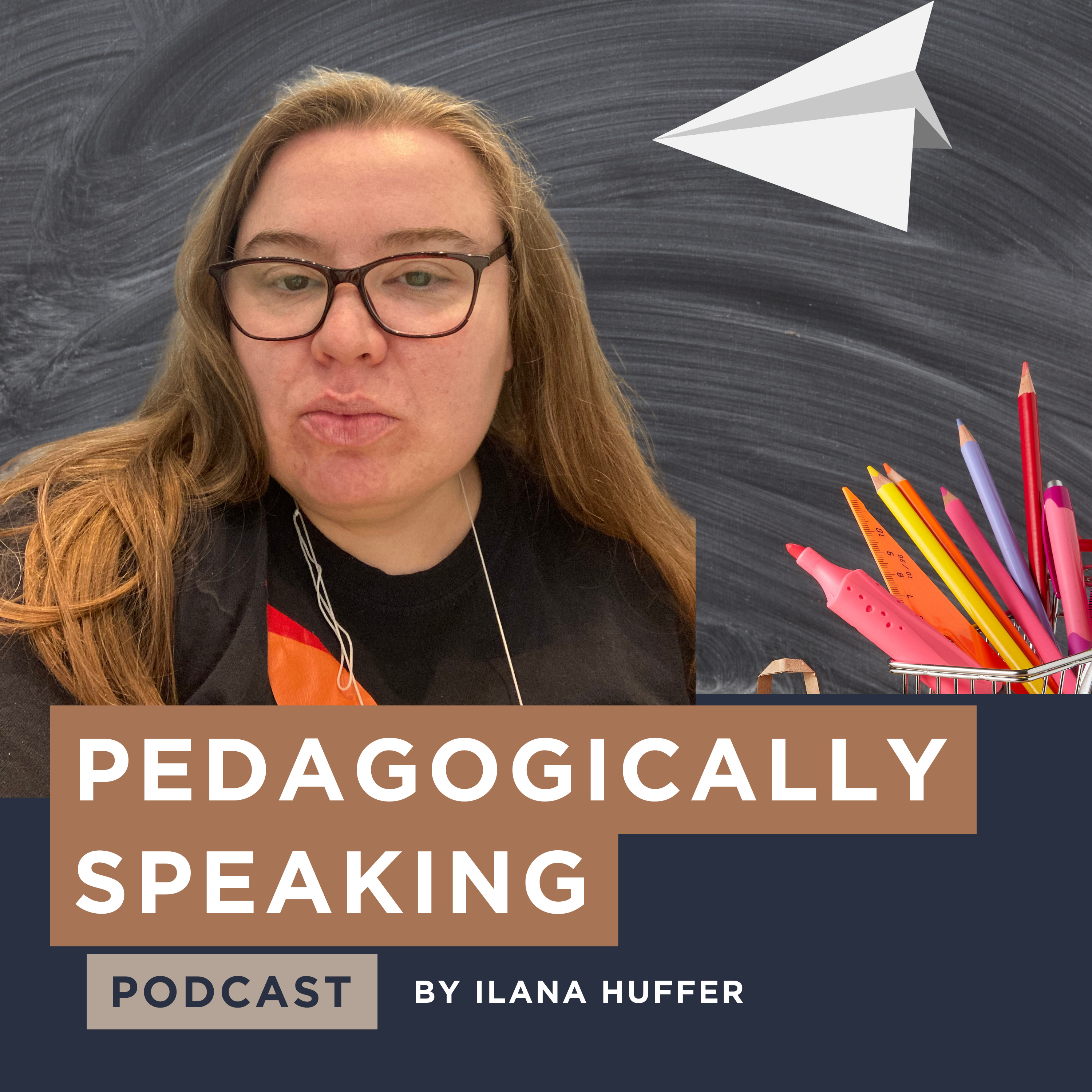
PODCAST · education
Pedagogically Speaking
by Ilana Huffer
Pedagogically Speaking is the podcast that helps teachers show up with confidence, clarity, and heart. I am an inclusive education teacher and mentor with 16 years in the classroom, my show delivers real talk, practical strategies, and empowering pep talks to help you thrive, not just survive, in the profession you love.From classroom management to teacher well-being, leadership, and inclusive practices… we cover the stuff they don’t teach you in teacher prep.If you’re a passionate educator who wants to grow, laugh, feel seen, and make a meaningful impact — you’re in the right place!
-
23
Students Don’t Care Anymore… Now What? (Teacher Burnout, Student Engagement & End-of-Year Reality)
Students don’t care anymore… or at least that’s what it feels like right now.If your students are disengaged, refusing work, or saying “I don’t care,” this episode breaks down what’s actually happening—and why it’s not about laziness or defiance.In this episode of Pedagogically Speaking, we unpack:Why student engagement drops at this time of yearThe truth behind “I don’t care” behaviorWhy pressure and consequences often make things worsePractical, realistic strategies that actually work in May and JuneHow to support students without burning yourself outThis is a real conversation for teachers who are tired, overwhelmed, and still showing up every day.If you’ve been questioning your impact lately—this episode is for you.student engagement, teacher burnout, end of year teaching strategies, disengaged students, classroom management, learning support, student motivation, why students don’t care, teacher reality, education podcastIf this resonates, share it with a teacher who needs to hear this right now.And don’t forget to subscribe to Pedagogically Speaking for real conversations about teaching that actually reflect what’s happening in classrooms.
-
22
Imposter Syndrome
The conversation covers the journey of a teacher from the initial decision to become a teacher, transitioning from an EA to a teacher, dealing with overwhelm and imposter syndrome, belonging and self-doubt in teaching, effective teaching strategies, adapting to student diversity, teaching standards, classroom management, and advice for new teachers. The conversation covers a range of topics related to teaching, including building trust and setting boundaries, seeking help and communication, connecting with veteran teachers, survival strategies for new teachers, building relationships with challenging students, coping with stress and workload, maintaining sanity and collaboration, early teaching experience and classroom preparation, support and reassurance for new teachers, classroom organization and teaching materials, staff meetings and school culture, and beach experiences and summer plans.TakeawaysTransitioning from an EA to a teacher can be challengingDealing with overwhelm and imposter syndrome is common in teaching Building trust and setting boundaries are crucial for new teachersEffective communication and collaboration with colleagues are essential for success in teachingChapters00:00 Choosing the Teaching Profession06:00 Dealing with Overwhelm and Imposter Syndrome12:09 Teaching Strategies and Lesson Effectiveness18:00 Teaching Standards and Classroom Management24:00 Building Trust and Setting Boundaries29:03 Survival Strategies for New Teachers35:17 Maintaining Sanity and Collaboration42:09 Beach Experiences and Summer Plans
-
21
We’ve Trained Students to Fear Failure. Here’s How to Undo It
The conversation explores the impact of fear of failure on students and the importance of normalizing struggle, slowing down the rescue instinct, and praising the process and effort. It emphasizes the need to change the narrative around failure and make it a part of the learning process.TakeawaysNormalizing struggle and making it a part of the learning processSlowing down the rescue instinct and allowing students to sit in discomfortPraising the process and effort, not just the outcome
-
20
Impacts of Violence in Classrooms Part 2 with guest Alex
The conversation delves into the challenges faced by educators in schools, including the impact of violence, the emotional toll on educators, and the need to navigate paradoxes. It also explores the dynamics of teacher-student relationships, assessment and grading challenges, creating safe spaces for students, and reflecting on mistakes as a means of growth. The conversation covers the challenges of balancing work and health, navigating work responsibilities, managing time and energy, teaching challenges and support, teaching strategies and adaptations, challenges of the education system, and teacher well-being and support. The discussion emphasizes the need for support, understanding, and adaptation in the teaching profession, as well as the systemic challenges faced by educators.TakeawaysImpact of violence on educatorsNavigating paradoxes Balancing work and health is a significant challenge for educatorsTeacher well-being and support are crucial for the success of the education systemChapters00:00 Challenges in Schools01:03:31 Living Within Paradoxes01:18:39 Assessment and Grading Challenges01:28:42 Creating Safe Spaces for Students01:35:14 Teaching Challenges and Support01:47:23 Challenges of the Education System01:55:11 Teacher Well-being and Support
-
19
The Realities of Teaching: Insights from Experienced Educators Part 1
The conversation delves into the challenges and realities of teaching, including the struggles of new and veteran teachers, the impact of teaching contracts on work-life balance, the lack of support for French immersion teachers, and the importance of flexibility and adaptability in lesson planning. The discussion also highlights the impact of teaching and the need for boundaries and work-life balance. The conversation covers various aspects of teaching, including, extracurricular involvement, and the impact of music and arts education. It also delves into the invisible parts of teaching, preparation, administrative work, documentation, and challenges in accessing support for students with learning disabilities.TakeawaysTeaching is a challenging and dynamic professionFlexibility and adaptability are essential in lesson planning and teachingSetting boundaries and maintaining work-life balance is crucial for teacher well-being Teaching methods should be tailored to individual preferences.The challenges of teaching extend beyond the classroom and involve administrative work, extracurricular involvement, and navigating support for students with learning disabilities.Chapters00:00 The Reality of Teaching05:50 Teaching Contracts and Compensation12:02 Work-Life Balance and Boundaries18:01 Teaching During COVID-1928:46 Teaching Methods and Individual Preferences33:55 Teaching as a Calling and the Guilt Factor40:48 Challenges in Access to Music Education46:29 Preparation and Administrative Work55:30 Navigating Support for Students with Learning Disabilities
-
18
Don’t Ruin Your Spring Break on Sunday: The 5-Step Teacher Reset Before Monday
In this episode, Ilana discusses the importance of a teacher reset before Monday and provides five steps to achieve it. The steps include planning for Monday, reducing overwhelm, setting energy boundaries, and anchoring a win for Monday. Ilana emphasizes the need for teachers to set boundaries and prioritize their well-being.TakeawaysTeacher resetSetting boundariesChapters00:00 Teacher Reset Before Monday07:02 Planning for Monday17:56 Setting Energy Boundaries
-
17
Spring Break Recharge: Mental Health Strategies for Teachers
Episode 14 of Pedagogically Speaking focuses on the mental health of teachers, addressing burnout, stress management, work-life balance, and the importance of rest and recovery. It emphasizes the need for community, mindfulness, and reconnecting with non-teaching identities.TakeawaysRecognizing signs of burnout in teachersEmbracing rest and recovery for mental well-beingChapters00:00 Building Community with Teachers05:18 Recognizing Burnout in Teachers16:23 Establishing Work-Life Balance24:01 Building a Support Network
-
16
How to survive teaching without losing yourself.
Episode 13: I talk about being close to the end of term 2, and report cards leading to burnout in teaching, and we explore the signs, causes, and impact of burnout on educators. I emphasize the need for boundary-setting, self-care, and system redesign to address burnout effectively.TakeawaysBurnout is a result of overloaded systems and requires system redesign, not shame.Educators should prioritize self-care, set boundaries, and focus on sustainable teaching practices.Chapters00:00 Introduction and Community Building10:26 Impact of Report Card Season and Lack of Support19:39 Minimum Viable Teacher Framework27:13 Recognizing Burnout and Making Career Decisions
-
15
The 5 structures that turn chaos into calm
In Episode 12 of Pedagogically Speaking I talk about the importance of structure and clarity in the classroom, dealing with chaos, and managing dysregulation. The episode emphasizes the need for structure, clarity, and co-regulation to create a calm and effective learning environment.Chapters00:00 Podcast Introduction and Feedback06:38 Chaos in the Classroom14:35 Importance of Structure and Clarity29:04 Tightening Up Classroom Routines36:25 Dealing with Dysregulation
-
14
They’re Not Ignoring You. They’re Drowning.
Are your students staring at blank pages? Avoiding work? Saying “I don’t get it” before they even try?They’re not ignoring you. They’re overwhelmed.In this episode of Pedagogically Speaking, we’re unpacking executive functioning in the classroom — what it actually looks like, why we mislabel it as laziness or defiance, and how to use practical classroom management strategies that reduce overwhelm and increase task initiation.If you’re a new teacher (or a tired one) struggling with:Students who won’t start assignmentsA loud, busy classroom that feels chaoticKids who “shut down” during independent workConstant reminders that don’t workThis episode will give you real executive functioning strategies that actually work in real classrooms.You’ll learn:✔ What executive dysfunction really looks like in students✔ The 3 scaffolds that reduce cognitive overload✔ How to teach planning skills without becoming their planner✔ The assignment breakdown formula✔ The “I Can’t Start” solution for task avoidanceIf you want calmer classrooms, stronger task initiation, and less burnout, press play.
-
13
Belonging is Felt: Rethinking Inclusion in Schools
Keywordsinclusion, education, mental health, community, barriers, safe environment, collaboration, teaching strategies, student support, holistic approachSummaryIn this conversation, Ilana discusses the multifaceted nature of inclusion in education, emphasizing the importance of creating a safe and supportive environment for all students. She explores the challenges and barriers to effective inclusion, the role of community, and the need for collaboration among educators. The discussion highlights the significance of understanding students' individual needs and fostering a sense of belonging in the classroom.TakeawaysInclusion is a holistic approach to education.Creating a safe environment is essential for learning.Felt safety is different from just feeling safe.Inclusion requires understanding students' diverse backgrounds.Collaboration among educators is crucial for effective inclusion.Barriers to inclusion often stem from systemic issues.Behavior is a form of communication that needs to be understood.Inclusion should not just be about compliance.Community plays a vital role in fostering inclusion.Educators must reflect on their teaching practices to support inclusion.Sound bites"You need to educate everyone, no matter what.""Felt safety is crucial for students.""Behavior is communication."Chapters00:00 Understanding Inclusion in Education10:02 Creating a Safe and Inclusive Environment20:08 Barriers to Inclusion and Systemic Challenges29:59 Practical Strategies for Inclusive Teaching
-
12
Teacher Burnout & Belonging: Practical Classroom Strategies with Morgane Michael
In Episode 9 of Pedagogically Speaking, host Ilana Huffer sits down with internationally recognized educator and author Morgane Michael for a powerful conversation about teacher burnout, belonging in education, and the simple, but deeply impactful, strategies that help students and teachers, feel safe, connected, and seen.Morgane shares her personal journey of reclaiming language and identity, and explains why belonging is not a “nice-to-have” in schools, it’s the foundation for learning, creativity, and emotional safety. Together, Ilana and Morgane explore how nonverbal cues, predictable routines, affirmations, and intentional classroom culture-building can transform student confidence and engagement.This episode also introduces Morgane’s practical Five Rs framework for navigating overwhelm and burnout:✨ Reflect, Reframe, Refocus, Reconnect, RevealIf you’re an educator feeling stretched thin, disconnected, or overwhelmed—this episode will remind you: you’re not alone, and burnout isn’t a personal failure.🎙️ Sound bites from the episode:“Creativity comes when we feel safe.”“Teaching is very personal.”“You have to honor yourself in that.”💡 Key Topics in This Episode:Why belonging is essential for learningThe power of nonverbal cues in student connectionCreating predictable routines to build emotional safetyUsing affirmations to shift student identity + confidenceThe Five Rs for teacher well-being and burnout preventionSmall changes that make classrooms feel safer and more joyfulHow teachers can advocate for themselves in systemic challenges⏱️ Chapters00:00 Introduction to Pedagogically Speaking02:43 Morgane Michael: A Journey of Purpose and Belonging08:57 Reclaiming Language and Identity10:04 Creating Positive Classroom Cultures16:12 The Five Rs: Reflect, Reframe, Refocus, Reconnect, Reveal23:30 The Power of Words and Impactful Teaching26:53 Embracing Failure and Building Relationships30:40 Creating a Safe and Joyful Learning Environment36:05 Navigating Overwhelm in Teaching41:10 Implementing Morning Meetings in Small Classrooms44:43 Living a Wholehearted Teaching Life🔎 Keywordseducation, burnout, belonging, teaching strategies, classroom culture, teacher well-being, leadership, language identity, student connection, empathy
-
11
Teachers Were Never Meant to Do This Alone: Community, Solidarity, and Support
The conversation covers the themes of community building among educators, early teaching experiences, transition to a teaching career, teaching in Saskatchewan, relocation and adjustment, and union activism and social justice. It explores the challenges, adventures, and experiences of educators, highlighting the need for collaboration, the passion for teaching, and the normalization of classroom conditions. The conversation delves into the challenges faced by educators in navigating support and understanding from unions, as well as the importance of union activism in a capitalist society. It also explores the impact of underfunded education on students and teachers, highlighting the need for resources and funding to ensure a safe and thriving learning environment. The conversation delves into the emotional burden carried by teachers due to the state of the world, the impact of union activism on personal boundaries, coping strategies for mental health, the pursuit of personal and academic development, and the importance of solidarity and community support in the teaching profession. It highlights the need for teachers to navigate challenges and find support within their communities, while also balancing personal well-being and professional commitments.TakeawaysCommunity BuildingEarly Teaching Experiences Union activism in a capitalist societyChallenges of underfunded education Teachers carry a significant amount of grief and worry due to the state of the world, and this affects their ability to create safe spaces in the classroom.The importance of community and solidarity in supporting teachers through isolation and challenges.Chapters00:00 Building Community as Educators07:38 Teaching in Saskatchewan17:02 Union Activism and Social Justice23:56 Navigating Support and Union Understanding39:31 Navigating Workplace Advocacy50:55 Impact of Underfunded Education on Students and Teachers01:00:33 The Grief of Teachers01:07:08 Mental Health and Coping Strategies01:21:19 Solidarity and Community Support
-
10
Reimagining Assessment: Transforming Assessment into a Learning Tool
EPISODE 7: In this episode of Pedagogically Speaking I explore the transformation of assessment into a learning tool, the limitations of traditional assessments, ethical considerations in large-scale assessments, the dominance of behaviorist thinking in schools, the contrast between behaviorism and constructivism, the importance of culturally responsive and ethical assessments, and the role of data in formative assessment and instruction.TakeawaysFormative assessment provides immediate actionable informationAssessment should be an ongoing dialogueChapters00:00 Reimagining Assessment: Transforming Assessment into Learning06:04 Ethical Considerations in Large-Scale Assessments and Data Use11:27 The Power of Formative Assessment and Feedback18:09 Culturally Responsive Assessment and Inclusion24:36 Assessments Reflecting Student Diversity and Fairness30:39 Culturally Responsive Assessments and Representation in Learning Materials38:29 High Stakes vs. Formative Assessments and the Use of Data
-
9
Community will bring us Together
Ange Coutts shares her journey into teaching, overcoming adversity, and advocating for LGBTQ+ representation and inclusivity in education. She discusses the challenges she faced as a substitute teacher, the impact of LGBTQ+ representation in education, and the empowerment of female athletes through coaching. Ange also addresses the prevalence of prejudice and the importance of promoting inclusivity in the education system. The conversation covers a range of topics including the intersection of, challenges of gender identity and marriage, inequities in maternity and paternity leaves, advocacy for policy change, gender representation in physical education, inclusive physical education practices, challenges of teaching and coaching, building positive school culture, motivation for teaching and coaching, and support and community for new teachers. The discussion emphasizes the need for inclusivity, understanding, and equitable policies in education and society, as well as the impact of personal fulfillment and community support on educators.TakeawaysResilience in pursuing a career in educationAdvocacy for LGBTQ+ representation and inclusivity in education The importance of inclusivity and understanding in religious communitiesThe need for equitable policies and support for LGBTQ+ educatorsThe impact of personal fulfillment and community support on educatorsChapters00:00 Introduction to Pedagogically Speaking Podcast06:14 Support Systems and Mentorship11:17 Struggles as a Substitute Teacher17:13 Persistence and Adaptability in Teaching22:23 Impact of LGBTQ+ Representation in Education27:29 Gender Equality in Sports and Education32:54 Navigating LGBTQ+ Identity in Education39:12 Addressing Prejudice and Promoting Inclusivity44:12 Inequities in Maternity and Paternity Leaves50:19 Gender Representation in Physical Education01:00:05 Building Positive School Culture01:06:26 Motivation for Teaching and Coaching01:13:05 Support and Community for New Teachers
-
8
Nobody has the Monopoly on Good Ideas
The conversation covers Vasuhi's, career transitions, challenges, and growth, the impact of nutrition on health, and the implications of problem-solving and foresight. Vasuhi's experiences highlight the importance of mental health, the value of career transitions, and the significance of education in personal and professional development. The conversation delves into the challenges of parenting, career aspirations, and the importance of mentorship and leadership. Vasuhi discusses the difficulties of letting go as a parent, her career aspirations and challenges, and the significance of mentorship and leadership in professional growth. The conversation covers topics related to leadership, validation, title classification, education, relationships, and personal growth. It delves into the challenges of leadership, the impact of title classification in education, and the dynamics of personal relationships and growth.TakeawaysMental health and fitnessCareer transitions and growth Parenting challengesCareer aspirationsMentorship and leadership Leadership and validationTitle classification and educationRelationships and personal growthChapters00:00 Introduction and Fitness Journey12:57 Nutrition and Health18:04 Project Management and Education30:58 Problem Solving and Foresight51:06 Mentorship and Leadership57:44 Leadership and Validation01:05:14 Relationships and Personal Growth
-
7
Navigating Teacher Exhaustion During Winter Break
In episode 4 of Pedagogically Speaking, host Ilana Huffer discusses the challenges educators face during winter break, emphasizing the importance of rest and self-care. She reflects on the exhaustion many teachers feel, particularly after a long term, and addresses the feelings of self-doubt that often arise during this time. Ilana encourages teachers to embrace their humanity, recognize that survival mode is a valid state, and gives permission to rest without the pressure of productivity. The conversation highlights the need for support, understanding, and reflection in the teaching profession.Sound Bites"Fun can be a burden.""You do not need clarity right now.""You are amazing. Enjoy yourselves."Chapters00:00 Welcome to Pedagogically Speaking01:09 Navigating Winter Break as Educators10:55 Understanding Survival Mode in Teaching18:40 The Reality of Teaching Challenges30:12 Reflections on Self-Doubt During Breaks
-
6
Are Teachers Ready for Winter Break?
Episode 3 of Pedagogically Speaking, Ilana Huffer discusses the challenges educators face as they approach the winter break. She emphasizes the importance of maintaining routines, understanding mental exhaustion, and practicing self-care. Ilana shares strategies for compassionate teaching and encourages educators to embrace their emotions while recognizing the need for rest. The conversation aims to support teachers in navigating the end of the term with grace and understanding.December is cognitively exhausting for educators.Mental check out is a natural response to stress.Small gestures can significantly impact students.Release the pressure to create perfect lessons.Naming your feelings can help reduce their weight.Rest is essential for returning to teaching refreshed.Chapters00:00 Introduction to the Pedagogy of Peace02:28 Navigating the Pre-Holiday Stress05:22 Understanding Mental Check-Outs07:49 Strategies for Compassionate Teaching10:27 Embracing Emotions and Self-Care13:08 Conclusion and Encouragement for Educators
-
5
Beyond the Notes: Cindy Romphf on Music, Mentorship & Making Safe Spaces
In this conversation, Cindy Romphf, a dedicated music educator, shares her journey in music education, the importance of advocacy for music programs, and the impact of music on students' lives. She discusses her experiences navigating racial identity in a predominantly white community and emphasizes the need for safe spaces in education. Cindy also highlights the significance of mentorship and community support among music educators, and the emotional connections that music fosters among students. Throughout the discussion, she advocates for the value of music education and encourages listeners to support their local music programs.Takeaways:Cindy Romphf has been a passionate advocate for music education throughout her career.Music education provides a safe space for students and fosters community.Cindy's own experiences as a racialized student inform her teaching philosophy.Advocacy for music programs is crucial, especially during budget cuts.Mentorship plays a vital role in supporting new music educators.Music education helps students develop important life skills.Cindy emphasizes the emotional connections that music creates among students.The importance of reaching out to support music teachers in schools.Cindy's journey reflects the challenges and rewards of teaching music.Music education is essential for the holistic development of students.Chapters:00:00 Introduction to Cindy Romphf and Her Journey05:20 The Impact of Music Education11:04 Navigating Racial Identity in Education17:02 Advocacy for Music Education22:54 Mentorship and Community in Music28:36 The Role of Music in Student DevelopmentKeywordsmusic education, advocacy, mentorship, community, racial identity, student impact, teaching, music teacher, safe spaces, music programs
-
4
From Surviving to Thriving: Confidence in the Classroom
In the inaugural episode of "Pedagogically Speaking," host Ilana Huffer delves into the often unspoken challenges of teacher confidence. Through personal stories and practical insights, Ilana explores how confidence is built not through perfection, but through consistency, community, and embracing the learning journey. Join us as we uncover the power of small wins, the importance of supportive networks, and the transformative impact of self-compassion in the classroom. Whether you're a new teacher or a seasoned educator, this episode offers encouragement and strategies to help you thrive.
We're indexing this podcast's transcripts for the first time — this can take a minute or two. We'll show results as soon as they're ready.
No matches for "" in this podcast's transcripts.
No topics indexed yet for this podcast.
Loading reviews...
ABOUT THIS SHOW
Pedagogically Speaking is the podcast that helps teachers show up with confidence, clarity, and heart. I am an inclusive education teacher and mentor with 16 years in the classroom, my show delivers real talk, practical strategies, and empowering pep talks to help you thrive, not just survive, in the profession you love.From classroom management to teacher well-being, leadership, and inclusive practices… we cover the stuff they don’t teach you in teacher prep.If you’re a passionate educator who wants to grow, laugh, feel seen, and make a meaningful impact — you’re in the right place!
HOSTED BY
Ilana Huffer
CATEGORIES
Loading similar podcasts...
Frequently Asked Questions
How many episodes does Pedagogically Speaking have?
Pedagogically Speaking currently has 20 episodes available on PodParley. New episodes are automatically indexed when they're published to the podcast feed.
What is Pedagogically Speaking about?
Pedagogically Speaking is the podcast that helps teachers show up with confidence, clarity, and heart. I am an inclusive education teacher and mentor with 16 years in the classroom, my show delivers real talk, practical strategies, and empowering pep talks to help you thrive, not just survive, in...
How often does Pedagogically Speaking release new episodes?
Pedagogically Speaking has 20 episodes. Check the episode list to see recent publication dates and frequency.
Where can I listen to Pedagogically Speaking?
You can listen to Pedagogically Speaking on PodParley by clicking any episode. We provide an embedded audio player for direct listening, and you can also subscribe via your preferred podcast app using the RSS feed.
Who hosts Pedagogically Speaking?
Pedagogically Speaking is created and hosted by Ilana Huffer.
URL copied to clipboard!