
PODCAST · society
Rivers West - The Path of Lewis and Clark
by Bob Taylor
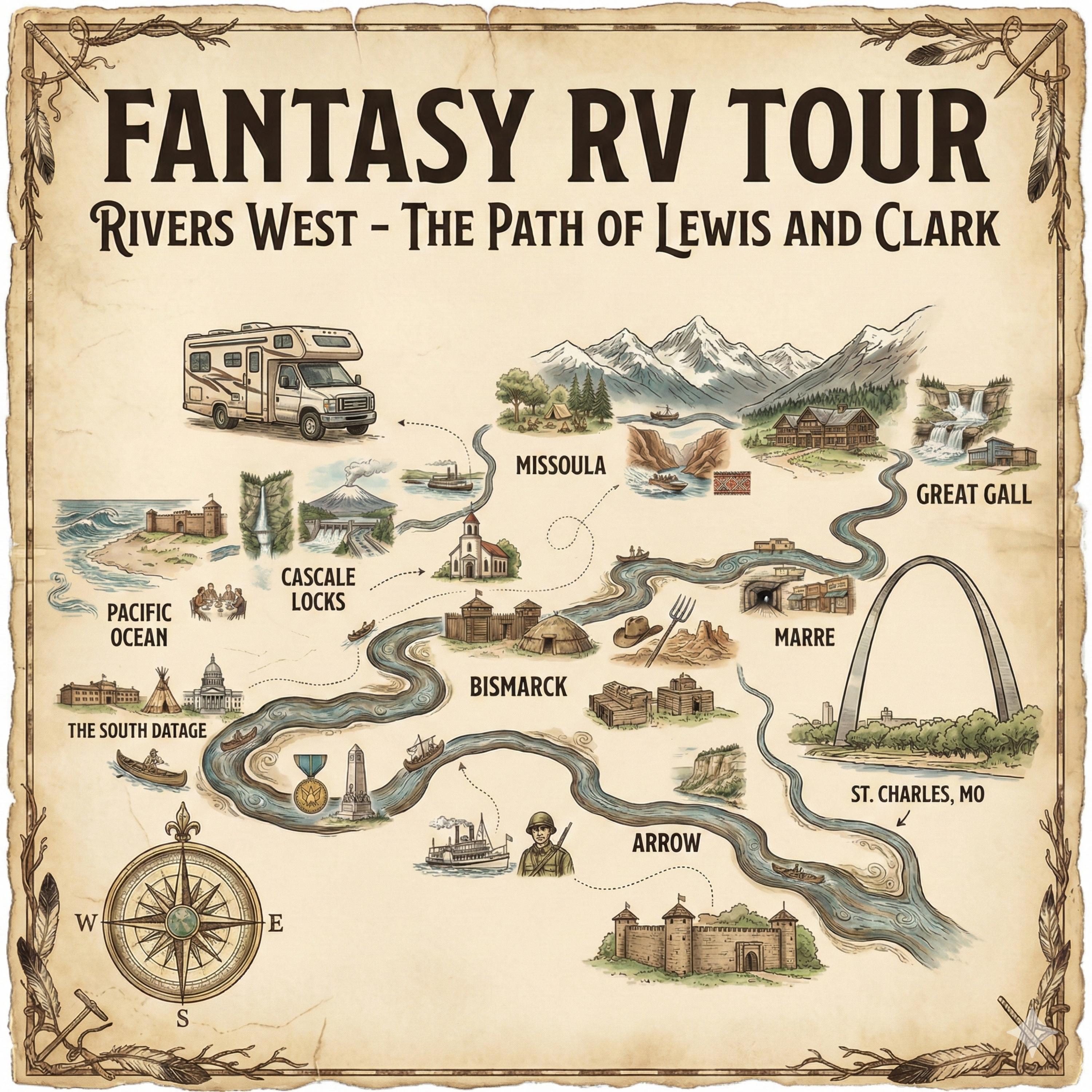
This is the audio archive of my personal travel research for Rivers West: The Path of Lewis and Clark RV Tour. I dive deep into the history, logistics, and "must-see" stories of this expedition. These episodes are the result of that preparation—distilled into audio briefings designed for me to listen to while in transit. From historical deep-dives to logistical reminders, this channel is my hands-free travel binder. It’s curated specifically for my interests, my pace, and my upcoming itinerary. If you’re hearing this, you’re listening in on the prep work for my latest journey.
-
28
Podcast 28 - The Untold Story of Sacagawea
The Untold Story of Sacagawea: Beyond the LegendFor most people, Sacagawea is simply known as the fearless teenage mother who guided the Lewis and Clark Expedition across America with her baby tied to her back. But the true story of this Indigenous icon is filled with harrowing tragedy, incredible resilience, and untold sacrifices.In this episode, we peel back the myths to uncover the real life of the Shoshone explorer. Listeners will discover:A Tragic Childhood: How Sacagawea survived a vicious raid by the Hidatsa tribe, only to be abducted and treated as a servant for years before being sold at age 16 to Toussaint Charbonneau—a cruel French-Canadian trapper 30 years her senior who was already married to another woman.The Expedition's True Hero: Why Lewis and Clark primarily tolerated the terrible Charbonneau just to get Sacagawea's translation skills, and how she proved her grit by trekking across the continent mere weeks after giving birth to her son, Jean Baptiste.Acts of Unbelievable Bravery: We recount the famous moment when Charbonneau panicked and nearly capsized their boat, while Sacagawea bravely dove into the water to rescue the expedition's most valuable journals and scientific instruments.Heartbreak and Abuse: We dive into the darker realities of the journey, including how she contracted a severe illness from her husband, the brutal physical abuse she suffered at his hands until William Clark intervened, and the emotional moment she was unexpectedly reunited with her brother—now a Shoshone chief.A Mother's Ultimate Sacrifice: We explore her platonic, uncle-niece-like bond with William Clark, and her devastating decision to leave her beloved son "Pompy" with him in St. Louis to ensure the boy had a better life and education.Join us as we honor the complete, unvarnished story of Sacagawea—a woman who endured unimaginable hardships, whose tragic death at just 24 years old cut short a remarkable life, and whose adventurous spirit helped shape a nation.
-
27
Podcast 27 - Navigating the Unknown
Navigating the Unknown: How Lewis and Clark Crossed a ContinentThe Lewis and Clark Expedition's 8,000-mile journey to the Pacific Ocean and back was not just a feat of human endurance, but a masterclass in logistical adaptation. In this video, we explore the incredible and diverse transportation methods the Corps of Discovery utilized to conquer the unpredictable rivers and rugged mountains of the American West.Listeners and viewers will discover the fascinating evolution of the expedition's transportation, which included:The Flagship Keelboat: The journey began with a custom-built, 55-foot keelboat capable of carrying 12 tons of cargo. Designed by Meriwether Lewis and built in Pittsburgh, this vessel was propelled by 22 oars, sails, and setting poles. It served as a floating fortress and laboratory until the Missouri River became too shallow, and it was sent back to St. Louis in the spring of 1805.The Red and White Pirogues: Accompanying the keelboat were two smaller, flat-bottomed pirogues. The Red Pirogue hauled heavy cargo and was manned by experienced French engagés, while the highly stable White Pirogue served as the command auxiliary and transported sensitive instruments and journals.Dugout Canoes: As the rivers narrowed, the expedition had to build their own fleet. They spent a winter carving six cottonwood canoes at Fort Mandan. Later, after crossing the Bitterroot Mountains, the Nez Perce taught them to use a "burning-out" method to hollow out five ponderosa pine canoes for their descent to the Pacific.The Failed "Experiment": We dive into Lewis's brilliant but ultimately doomed invention—a 40-foot collapsible, iron-framed boat. Intended to be covered with elk and buffalo hides, the vessel leaked uncontrollably and had to be abandoned when the crew couldn't find pine trees to make the pitch necessary to waterproof its seams, relying instead on an ineffective mixture of beeswax, charcoal, and buffalo tallow.Improvised Watercraft: Discover how the explorers adapted by acquiring two Native American-made canoes on the lower Columbia River. We also recount the incredible ingenuity of Sergeant Nathaniel Pryor's detachment; when their horses were stolen by a Crow raiding party on the return trip, they quickly constructed two circular, Mandan-style bullboats out of buffalo hides to float down the Yellowstone River.Overland Travel and Equestrian Lifelines: The rivers couldn't take them everywhere. The crew endured a brutal 18-mile overland portage around the Great Falls of the Missouri, building makeshift wagons with cottonwood wheels to haul their heavy canoes and supplies. Ultimately, crossing the rugged Continental Divide was only possible after Sacagawea helped them negotiate for 29 horses and a mule from the Shoshone.Grueling River Mechanics: We also unpack the immense physical labor required to move upstream. When rowing and sailing weren't enough, the men used setting poles to push against the riverbed, or resorted to "cordelling"—towing the massive boats by hand using elk-skin ropes while walking or wading along muddy, treacherous riverbanks.Join us as we explore the frontier engineering, the grueling physical labor, and the impressive, shifting modes of transportation that carried the Corps of Discovery into history!
-
26
Podcast 26 - The Right Boat
Engineering the Corps: The Fleet That Conquered the MissouriThe success of the Lewis and Clark Expedition relied on much more than overland endurance; it demanded a sophisticated, custom-engineered maritime fleet designed to navigate the chaotic, unpredictable, and fiercely powerful Missouri River. In this episode, we explore the incredible navigational architecture and grueling riverine labor that propelled the Corps of Discovery into the unknown.At the center of our story is the expedition's flagship: a custom-built, 55-foot keelboat. Far from a simple transport barge, this vessel served as a floating laboratory, a diplomatic stage, and a fortified military command center capable of carrying 12 tons of essential cargo upstream. We dive into Meriwether Lewis's ingenious frontier design features, including a 32-foot hinged mast that could be quickly lowered to avoid overhanging tree branches, and heavy-duty storage lockers that could be raised to form defensive breastworks, instantly transforming the boat into a floating blockhouse to protect the crew during an ambush.Listeners will also discover the immense physical toll of early 19th-century river travel. We unpack the "human engine" of the expedition, detailing how the crew had to row, push the boat upstream using 18-foot setting poles, and even "cordell" (tow the massive boat by hand using elk skin ropes) through violent currents, shifting sandbars, and deadly submerged trees.Beyond the keelboat, we explore the critical roles of the fleet's auxiliary vessels. We highlight the heavy-lifting Red Pirogue operated by expert French engagés, and the highly stable White Pirogue, which the captains trusted with their most sensitive scientific journals and diplomatic gifts. Finally, we examine the limits of their technological planning by looking at "The Experiment"—Lewis's brilliant but ultimately doomed collapsible iron-framed boat, which catastrophically leaked when the crew couldn't find proper pine pitch to seal its elk-skin hull.Join us as we navigate the maritime triumphs, the grueling physical labor, and the specialized river technology that made America's greatest voyage of discovery possible!
-
25
Podcast 25 - Preparing for the Expedition
Before the First Step: Assembling the Corps of DiscoveryThe story of the Lewis and Clark Expedition often begins with their launch up the Missouri River, but the monumental success of their 8,000-mile trek was actually forged during months of grueling, meticulous preparation. In this episode, we dive into the massive logistical, scientific, and military mobilization that had to happen long before the expedition ever left Camp Dubois.Listeners will discover the incredible groundwork laid in the East, including:The Philadelphia Crash Course: How President Thomas Jefferson sent Meriwether Lewis to study with the brightest minds of the American Enlightenment. We explore Lewis's rapid education in botany, paleontology, celestial navigation, and frontier medicine—including his consultation with Dr. Benjamin Rush and the acquisition of his infamous "Thunderclappers" (powerful laxative pills).Logistics and The Iron Boat: The staggering task of procuring over two and a half tons of supplies, ranging from 193 pounds of portable soup to Indian peace medals and a rapid-firing Girandoni air rifle. We also look at Lewis's time at the Harpers Ferry armory, where he designed a collapsible iron-framed boat—a brilliant experiment that ultimately met a frustrating end in the western wilderness.Building the Keelboat and the Team: The stressful weeks spent in Pittsburgh dealing with a frequently intoxicated boat builder to finish their 55-foot keelboat, followed by the treacherous journey down the shallow Ohio River. We highlight the pivotal moment Lewis reunited with William Clark at the Falls of the Ohio, bringing aboard the legendary "Nine Young Men from Kentucky" and Clark's enslaved lifelong companion, York.The Crucible at Camp River Dubois: The expedition's winter encampment of 1803–1804 in the Illinois territory. While Lewis gathered vital intelligence, maps, and supplies in nearby St. Louis, Clark took charge of the camp, using strict military discipline and marksmanship drills to forge a rowdy group of soldiers and civilian frontiersmen into the unified Corps of Discovery.Join us as we explore the ingenuity, the setbacks, and the rigorous training that prepared these explorers to step off the map and into history on May 14, 1804.
-
24
Podcast 24 - A Brief Bio of Meriwether Lewis
The Architecture of Command: The Complex Life of Meriwether LewisThe legacy of Meriwether Lewis is often reduced to his role as a famous explorer, but his life was a profoundly complex crucible for the emerging American identity. In this special biographical brief, we explore the man behind the expedition. Born into the Virginia gentry and raised on the rugged Georgia frontier, Lewis developed vital survival skills and a foundational knowledge of herbal medicine from his mother.We dive into his early military career, where he served under General "Mad Anthony" Wayne and first crossed paths with William Clark, building a lifelong bond of mutual respect. Listeners will discover how his tenure as President Thomas Jefferson’s private secretary served as an "ideal finishing school." By acting as the administration's trusted confidante and vetting military officers, Lewis proved he had the fidelity, physical resilience, and diplomatic instincts necessary to lead Jefferson's transcontinental mission.While Lewis proved to be a masterful military leader and an extraordinary field scientist—meticulously documenting hundreds of new plant and animal species across an 8,000-mile journey—his triumphant return was short-lived. We explore his disastrous term as the Governor of the Louisiana Territory, a role that mismatched his temperament and was plagued by political infighting with his territorial secretary and sudden financial ruin.Finally, we examine his tragic death at Grinder's Stand at the age of 35. Was his death a tragic suicide fueled by his documented "unreasonable melancholy" and illness, or was it a frontier murder?Join us as we unpack the triumphs, the strict military discipline, and the profound struggles of America's quintessential "Renaissance frontiersman".
-
23
Podcast 23 - A Brief Bio on William Clark
The Pragmatic Pioneer: The Contradictions of William ClarkOften remembered simply as the co-commander of America's most famous transcontinental trek, William Clark was a deeply complex figure whose life bridged the gap between the refined Virginia gentry and the rugged American frontier. In this special biographical brief, we explore the man who served as the grounding force and master cartographer of the Corps of Discovery.Raised on the volatile trans-Appalachian frontier of Kentucky and mentored by his Revolutionary War hero brother, George Rogers Clark, William skipped a formal classical education in favor of the practical arts of surveying, woodland survival, and military tactics. We dive into his early military crucible under General Anthony Wayne, where he commanded an elite rifle company and first crossed paths with a young, temperamental ensign named Meriwether Lewis—forging a powerful bond of trust that would ultimately change American history.Listeners will discover exactly why Lewis insisted on sharing absolute command with Clark. We explore Clark's indispensable skills: his "dead reckoning" cartographic genius that meticulously mapped the unknown West, his expert river navigation, and his stable, composed temperament that saved the expedition from disaster during tense diplomatic standoffs, such as their encounter with the Teton Sioux.But Clark's legacy is also deeply fraught with the moral contradictions of the early Republic. We examine his post-expedition career as a territorial governor and Superintendent of Indian Affairs—a man who provided medical treatments to Native tribes and was seen as a "friend," yet personally orchestrated 37 treaties that systematically displaced them from millions of acres of ancestral lands. We also confront the darkest chapter of his private life: his harsh and deeply unjust treatment of York, his enslaved lifelong companion who contributed immensely to the expedition's success, only to be denied his freedom and subjected to severe punishment upon their return.Join us as we unpack the triumphs, the personal family tragedies, and the profound moral complexities of the pragmatic frontiersman who anchored America's expansion into the West.
-
22
Podcast 22 - Stop 18 - Warrenton, OR
Days 42 through 45 mark the grand finale of our journey in Warrenton, Oregon, following a 136-mile drive to the shores of the Pacific Ocean. This area represents the historic end of the Lewis and Clark trail, where the Corps of Discovery finally achieved their goal of reaching the coast and established their winter camp for 1805–1806.During this final basecamp at the Astoria/Warrenton/Seaside KOA Resort, travelers will reflect on the immense challenges and triumphs of the expedition through a series of powerful guided excursions. Highlights for this concluding leg include:Warrenton Guided Motorcoach Tour: An included excursion to explore the region's most significant historical landmarks. Guests will visit Knappton Heritage Cove, Fort Clatsop (a reconstruction of the expedition's winter quarters), and Dismal Nitch—the miserable, rain-soaked cove where the explorers were trapped by fierce winter storms for six days just miles from their Pacific destination.Lewis and Clark Interpretive Center: A comprehensive museum visit overlooking the Columbia River and the Pacific Ocean, detailing the expedition's homeward journey and their profound lasting legacy on the Pacific Northwest.A Wealth of Optional Excursions: During their free time, travelers can climb the Astoria Column for panoramic views, visit the Columbia River Maritime Museum or Oregon Film Museum, and explore the beautiful Fort Stevens State Park to see the historic shipwreck of the Peter Iredale. Pop-culture fans can even channel their inner explorer by checking out local filming locations from the 1980s classic movie, The Goonies.To bring this epic 3,000-mile adventure to a close, the group will gather for a special Farewell Dinner to reminisce and share stories of the road, followed by a Goodbye Continental Breakfast the next morning before the caravan parts ways.
-
21
Podcast 21 - Stop 17 - Cascade Locks, OR
Days 38 through 41 bring our expedition to Cascade Locks, Oregon, situated in the heart of the breathtaking Columbia River Gorge National Scenic Area. When the original Corps of Discovery passed through this region in the fall of 1805, they faced the daunting task of navigating the Columbia River's treacherous and turbulent rapids while marveling at the towering cliffs and numerous cascading waterfalls along the southern shore.During this action-packed four-day basecamp, modern travelers will experience the raw power and scenic beauty of the Pacific Northwest through a series of incredible guided excursions. Highlights for this leg of the journey include:Columbia Gorge Guided Motorcoach Tour: A spectacular drive along the scenic Columbia Gorge Highway, featuring stunning vista points and a visit to the magnificent 620-foot Multnomah Falls—one of the notable cascades explicitly documented by Meriwether Lewis in 1805.Bonneville Dam and Fish Hatchery: A firsthand look at the operation of two of the nation's largest hydroelectric powerhouses, complete with a stop at the underwater viewing rooms to watch migrating fish travel upstream.Portland Spirit Lunch Cruise: A relaxing dining cruise that allows guests to experience the majestic Columbia River right from the water, tracing the water-bound route the explorers took.Mount St. Helens Guided Motorcoach Tour: A powerful excursion to the Mount St. Helens Volcanic Monument and Johnston Ridge Observatory to learn about the devastating 1980 eruption. While Lewis and Clark noted this towering, snow-capped volcano in their journals, modern travelers will witness its dramatically altered landscape and flood plains.During their free time, guests can explore the immediate local area, with optional visits to the Cascade Locks Marine Park—where displays explain the 19th-century locks that finally made the turbulent river passable—the Bridge of the Gods, or the Cascade Locks Historical Museum.
-
20
Episode 20 - Stop 16 - Boardman, OR
Day 37 brings our expedition to Boardman, Oregon, nestled right along the scenic shores of the Columbia River.As travelers make the 170-mile drive into the state, they have the option to stop en route at the historic Marcus Whitman Mission. This stop offers a sobering but important look at the early influx of American settlers on the Oregon Trail and the tragic 1847 Whitman Massacre, a pivotal event that profoundly impacted the region and its indigenous Cayuse people.Once basecamp is set up at the beautiful Boardman Marina and RV Park, guests can unwind by taking a relaxing stroll or bike ride along the park's 3-mile paved walking trail right beside the river. The afternoon offers plenty of free time for optional local activities, such as visiting the interactive SAGE Center, exploring the natural beauty of Hat Rock State Park, or checking out the Boardman Train Depot and local farmers market.As the sun sets over the Columbia River, the group will gather together for a classic campground cookout—providing the perfect evening to share food, fun, and stories from the road with fellow travelers.
-
19
Podcast 19 - Stop 15 - Clarkston, WA
Days 33 through 36 bring our expedition to Clarkston, Washington, situated at the scenic and historic confluence of the Clearwater and Snake rivers.This stop highlights a crucial turning point in the Lewis and Clark Expedition. When the original Corps of Discovery emerged from the Bitterroot Mountains in the fall of 1805, they were starving and exhausted. Their survival and ultimate success were made possible by the profound generosity of the Nez Perce (Nimiipuu) people, who fed them and helped them build dugout canoes at "Canoe Camp" for the final water-bound leg to the Pacific Ocean.During this four-day basecamp at the Hells Canyon RV Resort along the Snake River, travelers will dive into this vital partnership and experience the raw power of the region's waterways. Highlights for this leg include:Nez Perce National Historical Park: An included visit and presentation where guests will learn about the rich history and culture of the Nimiipuu people and their deep collaboration with the explorers.Hells Canyon Jet Boat Ride: A thrilling high-speed boat excursion through North America's deepest river gorge. While Lewis and Clark had to paddle the treacherous currents of the Snake River in wooden canoes, modern travelers will get to experience the power of these rapids in comfort and style.Free Time and Local Dining: The stop features an included local dinner and a full free day to explore the Clarkston and Lewiston area. Guests can use this time to check out optional local attractions like Hells Gate State Park, Basalt Cellars winery, or take a relaxing stroll along the Greenbelt Trail.
-
18
Podcast 18 - Stop 14 - Missoula, MT
Days 31 and 32 bring our expedition to Missoula, Montana, a crucial resting point for the original Corps of Discovery. It was just outside of present-day Missoula that the explorers established Travelers' Rest, a camp they utilized both before their treacherous, near-starving trek across the Bitterroot Mountains in the fall of 1805, and again on their return journey in the summer of 1806. Remarkably, thanks to the discovery of their mercury-laden latrines, this is the only Lewis and Clark campsite that has been archaeologically verified.During this two-day stop, the tour blends this profound expedition history with the vibrant culture and natural beauty of the modern-day Missoula area. Highlights for this leg of the journey include:Travelers' Rest State Park: An included visit to explore the very grounds where the expedition camped, which also features a rich history of the Indigenous Salish people who utilized the site long before the explorers arrived.Holt Heritage Museum: An optional excursion allowing guests to dive deeper into regional Western heritage.Extensive Free-Time Explorations: Travelers have a massive array of optional activities to choose from while basecamped here. Guests can step back in time at the beautifully preserved Garnet Ghost Town or the Moon-Randolph Homestead, explore the Historical Museum at Fort Missoula and the Museum of Mountain Flying, or take in the local wildlife and ecology at the Rocky Mountain Elk Foundation and the Montana Natural History Center.
-
17
Podcast 17 - Stop 13 - Helena, MT
Days 27 through 30 bring our expedition to Helena, Montana, the state's capital city and the gateway to one of the most visually stunning natural landmarks of the entire journey.During this four-day basecamp, the tour explores both the breathtaking geology that awed the original Corps of Discovery and the explosive Gold Rush wealth that later shaped the region.Highlights for this leg of the journey include:Gates of the Mountains Boat Cruise: An unforgettable cruise through a narrow, spectacular canyon of 1,200-foot limestone cliffs. Meriwether Lewis named this site in July 1805, noting how the towering rock walls seemed to mysteriously close behind their boats like gates.Last Chance Ranch Dinner: A special evening where guests travel via horse-drawn wagons through high mountain forests to the hand-crafted Moose Mountain Cabin for a night of great food and live music.Helena Guided Trolley Tour: An exploration of Helena's rich mining history, dating back to a time when the city boasted more millionaires per capita than anywhere else in the United States. The tour visits the State Capitol, the Cathedral of St. Helena, the opulent Mansion Row, and the Historical Society Museum.For travelers wanting to dive even deeper into the region's history, this stop offers incredible optional excursions. Guests can visit the Missouri Headwaters State Park to stand at the exact geographic point where the Jefferson, Madison, and Gallatin rivers merge to form the mighty Missouri River. Other options include stepping back in time at Virginia City—a remarkably preserved Old West Victorian gold mining town—or exploring the Bannack State Park and Ghost Town.
-
16
Podcast 16 - Stop 12 - Great Falls, MT
Days 24 through 26 bring our expedition to Great Falls, Montana, marking the site of one of the most physically demanding obstacles the original Corps of Discovery ever faced. In the summer of 1805, the explorers were forced to undertake a grueling, month-long 18-mile overland portage to drag their heavy canoes and supplies around a series of five massive waterfalls.Fortunately, modern travelers will have a much easier time exploring this historic area! Highlights for this three-day basecamp include:Lewis & Clark Honor Guard Performance: An included local welcome dinner followed by an exciting living history performance, bringing the military protocols, firearms, and frontier skills of the 1805 expedition to life.Great Falls Guided Bus Tour: A guided excursion to trace the expedition's actual portage route and view the historic waterfall sites—which are now home to impressive modern hydroelectric structures like Ryan Dam and Black Eagle Falls.The Lewis and Clark Interpretive Center: A world-class facility situated on the edge of the Missouri River that immerses visitors in the immense challenges the explorers faced while navigating the falls and stepping into the "unknown" West.C.M. Russell Museum: A visit to explore the world's most complete collection of art and memorabilia from legendary Western artist Charles M. Russell, including a tour of his original 1903 log art studio and historic home.
-
15
Podcast 15 - Stop 11 - East Glacier
Days 21 through 23 elevate our journey to East Glacier, Montana, following a 211-mile drive from the plains of Havre. While the original Corps of Discovery crossed the Continental Divide further south, this spectacular stop perfectly represents the formidable alpine geography and "immense ranges" of the Rocky Mountains that Meriwether Lewis first sighted—a daunting, snowy barrier the explorers realized they had to cross to reach the Pacific.During this three-day basecamp, travelers will have the opportunity to immerse themselves in the towering peaks, pristine lakes, and alpine meadows of Glacier National Park. Highlights for this leg of the journey include:Old North Trail Red Bus Tour: An included guided tour of the national park riding in one of its iconic, vintage 1930s Red Buses, offering spectacular vistas of the rugged mountain landscape.Glacier Park Lodge: An included group lunch at this magnificent and historic wilderness lodge.Breathtaking Optional Excursions: Ample free time to explore the park's natural wonders, with options to drive the famous Going-to-the-Sun Road or hike to sights like Wild Goose Island Lookout, Jackson Glacier, and numerous waterfalls. Guests with a passport even have the option to cross the northern border to explore Waterton Lakes National Park on the Canadian side.
-
14
Podcast 14 - Stop 10 - Havre, MT
Days 19 and 20 bring our expedition to Havre, Montana, marking our entry into the vast, sweeping plains of "Big Sky" country following a 364-mile drive from the North Dakota Badlands. While the original Corps of Discovery navigated the Missouri River just to the south and Captain Lewis explored the Marias River further west during the 1806 return journey, this two-day stop provides a fascinating look at the diverse cultures, military history, and frontier booms that followed in the explorers' wake.During this stop, the tour shifts focus to the grit and ingenuity of later Western settlement and the region's deep Indigenous history. Highlights for this leg of the journey include:Havre Beneath the Streets: An included guided tour exploring a subterranean frontier town. When fire destroyed Havre's above-ground wooden buildings, resourceful residents and business owners moved underground, creating a network of tunnels connecting a bank, saloon, drugstore, funeral parlor, and a Chinese laundry.Wahkpa Chu’gn Buffalo Jump: An optional visit to a prehistoric Native American bison kill site and archaeological dig to better understand the ancient hunting practices of the Plains Indians.Historic Fort Assinniboine: An optional excursion to explore one of Montana's most significant 19th-century military posts.Blaine County Museum (Chinook, MT): Travelers can opt to visit this rich heritage center, which features immersive exhibits on the grueling homesteading era, the agricultural boom sparked by the Great Northern Railway, and the deep cultural roots of the Gros Ventre (A'aninin) and Assiniboine (Nakoda) peoples. The museum also features a multimedia presentation on the tragic Nez Perce War of 1877 and the nearby Bear Paw Battlefield.H. Earl Clack Memorial Museum: Another optional museum stop in Havre where visitors can dive deeper into the regional history and paleontology of North Central Montana.Guests will also enjoy a classic campground cookout with fellow travelers, making it the perfect time to share stories of the road before the caravan presses onward toward the towering peaks of Glacier National Park.
-
13
Podcast 13 - Stop 9 - Medora, ND
Days 17 and 18 take our caravan into the heart of the breathtaking Badlands in Medora, North Dakota. While the original Corps of Discovery found this rugged landscape visually stunning yet incredibly difficult to navigate, modern travelers will get to experience its beauty with ease.During this two-day stop, the tour celebrates the vibrant ranching and frontier culture that emerged in the century following Lewis and Clark's expedition. Highlights of this leg include:Theodore Roosevelt National Park: Time to explore the sweeping, painted canyons and diverse wildlife of this iconic national park.Pitchfork Fondue Dinner & Medora Musical: A true western evening featuring ribeye steaks cooked on pitchforks over hot oil, followed by a spectacular, fast-paced live theater performance in the outdoor Burning Hills Amphitheatre.Immersive Frontier History: Guests have plenty of optional activities to dive deeper into the region's heritage, including visits to the North Dakota Cowboy Hall of Fame, the Chateau de Mores State Historic Site, and Theodore Roosevelt's own Maltese Cross Cabin.
-
12
Podcast 12 - Stop 8 - Bismarck, ND
Days 13 through 16 anchor us in Bismarck, North Dakota, where the original Corps of Discovery hunkered down to survive the freezing winter of 1804–1805. It was here, among the Mandan and Hidatsa villages, that the expedition built Fort Mandan and made one of their most crucial decisions: recruiting French-Canadian trapper Toussaint Charbonneau and his Shoshone wife, Sacagawea, whose presence and skills would prove vital for the journey ahead.During this four-day stop, travelers will dive into immersive, hands-on experiences that bring the frontier to life. Highlights of this leg include:Fort Mandan: A guided tour of a full-sized replica of the expedition's triangular winter fort. History truly comes alive here as the "Missouri Muzzle Loaders" join the group to reenact the winter campout, allowing guests to fire antique guns, practice hatchet-throwing, and sample authentic food cooked over an open fire.The North Dakota Lewis & Clark Interpretive Center: A world-class facility highlighting the region's long history as a Native American trading hub. The center also features a comprehensive gallery of the famous Karl Bodmer aquatint prints, visually documenting the Upper Missouri landscape and its peoples.Fort Abraham Lincoln and On-a-Slant Indian Village: An exploration of a 400-year-old Mandan earthlodge community where the Corps once observed the ruins. The park also features the reconstructed 1876 home of General George Custer.North Dakota Heritage Center and State Capitol: A guided motorcoach tour taking guests through the state's deep geological and cultural history, paired with a visit to North Dakota's striking 19-story art deco Capitol building.
-
11
Podcast 11 - Stop 7 - Pierre, SD
Day 12 brings our journey to Pierre, South Dakota, the state's capital and the location of one of the most dramatic and pivotal moments of the entire Lewis and Clark Expedition.In September 1804, the Corps of Discovery had their first meeting with the powerful Teton Sioux (Lakota) nation at the confluence of the Bad and Missouri rivers. Due to a lack of a fluent interpreter and differing trade objectives, this diplomatic meeting quickly escalated into a tense armed standoff. It was the closest the expedition came to a premature and violent end, but the situation was thankfully defused by the peacemaking efforts of Chief Black Buffalo.During this stop, travelers will dive into this rich frontier history with a guided motorcoach tour of the city, including a guided walk through the beautiful South Dakota State Capitol. Guests will also explore the South Dakota Cultural Heritage Center, which features in-depth exhibits on the grit of early homesteaders and the vibrant cultures and traditions of the Plains Indians. Finally, the tour brings this history to life with a visit to Fischers Lilly Park—the exact site of the historic Bad River Encounter—where a special guest speaker will recount the incredible story of this crucial 1804 standoff.
-
10
Podcast 10 - Stop 6 - Oacoma, SD
Day 11 brings our expedition to Oacoma, South Dakota, and the neighboring Chamberlain area, situated along the breathtaking shores of the Missouri River's Lake Francis Case. This stop dives deep into the rich heritage of the region's Indigenous peoples, whom the original Corps of Discovery encountered as they moved upriver.Highlights for this leg of the journey include an included visit to the Aktá Lakota Museum & Cultural Center to explore the fascinating history, art, and culture of the Northern Plains Indian Tribes. Travelers also have the option to visit the Chamberlain Lewis and Clark Welcome Center—featuring a unique keelboat-shaped balcony and expedition exhibits—and marvel at Dignity: of Earth & Sky, a stunning 50-foot stainless steel statue honoring the Lakota and Dakota nations.Guests can round out their day by exploring local antique shops, visiting the South Dakota Hall of Fame, or grabbing a bite at the legendary local staple, Al's Oasis.
-
9
Podcast 9 - Stop 5 - North Sioux City, SD
Day 10 brings our journey to North Sioux City, South Dakota, an area that marks a somber but deeply significant milestone in the Lewis and Clark Expedition. It was near this site, at the confluence of the Floyd River, that the Corps of Discovery suffered its one and only fatality when Sergeant Charles Floyd passed away from a ruptured appendix in August 1804.En route to our basecamp, the tour features a guided stop at Fort Atkinson—the very first U.S. military post established west of the Missouri River, built based on a strategic recommendation from William Clark himself. Travelers also have the option to visit the Lewis & Clark State Park Museum along the way.Once in the North Sioux City area, the expedition's history truly comes to life through the local landscape. Highlights for this stop include:Adams Homestead and State Nature Preserve: Here, visitors can hike or bike along one of the last remaining free-flowing sections of the Missouri River, experiencing the wild, unpredictable currents and sandbars exactly as the explorers did over 200 years ago.Sergeant Floyd Monument and River Museum: A chance to pay respects at the 100-foot obelisk marking Floyd's gravesite and explore regional history inside a historic riverboat.Local Museums and Parks: Travelers can round out their stay by exploring the Sioux City Railroad Museum, the Dorothy Pecaut Nature Center, or taking in the scenic views at Stone State Park.
-
8
Podcast 8 - Stop 4 - Greenwood, NE
Days 8 and 9 take our journey to Greenwood, Nebraska, serving as our gateway to the Omaha and Council Bluffs area, where the original expedition shifted into a critical phase of active diplomacy and scientific discovery.During this stop, travelers will explore the crucial first encounters between the United States and the tribal nations of the Great
-
7
Podcast 7 - Stop 3 - Lawrence, KS
Days 5 through 7 anchor us in Lawrence, Kansas, which serves as our basecamp for exploring the greater Kansas City area and the historic confluence of the Kansas and Missouri rivers at Kaw Point—where the original Corps of Discovery camped for three days in June 1804.During this three-day stop, travelers will dive into both the immediate history of the expedition and its massive ripple effects on American expansion. Highlights include:• Case Park and Clark's Point: A scenic visit to the Lewis & Clark statue overlooking the Missouri River Valley, marking the exact spot where the explorers paused on their return journey in 1806 to take in the vast landscape they had successfully navigated.• The Arabia Steamboat Museum: A guided tour featuring a massive collection of perfectly preserved frontier artifacts salvaged from a sunken 1856 steamboat, illustrating the rapid commercial boom that followed the expedition's initial mapping of the river waterway.• The National World War I Museum and Memorial: A comprehensive tour offering broader historical context on America's ultimate rise to a global power—a national trajectory that was fundamentally launched by Lewis and Clark's westward expansion.
-
6
Podcast 6 - Stop 2 - Arrow Rock, MO
Day 4 of our journey brings us to historic Arrow Rock, Missouri, following a scenic 142-mile drive from the St. Louis area.Known to the original Corps of Discovery as the "Prairie of Arrows," this location was notably documented by William Clark on June 9, 1804. Standing above the dangerous river currents below, Clark immediately recognized the strategic importance of these high river bluffs and accurately predicted the site's potential as a future bustling town.During this stop, travelers will explore the fascinating village exhibits at Arrow Rock Park and dive deep into the regional pioneer history with educational presentations on the historic "Boone's Lick Country".
-
5
Podcast 5 - Stop 1 - The Start - St Charles
Our journey begins in St. Charles, Missouri, the historic launching pad where Meriwether Lewis and William Clark officially began their legendary expedition in May 1804. Serving as the rally point for the first three days of the tour, this stop immerses travelers in the atmosphere of the early American frontier.Highlights of this kickoff phase include a visit to Camp River Dubois, where the original Corps of Discovery spent the winter training and preparing for their voyage, and the Lewis and Clark Boat House, which features full-scale, operational replicas of the massive 55-foot keelboat used to navigate the treacherous river currents. Guests will also explore the historic Daniel Boone Home, take a tram ride to the top of the iconic 630-foot Gateway Arch in St. Louis, and enjoy a Welcome Dinner featuring a living history performance to perfectly set the stage for the 3,000-mile adventure ahead
-
4
Podcast 4 - The Story of the Lewis and Clark Expedition
A deep dive into the Lewis and Clark expedition.
-
3
Podcast 3 - Why did Lewis and Clark Make this Expedition.
This a look at why this expedition was commissioned and carried out. Why it was important to the country.
-
2
Podcast 2 - Pre-trip Planning and Preparation
Overviews the recommended and required pre-trip preparation for the Fantasy RV Tour Rivers West The Path of Lewis and Clark trip leaving May 23, 2026
-
1
We're indexing this podcast's transcripts for the first time — this can take a minute or two. We'll show results as soon as they're ready.
No matches for "" in this podcast's transcripts.
No topics indexed yet for this podcast.
Loading reviews...
ABOUT THIS SHOW
This is the audio archive of my personal travel research for Rivers West: The Path of Lewis and Clark RV Tour. I dive deep into the history, logistics, and "must-see" stories of this expedition. These episodes are the result of that preparation—distilled into audio briefings designed for me to listen to while in transit. From historical deep-dives to logistical reminders, this channel is my hands-free travel binder. It’s curated specifically for my interests, my pace, and my upcoming itinerary. If you’re hearing this, you’re listening in on the prep work for my latest journey.
HOSTED BY
Bob Taylor
Loading similar podcasts...
Frequently Asked Questions
How many episodes does Rivers West - The Path of Lewis and Clark have?
Rivers West - The Path of Lewis and Clark currently has 28 episodes available on PodParley. New episodes are automatically indexed when they're published to the podcast feed.
What is Rivers West - The Path of Lewis and Clark about?
This is the audio archive of my personal travel research for Rivers West: The Path of Lewis and Clark RV Tour. I dive deep into the history, logistics, and "must-see" stories of this expedition. These episodes are the result of that preparation—distilled into audio briefings designed for me to...
How often does Rivers West - The Path of Lewis and Clark release new episodes?
Rivers West - The Path of Lewis and Clark has 28 episodes. Check the episode list to see recent publication dates and frequency.
Where can I listen to Rivers West - The Path of Lewis and Clark?
You can listen to Rivers West - The Path of Lewis and Clark on PodParley by clicking any episode. We provide an embedded audio player for direct listening, and you can also subscribe via your preferred podcast app using the RSS feed.
Who hosts Rivers West - The Path of Lewis and Clark?
Rivers West - The Path of Lewis and Clark is created and hosted by Bob Taylor.
URL copied to clipboard!