
PODCAST · society
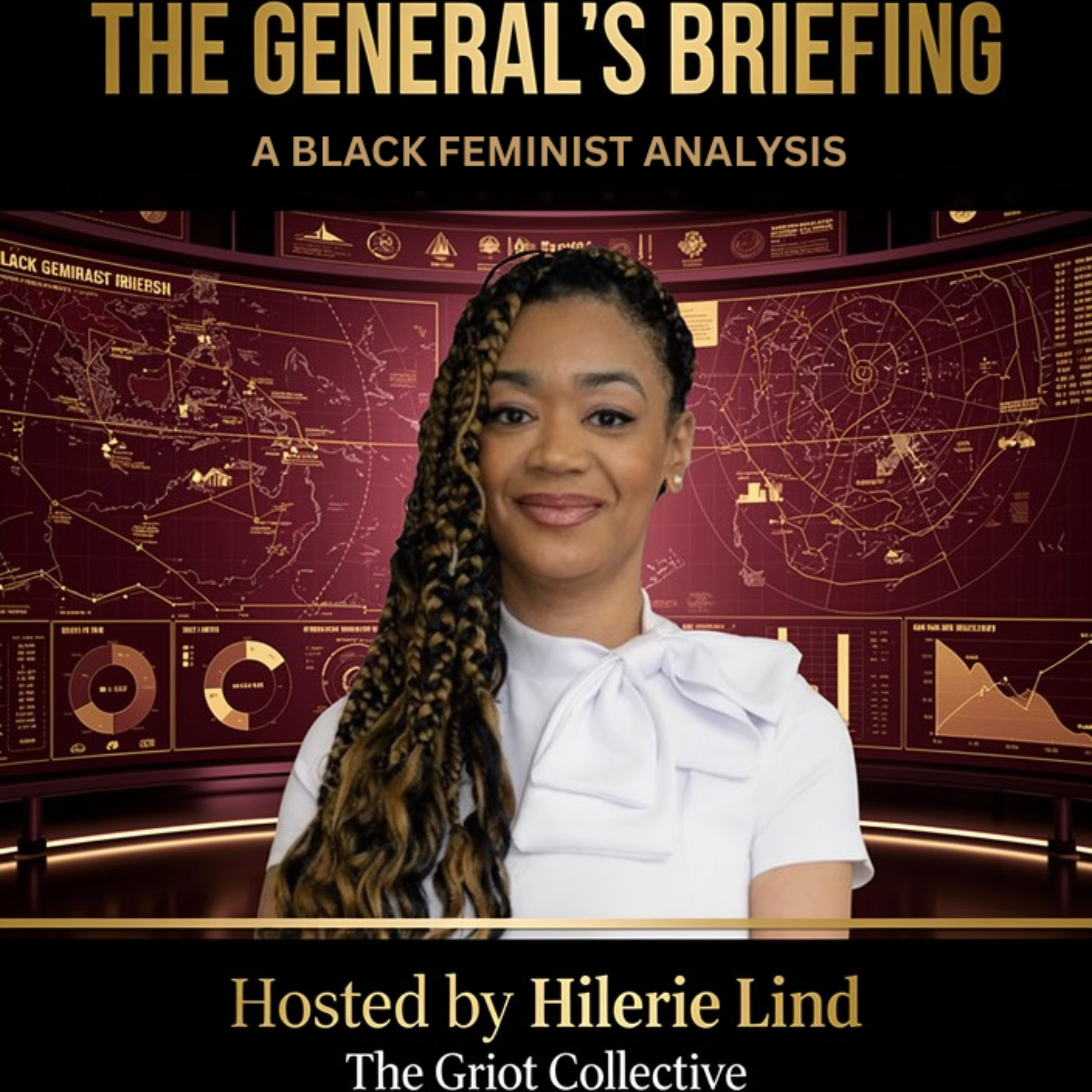
The General's Briefing
by Hilerie Lind
A podcast where Black feminist analysis meets cultural commentary. This is your command center for understanding the systems that shape Black life, Black love, and Black survival. Each episode is a strategic briefing on the forces we're up against and the tools we need to fight back. From the "Sacrificial Bargain" that polices Black women's bodies and choices, to the "Faustian Bargain" that questions Black men's authenticity, we're breaking down the vernacular theories that govern how we judge success, navigate trauma, and protect—or abandon—each other.
-
35
The Antidote: Why Black Self-Love Is the Refusal of the Sacrificial Bargain
On May 4, 2026, the Supreme Court issued an emergency ruling that devastated Black political power across the South. The Court struck down Louisiana's congressional map, eliminating two majority-Black districts, and gutted Section 2 of the Voting Rights Act. Early voting had already begun. Black voters had already cast their ballots. And the state suspended the election.This is not just a legal decision. This is an attack on Black people. This is proof that everything this country is doing is anti-Black.In this special teaching episode, I connect the Supreme Court decision to the 400-year project to erase Black people from this country. I teach you about the Doll Test, "Good Hair," and colorism, the systematic indoctrination that teaches Black children to hate themselves by age 3. I tell you my personal story: how my mother put Black history books in my hands before I could read, how I wrote my first book in second grade about a Black girl being kidnapped, how I loved us before I even knew what it meant.And I address the accusation head-on: "If we say 'White Love,' it's bad. Why is 'Black Love' okay?"Here's my answer: Black love is not the opposite of white hate. Black love is the antidote to white supremacy.For 400 years, Black people have been systematically taught to hate ourselves. We have been taught that everything white is good, beautiful, intelligent, and worthy, and everything Black is bad, ugly, ignorant, and disposable. We have been taught that white skin is beautiful and Black skin is ugly. We have been taught that straight hair is "good hair" and kinky hair is "bad hair." We have been taught that our history doesn't matter, our culture is inferior, and our lives are disposable.This is not an accident. This is a deliberate system of indoctrination designed to maintain white supremacy.
-
34
The Loneliness Epidemic: Why Black Women Are Building Empires and Going to Bed Alone (My Eyes Are Green)
Yesterday, I recorded three episodes. And I was sitting there wanting to record a fourth one. Not because I had something urgent to say. But because I didn't want to feel what I was feeling.I was sad as fuck. I was lonely. And I didn't know how to sit with it.So I did what I always do: I worked. I recorded episodes. I planned events. I wrote papers. I built businesses. I stayed busy so I didn't have to feel the pain.And then I stopped. I took my anxiety medication. I went to bed. And this morning, I woke up ready to tell the truth.The truth is: I live in Atlanta. The Black Mecca. The city where Black people thrive, where we connect, where we build. I'm surrounded by Black excellence. I'm building professional relationships. I'm launching 5 businesses. I'm a PhD candidate at Clark Atlanta University. I'm running a gubernatorial campaign.Success is coming to me.And yet, every night when I go to bed, I am profoundly lonely.I'm a single mother of two autistic boys. I don't have a partner. I don't have a community that holds me. I watch other people have successful relationships, and my heart hurts. My eyes are green with envy, longing, and grief.And I thought: Maybe it's just me. Maybe I'm doing something wrong. Maybe I don't know how to date right. Maybe no one wants me.But then I looked at the data. And I realized: This is not just me. This is a structural pattern. This is the loneliness epidemic. And it's killing Black women.In this episode, I show you the evidence:Only 33.3% of Black women are married (compared to 52.3% of white women)50% of Black women have never been married (compared to 28% of white women)64% of Black children are being raised by single mothers22% of Black women report chronic loneliness (the highest rate among all racial groups)Black women are 3 times more likely to die from pregnancy-related causes than white womenOnly 10.3% of Black women seek mental health services (compared to 21.5% of white women)I connect this data to the Sacrificial Bargain—the expectation that Black women will sacrifice our bodies, our time, our emotional labor, our peace for the sake of the community. I analyze the Crooked Room—the disorienting environment that punishes Black women who refuse to shrink. And I examine the collapse of the collective—how Gen X and Millennials broke the silence about abuse but lost the communal support that previous generations had.I also explore the hip-hop connection: while Black women are building empires and going to bed alone, Black men in hip-hop are celebrated for having 10-14 kids with different women. Nick Cannon. Future. NBA YoungBoy. These men are called "legends" for "spreading their seed"—while Black women are expected to raise these children alone and be "strong single mothers."And I examine the political stakes: if a Republican wins the Georgia gubernatorial race, it will devastate Black families—especially Black single mothers. Medicaid expansion will be blocked. Abortion access will be further restricted. Public education funding will be cut. This is why Derrick Jackson's campaign matters. This is why I'm fighting so hard.
-
33
Follow the Money: The Systematic Erasure of Black Political Power in the Georgia Gubernatorial Primary
I am Hilerie Lind. And I am unbought and unbossed.In this episode, I teach you about the Crooked Room, the disorienting psychological and structural space that Black women navigate, where the norms themselves are tilted against us. But the Crooked Room is not just psychological. The Crooked Room is political. The Crooked Room is the Georgia Democratic Primary.Metro Atlanta is the "Black Mecca", the city with the largest Black middle class in America, the city where Black culture is produced and exported to the world. But Georgia hasn't had a Democratic governor since 1999. And in the 2026 gubernatorial primary, the most qualified Black candidate is being systematically erased.
-
32
Black Cotton: Live Free or Die
A few weeks ago, Kip Carr called me "the Harriet Tubman of this century." And when he said it, I didn't know what to do with it. I didn't know if I was worthy of that title. I didn't know if I could live up to it.But then he said something else. He said:"The way that some of these Black people fetch and step to Mr. Charlie, Harriet would've shot them in the back of the head."And I realized: He's not just giving me a compliment. He's giving me a calling.In this episode, I teach you about the Harriet Tubman they didn't teach you about in school. Not the gentle, kind woman who led people to freedom with a smile and a prayer. But Harriet Tubman the revolutionary. Harriet Tubman the disruptor. Harriet Tubman the woman with a gun who was willing to kill to protect the freedom struggle.I take you through the lineage of Black revolutionaries who refused to betray the freedom struggle—even when it cost them everything:Harriet Tubman (1822-1913): The woman who went back to the South 13 times, carried a gun, and told the people she was leading: "You'll be free or die. Dead folks tell no tales. You go on or die." She was willing to shoot people who wanted to turn back—because their betrayal would cost lives.Malcolm X (1925-1965): The man who discovered the Nation of Islam's corruption and was faced with a choice: stay silent or speak the truth. He chose the truth. He said: "I'm for truth, no matter who tells it. I'm for justice, no matter who it's for or against." And on February 21, 1965, the Nation of Islam killed him for it.Fred Hampton (1948-1969): The 21-year-old chairman of the Illinois Black Panther Party who was building a multiracial, working-class revolution. The FBI tried to co-opt him. He refused. He said: "You can kill a revolutionary, but you can't kill the revolution." And on December 4, 1969, the FBI assassinated him in his sleep.Assata Shakur (1947-present): The revolutionary who was convicted of a crime she didn't commit and sentenced to life in prison. She was faced with a choice: accept captivity or escape and live in exile. She chose freedom. She escaped in 1979 and has lived in Cuba for over 40 years. She said: "It is our duty to fight for our freedom. It is our duty to win. We must love each other and support each other. We have nothing to lose but our chains."The pattern is clear: Black people who refuse to betray the freedom struggle are killed, exiled, or erased. But they leave us a blueprint.
-
31
THE HARRIET TUBMAN OF THIS CENTURY
In this episode, I connect my personal life to Georgia politics to show you how the Sacrificial Bargain operates everywhere, in our relationships, in our political campaigns, in our communities. I tell you about the man I was dating since February, the professional opportunity I gave him, and how he punished me when I operated in integrity. And then I show you how that same pattern is playing out in the Georgia gubernatorial primary, where Black women are volunteering for Geoff Duncan, a man who was a Republican Lieutenant Governor from 2019-2023, who called himself "100% pro-life," who called Planned Parenthood a "malicious organization," and who helped pass Georgia's six-week abortion ban, one of the harshest in the nation.According to Emily's List, Geoff Duncan "played a key role in passing Georgia's six-week abortion ban" and "actively killed Democrat-proposed amendments that would have removed so-called fetal personhood and tax benefits for fetuses from the bill, before empowering Republicans to approve it." This ban has already cost lives. Black women are 3-4 times more likely to die from pregnancy-related complications than white women. And this ban disproportionately harms Black women.And now Geoff Duncan is running as a Democrat. And Black women are volunteering for him.Meanwhile, Derrick Jackson, a 22-year Navy veteran, a 10-year state representative, a former CEO, and a man who speaks to Black maternal health all the time, is being ignored. People are saying he's "not palatable" or "too aggressive." This is the Faustian Bargain operating against Derrick Jackson. He's being punished for being "too Black," "too honest," "too uncompromising.
-
30
Which Voice Will You Believe? Congresswoman Beatty vs. Stephen A. Smith
On Sunday, April 26, 2026, I executed one of the most successful political events of my career. Over 200 people attended. The execution was flawless. And Congresswoman Joyce Beatty, a senior member of Congress, a former in the Congressional Black Caucus, Associate chair of the DNC, a woman I worked for 20 years ago, stood at that podium and said:"Twenty years ago, I gave her a job when she walked in my office because she was brilliant then, she was aggressive then, she was smart then. And look at her tonight chairing this event. I love you. I'm proud of you, and may God continue to bless you."Brilliant. Aggressive. Smart. I love you. I'm proud of you.But less than 12 hours later, the man I've been seeing since February berated me outside a bar. He threatened me with physical violence. He told me: "As smart as you are, I don't understand how you can act stupid. I need to listen to him when he tells me to do something. Leave before I do something to you."And the next morning, I woke up and saw that Megan Thee Stallion had announced that Klay Thompson cheated on her. And within 24 hours, Stephen A. Smith went on his podcast and said: "You want a man dedicated to you? Be worthy of being dedicated to."This is the same story. This is the same pattern. This is the Sacrificial Bargain in real time.
-
29
THE PARADOX: AL SHARPTON, EAZY-E, AND THE WHITE HOUSE
In 1991, Eric "Eazy-E" Wright—the founder of N.W.A., the man who rapped "Fuck tha Police", attended a Republican fundraiser at the White House and met President George H.W. Bush.Most people think it was a publicity stunt. But here's what they don't know: Eazy-E was invited because he donated $2,490 to the Republican Party. He didn't challenge the system. He didn't speak truth to power. He bought his way into the room.This is the Faustian Bargain in its purest form: Money buys access. And access erases politics.But here's the paradox: The same year Eazy-E was shaking hands with President Bush, he was also rapping lyrics that degraded Black women. The same year he was being invited to the White House, he was also being attacked by C. Delores Tucker for his misogyny.In this episode, I break down three case studies that reveal the paradox of hip-hop activism and misogynoir:Eazy-E and the White House (1991): How the man who rapped "Fuck tha Police" became a "big Bush fan" and traded his radical politics for proximity to power.Al Sharpton and the Congressional Black Caucus (1994): How Al Sharpton defended hip-hop's right to critique systemic racism but stayed silent on hip-hop's degradation of Black women—deferring Black women's dignity in favor of hip-hop's political legitimacy.Jay-Z and the Jena 6 (2006-2007): How Jay-Z invoked the Jena 6 case to justify his continued use of the word "bitch," declaring: "When Jena Six don't exist, tell him that's when I'll stop saying 'bitch'... BITCH!"I connect these case studies to my dissertation framework—the Faustian Bargain (where Black men trade authenticity for success), the Sacrificial Bargain (where Black women are expected to support Black men's liberation while absorbing the harm of their misogynoir), and the Crooked Room (where hip-hop artists stand upright in their critique of white supremacy but lean in their treatment of Black women).And I ask the question: Can we hold both truths at once? Can we celebrate hip-hop as a force for social change while also holding it accountable for the harm it has caused to Black women?The answer is yes. We can. We must. But holding both truths does NOT mean accepting the Sacrificial Bargain. It means refusing it.This episode is a continuation from "C. Delores Tucker and the Generational Divide." It's the teaching moment about the paradox. It's where we hold both truths at once. It's where we refuse the Sacrificial Bargain.
-
28
C. Delores Tucker and the Generational Divide: Was She Wrong, or Was She Just Asking the Question Nobody Wanted to Answer?
In 1996, Tupac Shakur released a song called "How Do U Want It." It was a hit. It went to #1 on the Billboard Hot 100. It was played on every radio station, in every club, at every party.But buried in the second verse was a line that most people didn't catch. Tupac rapped:"Delores Tucker, you's a motherfucker / Instead of trying to help a nigga, you destroy a brother"C. Delores Tucker was a 68-year-old civil rights activist. She had marched with Dr. Martin Luther King Jr. She had fought for voting rights. She had served as Pennsylvania's Secretary of State—the first Black woman to hold that position in any state.And Tupac Shakur, one of the most influential artists of his generation, called her a motherfucker on a #1 hit record.And the hip-hop community cheered.Eminem called her out. Snoop Dogg dismissed her. The entire hip-hop community turned on her. She became a punchline. She became the enemy.But here's the question: Was C. Delores Tucker wrong?Or was she just asking the question that nobody wanted to answer: What is the cost of free speech when Black women are the ones paying the price?In this episode, I take you deep into the life and legacy of C. Delores Tucker, the civil rights icon who launched a crusade against gangsta rap in the 1990s and was vilified for it.
-
27
Pop That Coochie: Uncle Luke, 2 Live Crew, and the Supreme Court Battle That Changed Hip-Hop Forever
In 1990, a federal judge in Florida declared an album legally obscene for the first time in U.S. history. The album was As Nasty As They Wanna Be by 2 Live Crew. Record store owners were arrested for selling it. Members of the group were arrested for performing it live. The Broward County Sheriff's Office raided stores and confiscated copies.And Luther Campbell, better known as Uncle Luke—took the case all the way to the Supreme Court. And he won.In 1992, the 11th Circuit Court of Appeals ruled that As Nasty As They Wanna Be was protected by the First Amendment. This was a landmark victory for free speech. This was a victory for hip-hop. Uncle Luke had won TWO Supreme Court cases—one for obscenity and one for copyright parody, making him one of the most important figures in hip-hop legal history.But here's the question nobody asked: What was the cost of that victory? And who paid the price?In this episode, I take you deep into the 1990s, the decade when hip-hop exploded into the mainstream, when the culture went to war for free speech, and when Black women became the collateral damage. I break down:The historical context: The crack era, mass incarceration, the Crime Bill, and how hip-hop became the voice of resistanceThe Supreme Court cases: Luke Records, Inc. v. Navarro (1992) and Campbell v. Acuff-Rose Music, Inc. (1994)—the landmark rulings that protected hip-hop under the First AmendmentUncle Luke's story: Using his memoir The Book of Luke: My Fight for Truth, Justice, and Liberty City, I explain who Uncle Luke was, why he fought, and what he wonThe Faustian Bargain: How Uncle Luke traded the dignity of Black women for the right to free speechThe Sacrificial Bargain: How Black women were expected to absorb the harm, stay silent, and pay the price for Black men's freedomThis is not just a music history lesson. This is a reckoning. This is the beginning of a multi-episode series where I'm asking the question: Can we celebrate hip-hop's victories while also holding the culture accountable for the harm it has caused to Black women?This is the first episode in "The General's Video Vault" series, a deep dive into the 1990s hip-hop wars, the Supreme Court battles, and the women who were left behind.Hosted by Hilerie Lind, "The General" - PhD candidate at Clark Atlanta University, program manager, mother, political organizer, hip-hop historian, and cultural critic.Produced by The Griot Collective.
-
26
Cranes in the Sky: Why Black Women Fill Their Plates to Avoid Feeling the Pain of Loneliness
I woke up this morning feeling blah. I looked at my phone. And it was dry. Again. And it hurt.Then I thought about Monty—my first love, the man who introduced me to hip-hop. And I felt 12 years old again.Then I started yearning for love. And the anxiety crept in.So I took a nap. Because that's what I do when the pain gets too close.So I started sending out emails. Taking care of business. Filling my plate.Full time job. PhD. Campaign manager. Special Events Chair. VP of Programs. Podcast. Bookstore. Single mother. IEP battles. Medical advocacy. Blue Ballot event.I am doing the work of TEN PEOPLE.And then the sadness crept in again.And I said to myself: "I really need to go to that boxing trainer."And then I laughed at myself. Because I realized: The reason my plate is full is because of loneliness. I pile it all on to take up any space that my loneliness would allow that feeling to creep in.I fill my life up to not feel pain.And that's when I thought about Solange. I thought about "Cranes in the Sky." I thought about how she sings:"I tried to drink it away / I tried to dance it away / I tried to work it away / I tried to sex it away"And I realized: I've been trying to WORK it away. I've been filling my plate to not feel the pain of loneliness.In this episode, I break down Solange's "Cranes in the Sky" and connect it to the Sacrificial Bargain, the expectation that Black women must sacrifice their bodies, their time, their emotional labor, their peace for the community. I analyze Solange as an artist who has consistently refused the Sacrificial Bargain through verifiable career choices: leaving Columbia Records to maintain creative control, founding Saint Records to support Black artists, releasing A Seat at the Table as a refusal of respectability politics, and canceling performances to honor her own need for rest and healing.
-
25
BROWN SUGAR, PART 2: A CONVERSATION WITH MONTY
Thirty years ago, I was 11 years old when I saw a boy on a talent show tape, rapping on stage. I was immediately captured. A few weeks later, he rode down my street on a moped, stopped, and we talked. And that was it. That was the beginning of everything.His name was Monty. And he was my first love.But Monty wasn't just my first romantic love. He was the boy who introduced me to the grit and the hood of hip-hop. He was the boy who showed me that the poetry I loved in Maya Angelou and Langston Hughes could also live in the streets. He was the boy who made me fall in love with hip-hop—and with myself as a writer.This is my Brown Sugar moment.A few weeks ago, I released an episode called "Brown Sugar: When I Fell in Love with Hip-Hop (And the Boy Who Showed Me the Hood)." And in that episode, I told the story of Monty—the origin of my calling, the man who shaped my identity as a writer, the man who, 30 years later, is still one of the most important people in my life.And after that episode aired, something incredible happened. He called me. And he said: "I want to be on the podcast."So today, I'm sitting down with Monty—my first love, my introduction to hip-hop, and the man who is the origin of everything I do—for a live conversation about our childhood, our 30-year friendship, and what it means to be someone's "first love" in multiple ways—not just romantically, but musically and intellectually.In this episode, we talk about:The talent show tape (where I first saw Monty rapping)The day he rode down the street on a moped and we talked for the first timeWhy it took him two years to be in a relationship with me (and what he was thinking during that time)His hip-hop origin story (how he fell in love with the culture)The most influential artists to the hood (his list vs. my list—and what that says about how we experienced hip-hop differently)What it means to be connected for 30 years (and what it means to be someone's "first love" in multiple ways)The No-Bargain (the relationships that don't require sacrifice, that give instead of take)This is not just a conversation about nostalgia. This is a conversation about the origin of my calling. Monty introduced me to hip-hop. He shaped my identity as a writer. He is the reason I became a scholar, a cultural critic, a hip-hop historian. And 30 years later, we're still connected. We're still "my first love." We're still part of each other's story.And that's the gift.This is what the No-Bargain looks like. This is what it looks like when a relationship doesn't require you to sacrifice your authenticity, your body, your peace, or your calling. This is what it looks like when a relationship gives instead of takes.Monty and I didn't end up together romantically. But 30 years later, we're still connected. And this conversation is the full-circle moment.
-
24
How's It Going Down? The Hip-Hop Songs That Taught Me to Accept Crumbs—And the Women Who Are Teaching Me to Refuse
It's Sunday morning, April 19, 2026. I'm 41 years old, four months shy of my 42nd birthday. And I just woke up with a realization: I deserve to be valued. Not simply treated as pussy. Not simply treated as "high value pussy that is supposed to be unattainable." But valued as a whole human being.And I'm asking myself: How did I get here? How did I learn to accept crumbs? How did I learn that I'm not worthy of love?The answer came to me, clear as day: Hip-hop taught me. At 11 years old.In this episode, I break down four songs by male artists—DMX's "How's It Going Down," Jay-Z's "Money, Cash, Hoes," Ja Rule's "Down Ass Bitch," and Drag-On & Juvenile's "Down Bottom"—that taught me the Sacrificial Bargain when I was 11, 12, 13, 14 years old. These songs didn't just entertain me. They socialized me. They taught me what love was supposed to look like. They taught me what I was supposed to sacrifice to be chosen.And then I analyze three songs by female artists—Aaliyah's "Are You That Somebody?" and Tink's "Treat Me Like Somebody" and "GANG"—that are teaching me, and maybe teaching you, the refusal. Aaliyah asked the question I was too scared to ask: "Are you that somebody?" Tink is demanding what I've been too scared to demand: "Treat me like somebody." But even Tink's newest song, "GANG" (February 2026), shows how the Sacrificial Bargain has evolved—now we're expected to be "gang" about men, to ride for them like soldiers, to hold them down like we're in the streets.I connect all seven songs to my dissertation framework—the controlling images (the Jezebel, the Mammy-Savior), the Crooked Room, and the Emotional Sacrificial Bargain. I show how these songs taught me that women are "hoes," that love means lying for him, dying for him, killing for him, comforting him—and that if I ask a man "Are you with me or what?", he's going to say "We gon' always be best of friends," but never commitment.And I'm 41 years old, four months shy of 42, and I just woke up realizing: I've been living these lyrics my entire life. I've been performing the "down ass bitch." I've been "gang about" men who aren't gang about me. I've been accepting crumbs.And I'm done.This is not about tearing down hip-hop. Hip-hop is the soundtrack to my life. These artists are my favorites. But love doesn't mean we can't ask questions. Love doesn't mean we can't examine what we've been taught. Love doesn't mean we can't reckon with the ways the culture we love has also shaped the ways we accept harm.And maybe—just maybe—this is not just my story. Maybe this is your story too. Maybe you're listening to this right now and you're having the same epiphany I had this morning. Maybe you're realizing: I've been accepting crumbs my entire life. And I'm done.This is the refusal. This is the reckoning. This is the moment we choose ourselves.
-
23
Sharks in the Water: Why Niggas Never Leave (And Why They Always Come Back When You're Vulnerable)
I always tell my friends, "Don't ever sweat a man when he disappears. Because niggas NEVER leave. Sooner or later, he will be back around."And I was right. They always come back. Always.One ex keeps calling. We were on-and-off for six years. And even though I've moved on, even though I've told him I'm done, he keeps calling.Another guy is hitting me up. I met him two years ago. We haven't spoken in over a year. But here he is, popping up in my DMs, asking how I'm doing, telling me he's been thinking about me.And then there's my ex, who texted me at 4 AM. "I miss you!" he said. I blocked him immediately. But the fact that he still has my number? The fact that he thought it was okay to text me at 4 AM after two years? That's the audacity.And then there's the man I've been seeing since February. The one I started to like. The one who said he would come over after work. The one who never showed up. No call. No text. Nothing.But here's what I know: He will be back. Just like the six-year ex. Just like the entertainment industry guy. Just like the one who texted me at 4 AM. They always come back.In this episode, I break down the Triple Sacrificial Bargain—sexual, professional, and emotional. I tell you about the man I've been seeing since February and how the moment I admitted I liked him, everything changed. He reduced me to a sexual service provider ("I need a real dick suck in my life"). He overslept on the day we were supposed to go to the museum together (even though I hired him to do security for my event next weekend). And he said he would come over after work—and never showed up. No call. No text. Nothing.This is the Sacrificial Bargain in action:Sexual Sacrificial Bargain: Black women are allowed to give our bodies, but not our hearts. We're allowed to provide sexual labor, but not ask for love.Professional Sacrificial Bargain: Black women are allowed to give opportunities, but not ask for reliability. We're expected to put people on, but when OUR name is on the line, they don't show up with 100%.Emotional Sacrificial Bargain: Black women are allowed to be vulnerable, but not ask for commitment. We're allowed to have the conversation, but not expect follow-through.I connect this to Lil' Kim's "Magic Stick" (2003) and analyze how the song is about sexual power and transactional relationships. I ask: Is this power? Or is this the Sacrificial Bargain? I show how Lil' Kim is claiming sexual power ("I got the magic clit"), but she's also participating in a transactional relationship where sex is currency and bodies are commodities. And when Black women ask for more—when we say "I like you" or "I want commitment"—we're punished for it.I also teach you about the controlling images, the Jezebel (the hypersexual Black woman who is only allowed to provide sex, not ask for love), the Mammy-Savior (the self-sacrificing Black woman who puts people on but is never reciprocated), and the Sapphire (the angry Black woman who asks for commitment and is told she's "taking it too seriously").And I explain the pattern: Why do the exes always come back? And why do they always come back when I'm vulnerable, when I'm open, when I'm ready to be chosen?
-
22
Godmother's Price, How Zora Neale Hurston Taught Me About the Sacrificial Bargain
A few weeks ago, I received an email that changed everything. The subject line read: "Oxford Handbook of the Harlem Renaissance - Chapter Acceptance."I had to read it three times before I believed it. My chapter, "Godmother's Price: Zora Neale Hurston and the Sacrificial Bargain of Patronage"—had been accepted to the Oxford Handbook of the Harlem Renaissance, published by Oxford University Press.Out of an overwhelming number of submissions, my work was selected. I am now a published Oxford scholar. And I'm in my first year of my PhD program at Clark Atlanta University.But this episode is not about me bragging. This episode is about what my chapter is actually about. Because it's not just about Zora Neale Hurston. It's about every Black woman who has ever had to make a Sacrificial Bargain to achieve success.In this episode, I teach you about the Sacrificial Bargain, the framework that grounds my entire dissertation. I explain how it's different from the Faustian Bargain (the deal Black men make when they achieve mainstream success). While Black men are critiqued for trading their authenticity and community ties for wealth and power, Black women are critiqued for leveraging our bodies, sexuality, and emotional labor for access to resources and recognition.
-
21
From 'Song Cry' to '4:44': The Maturation Gap and Why Black Women Are Expected to Mature Faster
I want to tell you about three songs that changed the way I understand love, maturation, and the impossible standards Black women are held to.These three songs span 16 years of Jay-Z's career. And together, they tell the complete story of the maturation gap between Black men and Black women:"Song Cry" (The Blueprint, 2001) - When he wasn't ready"Lost One" (Kingdom Come, 2006) - When she wasn't ready"4:44" (4:44, 2017) - When he finally understandsIn "Song Cry," Jay-Z mourns a woman he lost because he was too focused on his career, too emotionally unavailable, too busy "doing his dirt." He's expressing regret—but he's already moved on. He got to mature and still be chosen.Five years later, in "Lost One," the roles are reversed. Jay-Z is ready to settle down, but the woman he's dating (widely believed to be Beyoncé) is flourishing in her career and isn't ready. He says: "She loves her work more than she does me." But when he did the exact same thing, he was celebrated. When she does it, it's a problem.Eleven years later, in "4:44," Jay-Z finally admits the truth: "You matured faster than me, I wasn't ready." Even though he's much older than Beyoncé, she matured faster. She was ready for commitment, for partnership, for building a life together. And he wasn't. But by then, he's already a billionaire married to the most successful woman in the world. He got to mature on his own timeline and still be chosen.Black women don't get that luxury.In this episode, I break down Jay-Z's three-album arc and connect it to the Sacrificial Bargain framework from my dissertation. I show how Black men get to prioritize their careers, be emotionally unavailable, and "do their dirt"—and when they're ready, they still get chosen. But when Black women prioritize our careers, when we say "I'm not ready," when we mature faster than the men around us—we're punished for it. We're called "too independent," "too focused on work," "intimidating."I also share my own story, without naming names, of navigating relationships with men who weren't ready, and then being judged when I wasn't ready. I talk about being 41 years old, accomplished in every area of my life, and asking myself: Why am I succeeding everywhere except love?This is not about complaining. This is not about blaming Black men. This is about naming a pattern that has been operating for generations. This is about asking: Why is it okay for Black men to mature on their own timeline, but Black women are expected to mature faster? And when we do, why are we punished for it?This is the maturation gap. This is the Sacrificial Bargain. And this is why Black women are the most educated demographic in the U.S., and the most alone
-
20
No Scrubs, But MAGA? How Chilli from TLC Betrayed the Soundtrack of My Childhood
I was in the fourth grade when I bought my first TLC album. Ooooooohhh... On the TLC Tip. I had the tape. I played it until it broke. I memorized every word. I studied the album cover. I wanted to be Left Eye.By the time CrazySexyCool came out, I was in middle school. And TLC was everything. Me and my friends had dance routines to "Waterfalls" and "Red Light Special." I had my haircut like T-Boz in the 8th grade. Girls dressed up as TLC for Halloween.TLC was not just music to me. TLC was identity formation. TLC was Black girlhood. TLC was the soundtrack to my coming of age.And now, in 2026, I'm finding out that Chilli—one-third of TLC—has been donating to Donald Trump's presidential campaign. She's been liking posts from right-wing commentators. She's been aligning herself with MAGA ideology for years.And I feel betrayed.In this episode, I break down the concrete facts: Chilli made multiple recurring donations to Trump's 2024 campaign, totaling over $1,000. She reshared a conspiracy theory video about Michelle Obama. She's been liking posts from Black conservative Brandon Tatum, including one that argues there is a "pro-trans agenda in America." And when she got caught, she claimed it was all a "mistake"—that she "didn't read the fine print."But the receipts tell a different story. This is not a mistake. This is a pattern.
-
19
Everyone Has a Price: The Heartbreak of Realizing Most People Will Sell Their Souls
I woke up this morning exhausted. Not the kind of tired that sleep can fix. But the kind of tired that comes from disappointment. The kind of tired that comes from realizing something you didn't want to believe.I woke up this morning and I realized: Most people have a price.I've been doing community work my entire adult life. Educating my people. Putting us in spaces we've never been. Organizing events. Building coalitions. Fighting for justice. And I thought—I really thought—that the people I was working with shared my values. I thought we all had a little good in us. I thought we all had love for humanity at the end of the day. For people. For us.But I've been living life with rose-colored lenses. Because what I'm seeing now is that most people have self-served missions. And they'll sell their souls for anything. A title. A position. Proximity to power. A seat at the table.And I am heartbroken.In this episode, I break down the Faustian Bargain within the movement—what happens when the people who claim to be "for the people" sell you out. I connect my experience to Malcolm X's realization that the Nation of Islam was not what he thought it was, and to the story of William O'Neal in Judas and the Black Messiah, the FBI informant who betrayed Fred Hampton from the inside.
-
18
From 'Girls, Girls, Girls' to 'Song Cry': How Hip-Hop Taught Me About Love
I became aware of hip-hop in the late 1990s. And the artist who shaped my understanding of love was Jay-Z.I was a teenager when The Blueprint came out in 2001. Jay-Z taught me what love was supposed to look like. In "A Girl's Best Friend," he rapped about diamonds and material love. In "Girls, Girls, Girls," he cataloged all the different types of women he'd been with—and I wanted to be one of those girls. I wanted to be chosen. I wanted to be seen. I wanted to be worthy.In this episode, I break down the Faustian Bargain (Jay-Z's evolution from "hustle" to "business") and the Sacrificial Bargain (Black women are expected to sacrifice our standards, our boundaries, our self-respect—to be chosen). I use my Voyant analysis from my dissertation research to show the quantifiable shift in Jay-Z's language across The Blueprint trilogy—from "hustle" and "streets" to "business" and "legacy." I connect this to my own maturation alongside his music, and I ask the question I've been asking myself for 20 years: Why don't I get picked?This is about hip-hop culture as pedagogy. This is about how Jay-Z taught me what love was supposed to look like—and how that lesson left me chasing men who don't choose me. This is about the double standard: Black men get to mature and still be chosen. Black women mature alone.
-
17
Brown Sugar: When I Fell in Love with Hip-Hop
In this bonus episode, I tell the story of when I fell in love with hip-hop. I was 11 years old when I saw Monty on a talent show tape, rapping on stage. I was immediately captured. A few weeks later, he rode down my street on a moped, stopped, and we talked. And that was it. That was the beginning of everything.I talk about how I started writing rap songs in a composition book because I was in love with him. I talk about how my love for Monty and my love for hip-hop grew together, inseparably. I talk about how it took him two years to be in a relationship with me, but when we finally got together, he took me to prom and left a lasting impact on my life.I connect this story to the film Brown Sugar (2002), where Sanaa Lathan's character Sidney falls in love with hip-hop at the exact same moment she falls in love with Dre (Taye Diggs). My story with Monty is the exact same structure. I fell in love with hip-hop at the exact same moment I fell in love with him. And those two loves became inseparable.But I also explore the deeper questions: Why did I want love so desperately at 11 years old? Why from him? Where did my lack of boundaries begin? And why was I so drawn to this smart, talented boy from the hood who was "definitely smarter than me back then"?This episode is playful, loving, and full of admiration for Black men—even as I hold them accountable. This is about my innocence, my need for love, and the origin of who I am. This is about the moment I inhaled hip-hop, love, and my identity as a writer. This is the origin story of The General.And thirty years later, I can look back at that moment and exhale—not because I'm finally free of the pain, but because I'm finally able to see the gift. Monty didn't break my heart. He opened it. And that opening is what made everything else possible.
-
16
Why Black Culture Shaped Me and Why I Refuse to Shrink
An hour ago, someone sent me a message on Instagram. They said, "That 8Ball & MJG song 'Don't Make' reminds me of you."And they're right. If you know that song, you know exactly what they meant. It's the song where 8Ball is basically saying, "Don't make me have to show you who I am. Don't make me have to remind you that I'm not the one to play with."That's me. That's The General.But I'm also the woman who was the first junior usher in my church. I'm the woman who sang in the choir. I'm the woman who loves God. I'm the woman who has four degrees and five certificates. I'm the woman who ran for Mayor of Brookhaven and made a campaign diss track to Jay-Z's "Ether" beat.I am ALL of these things. The church girl and the hip-hop head. The scholar and the street organizer. The woman who quotes Jadakiss and the woman who quotes scripture. The woman they call "The Ghetto Senator."I am everything they say Black people is. And I'm proud of that. I refuse to shrink. I refuse to be less Black, less loud, less brilliant, less ME to make other people comfortable.But here's the question that's been haunting me: Why am I ALL of these things and still by myself?In this bonus episode, I tell you why Black culture matters to me—the music (Jay-Z, Too $hort, Jadakiss), the movies (Boyz n the Hood, Waiting to Exhale, The Five Heartbeats), the church (the choir, the junior usher board, the discipline and service). I explain how Black popular culture shaped me into who I am and taught me that I contain multitudes—that I can be the church girl and the hip-hop head, the scholar and the street-smart organizer, the spiritual and the sexual.I talk about why people call me "The Ghetto Senator." I talk about making a mayoral campaign diss track to "Ether." I talk about getting compared to 8Ball & MJG on Instagram. I talk about being the first in my family to graduate from college, about working on my fourth degree, about having five other certificates, about running five businesses, about being a PhD candidate, a federal program manager, a campaign manager, a community organizer, a mother of two autistic boys.And I ask the question: Why am I ALL of these things and still by myself? Why do I fall in love with the wrong people—friends and romantic partners—over and over again? Why do I lack the boundaries to keep people who don't deserve me out of my life?This is about the Sacrificial Bargain. This is about being taught that Black women are supposed to sacrifice our boundaries, our peace, our joy for people who don't deserve us. And this is about learning that boundaries are not selfish—boundaries are survival.This is a love letter to Black culture. This is a lament about loneliness. This is a declaration of refusal. I am ALL of these things. And I refuse to shrink.
-
15
The Sacrificial Bargain of Success: Why Black Women Are the Most Educated and the Most Alone
I have 5 businesses. I'm a PhD candidate. I'm a federal program manager. I'm a campaign manager. I'm a community organizer. I'm a mother of two autistic boys. I'm suing the school district and my apartment complex. And by every metric, I'm winning.But I'm also exhausted. And I'm lonely. And I just realized: I haven't been in a relationship longer than 9 months in 20 years.In 2024, Eboni K. Williams—attorney, media personality, former Real Housewife—announced she was having a baby at 40. Through IVF. Intentionally. As a single mother by choice. And the Black community tried to destroy her. They called her selfish. They said her child would end up in jail. They blamed her for the "destruction of the Black family."But where was this energy for Nick Cannon? For Future? For all the Black men who have multiple children with multiple women and don't take care of any of them? Nowhere. Because the Sacrificial Bargain only applies to Black women.In this episode, I break down the Sacrificial Bargain through the lens of Black women's success and the loneliness that comes with it. I analyze Eboni K. Williams's story and the vicious backlash she faced for choosing motherhood on her own terms. I share my own story—17 years of relationships that don't last, of pouring myself into work to mask the pain, of asking "Is it me?" and finally realizing: it's not me. It's the Sacrificial Bargain.I examine the statistics: Black women are the most educated demographic in the United States, but we're also the most likely to be raising children alone. We have the highest rates of obesity, hypertension, diabetes, and maternal mortality. We carry the stress. We carry the exhaustion. We carry the loneliness. And our bodies pay the price.I talk about gaining 10 pounds in 2 days from stress, about stopping my anxiety medication, about drinking to numb the pain, about crying out to God because God is the only safe place left. And I ask the question that's been haunting me: Why can't Black women enjoy success with a Black man on par with them?This is about Eboni K. Williams. This is about me. This is about every successful Black woman who has ever asked herself, "When do I get to rest? When do I get to be loved? When do I get to exhale?
-
14
From Savannah to Me: Why We're Still Waiting 30 Years Later
In 1995, Terry McMillan gave us Waiting to Exhale—four Black women waiting for Black men to get it together. Waiting for them to commit. Waiting for them to choose them. Waiting for them to show up. Waiting to exhale.Thirty years later, in 2026, we're STILL waiting.The last time I was in a relationship that lasted longer than 9 months was from August 2005 to January 2009. That's 3.5 years. And since then? 17 years of relationships that don't last. 17 years of asking myself, "Is it me? What am I doing wrong? Why can't I make this work?"And I just realized something: It's not me. It's the Sacrificial Bargain.In this episode, I break down Waiting to Exhale through the lens of the Sacrificial Bargain, analyzing how Savannah, Bernadine, Robin, and Gloria each made impossible sacrifices for Black men who didn't deserve them. I connect their stories to contemporary examples—Cardi B waiting for Offset to change, Remy Ma being dragged while Papoose dates someone half his age—and I tell you my own story of 17 years of waiting, of sacrificing, of asking "Is it me?"I analyze the controlling images—the Jezebel, the Sapphire, the Mammy-Savior—that keep Black women waiting. I examine why Black women are expected to be patient, to forgive, to give second chances, while Black men take their time figuring themselves out. And I declare: I'm done waiting.This is about Waiting to Exhale. This is about Cardi B and Remy Ma. This is about me. This is about every Black woman who has ever asked herself, "Is it me?" And the answer is: No. It's the Sacrificial Bargain. And it's time we refuse it.
-
13
The Sacrificial Bargain: Why I Protected My Rapist for 20 Years
Twenty years ago, I was raped by a man named Jino Vitale. I went to the hospital. I had a rape kit done. I told the man I loved. And nothing happened. No arrest. No justice. No accountability.Not because the system failed me—though it did. But because I left the hospital before the police arrived. Because the man I loved, Chance, didn't believe me. He said I was only saying it happened because I didn't want him to think I cheated. Because I was too afraid to speak his name name.For 20 years, I have carried this silence. I have protected my rapist. I have made the Sacrificial Bargain—absorbing the harm, carrying the trauma, staying silent to protect a Black man who destroyed me. And I've been living my dissertation, analyzing the Sacrificial Bargain in Megan Thee Stallion's story, in Cassie's story, in Beyoncé's story—while refusing to apply that same framework to my own life.But this week, a friend asked me a question I couldn't ignore: "Why have you never called out the person who raped you?" He told me about a friend of his, who recently named the person who sexually abused him as a child. The friend said, "I'm not carrying this anymore. I'm not protecting him anymore. I'm telling my truth."And I realized: it's time.In this episode, I break down the theoretical framework of the Sacrificial Bargain and show you how it operated in my own life. This is not just my story. This is the Sacrificial Bargain in its most devastating form. This is what happens when Black women are expected to absorb harm, stay silent, and protect Black men—even when those men destroy us. And it's time we name it.
-
12
The Perilous Environments—Before the Bargain, There's the Battle
In 1991, John Singleton released Boyz n the Hood with a devastating statistic: "One out of every twenty-one Black American males will be murdered in their lifetime. Most will die at the hands of another Black male." This is the perilous environment—the crooked room Black boys are born into, long before they ever have a chance to make a Faustian Bargain.Before we judge Black men for "selling out," we have to understand the impossible circumstances that shaped their choices. Boyz n the Hood, Menace II Society, Snowfall, and the novels of Walter Dean Myers show us that Black men are navigating a world designed to kill them—making impossible choices just to survive.But here's what nobody wants to talk about: Black women are navigating perilous environments too. And one of the most dangerous environments we navigate is the one where we're expected to support, uplift, and advocate for Black men—while those same Black men try to dominate us, silence us, and dim our light.In this episode, I analyze the perilous environments Black men face through film and literature, connecting Boyz n the Hood, Menace II Society, Snowfall, and Walter Dean Myers to the Faustian Bargain framework. But I also share my own story from this week—battling a Black male vice chair in DeKalb County Democrats who told me I have to "listen to him" because of his title, and becoming campaign manager for Derrick Jackson, a Black gubernatorial candidate who is being dismissed as "not palatable" because he's a truth-teller who doesn't fit the mold.This is about the perilous environments Black men navigate. This is about the perilous environments Black women navigate when we support them. This is about the Faustian Bargain and the Sacrificial Bargain as two sides of the same coin. And it's time we name it.
-
11
Becky with the Good Hair and the Burden of Forgiveness
In 2016, Beyoncé released Lemonade and sang, "He better call Becky with the good hair." The internet exploded. And then, the most predictable thing happened: Beyoncé was blamed. Not Jay-Z. Beyoncé.Fast forward to 2026. Cardi B just had another child while separated from Offset, who cheated on her multiple times, including while she was pregnant with their first child. And the internet is dragging her. Not Offset. Cardi.Remy Ma is dating someone else while still legally married to Papoose, who is publicly dating Claressa Shields, a woman young enough to be his daughter. And the internet is dragging her. Not Papoose. Remy.Jamal Bryant's wife wore a dress to church that showed her shoulders. And the internet lost its mind..This is the Sacrificial Bargain—the expectation that Black women absorb the harm, stay silent, and protect Black men, even when those men are destroying us. And when we refuse, when we speak up, when we live our lives on our own terms, we are punished.In this episode, I break down the Sacrificial Bargain through the lens of Beyoncé's Lemonade, Cardi B and Offset's public relationship, Remy Ma and Papoose's separation, and the policing of Jamal Bryant's wife's body. I analyze how controlling images like the Mammy-Savior Complex and the Jezebel are deployed to punish Black women for refusing to make the sacrifice. I connect these contemporary cases to films like Claudine, What's Love Got to Do With It, and The Color Purple to show that this pattern is not new, it's a legacy of the crooked room Black women have been navigating for generations.This is about Beyoncé. This is about Cardi. This is about Remy. This is about every Black woman who has ever been blamed for a Black man's choices. This is the Sacrificial Bargain. And it's time we name it.
-
10
From Hustle to Business: Jay-Z, Kanye, and the Price of Evolution
In 2001, Jay-Z released The Blueprint and rapped about the hustle—the streets, survival, and staying real. By 2009, on The Blueprint 3, he declared, "I'm not a businessman, I'm a business, man." Same artist. Same series. But a completely different identity.This is the Faustian Bargain in action—the deal Black men make when they achieve mainstream success. They gain wealth, power, and influence, but they're accused of giving up their authenticity, their community ties, and their "realness." And the community asks: Did they sell out, or did they evolve?In this episode, I break down the Faustian Bargain through the lens of Jay-Z and Kanye West. I use data from my dissertation research—a Voyant analysis of Jay-Z's Blueprint trilogy—to show the quantifiable shift from "hustle" to "business." I bring in my exclusive interview with DeHaven Irby, Jay-Z's childhood friend and former business partner, who was there when the transformation happened and paid the price for it. I analyze Kanye West as the cautionary tale—the man who made the bargain but couldn't reconcile it, and it broke him. And I connect it all to the 50 Cent and T.I. beef happening right now on social media, proving that the Faustian Bargain is still operating in 2026.This isn't about shading Jay-Z or Kanye. This is about understanding the impossible choices Black men have to make to survive in an industry designed to exploit them. This is about the perilous environments they navigate long before success is even possible. This is about asking: What were their options? And who are we to judge the choices they made?
-
9
The Crooked Room, Part 2—Cassie, Diddy, and the Community's Complicity
In November 2023, Cassie Ventura filed a lawsuit against Sean "Diddy" Combs, alleging years of physical abuse, sexual assault, and sex trafficking. The lawsuit was settled within 24 hours. And the community said, "Well, she got her bag."Then, in May 2024, CNN released hotel surveillance footage from 2016 showing Diddy brutally assaulting Cassie in a hotel hallway. He kicked her. He dragged her. He threw a vase at her. And the community said, "We didn't know it was that bad."But here's the thing: We did know. We've always known. We just chose not to believe her until we saw the video. And even then, some of us still made excuses.In this episode, I break down why it took so long for the community to believe Cassie, and why that silence is deadly. I grapple with the 50 Cent dilemma—the man who made the Diddy documentary and gave voice to survivors, but who also supports Trump and terrorizes Black women on social media. I connect Cassie's story to R. Kelly and the pattern of protecting predators at the expense of Black women and girls. And I analyze the hip-hop relationships that prove the Sacrificial Bargain is still operating in 2026—from Faith Evans, Biggie, and Tupac to Remy Ma, Papoose, and Claressa Shields.This is about Cassie. This is about the crooked room. This is about the community's complicity. And it's time we name it.
-
8
The Crooked Room- Megan Thee Stallion and Why We Didn't Believe Her
On July 12, 2020, Megan Thee Stallion was shot in both feet by Tory Lanez. She told the truth. She identified her shooter. And instead of being believed, she was put on trial—not just in a courtroom, but by us, by the community that should have protected her.Her body was scrutinized. Her sexuality was weaponized. Her pain was turned into a meme. People made jokes. They questioned her story. They said she was lying for attention, that she was "too pretty to be shot," that she "brought it on herself" because of the way she dresses, the way she performs, the way she exists in her body.And when the verdict came back guilty—when Tory Lanez was convicted on all three charges and sentenced to 10 years in prison—it still wasn't enough. People still questioned her. They still blamed her. They still said she "ruined a Black man's life."In this episode, I break down the Sacrificial Bargain—the expectation that Black women absorb the harm, stay silent, and protect Black men even when those men harm us. I analyze how controlling images like the Jezebel and the Sapphire were deployed against Megan from the moment she came forward. I connect her story to the films that taught me to see the pattern—The Five Heartbeats, Lovecraft Country, and my own lived experience navigating the crooked room.This is about Megan Thee Stallion. This is about Baby Doll in The Five Heartbeats, who stayed down and got nothing in return. This is about every Black woman who has ever been harmed and not believed. This is about the crooked room. And it's time we name it.
-
7
The Sacrifice and the Silence: Black Women VS America
On February 19, 2026, I organized a historic gubernatorial forum in DeKalb County, Georgia, bringing together candidates, elected officials, and hundreds of voters to engage in the work of democracy. But while I was doing that work as a Black woman, over 350,000 Black women lost their jobs in 2025.Black women's unemployment rate surged from 5.4% to 7.3%, the highest in four years. We made up 54.7% of all job losses for women, despite being only 14.1% of the female workforce. And we are the most educated demographic in this country.So let me ask you: If Black women are the most educated, why are we the first fired? If we're the ones doing the work of democracy, why are we the ones being sacrificed? And why is nobody talking about it?In this episode, I break down the Faustian Bargain that Trump made with white America, a bargain where Black women are the collateral damage. I analyze the Sacrificial Bargain that expects Black women to absorb the harm, stay silent, and keep saving everyone else while our economic security is destroyed. And I call out the community's complicity in the silence surrounding Black women's job losses.This is about the gubernatorial forum I just organized. This is about the 350,000 Black women who lost jobs. This is about the work we do and the price we pay. This is the Sacrificial Bargain. And it's time we name it.
-
6
The Price of the Ticket
Welcome to the first briefing.In this episode, The General introduces the frameworks that will guide this entire series: the Faustian Bargain and the Sacrificial Bargain—two distinct paths Black men and Black women navigate when they achieve success in America.
We're indexing this podcast's transcripts for the first time — this can take a minute or two. We'll show results as soon as they're ready.
No matches for "" in this podcast's transcripts.
No topics indexed yet for this podcast.
Loading reviews...
ABOUT THIS SHOW
A podcast where Black feminist analysis meets cultural commentary. This is your command center for understanding the systems that shape Black life, Black love, and Black survival. Each episode is a strategic briefing on the forces we're up against and the tools we need to fight back. From the "Sacrificial Bargain" that polices Black women's bodies and choices, to the "Faustian Bargain" that questions Black men's authenticity, we're breaking down the vernacular theories that govern how we judge success, navigate trauma, and protect—or abandon—each other.
HOSTED BY
Hilerie Lind
Loading similar podcasts...
Frequently Asked Questions
How many episodes does The General's Briefing have?
The General's Briefing currently has 30 episodes available on PodParley. New episodes are automatically indexed when they're published to the podcast feed.
What is The General's Briefing about?
A podcast where Black feminist analysis meets cultural commentary. This is your command center for understanding the systems that shape Black life, Black love, and Black survival. Each episode is a strategic briefing on the forces we're up against and the tools we need to fight back. From the...
How often does The General's Briefing release new episodes?
The General's Briefing has 30 episodes. Check the episode list to see recent publication dates and frequency.
Where can I listen to The General's Briefing?
You can listen to The General's Briefing on PodParley by clicking any episode. We provide an embedded audio player for direct listening, and you can also subscribe via your preferred podcast app using the RSS feed.
Who hosts The General's Briefing?
The General's Briefing is created and hosted by Hilerie Lind.
URL copied to clipboard!