
PODCAST · business
The Trial Lawyer's Handbook
by Holland & Knight
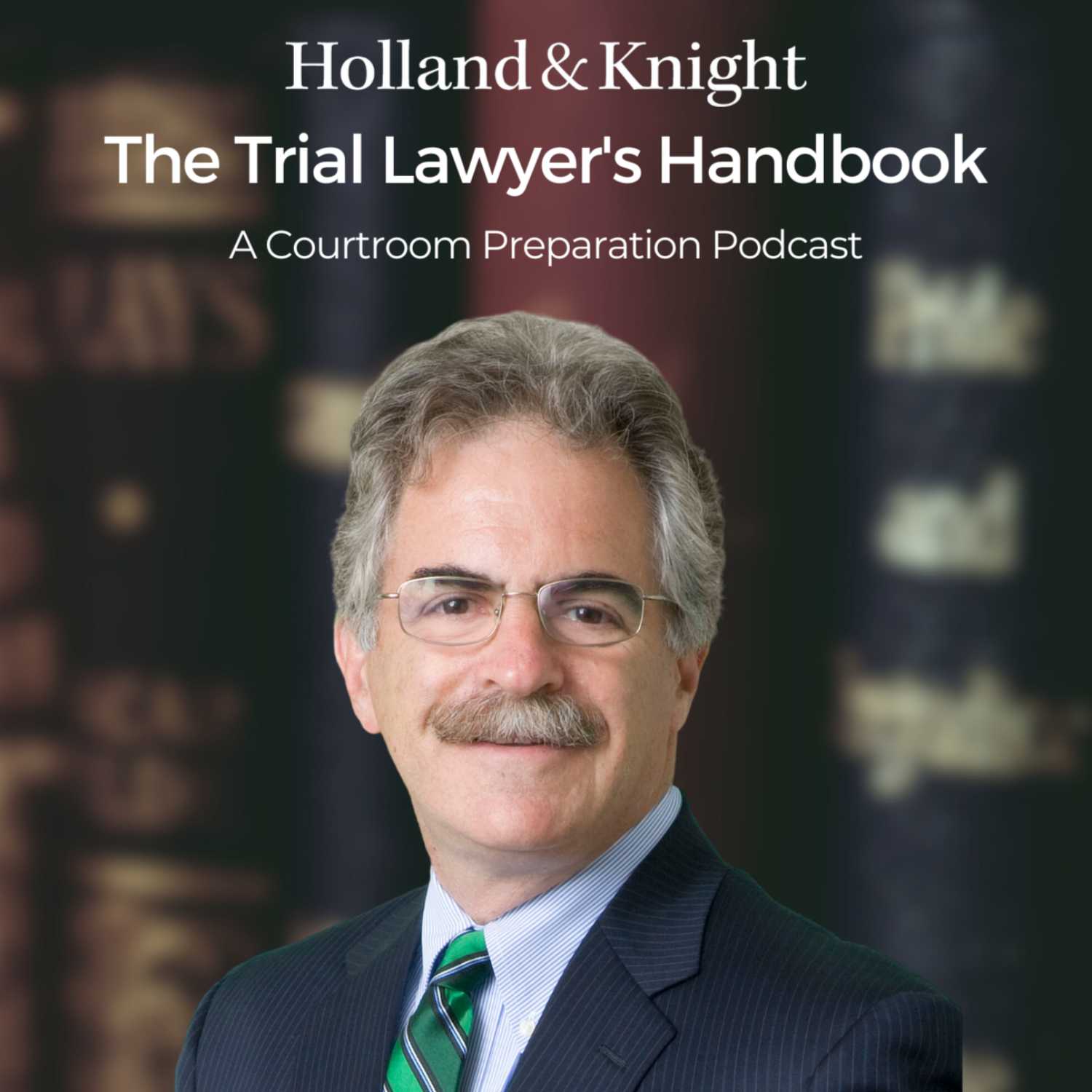
The Trial Lawyer's Handbook is a Courtroom Preparation podcast series brought to you by Holland & Knight. This series is hosted by litigation attorney Dan Small and is based on a longstanding article series he co-authored with Judge Dennis Saylor for Massachusetts Lawyers Weekly. Listeners of this series will gain a fresh perspective on how attorneys can address various trial preparation issues and set themselves up for success in and out of the courtroom.
-
144
Be a Role Model
Real reform begins when lawyers model the values they want the justice system to protect. In this episode of "The Trial Lawyer's Handbook," litigation attorney Dan Small concludes his discussion of pro bono work in Uzbekistan and reflects on a decade spent helping lawyers and judges advance rule-of-law reforms. He highlights the country's shift from a judge-driven, Soviet-style system to one that embraced constitutional protections such as the presumption of innocence, right to effective counsel and ability to confront witnesses. Mr. Small signs off by emphasizing that trial lawyers have a responsibility to respect the system, strengthen it and remember that others may look to them as a model of justice.
-
143
Finding the Truth
Cross-examination is a key part of the U.S. adversarial system, giving defense counsel one of their most important tools to find the truth and challenge the government. But during litigation attorney Dan Small's pro bono work in Uzbekistan, he encountered lawyers with little to no experience with cross-examination at all.In this episode of "The Trial Lawyer's Handbook," Mr. Small explains that defense lawyers in Uzbekistan at the time had so little power that they could do little more than hold their clients' hands as they were sent to jail. Having the chance to cross-examine a government witness — even in a mock trial — brought one Uzbek lawyer to tears. Listen to the full episode for more on this powerful reminder not to take these rights for granted.
-
142
Candor Saves Credibility in Courtrooms
The fastest way to destroy a witness' credibility is to let the jury think something is being hidden. Litigation attorney Dan Small draws on the mock trial case State v. Faulkner, used for his pro bono work in Uzbekistan, as well as lessons from the Appling County corruption case, to demonstrate this idea in his latest episode of "The Trial Lawyer's Handbook." Mr. Small explores why credibility is won not by pretending a witness is spotless, but by confronting weaknesses head on. From prior convictions and shady pasts to the prosecutor's old rule of BOBS — Bring Out the Bad Stuff — the discussion shows how honesty can defuse cross-examination, build trust with a jury and turn even a deeply flawed witness into a believable one. Along the way, it also highlights the striking cultural differences that emerged as Uzbek lawyers wrestled with the framework of an adversarial trial system and discovered that, in court, honesty is truly the best policy.
-
141
The "Referee" of the Judicial System
Order in the courtroom determines whether justice can move forward. In this episode of "The Trial Lawyer's Handbook," litigation attorney Dan Small examines the essential role judges play in the adversarial system through his pro bono work in Uzbekistan and the mock case State v. Faulkner. Drawing parallels to the Farmers Export and Rendle cases, Mr. Small shows how trial lawyers must balance forceful advocacy with respect for judicial authority. He recounts how an Uzbek judge, unfamiliar with the referee role, struggled to manage competing advocates until a makeshift gavel helped establish control. Mr. Small concludes that a fair adversarial system depends not only on skilled advocates but also on judges who can enforce rules and maintain fair, balanced proceedings.
-
140
The Jury Is the Audience
In the United States, a trial by jury is a familiar cornerstone of the justice process. In Uzbekistan, however, trials unfold in a different way. In this episode of "The Trial Lawyer's Handbook," litigation attorney Dan Small shares his experience teaching the U.S. trial system in Uzbekistan by walking participants through the fictitious State v. Faulkner case as part of his pro bono work.While working with Uzbek lawyers and judges, Mr. Small broke down how jurors are selected in the U.S., the role they play and how the judge functions as a neutral referee between the defense and prosecution. Through a mock trial, he demonstrated the U.S. system in action, ultimately resulting in a "not guilty" verdict – nearly unheard of in Uzbekistan's legal environment at the time.Listen to the full episode to hear his reflections, key takeaways and the differences between the two countries' judicial systems.
-
139
Trials Are About Connections
For trial lawyers, developing core themes is essential to building a persuasive case. In this episode of "The Trial Lawyer's Handbook," litigation attorney Dan Small recounts his pro bono work in Uzbekistan, where he helped educate Uzbek lawyers and judges about the U.S. adversarial justice system. Mr. Small explains how he used the fictional murder case State v. Faulkner to teach participants the importance of theme development and demonstrate how both the prosecution and defense can construct plausible narratives from the same set of facts. After extensive discussion and practice, the Uzbek lawyers embraced the process, delivering thoughtful and compelling arguments from each side. Mr. Small concludes that the experience underscores a broader point: The adversarial system demands rigor, but it offers fairness through demanding advocates to find and develop connections that together tell a compelling, yet plausible, story.
-
138
There's More Than One Way to Win
In trial work, courage often means pressing forward even when the outcome is uncertain. In this episode of "The Trial Lawyer's Handbook," litigation attorney Dan Small continues his discussion of the mock case State v. Faulkner and explains how he used it in his pro bono work in Uzbekistan. Referencing themes from his book for the American Bar Association Lessons Learned from a Life on Trial, Mr. Small reflects on cases with significant legal obstacles and why believing in the right result can justify taking risks. He describes how the mock trial revealed deep cultural differences in legal systems, including the Uzbek participants' resistance to trying a case they might lose and their unfamiliarity with direct and cross-examination. Mr. Small recounts a pivotal moment when one of the defense lawyers questioned whether it was even possible in her country to challenge a government witness and describes how the workshop offered a glimpse of what a balanced adversarial system could look like. He closes by sharing that a decade later Uzbekistan amended its constitution to include the right to cross-examine witnesses, showing that meaningful change can begin with small steps.
-
137
Reflections in the Courtroom: State v. Faulkner
What happens when an American trial lawyer carries the principles of justice halfway around the world? Litigation attorney Dan Small recounts his pro bono journey to Uzbekistan, where he worked with lawyers and judges seeking to reform a judicial system still shaped by former Soviet Union-era standards that gave judges most of the power. Using the fictional murder case State v. Faulkner as a teaching tool, he helped introduce the fundamentals of the adversarial process – cross-examination, competing narratives and rigorous truth-testing – to a legal culture with little experience in two-sided trials. The result is a compelling look at how one mock case became part of a much larger effort to open minds, challenge assumptions and support the slow yet rewarding work of judicial reform.
-
136
All Eyes on the Client
Trials can be stressful for attorneys, but the experience can be even more overwhelming for clients. In this episode of "The Trial Lawyer's Handbook," litigation attorney Dan Small explores how to navigate client relationships through the lens of a high‑profile corruption case he handled involving a former state governor.Mr. Small reflects on the ups and downs of the relationship with his client. Sometimes they argued or disagreed, but they also shared meals and attended events together to preserve a sense of normalcy amid the chaos of the trial process. This episode offers an inside look at the challenges he faced, the pressures of the case and the human side of working closely with a client under immense scrutiny.
-
135
Not a Level Playing Field
Trials are human and thus imperfect, and sometimes those inherent imperfections can tilt the playing field before the jury ever hears the full story. Continuing his behind-the-scenes account of defending former Louisiana Gov. Edwin Edwards, litigation attorney Dan Small shares what happens when a case lands in front of a judge with a long memory and an even longer grudge. With Louisiana's tight-knit political world making neutrality hard to find, the defense team faced an extremely long uphill battle, as seemingly small rulings and daily setbacks compounded over nearly three months in court. However, Mr. Small emphasizes, the true lesson for trial lawyers is to remain prepared to vigorously advocate for their clients' interests, also making sure to keep a client's spirits up even when fairness seems impossible to obtain. As he says, "buckle up and keep playing anyway" and continue trying the case.
-
134
"Nature Abhors a Vacuum." So Does the Media
In a high-profile case, if you do not fill the silence, someone else will. In this episode of "The Trial Lawyer's Handbook," litigation attorney Dan Small continues discussing his representation of former Louisiana Gov. Edwin Edwards and the challenge of managing public opinion in a case that drew intense media attention. Mr. Small explains how his arrival from Boston quickly became a story of its own, fueling speculation that he had been hired to negotiate a secret deal. He recounts how, without clear information, rumors escalated into a televised narrative involving then-U.S. Attorney General Janet Reno. Mr. Small describes a courthouse press moment where Edwards used humor and timing to debunk the false storyline, and he closes with a reminder that in major cases, even offhand moments can be observed and turned into headlines.
-
133
Cases Come in Many Ways
Sometimes, cases arrive when you least expect them. For litigation attorney Dan Small, one such moment involved stepping into an already high‑profile federal matter. In the latest episode of "The Trial Lawyer's Handbook" podcast series, he recounts being brought in from Massachusetts to Louisiana to represent former Gov. Edwin Edwards in a criminal proceeding. Mr. Small shares the background of the case and how it ultimately landed on his desk, offering an inside look at a complex legal challenge.
-
132
Victories and "Losses" in the Courtroom
In this episode of "The Trial Lawyer's Handbook" podcast series, litigation attorney Dan Small continues the story of the U.S. Securities and Exchange Commission's (SEC) civil case against internet game company SG Limited, recounting how an initial courtroom win was undone when the U.S. Court of Appeals for the First Circuit reversed the lower court decision against a motion to dismiss. Mr. Small uses this moment to explain the critical difference between "losing" narrow legal rulings and prevailing in the broader narrative, showing how the appellate court's own words validated SG's central theme: no reasonable player could have believed the game's "stocks" were real or profits guaranteed. He then walks through how that story powered settlement negotiations, culminating in a very unlikely outcome: return of most of the frozen funds, a face-saving escrow proposal for any truly misled "victims."
-
131
Finding Humor in Law
What happens when the government treats online "play money" like real securities?In this episode of "The Trial Lawyer's Handbook," litigation attorney Dan Small recounts a civil enforcement action brought by the U.S. Securities and Exchange Commission (SEC) against SG Limited, an early internet stock market game created by programmers overseas that built a large U.S. player base. He explains the SEC's attempt to characterize the game's virtual shares as unregistered securities and resulting allegations that the platform functioned as a Ponzi scheme, leading to a court-ordered freeze of approximately $5.5 million. Mr. Small walks through SG Limited's defense and the strategic choice to keep the case grounded in a clear, common-sense narrative, emphasizing that the platform presented itself as entertainment, not an investment. The episode spotlights the power of storytelling in trial advocacy, illustrated by how the district court responded to SG Limited's arguments in ultimately dismissing the SEC's case.Much like video games have a sequel, however, the story does not end there. In the next episode, Mr. Small continues the narrative at the appellate level.
-
130
Keeping Your Vessel Stable During Cross-Examination
In this episode of "The Trial Lawyer's Handbook" podcast, litigation attorney Dan Small delves deeper into the naval architect negligence case introduced in the previous episode. During the trial, the two experts disagreed, resulting in a credibility contest. Mr. Small shares the strategy he used to successfully cross-examine the other side's expert witness. In technical cases such as this one, it is your responsibility as the trial lawyer to learn the specifics of the case. By mastering the technical details himself, rather than relying solely on his team and client, Mr. Small was able to go toe-to-toe with the plaintiff's expert during cross-examination, a key factor in ultimately winning the case.
-
129
The Stability in Simplicity
In this episode of "The Trial Lawyer's Handbook" podcast series, litigation attorney Dan Small introduces a new case that illustrates a new strategy for trial. Naval architect Jack Gilbert was accused of selling a boat with stability issues and was sued by the owner of the 93-foot fishing vessel for negligence in federal court in Portland, Maine. Mr. Small provides an overview of the case and the technical details underlying it before describing the central role his "core themes" played at trial as he presented his arguments before the jury.
-
128
Reading the Room
In this episode of "The Trial Lawyer's Handbook," litigation attorney Dan Small continues the discussion of U.S. v. Rendle and explains why reading the room matters in court. Mr. Small shows how judges, juries and the pace of a trial should guide your choices across all aspects of the proceeding, not just your arguments. He shares a Boston case where a defense lawyer's approach at sentencing hurt the client, and a moment in U.S. v. Rendle when a lengthy cross-examination allowed the government to respond with a strong redirect. This episode offers clear lessons on timing, tone, selecting the right witness, when to object and how courtroom dynamics can lead to plea deals.
-
127
Respect in the Courtroom
In this episode of "The Trial Lawyer's Handbook" podcast series, litigation attorney Dan Small uses the white-collar corruption case of United States v. Rendle and his experience before the famously pro-defense Judge Joseph Tauro to explore the central role of respect in the courtroom. Drawing on stories from his time as a federal prosecutor, Mr. Small explains how rigorous preparation and sound judgment – especially knowing when to push hard and when to "move on" – helped him earn the respect of a judge many colleagues feared. Mr. Small underscores why neither constant combativeness nor habitual capitulation works, how to "pick your battles" in motions and arguments, and why genuine respect must extend beyond the bench to clerks, court staff and everyone in the courthouse.
-
126
Understanding the Media
In this episode of "The Trial Lawyer's Handbook" podcast series, litigation attorney Dan Small underscores the importance of understanding the media as a trial attorney. He recounts lessons learned from a high-profile government corruption case in Boston, where he interacted with reporters from two competing newspapers. As he explains, he inadvertently gave an exclusive quote to one of the journalists, blindsiding and angering the other news outlet. Mr. Small's message: A trial attorney's job is to address the court and inform the press, without favoring one publication over another.
-
125
Jurisdiction Is in the Eye of the Beholder
In this episode of "The Trial Lawyer's Handbook," litigation attorney Dan Small recounts attempting to prosecute a New England mob boss and the challenge of filing a complex case before the statute of limitations expired. Mr. Small explains how the case moved between Miami and Providence, how venue and timing decisions shaped strategy and why the trial judge ultimately dismissed the case despite a grand jury indictment. He highlights lessons on venue, audience and the importance of aligning the forum with the story you need to tell.
-
124
Allergic to Courtrooms
In this episode of "The Trial Lawyer's Handbook," litigation attorney Dan Small looks back on his experience prosecuting the notorious New England mob boss Raymond Patriarca — or lack thereof. As a 73-year-old man who had spent more than 30 years as the head of a criminal organization, it was not difficult for Patriarca to find a doctor to declare him medically unfit for trial. Mr. Small, needing a doctor of his own to keep the mob boss included in the trial, quickly discovered that Patriarca's reputation preceded him, and shares the difficulties he faced in getting Patriarca into the courtroom.
-
123
Dangers of Climbing the Ladder
In this episode of "The Trial Lawyer's Handbook" podcast, litigation attorney Dan Small discusses the opportunities and challenges of "climbing the ladder" in a corruption case. This approach starts with securing a defendant willing to testify against their superiors and then working to uncover what additional crimes or targets they can identify. He illustrates this strategy with the extortion case against Ted Anzalone, in which George Collatos, a Boston city employee, served as a key witness. Collatos was arrested for extorting cash from a building contractor. After he pleaded guilty, Mr. Small and his team brought him before the grand jury to ask about illegal fundraising and other unlawful activities in hopes of obtaining additional information. Eventually, Collatos revealed facts about Anzalone's activities, but it was not smooth sailing. Mr. Small explains why "climbing the ladder" proved to be difficult in this case and how it ultimately ended in Anzalone's acquittal.
-
122
Show and Tell
In this episode of "The Trial Lawyer's Handbook" podcast series, litigation attorney Dan Small makes the case for "show and tell" in the courtroom. As he contends, jurors do not learn best by listening alone, so powerful demonstratives are essential, especially in complex financial cases. Drawing on the Anzalone money laundering trial, he explains how a simple poster depicting a web tracing $100,000 in cash split into 12 sub‑$10,000 checks clarified the scheme better than words ever could and kept the jury focused on the issues at play. The takeaway: Keep visuals clear, memorable and ever‑present. Ears to listen, eyes to see, hands to hold.
-
121
The Law Is the Law
In this episode of "The Trial Lawyer's Handbook" podcast series, litigation attorney Dan Small unpacks the prosecution of Ted Anzalone, a top aide to Boston Mayor Kevin White, through two alleged money laundering schemes: a "birthday gift" check-planting operation that sowed jury confusion and led to acquittal, and a clearer $100,000 cash structuring scheme using sub‑$10,000 cashier's checks to evade bank reporting. Despite a compelling trial win on the structuring count, the U.S. Court of Appeals for the First Circuit reversed, holding that "the law is the law" and Congress hadn't yet criminalized that type of financial activity. Mr. Small reflects on the limits of prosecutorial creativity, a memorable bench rebuke and how the case ultimately spurred lawmakers to close the loophole – too late for Anzalone, whose conviction was vacated, but paving the way for successful prosecutions thereafter.
-
120
Telling the Whole Story
In this episode of his "The Trial Lawyer's Handbook" podcast series, litigation attorney Dan Small emphasizes the importance of providing the jury with all relevant facts to help them discern the truth. At times, however, court decisions can hinder a party's ability to tell the whole story. This was true in the United States v. Anzalone case, which Mr. Small prosecuted. Ted Anzalone was charged with extortion and money laundering, but because both charges involved secret cash transactions, it was difficult to present non-circumstantial evidence to the jury. To make matters worse, the defense counsel persuaded the judge to sever the two charges, making it nearly impossible to corroborate the evidence. This episode highlights the importance of always fighting to tell the full narrative.
-
119
The Benefits of Using an Interpreter
In this episode of "The Trial Lawyer's Handbook" podcast series, litigation attorney Dan Small delves into the debate on using interpreters for witnesses in the courtroom. In some instances there is no choice: A witness who cannot understand English requires an interpreter. But when it's a gray area, some lawyers argue that an interpreter diminishes the connection between the witness and the jury. Mr. Small disagrees and offers a humorous anecdote from the corruption case United States v. Wallen, which he prosecuted, to support his pro-interpreter stance. He closes by reminding the listeners that misunderstandings often hurt your case and that interpreters help minimize them for both sides.
-
118
Trust Is Key
In this episode of "The Trial Lawyer's Handbook" podcast series, litigation attorney Dan Small shares how building genuine trust with a witness can make or break a case, recounting his extraordinary trip to Italy to meet Domenic D'Alessandro in the Frank Wallen corruption investigation. What began as a long-shot effort — navigating approvals from U.S. Department of Justice (DOJ) and and U.S. Department of State, coordinating with the IRS and overcoming internal skepticism — turned into a lesson in human connection. Over a shared meal and conversation, plus more than a few glasses of wine, Mr. Small and Mr. D'Alessandro developed mutual respect and forged a bond that led to Mr. D'Alessandro's voluntary return to the U.S., guilty plea and critical testimony. The story underscores a central tenet in trial preparation: You cannot extract the truth from strangers on a park bench; you must invest the time to create rapport and reliability with witnesses, because trust, not pressure, opens the door to honest testimony.
-
117
The Challenge of Corruption
In this episode of "The Trial Lawyer's Handbook" podcast, litigation attorney Dan Small explores the complexity of federal corruption cases. He highlights a matter he handled as an assistant U.S. attorney in the Boston U.S. Attorney's Office Public Corruption Unit: a case in Brockton, Massachusetts, in which the IRS uncovered corrupt relationships between contractors and Frank Wallen, the city's superintendent of sewers and then-commissioner of public works. Mr. Small shares insights into how the case arose, what work his team focused on and why it was so difficult to prosecute.
-
116
Clarity Over Complexity at Trial
In this episode of "The Trial Lawyer's Handbook," litigation attorney Dan Small explains why simplifying a complex case is essential to persuading a jury. Recalling the federal prosecution of U.S. budget director Bert Lance, Mr. Small describes how large investigations can produce lengthy indictments that confuse rather than convince, and emphasizes that focusing on clear, provable charges can strengthen a case. He outlines the risks of overcomplication and the importance of telling a straightforward story that a juror can follow.
-
115
Part II - Recent Changes in Jury Dynamics and How to Prepare Your Expert Accordingly
In the second part of this special guest episode of "The Trial Lawyer's Handbook" podcast series, litigation attorney Dan Small is once again joined by Partner Eric Alexander, who leads the firm's Product Liability – Life Sciences Team. This episode's conversation focuses on product liability trials and how they differ from other types of litigation, as well as recent shifts in juror attitudes and the effects on expert witness selection and preparation. Mr. Small shares an anecdote to emphasize that getting the jury to like you isn't just a part of trial, it's the only part of trial. For his part, Mr. Alexander suggests that changes in juror dynamics were likely accelerated by COVID-19 and the associated shutdowns. The attorneys agree that a strong expert nowadays is defined more by the ability to speak "juror's English" than by degrees or professional experience. The dialogue offers a behind-the-scenes look into the world of product liability litigation and the factors that can determine success in the courtroom.
-
114
Miss Lillian "Testifies": The Importance of Witness Preparation
In this episode of "The Trial Lawyer’s Handbook" podcast, litigation attorney Dan Small describes the unnatural environment of the courtroom and the importance of preparing witnesses for the off-putting rhythm of testimony that he summarizes as "question, pause, answer, stop." In the corruption case United States v. Bert Lance, because the defense sought to call numerous character witnesses, the judge limited counsel to four legalistic questions. The most notable witness, Miss Lillian, the elderly mother of then-President Jimmy Carter, had known Lance his whole life and could have played a key role in his defense. However, she was not prepared for the unusual phrasing of the questions and, after an 18-hour flight to get to court, concluded her testimony in about two and a half minutes. Mr. Small reminds the listeners that every witness is Miss Lillian and must be prepared accordingly.
-
113
Learn from the Masters
In this episode of "The Trial Lawyer’s Handbook" podcast, litigation attorney Dan Small discusses the value of observing and learning from experienced colleagues, both professionally and socially. He reflects on one of his first significant cases as a federal prosecutor, when the U.S. Department of Justice (DOJ) secured a grand jury indictment in Atlanta against Bert Lance, the former director of the Office of Management and Budget, and three associates on charges that they conspired to violate U.S. banking laws to obtain millions of dollars in loans. Mr. Small joined the DOJ team led by Ed Tomko and Marvin Loewy and learned from watching them and the opposing counsel in action.
-
112
Part I - Going from Young Associate to Veteran Lawyer
In the first part of this special guest episode of "The Trial Lawyer's Handbook" podcast series, litigation attorney Dan Small is joined by Partner Eric Alexander, who leads the firm's Product Liability – Life Sciences Team. Mr. Small talks with Mr. Alexander about the transition from being in the back row of a trial team to having a stand-up role. After reflecting on the beginning of his legal career, Mr. Alexander offers advice for young litigators on how to prepare for a trial and how to best support the attorneys on your team, plus some important don'ts to avoid in the courtroom. Mr. Alexander also emphasizes that there is no one way to approach a trial. Taking an approach that fits your case and fits who you are is important and will help you to come across as genuine.
-
111
Juror No. 6 and the Unexpected Misunderstanding
In this episode of "The Trial Lawyer's Handbook" podcast series, litigation attorney Dan Small reflects on the unpredictable and often mysterious nature of jury selection and engagement, sharing the story of Juror No. 6 from the challenging Cammarata Racketeering Influenced and Corrupt Organizations Act (RICO) trial. Despite appearing disengaged and distant throughout the trial, Juror No. 6 proved a key contributor in deliberations, demonstrating the importance of patience and understanding in the courtroom. Mr. Small emphasizes that trial lawyers must craft their narratives with Juror No. 6 in mind: assuming that jurors are listening and striving to make complex stories accessible and meaningful to every member of the jury, even those who may seem withdrawn. This episode offers a powerful reminder of the human element in trials and the responsibility lawyers have to connect with juries to achieve justice.
-
110
The View from the Jury Box
In this special guest episode of "The Trial Lawyer's Handbook" podcast series, litigation attorney Dan Small talks with Miami litigation attorney Jose Casal about his recent experience serving as a juror in the Miami-Dade courthouse. Mr. Casal states he wished he had the opportunity to serve on a jury at the beginning of his career because of the perspectives it gave him on how the jury thinks and operates. Sitting on the other side of the bench made him realize that tactics such as objections and impeachments were often seen by jurors as annoying and ineffective, merely slowing down the trial and distracting from its main points. Similarly, the case featured numerous claims and objections, resulting in a 22-page verdict that Mr. Casal found confusing even as a trained lawyer. Based on this experience, Mr. Small and Mr. Casal agree that presenting your case simply and clearly is far more beneficial and convincing for Juror No. 6 than legal technicalities they do not understand.
-
109
Connecting with the Jury
In this episode of "The Trial Lawyer's Handbook" podcast series, litigation attorney Dan Small explores the unique and challenging relationship between trial lawyers and juries, illustrated through his experience prosecuting the complex and emotionally charged Racketeering Influenced and Corrupt Organization Act (RICO) case against the Cammarata Organization. He highlights how, despite the inability to converse directly, subtle interactions, gestures and small moments — such as a mishap with a wrapped finger or a cheeky message to opposing counsel — helped build a connection with the jury during the grueling month-long trial. The episode emphasizes the importance of consistently striving to respect, engage and communicate effectively with jurors, reminding trial lawyers that every action, no matter how trivial it may seem, can influence how the jury understands and responds to a case.
-
108
Bad Facts Make Bad Law
In this episode of "The Trial Lawyer's Handbook" podcast series, litigation attorney Dan Small explains the exclusionary rule, which states that evidence obtained by illegal methods must be excluded at trial. In the Cammarata drugs-and-murder Racketeering Influenced and Corrupt Organizations Act (RICO) case, a voluntary eight-page confession was initially suppressed under the exclusionary rule because the Texas Rangers did not include the arrested individual's last name on the warrant. Mr. Small appealed the decision, and the U.S. Court of Appeals for the Fifth Circuit ruled in his favor, making the confession admissible at trial. The ruling helped establish the "good-faith exception" to the exclusionary rule, which was soon officially adopted by the U.S. Supreme Court.
-
107
Actors on a Stage
In this episode of "The Trial Lawyer's Handbook" podcast series, litigation attorney Dan Small reflects on the dangerous yet invaluable role of an undercover agent, exemplified by the Cammarata Racketeer Influenced and Corrupt Organizations Act (RICO) case. The Cammarata Organization, like many organized criminal groups, was highly secretive, and building evidence for trial would be challenging without insider testimony. Working alongside the Texas Rangers, Mr. Small befriended skilled undercover agents and learned their strategies for creating a false persona. The episode offers a glimpse into infiltrating a criminal organization, as well as amusing anecdotes from Mr. Small's first attempt at going undercover at a local honky-tonk.
-
106
"I Was Just Playing a Role"
In this episode of "The Trial Lawyer's Handbook," litigation attorney Dan Small explores the complicated dynamics of using informants in organized crime cases. Drawing from his prosecution of Sam Cammarata, Mr. Small explains how informants can both help and hinder investigations, especially when they manipulate their insider status for personal gain. He discusses the challenges prosecutors face in building persuasive arguments using informant testimony, tactics defense lawyers use to cast doubt on informant credibility and strategies that help reveal the truth in court. This episode offers insights into the delicate balance required to pursue justice when relying on those closest to criminal activity.
-
105
Too Dirty for Dirty Crime
In this episode of his "The Trial Lawyer's Handbook" podcast series, litigation attorney Dan Small talks about his experience prosecuting the Cammarata Organization while serving with the U.S. Department of Justice's (DOJ) Organized Crime Strike Force. Mr. Small explains how traditional organized crime groups struggled with the transition into drug trafficking, a business they once saw as off-limits. He details how the Cammarata group's excessive ambition and reliance on violence undermined their criminal enterprises, including failed international deals and brutal tactics that ultimately led to their downfall. This episode explores the realities of investigating organized crime, the economic principles underlying illegal enterprises and how prosecutors use evidence of violence to portray criminal organizations in court.
-
104
The Godfather of Houston
In the 100th episode of "The Trial Lawyer's Handbook" podcast series, litigation attorney Dan Small introduces his listeners to Sam Cammarata, a career criminal who tried to follow his dreams and become the "Godfather of Houston." After brief stints in the Boston and New Orleans mafia, Cammarata decided to start his own criminal empire in Houston, Texas. With a nightclub as a legal front and a second-in-command with a love of violence, the Cammarata organization quickly grew more prominent and more profitable as it engaged in illegal activities such as bookmaking, loansharking, prostitution and extortion. As a prosecutor for the U.S. Department of Justice's Organized Crime Strike Force, Mr. Small was sent to Texas to help the Texas Rangers indict members of the criminal enterprise.
-
103
A Good Lickin'
In this episode of "The Trial Lawyer's Handbook" podcast series, litigation attorney Dan Small reflects on the wisdom of juries demonstrated in the complex drug smuggling Racketeer Influenced and Corrupt Organizations Act (RICO) case in Appling County, Georgia. He recounts the dramatic trial of Larry Jackson and his family, who were charged with money laundering and tax evasion. A key moment came when AZ Jackson, Larry's father, took the stand with a seemingly implausible story denying involvement despite overwhelming evidence supporting the opposite. Mr. Small's intense cross-examination exposed the truth, helping the jury deliver a verdict convicting all defendants – notably except AZ – on tax charges. Mr. Small's post-trial conversations with jurors about AZ gave him an opportunity to reflect on the profound insights they can bring, reminding lawyers how important it is to present clear, compelling cases while also focusing on what truly matters.
-
102
Bring Out the Bad Stuff
In this episode of "The Trial Lawyer's Handbook," litigation attorney Dan Small examines the challenges of preparing witnesses for trial, emphasizing the importance of honesty and addressing unfavorable facts in advance. Mr. Small shares his experience working with Billy Breen, a former drug trafficker turned government informant in the Appling County, Georgia, Racketeer Influenced and Corrupt Organizations (RICO) Act case. He details the process of building trust with witnesses, explains how financial incentives and personal history can impact testimony, and highlights the strategy of bringing out damaging information on direct examination. The episode offers practical insights into effective witness preparation and underscores the value of transparency and credibility in the courtroom.
-
101
Just Press "Play"
In this episode of "The Trial Lawyer's Handbook" podcast series, litigation attorney Dan Small highlights the critical role voice recordings can play in court. He details three primary ways to obtain recordings: wiretaps, undercover agents and cooperators. Drawing on his experience investigating drugs and corruption in Appling County, Georgia, Mr. Small shares how he enlisted a trusted cooperator to capture incriminating conversations — an approach that proved highly effective. This insightful episode explores why and how this strategy can lead to success.
-
100
“I Lied Like a Dog!”
In this episode of "The Trial Lawyer's Handbook" podcast series, litigation attorney Dan Small explores the critical issue of false testimony and its damaging effects on the justice system. Centered on the case of Charlotte Lightsey, a deputy sheriff and wife of the Appling County sheriff in Georgia, the story reveals how she aggressively lied before a grand jury to deny involvement in corruption and drug smuggling. Unbeknownst to her, one cooperating deputy was secretly recording their conversations, capturing her candid admission, "I lied like a damn dog!" This tape became crucial evidence leading to her conviction for perjury and contributing to a substantial prison sentence. The episode highlights the challenges of prosecuting perjury, the dangerous mindset that allows it and the vital importance of holding witnesses accountable to preserve the integrity of justice.
-
99
Part II: The Do’s and Don’ts of Demonstratives
In the second part of this special guest episode of "The Trial Lawyer's Handbook" podcast series, litigation attorney Dan Small interviews Scott Duval, managing director at FTI Consulting, about the practical aspects of working with trial graphics and multimedia designers. They discuss key considerations for attorneys when selecting a graphics expert, the importance of teamwork and venue-specific presentation styles, and common pitfalls such as overwhelming juries with too much information. Mr. Duval shares insights on effective storytelling through visuals, including the challenges and power of presenting video depositions. The conversation highlights how strategic use of graphics and multimedia can enhance jury comprehension and trial outcomes, emphasizing clarity, readability and thoughtful presentation roadmaps.
-
98
Persistence and Determination
In this episode of "The Trial Lawyer's Handbook" podcast series, litigation attorney Dan Small discusses the evolution of the Racketeer Influenced and Corrupt Organizations (RICO) statute. As a young lawyer with the U.S. Department of Justice's (DOJ) Organized Crime and Racketeering Strike Force, Mr. Small reviewed proposed RICO cases, including one against law enforcement officers in Appling County, Georgia, accused of participating in an illegal drug smuggling operation. The indictment faced several hurdles in getting approved, including pushback from higher-ups who believed that RICO was specifically meant for cases involving the Mafia. With help from a U.S. Attorney and FBI Special Agent Bill Hinshaw, the case was eventually approved. Later, at trial, they initially faced skepticism from the judge, but clear and compelling evidence led to a maximum sentence and helped reinforce the statute's reach beyond traditional organized crime.
-
97
Part I: The Do’s and Don’ts of Demonstratives
In the first part of this special guest episode of "The Trial Lawyer's Handbook" podcast series, litigation attorney Dan Small interviews Scott Duval, managing director at FTI Consulting, to discuss the vital role of trial graphics and multimedia in persuading juries and other fact-finders. Mr. Duval shares his journey from journalism and design to supporting trial teams with visuals for more than 25 years, highlighting how technology has transformed courtroom presentations from simple boards to dynamic animations and interactive exhibits. Together with Mr. Small, he explores how well-crafted graphics help clarify complex information, influence deliberations and create memorable narratives, including real examples from arbitration and high-profile litigation. The conversation reveals the power of visuals to engage multiple senses and underscores the evolving expectations for legal presentations in courts and arbitrations worldwide.
-
96
Walking Tall
In this episode of his "The Trial Lawyer's Handbook" podcast series, litigation attorney Dan Small recounts a compelling story from Appling County, Georgia, where corruption and drug smuggling under a powerful sheriff threatened the integrity of the community. A local resident motivated by a sense of justice, but lacking law enforcement experience, took it upon himself to run for sheriff. After narrowly winning, he sought federal assistance and collaborated with the FBI and U.S. Attorney's Office in an effort to save his county. The episode highlights the slow, complex federal investigation involving Racketeer Influenced and Corrupt Organization Act (RICO) charges, undercover operations and community doubt amid procedural delays. In sharing this case, Mr. Small reflects on how legal battles impact real lives and communities.
-
95
The Seeds of Corruption
In this episode of "The Trial Lawyer's Handbook," litigation attorney Dan Small begins a multi-part examination of a drug trafficking and corruption case in Appling County, Georgia. As increased law enforcement efforts in Florida pushed drug smuggling operations into Georgia, local law enforcement officers, including both a former and a sitting sheriff, became involved in facilitating drug shipments. Mr. Small explains how financial incentives and personal relationships contributed to the involvement of officers in criminal activity. He describes the investigation, the use of grand jury subpoenas and the challenges faced in confronting corruption within law enforcement. The episode highlights the realities of prosecuting these cases and the importance of maintaining accountability in the justice system.
We're indexing this podcast's transcripts for the first time — this can take a minute or two. We'll show results as soon as they're ready.
No matches for "" in this podcast's transcripts.
No topics indexed yet for this podcast.
Loading reviews...
ABOUT THIS SHOW
The Trial Lawyer's Handbook is a Courtroom Preparation podcast series brought to you by Holland & Knight. This series is hosted by litigation attorney Dan Small and is based on a longstanding article series he co-authored with Judge Dennis Saylor for Massachusetts Lawyers Weekly. Listeners of this series will gain a fresh perspective on how attorneys can address various trial preparation issues and set themselves up for success in and out of the courtroom.
HOSTED BY
Holland & Knight
Loading similar podcasts...
Frequently Asked Questions
How many episodes does The Trial Lawyer's Handbook have?
The Trial Lawyer's Handbook currently has 50 episodes available on PodParley. New episodes are automatically indexed when they're published to the podcast feed.
What is The Trial Lawyer's Handbook about?
The Trial Lawyer's Handbook is a Courtroom Preparation podcast series brought to you by Holland & Knight. This series is hosted by litigation attorney Dan Small and is based on a longstanding article series he co-authored with Judge Dennis Saylor for Massachusetts Lawyers Weekly. Listeners of this...
How often does The Trial Lawyer's Handbook release new episodes?
The Trial Lawyer's Handbook has 50 episodes. Check the episode list to see recent publication dates and frequency.
Where can I listen to The Trial Lawyer's Handbook?
You can listen to The Trial Lawyer's Handbook on PodParley by clicking any episode. We provide an embedded audio player for direct listening, and you can also subscribe via your preferred podcast app using the RSS feed.
Who hosts The Trial Lawyer's Handbook?
The Trial Lawyer's Handbook is created and hosted by Holland & Knight.
URL copied to clipboard!