
PODCAST · religion
Veda & Vitality
by Anindita Sarkar
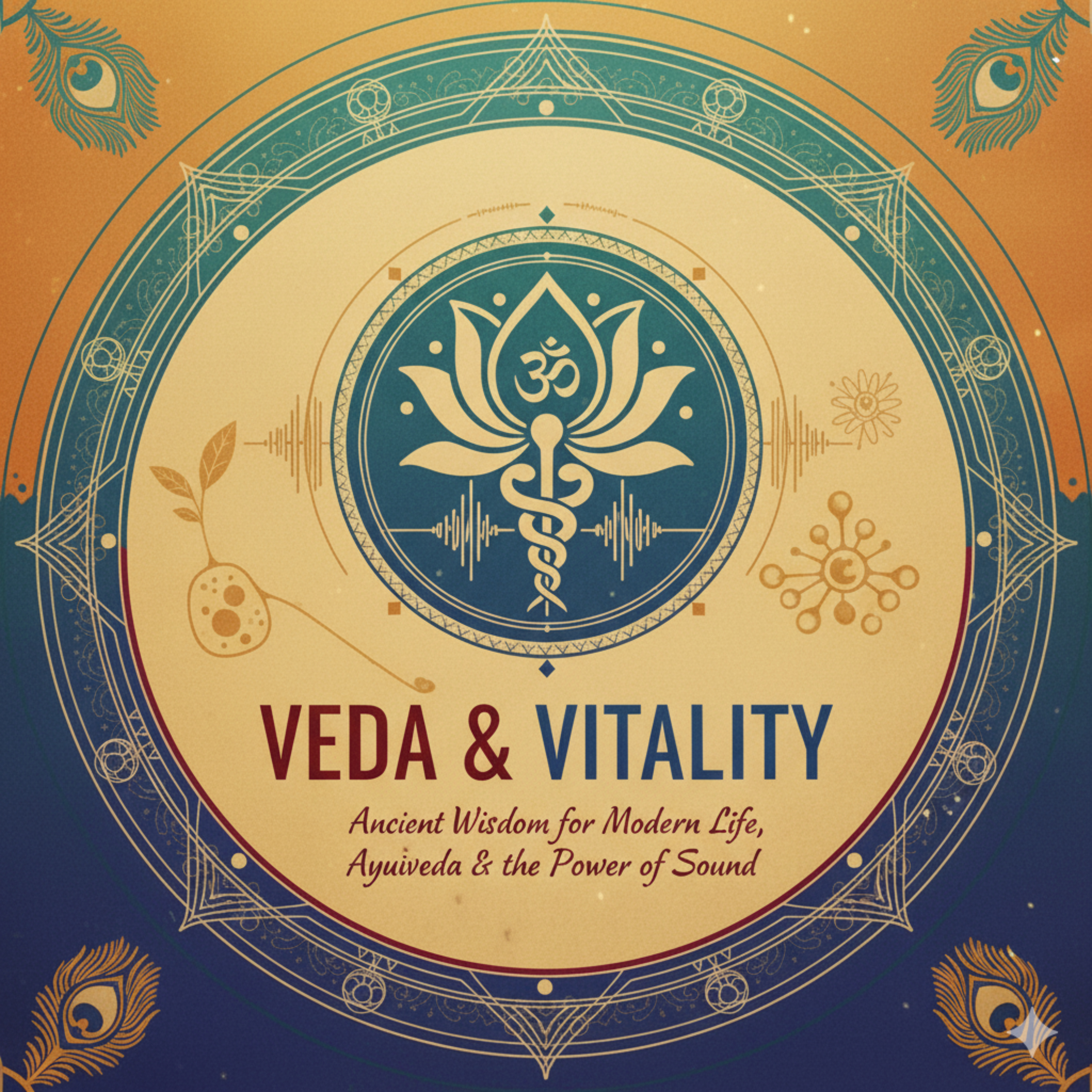
Veda & Vitality bridges ancient Vedic wisdom with modern systems biology to help high-pressure professionals reclaim their natural energy. By translating the world's oldest system of personalized preventative health—Ayurveda—into evidence-based protocols, we empower individuals to optimize focus, sleep, and digestion.Our approach integrates the science of life with the power of sound, utilizing traditional Sanskrit chanting and linguistic exploration to foster mental clarity and spiritual alignment. Our mission is to provide the tools for a life lived with deep purpose and lasting vitality,
-
5
4. The Frequency of Peace — Navigating the Modern Storm
We live in a world that never stops moving. We have high-pressure jobs, endless notifications, and a mind that often feels like a storm at sea. But what if I told you that the antidote to this chaos isn't a vacation, but a vibration? I’m your host, Anindita, and today on Veda & Vitality, we explore the 'Universal Peace Prayer' from the Yajurveda—a tool to stabilize your mind and reclaim your natural state of Svastha.We will recite this sacred mantra two times. The first time is to seed the vibration in our space, and the second is to allow it to settle into our cellular memory.Devanagari Script:ॐ द्यौ: शान्तिरन्तरिक्षं शान्ति:,पृथ्वी शान्तिराप: शान्तिरोषधय: शान्ति: ।वनस्पतय: शान्तिर्विश्वे देवा: शान्तिर्ब्रह्म शान्ति:,सर्वं शान्ति: शान्तिरेव शान्ति:, सा मा शान्तिरेधि ॥ॐ शान्ति: शान्ति: शान्ति: ॥ English Transliteration:Oṃ dyauḥ śāntir-antarikṣaṃ śāntiḥ, pṛthivī śāntir-āpaḥ śāntir-oṣadhayaḥ śāntiḥ | vanaspatayaḥ śāntir-viśve devāḥ śāntir-brahma śāntiḥ, sarvaṃ śāntiḥ śāntir-eva śāntiḥ, sā mā śāntir-edhi || Oṃ śāntiḥ śāntiḥ śāntiḥ || Deep Teaching: Peace Across the Elements"This mantra, known as the Shanti Paath, is more than just words; it is a request for peace to permeate every layer of existence: Dyauh: Peace in the heavens.Antariksham: Peace in the sky and space.Prithvi: Peace on the earth.Aapah: Peace in the waters.In Ayurveda, we understand that we are a microcosm of this macrocosm. If the space around us is agitated, our inner space—our Manas (mind)—becomes restless, fueled by Raja-Guna."The Modern Connection: From Chaos to Sattva"When we recite this mantra, we are vibrating at a frequency that reduces mental restlessness and creates a 'Sattvic' or harmonious environment. For the high-pressure professional, this is the prerequisite for healing. You cannot optimize your Agni (digestive fire) or your sleep if your system is in a state of 'fight or flight'. Peace is the foundation upon which vitality is built."Drops of Ayurveda (Daily Practice):"Here is how you can take this Vedic wisdom into your high-pressure day: The Optimal Time (Brahma Muhurta): For the deepest impact on your nervous system, recite this Shanti Paath during Brahma Muhurta—the 'ambrosial hours' just before sunrise. This is when the environment is naturally Sattvic and your mind is most receptive.The Ritual of Two: In your personal practice, recite the full mantra two times.Before Focused Work: Recite it immediately before a high-stakes consultation or deep-work session to clear the ego and focus the mind on rejuvenation.The 3-Breath Reset: When a meeting gets heated, stop. Take three deep breaths and silently recite 'Shanti' three times. It tells your nervous system you aren't being chased by a tiger.Space Clearing: Before you start work, play a recording of this mantra to let the sound waves clear 'mental sludge' or Ama from your environment.The Evening Seal: End your day by acknowledging the peace in the elements around you. It helps you transition from 'doing' to 'being,' ensuring you are 'seated in yourself' (Svastha) before sleep.""Thank you for spending a few minutes with me in the space of peace. Remember, your vitality isn't something you have to go out and buy—it's a frequency you can tune into. The next time you say 'Shanti,' remember it is not just a word, but a dialogue with the entire universe. If this episode helped you find a moment of calm, share it with a colleague who needs to hear it. I’m Anindita, reminding you to stay seated in yourself. Om Shanti."
-
4
3. The Sacred Hearth — Agni and the Alchemy of Life
Hi everyone, I’m Anindita Sarkar, and this is Veda & Vitality. If you’re someone who spends your day making high-stakes decisions but goes home feeling physically drained and mentally 'on edge,' you’re in the right place. Most of us treat our bodies like machines—we wait for a part to break before we fix it. I’m here to show you a different way. We take the ancient, common-sense wisdom of Ayurveda and map it onto how our bodies actually work today. No jargon, just real tools to help you sleep better, think clearer, and finally get your energy backThink about the last time you ate a 'perfect' healthy meal while you were staring at your inbox or fuming about a meeting. Did you actually feel nourished? Probably not. You probably felt bloated or heavy. That’s because in Ayurveda, how you eat is just as important as what you eat. Today, we’re talking about your inner fire—your Agni.The Invocation: (Recite with warmth)Devanagari:ॐ सह नाववतु । सह नौ भुनक्तु ।सह वीर्यं करवावहै ।तेजस्वि नावधीतमस्तु मा विद्विषावहै ।ॐ शान्तिः शान्तिः शान्तिः ॥Transliteration: "Oṃ saha nāvavatu saha nau bhunaktu saha vīryaṃ karavāvahai tejasvināvadhītamastu mā vidviṣāvahai oṃ śāntiḥ śāntiḥ śāntiḥ"The "Human" Meaning: "This is an old student-teacher prayer. It basically says: 'May we both be protected, may we both be nourished, and may our work together be full of light.' It’s about turning a simple podcast into fuel for your life."Your Inner Alchemist: "Agni isn't a metaphor—it's your metabolism. It’s the fire that turns a sandwich into 'you.' If that fire is flickering and low, you feel sluggish. If it's a wildfire, you feel burnt out and acidic. We want a steady, glowing hearth. When your Agni is strong, your focus is sharp and your mood is stable.The Reality of 'Ama' (The Sludge): "When we don't 'digest' our day—whether it’s a big lunch or a stressful email—we get Ama. It's the physical and mental sludge. You know that foggy feeling where you can't quite get your gears to turn? That's undigested life. It shows up as that white coating on your tongue in the morning. It's your body's way of saying: 'Hey, I'm overwhelmed.Drops of Ayurveda (Daily Practice): "Here is how you actually use this today:The 3-Breath Rule: Before you eat, just stop. Take three deep breaths. It tells your body you aren't being chased by a tiger, so it can actually start the fire to digest your food.The Morning Check: Tomorrow morning, look at your tongue. If it's coated, your 'fire' is struggling. Try having a warm glass of water with a little ginger instead of that first heavy cup of coffee.Stop 'Topping Off': Only eat when you’re actually hungry. Putting more fuel on a dying fire just puts it out."What 'Health' Actually Means: "In the Vedas, they use the word Svastha for health. It literally means 'being seated in yourself.'Devanagari:समदोषः समाग्निश्च समधातुमलक्रियः ।प्रसन्नात्मेन्द्रियमनाः स्वस्थ इत्यभिधीयते ॥The Reality: You aren't just healthy because your labs look 'okay.' You’re healthy when your digestion is easy, your energy is steady, and your mind is actually happy. That is the goal of everything we do here.Closing Note:"Thanks for spending a few minutes with me. Remember, your vitality isn't something you have to go out and buy—it's something you already have, we just need to clear away the sludge. If this helped you, send it to a friend who is feeling the burnout. We're all in this together. I’ll see you in the next episode. Namaste.
-
3
2. The Shanti Mantras: Engineering a Sattvic Environment
"Welcome to Veda and Vitality. I’m your host, and today we are looking at the Shanti Mantras. While often translated simply as 'peace,' we’re going to look at these chants as a form of environmental engineering—creating a Sattvic state where the body’s biological noise is lowered, allowing for true systemic healing and clarity.""Today we focus on a specific Shānti Pāṭha taken from the Krishna Yajurveda Taittiriya Upanishad (2.2.2). Traditionally known as the 'Teacher-Student' mantra, it is recited to harmonize the energetic field between the giver and the receiver of knowledge, ensuring that the transmission of wisdom remains pure and undistorted."Devanagari Script:ॐ सह नाववतु।सह नौ भुनक्तु।सह वीर्यं करवावहै।तेजस्वि नावधीतमस्तुमा विद्विषावहै।ॐ शान्तिः शान्तिः शान्तिः ॥Transliteration:Oṃ saha nāvavatusaha nau bhunaktusaha vīryaṃ karavāvahaitejasvi nāvadhीtamastumā vidviṣāvahaiOṃ śāntiḥ śāntiḥ śāntiḥ"The mantra translates to: 'May the Divine protect us both together. May we be nourished together. May we work together with great energy. May our study be effective and brilliant. May there be no hostility or misunderstanding between us.'"Why do we say Shanti three times?"In the Vedic tradition, we repeat Shanti thrice to pacify the Trividha Tapa—the three categories of disturbances that prevent a Sattvic state:Adhyatmika: Disturbances arising from our own body and mind (pain, anxiety, or illness).Adhibhautika: Disturbances arising from other living beings or our immediate environment (noise, insects, or difficult people).Adhidaivika: Disturbances from natural or unseen forces (weather, fate, or cosmic events).By chanting it three times, we are systematically 'clearing the signal' across all three levels of our existence."Oṃ: The primordial sound, the universal frequency.Saha (सह): Together; in conjunction with.Nau (नौ): Us two (referring to the dual relationship).Avatu (अवतु): May He protect/govern.Bhunaktu (भुनक्तु): May He nourish.Vīryaṃ (वीर्यम्): Vitality, prowess, or heroic energy.Karavāvahai (करवावहै): May we both achieve or exert.Tejasvi (तेजस्वि): Full of Tejas (brilliance, fire, or spiritual luster).Adhītam (अधीतम्): That which is studied or learned.Astu (अस्तु): Let it be so.Mā (मा): Not (the negative particle).Vidviṣāvahai (विद्विषावहै): May we not dispute or feel animosity.Śāntiḥ (शान्तिः): Peace; pacification of disturbances.Why: To transition the mind from a Rajasic (active/distracted) state to a Sattvic (clear/receptive) state. This mirrors the shift from sympathetic dominance to parasympathetic receptivity, optimizing the brain for neuroplasticity.When: Recite this before any deep work, collaborative research, or teaching session to ensure biological alignment.How Many: Recite the full mantra once, ending with the intentional triple Shanti to address the three realms of suffering."By chanting these words from the Taittiriya Upanishad, we are setting a biological and energetic boundary for our work. Thank you for tuning into Veda and Vitality. May your week be full of Tejas and void of Vidviṣa."
-
2
1. Dhantvantari Maha Mantra
Namaste. I am Anindita Sarkar a researcher and practitioner. Welcome to Veda and Vitality, where we explore the vibrational heart of Ayurveda. My mission is to help practitioners and students master the sacred Sanskrit chants that underlie our healing science. This isn't just about pronunciation—it’s about integrating the spiritual pulse of the Vedas into your clinical practice and personal vitality.Om Namo Bhagavate Vasudevaya Dhanvantaraye Amrita Kalasha Hastaya Sarva Maya Vinashanaya Trailokya Nathaya Shri Mahavishnave NamahaThe Full Meaning"I bow to the Divine Lord Vasudeva, the celestial physician Dhanvantari, who holds the golden pot of nectar in his hand. I offer my salutations to the one who removes all fears and diseases, the protector of the three worlds, and the sustainer of all life."Word-by-Word Recital & Meaning (Nirukta)Instruction: Speak each Sanskrit word slowly and clearly, followed by its meaning.Om Namo Bhagavate... I offer my salutations to the Divine Lord.Vasudevaya... To the one who lives in all things, the indwelling soul.Dhanvantaraye... To Lord Dhanvantari, the God of Ayurveda.Amrita Kalasha Hastaya... To him who carries the pot of nectar in his hand.Sarva Maya Vinashanaya... To the destroyer of all delusions, fears, and diseases.Trailokya Nathaya... To the Lord and protector of the three worlds.Shri Mahavishnave Namaha... I bow to the great Lord Vishnu, the sustainer of life.Why, When, and How Many TimesWhy: To clear the practitioner's ego and focus the mind on pure rejuvenation.When: During Brahma Muhurta (early morning) or immediately before starting a consultation or preparing herbs.How Many: 3 times to sanctify body, speech, and mind, or 108 times for deep spiritual 'charging.'Closing Note"Thank you for joining me on Veda and Vitality. As you carry this chant into your practice, remember that the vibration of the word is as potent as the herbs themselves. May your study of the Vedas bring clarity to your hands and peace to your heart. Stay grounded in the wisdom of Ayurveda. Namaste."
No matches for "" in this podcast's transcripts.
No topics indexed yet for this podcast.
Loading reviews...
ABOUT THIS SHOW
Veda & Vitality bridges ancient Vedic wisdom with modern systems biology to help high-pressure professionals reclaim their natural energy. By translating the world's oldest system of personalized preventative health—Ayurveda—into evidence-based protocols, we empower individuals to optimize focus, sleep, and digestion.Our approach integrates the science of life with the power of sound, utilizing traditional Sanskrit chanting and linguistic exploration to foster mental clarity and spiritual alignment. Our mission is to provide the tools for a life lived with deep purpose and lasting vitality,
HOSTED BY
Anindita Sarkar
CATEGORIES
Loading similar podcasts...
URL copied to clipboard!