
PODCAST · society
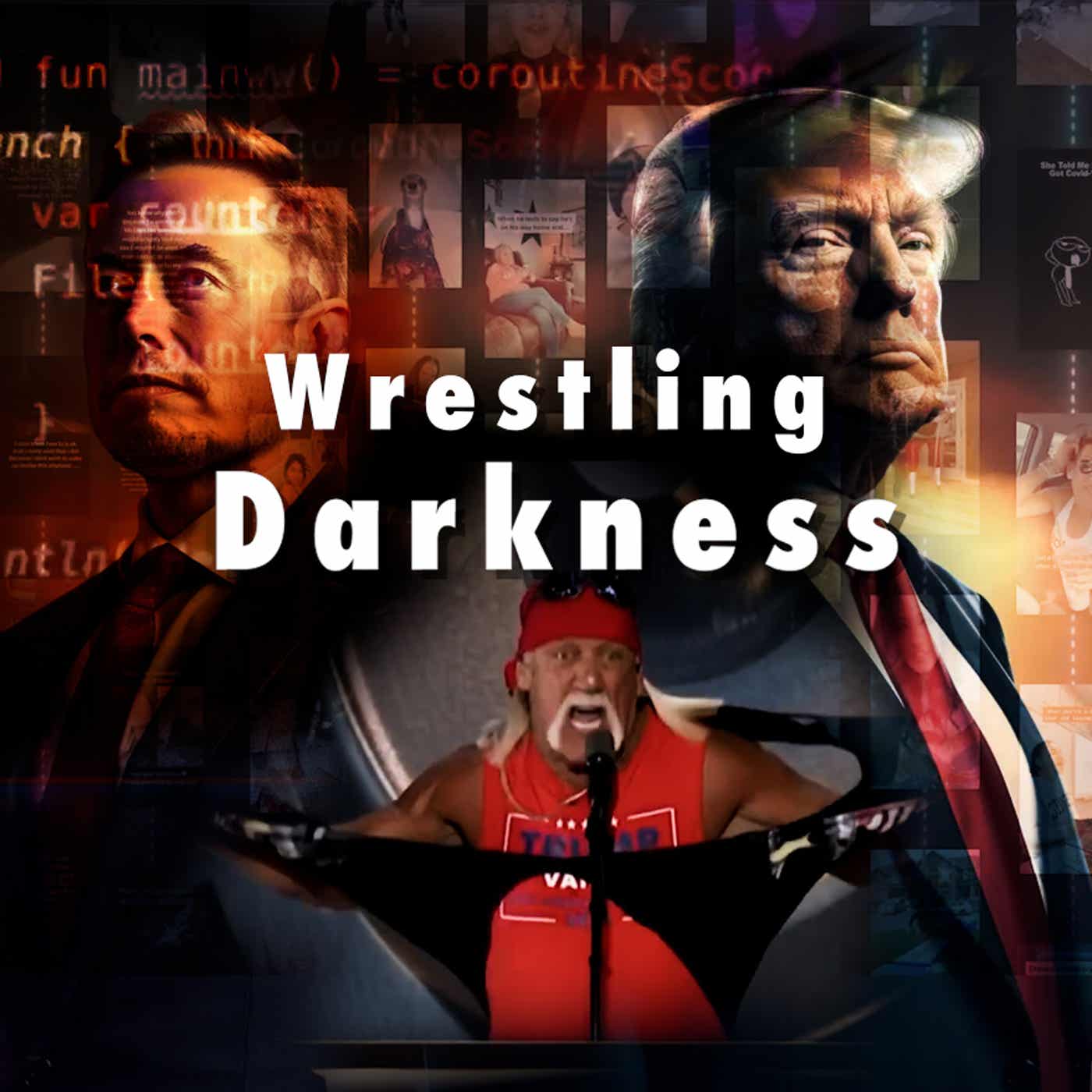
Wrestling Darkness
by Eric Byler
How did the lowest standards for accuracy and authenticity, like those of professional wrestling, become the standards for cable news, politics, and the U.S. federal government? World leading scholars and historians offer insights and clues in this "cultural forensics" investigation into how professional wrestling and its imitators transformed media, and thus all aspects of American life that depend on media.Wrestling Darkness (available with video via https://ericbyler.substack.com) begins with cultural shift that began with the runaway success of the World Wrestling Foundation (WWF) in the 1980s. Wrestling's engrossing approach to melodrama — reflecting current political conflicts with scripted scenes and violent choreography prescribing good guys, bad guys and avenues for fan participation — was then emulated by the Fox News channel, countless reality TV programs, and TV talk shows, also with meteoric success. Social media platforms have since deployed addictive algorithms that ex
-
17
The truth about Hulk Hogan — Episode 12
The most famous and emblematic American hero of his time, he defended us against the offenses of foreigners, fairies, and egoists. He abused illegal steroids, but denied it so he could be a good role model for generations of children for whom he recommended more traditional vitamins. Behind the scenes, he ratted out his fellow wrestlers as they sought healthcare and labor protections from a boss who exploited them. Disgraced and erased after leaked audio of his bigoted remarks surfaced in 2015, he was later redeemed and reclaimed, as attitudes shifted to make room for bigotry, even in our heroes.Hulk Hogan died of heart failure on July 24, 2025. Now that his family, his friends, and his millions of fans have had time to mourn, we feel it is our responsibility to talk about Hulk Hogan, less as an action figure, and more as an historical figure.Somebody had to.To help me, I’ve invited back media critic and wrestling fan Sarah Kurchak and wrestling’s world-leading scholar, Dr. Sharon Mazer. Sarah joined us from Toronto and Sarah from New Zealand, where she had been in high demand as an interviewee on the day of Hogan’s demise. Early on, we threw off the thoughtless reverence that accompanied such early reports, while embracing nostalgia and compassion for a man who was a hero of mine three decades ago. When Sharon suggested that he died knowing his actions and his words had alienated the majority of the wrestling world, I genuinely felt sorry for him, as you can hear and/or see.The most relevant previous episode of Wrestling Darkness, and all of the others, are listed below with hyperlinks.Ep. 5: Why wrestling fans boo Hulk HoganBoos and screams of “Nobody cares!” and “f***ing b******t!” drowned out Hulk Hogan’s pitch for his homophobic beer brand. Why are today’s wrestling fans so sick of yesterday’s hero, and what might it mean for America’s future?Read full storyTo support Wrestling Darkness and other content on the Eric Byler Substack feed, please subscribe or make a tax deductible donation.Episode 2 — Wrestling Has Infected EverythingIn which we trace wrestling’s important impact on entertainment, cable news, culture, and politics in the U.S., as well as the psychology of fandom, and the appetite for Mr. Trump’s carnival of fascism.Episode 3 — How to Please a DemigodIn which we speak to two Australian university students who posed as MAGA fans in order to interview Trump supporters and attend one of Mr. Trump’s political rallies.Episode 4 — Age of the FantasistIn which Prof. Larry Lessig explains the impact of the algorithms that govern social media, and how a pro-wrestling standard for authenticity has impacted social media, and thereby politics and culture.Episode 5 — Why Wrestling Fans Boo Hulk HoganIn which wrestling experts Sharon Mazer and Sarah Kurchak offer a closer analysis of professional wrestling in its current incarnation.Episode 6 — The Stubborn Illusion of the TheatricalWrestling experts Sharon and Sarah comment on the fiasco in the Oval Office starring President Trump and President Zzelenskyy, then predict the future of Trump’s America, including, correctly, the break with Elon Musk and Mr. Trump.Episode 7 — Sins of the Algorithmic CuratorFollows on from Episode 4 and the impact of algorithms and social media technology with author and expert Renee DiResta Episode 8 — Virtual Manhood, Virtual RapeConnects back to “Woman Hating” and it’s most sinister manifestations online, including death threats, rape threats and “Deep Fake Porn” targeting outspoken women, with author and expert Nina Jankowicz.Episode 9 This Molten Thing About Interracial SexThe intersection of race, sex, and politics in America with historian Tim Tyson, focusing on his bestselling books “The Blood of Emmitt Till” and “Blood Done Sign My Name.”Episode 10 and Episode 11 White Genocide, Black FatigueTwo-part interview with author and political theorist Sisonke Msimang about South Africa and the United States. Episode 10 focuses on her memoir, “Always Another Country.” Episode 11 debunks President Trump’s fable about a “white genocide” in South Africa. Get full access to Wrestling Darkness at ericbyler.substack.com/subscribe
-
16
White genocide, Black fatigue — Ep.11
In part 1 of my interview with Sisonke Msimang, I brought up the phenomenon of “Black fatigue” by telling her a story about a white man who had attended a Black Lives Matter rally during the aftermath of George Floyd’s murder. After the police shot him with a rubber bullet, he decided he would no longer attend such rallies.From there, Sisonke and I agreed upon a basic definition of “Black fatigue” — the expression of annoyance or exhaustion with the awareness and/or attempts to address the legacy of white supremacy. Confronting the past and the present in an honest manner can make people feel sad, ashamed, and uncomfortable. It’s understandable.The flip side of “Black fatigue” is the grotesque overinflation of white victimization and grievance. There is perhaps no better example than President Donald Trump’s “white genocide” fable, which has become a foundation of U.S. foreign policy despite the fact that is fabricated for the purpose of winning a land policy dispute.RootsThe “white genocide” narrative has roots in the pre-Apartheid, British colonial era of South Africa. In fact, as Sisonke says, it was instrumental in the political campaign that installed the Apartheid regime in 1948.Today’s incarnation of the white genocide fable is the project of Kallie Kriel and Ernst Roets, two white South African activists of Dutch ancestry (Afrikaners) who have found allies among American white nationalists such as Tucker Carlson, Steve Bannon, and Charlie Kirk. Their performances on podcasts and other mediums have captivated President Trump ever since his previous administration. But this time around, Trump isn’t just watching the wrestlers in the ring; he has joined them.Foggy insinuations about “terrible things” soon grew to accusations of genocide in the Oval Office, and in between, the United States expelled the South African ambassador Ebrahim Rasool.(Elaborate lies spewed at campaign rallies or spread on social media are par for the course in Trump’s America. But when an unfounded conspiracy theory becomes a state-sponsored soap opera, and that soap opera becomes the basis for U.S. foreign policy, that really should be some sort of red alert. But that is not our purpose here.)While the general public in South Africa has responded with flippancy and laughter, the political class and the business community have failed to see the humor. As Sisonke Msimang writes for The Intercept:At first, the nation was furious with the Afrikaner organizations. The executive order was strongly worded and threatened sanctions. South Africans across all race groups criticized Kriel and Roets for convincing a foreign government to collectively punish the entire country over falsehoods. They were accused of peddling lies and disinformation and called traitors, as the nation worried that the U.S. would impose sanctions. Even AgriSA, a group that specifically represents the interests of farmers and has historically been dominated by Afrikaners, said “claims linking farm murders to the signing of the [Land Expropriation] act are baseless and irresponsible.”As the anger mounted, AfriForum and Solidarity held a press conference in which they tried to distance themselves from Trump’s order. With his tail between his legs, Kriel backtracked on his claims of a white genocide. He has gone on to turn down Trump’s offer of asylum, insisting he was a patriotic South African who wanted to reaffirm “our commitment, our recommitment, to the country and all its people.”Catching up with Mr. Trump’s wrestling showOn Feb 2, 2025, President Trump announced that South Africa is “under investigation.” A reporter had asked him why he posted to social media that the U.S. would suspend aid to South Africa. What was the offense?That’s when Trump stumbled on the fateful phrase, “Terrible things are happening in South Africa.” These seven words would inspire waves of mockery, defiance, and interracial fellowship, as South Africans of all races posted videos and memes depicting kissing, dancing, and fully integrated, harmonious daily life as sarcastic examples of “terrible things.”But Mr. Trump wasn’t finished. His executive order five days later proclaimed that the U.S. would no longer provide foreign aid or assistance to South Africa, and it established a refugee program for the white people in South Africa “who are victims of unjust racial discrimination” (meanwhile, legitimate refugee programs that bring nonwhite people to the United States had been indefinitely suspended). By the time South African President Cyril Ramaphosa sat down in the Oval Office on May 21, 2025, Mr. Trump had prepared a stack of web clippings and a video montage that he thought would expose white genocide, embarrass Ramaphosa, and shock the world. Journalists quickly fact-checked Trump’s presentation and found jaw dropping mistakes, such as photographs of events that did not take place in South Africa, and the inclusion of white crosses arranged for a political demonstration which Mr. Trump had mistaken for a mass grave for thousands of murdered white people.Notes: * Click here for part 1 of this conversation, which focuses on Sisonke’s acclaimed memoir, Always Another Country.* During this episodes, we discuss Sisonke’s article, How Trump’s Embrace of Afrikaner “Refugees” Became a Joke in South Africa. You might also read On Trump and the invention of white victims in South Africa, which she published on Substack.* During this conversation, I referenced Episode 10 of Wrestling Darkness as I compared South African Apartheid to the Jim Crow Era in the United States. To support Wrestling Darkness, please become a subscriber (free or paid) and/or make a tax deductible donation. Get full access to Wrestling Darkness at ericbyler.substack.com/subscribe
-
15
Black fatigue, White genocide — Ep.10
Attempts to address racism are fruitless unless we find paths that lead to healing. This is one of many epiphanies I found in reading Sisonke Msimang’s acclaimed memoir, Always Another Country. We talked at length about South Africa and the United States, our two, sister nations each struggling to free themselves from caste systems that date back to colonial times.The emotional heart of Always Another Country is in South Africa, but Sisonke’s revolutionary father and accountant mother raised their three daughters in exile during Apartheid. Born in Zambia, Sisonke also grew up in Canada and Kenya before attending university in the United States.After the fall of Apartheid, Sisonke “returned” to a country she had not yet seen. She engaged in suburban turf battles with white South Africans during the historic presidency of Nelson Mandela, and through them, she learned lessons about herself and her country that are germane to the challenges we now face in the United States.In reflecting on her efforts and encounters in South Africa and in North America, she concludes that once we have created a caste system, it’s difficult to replace it or even change it very much. Rifts created by race and class, she finds, should not supersede our moral responsibility to one another as human beings. She writes that “decisions I make, even the small ones, like extending a hand in friendship, will make a difference in the long run.”In both the memoir and our chat, Sisonke holds herself accountable for wielding power and privilege not unlike that which had been reserved for whites in South Africa not so long ago. In part two of our conversation, I ask Sisonke if there is a “grain of truth” in President Trump’s assertion that there is a “white genocide” in South Africa. To support Wrestling Darkness, please become a subscriber (free or paid) and/or make a tax deductible donation.NOTES: * This episode was recorded before Mr. Trump sent the U.S. military to suppress immigration protests in Los Angeles. * I searched far and wide to find the right guest to follow episode 9 which also discusses race and racism. Of all places, I located Sisonke in Australia, a complete coincidence (I recently returned to the U.S. after six years Down Under).* Rev. Dr. William Barber II is mentioned in the second half of this episode. The interview clip I included is from a work-in-progress documentary called Blood Kin.* The film I mentioned that begins with “Learn how to speak English!” is called 9500 Liberty can be seen here. Get full access to Wrestling Darkness at ericbyler.substack.com/subscribe
-
14
Remarks prior to arrest at the U.S. Capitol by Rev. Dr. William J. Barber
On the evening of April 2nd, 2013, Rev. Dr. William J. Barber II proposed what would become the Moral Monday movement to an emergency gathering at a North Carolina church. Within three years, they had taken down a governor and transformed the national conversation about the role of morality in civic life.Today, Rev. Barber faces the challenge of his life as the leader of the Repairers of the Breach movement, which is organizing civil disobedience actions at the U.S. Capitol on the first Monday of each month this summer.“This sacred action is a bold response to an immoral budget and unjust policies that harm the poor, women, children, and workers,” he writes. “Grounded in Micah 6:8 and the prophetic traditions of justice and mercy, we will stand together to say No to oppression and Yes to love, justice, and the sacred dignity of all. Sign up now and declare: ‘We will not be silent anymore.’” Get full access to Wrestling Darkness at ericbyler.substack.com/subscribe
-
13
This molten thing about interracial sex — Ep.9
“This molten thing about interracial sex” was always at the core of fights about integration and equality, explains historian and author Dr. Timothy B. Tyson.“The Southern Rape Complex” fueled a century of hate crimes & white dominance of our political process. But this racist lie and covenant was gradually vacated by white women, and its simmering rage now targets women in general, as well as nonwhite men.The ritual of sexually charged political violence echoes throughout this episode as it does throughout American history, as it continues to deform our psyche and our culture. The historical roots of today’s technology-driven, crowdsourced abuse of women online — the subject of a previous episode of Wrestling Darkness — can be traced back to the waves of domestic terrorism that ended Reconstruction.History catches up with usTim Tyson is a dear friend of mine. He taught me to like whisky, something I never would have expected, honestly. And, he showed me that a loving and moral man can love his culture and his country without being blind to its sins. This episode is, on one level, two friends catching up after a period of separation caused by my six years as a family man living in Australia.But this friend happens to have written two New York Times best-selling books, the first of which was impelled by his confusion and pain during a “late-model lynching” that took place during his childhood.The resulting book, Blood Done Sign My Name, lured one of the vanishing ghosts of the Jim Crow Era to come out of hiding. After reading it, she summoned Tim to her home for a private confession about the most infamous hate crime in American history, the murder of Emmett Till.Tim wasn’t planning on writing a book about the Till case. But Carolyn Bryant — the woman who accused Till of having sexually harassed and touched her at the family store — had given him the only two interviews she had granted in the five decades since Till’s death. And she had entrusted him with the pages of her unfinished memoir, which he agreed to one day furnish to the appropriate historical archive, but until then keep under wraps.He spent the next seven years researching the case. When The Blood of Emmett Till was published in 2017, Tim was contacted by the Mississippi Attorney General and the FBI. Under subpoena, he turned over all his research materials, including the unfinished memoir for a renewed investigation, that could potentially charge Carolyn Bryant with a crime.We discuss this during the episode, but the bulk of it is devoted to the myth of “the Black Beast Rapist” which was engineering by politicians and media moguls to incite the wave of terrorism that violently overthrew the democracies of each of the former Confederate states between 1875 and 1898 — and how this evil but ingenious narrative echoes in this, the era of Trumpism.Watch all episodes of Wrestling Darkness on Substack and YouTube, and hear them on all the usual podcast apps such as Apple Podcast and Spotify.Tim Tyson appears in The Headless Klansman of Selma, a short film I co-directed with Annabel Park. Get full access to Wrestling Darkness at ericbyler.substack.com/subscribe
-
12
Virtual manhood, virtual rape — Ep.8
Without hiding her pain or her vulnerability, Nina Jankowicz describes how hundreds of thousands of grotesquely sexual and violent online assaults have hurt her, frightened her, and impacted her life. We must “fight for a world that recognizes that our rights as women to free expression online are just as valuable as our abusers’,” she writes in her most recent book, How to Be a Woman Online. And fight she does, effectively and ferociously.In this episode we talk about how and why girls and women are attacked by virtual rape mobs, and how that might change with the passage of the Take It Down Act, legislation that has passed the U.S. Senate and is due for a vote in the House.How can 250 Fox News segments be wrong? Fox News has many, many things in common with professional wrestling. Both mass media products are conflict-driven soap operas that script and perform storylines that manufacture a pretext for violence.In the case of Jankowicz, the violence Fox News engineered has been virtual. It has also been grotesquely sexual, misogynistic, and antisemitic.Since Fox News aired 250 segments instructing its millions of viewers to hate her, Jankowicz has endured hundreds of death and/or rape threats, hundreds of thousands of messages containing sexualized and/or sexist abuse, a cyber stalker, and the virtual assault of “deep fake pornography.” A few weeks before she was due to give birth to her son, her private security contractor advised her and her husband to flee their home after their address was posted online.Now, you might be asking yourself why Fox News targeted her. What she might have done to deserve these attacks? Was she caught on camera sharing a ginger mint with her mother on Election Day? Did she once sign a petition alleging that 9/11 was a hoax? Well, no. And really, that’s not the point. She’s a progressive woman with ideas that sound threatening to some men and to many conservatives. But conservative women have faced online sexual abuse as well. Perhaps we can put political goals aside in the interest of equality, democracy, and free speech — or how about public safety?The purpose of crowdsourced online abuse is make the target feel afraid and alone. They hope she will feel so isolated that she will decide that her voice and her online civic engagement are not worth enduring the backlash.That’s precisely why we need the targets of such assaults to break their silences, and that’s why the rest of us need to have their backs.Mentioned in this the episode are This Molten Thing About Interracial Sex featuring Tim Tyson, and Woman Hating (Season 1, Ep1), and Renée DiResta who appears in Sins of the Algorithmic Curator (Season 2, Ep2).Watch all episodes of Wrestling Darkness on Substack and YouTube, and hear them on all the usual podcast apps such as Apple Podcast and Spotify.To support Wrestling Darkness and other content on the Eric Byler Substack feed, please subscribe or make a tax deductible donation Get full access to Wrestling Darkness at ericbyler.substack.com/subscribe
-
11
Sins of the Algorithmic Curator — Ep.7
“A deluge of content sorted by incentivized algorithms and shared instantaneously among aligned believers has enabled us to immerse ourselves in environments tailored to our own beliefs and populated with our own preferred facts.”So writes Renée DiResta in the era-defining book Invisible Rulers. She traces the history of human-to-human influence from the local tavern in preindustrial times to the early days of radio and television, and the present day incentive structures on social media that cut in favor of nastiness, lies, and vilification.In a previous episode of Wrestling Darkness, Lawrence Lessig attributed this phenomenon to the profit motive of Big Tech companies. Realizing that their users’ search, scrolling, and clicking preferences offered them a gold rush of data to be exploited for targeted advertising, companies like Google and Facebook kicked off an arms race, supercharging curation algorithms to induce addiction.Lessig cited and recommended DiResta’s book during the interview. I read it, loved it, and asked her to sit down with me for this fascinating conversation. The episode that led to this one is embedded below, and don’t miss DiResta’s interview with Mona Charon of The Bulwark.To support Wrestling Darkness and other content on the Eric Byler Substack feed, subscribe or make a tax deductible donation. Get full access to Wrestling Darkness at ericbyler.substack.com/subscribe
-
10
The stubborn illusion of the theatrical Ep.6
When we buy a ticket to see a movie or a play, the worst that can happen is we’ll be bored, or disappointed, or we won’t be able to maintain our suspension of disbelief. As viewers, we do all we can to believe in worlds of make believe, and in return we get escapism, catharsis, a good cry, a laugh, or a scare.But what happens when the form of entertainment to which we have committed ourselves follows us into our communities and our homes? What if there’s no escape from the escapism? And what if the consequences are life and death on a global scale?It seems the people best equipped to navigate politics in America today are wrestling performers, their followers, and their ringmasters. Donald Trump and Jon Stewart certainly understand the game. Vladimir Putin and Volodymyr Zelenskyy do too. Trumpian politics, like wrestling, is a never-ending parade of ruptures and realignments. When you have the power, the money, and the skill to decide for your audience who to hate and why, you have the power to transform a narrative, or summon a mob. Stewart’s breakdown of the infamous Oval Office debacle was both hilarious and tragic. He didn’t even need to mention Trump’s meteoric success as a professional wrestling performer 18 years ago, nor his shift to two important derivatives of wrestling theatricality: reality TV and cable news. His success on The Apprentice depended on the illusion that he had been successful as a businessman. His success as a cable news personality derived solely from his shameless depiction of a deranged bigot fixated on Barack Obama’s birth certificate.Most people I know think wrestling is for fools, not to be studied or considered beyond a cheap insult or a punchline. But the joke is on us, if a deeper understanding of wrestling parlance and culture eludes us for any longer.While season one of Wrestling Darkness examines how and why we came to live in the world pro wrestling created, Season 2 kicks off with an introduction to some of the most famous plot twists in wrestling history as a prism through which to see, yes, Trump and J.D. Vance’s tag team debacle in the Oval Office, but also other political performances that are otherwise incomprehensible. Wrestling’s leading scholar Dr Sharon Mazer joins us once again from New Zealand along with author and journalist Sarah Kurchak who joins us from Toronto.In her forthcoming essay, Dr Mazer grapples with the stubborn illusion of the theatrical as it applies to wrestling, politics, and humanity’s uncertain future.Below are three relevant episodes from Season 1 of Wrestling Darkness:To support Wrestling Darkness and other content on the Eric Byler Substack feed, please subscribe or make a tax deductible donation. Get full access to Wrestling Darkness at ericbyler.substack.com/subscribe
-
9
Why wrestling fans boo Hulk Hogan — Ep.5
A $5 billion dollar deal to stream World Wrestling Entertainment on Netflix kicked off on January 6, 2025 with 4 matches sprinkled across three hours of pageantry.But the headlines were stolen by Hulk Hogan. Boos and screams of “Nobody cares!” and “f***ing b******t!” drowned out his pitch for a beer brand he launched as part of a right wing backlash against a Bud Light commercial that featured a transgender woman.What does the Hulkster’s rude reception tell us about wrestling's past and America's future?Wrestling’s preeminent scholar, Dr Sharon Mazer, joins us along with wrestling fan and media critic Sarah Kurchak to help us sort it out.See all five episodes of Wrestling Darkness on Substack and YouTube, and hear them on all the usual podcast apps such as Apple Podcast and Spotify.—EricTo support Wrestling Darkness and other content on the Eric Byler Substack feed, please subscribe or make a tax deductible donation. Get full access to Wrestling Darkness at ericbyler.substack.com/subscribe
-
8
They faced down fear politics, and won: the story of 9500 Liberty
Seasons Greetings! The holidays have snuck up on me. I have added the documentary 9500 Liberty to the Wrestling Darkness feed as a bonus episode. In the opening seconds, you’ll understand how it relates to the podcast and to the present day. —EricArc of justiceIt looked pretty bleak for immigrant advocates in Prince William County, Virginia. On July 10th, 2007 the Board of County Supervisors had suddenly and unanimously passed “The Immigration Resolution,” legislation written for them by an anti-immigrant lobbying firm in Washington D.C.The Immigration Resolution required police officers to apply greater scrutiny to people who looked like immigrants. Once they had stopped a person for an otherwise lawful reason, such as a speeding ticket, police officers would be mandated to ask for proof of legal status if they discerned “probable cause” based on their appearance.Civil rights attorneys raised concerns about racial profiling and violations of the Constitution, in particular, Equal Protection under the law.Police officers were worried about losing the trust of communities of color, something they had worked hard to earn, and an important tool in preventing and solving crimes. Citizens and recent immigrants wondered if they would get pulled over by the cops because of the color of their skin.In a county of 380,000 residents, no one seemed to know about the Board of County Supervisors’ fateful vote, with the exception of an arch-conservative County Supervisor, the Beltway lobbyists who had approached him, and a local group of activists calling themselves “Help Save Manassas.”Help Save Manassas was led by a blogger named Greg Letiecq, a talented writer with fantasist communication skills far ahead of his time. It was as if Steve Bannon had used a time machine to send a digital foot soldier from the future.If a crime was committed by a person with a Latin-sounding name, the blog would pounce with frightening images and dire warnings about an invasion of dangerous criminals. Letiecq’s blog posts (and his chorus of commenters) created the perception that there was a crime wave in the county, even though crime rates had been steadily falling for years as the immigrant population had grown. The blog even blamed immigrants for the existence of rats.In the year-plus before the immigration controversy, Letiecq had attracted a sizable fan base — hundreds, perhaps thousands. He could persuade many of them to write an email to the Board of County Supervisors, or appear in person to speak during “Citizens Time,” with the click of a button.The Board of County Supervisors — made up of 6 Republicans and 2 Democrats at that time —quaked in their boots. Never had they received so many emails! The votes in favor of the Immigration Resolution in September and October were unanimous also.The Latino community responded with mass protests and angry denunciations. But the popular perception was that the immigrants were not voters, and thus should be ignored by elected officials sworn to represent Real Americans.And the Real Americans wanted the immigrants removed as quickly as possible, so much so that they were willing to divert public safety resources to do it.When the widely respected Chief of Police, Charlie Deane, who had been serving the county for five decades, was informed he was being attacked on a blog, he said, “What’s a blog?”People who opposed Letiecq’s views read the blog too. They felt compelled to keep up to date on who he was coming after next.If a business leader or a member of the clergy expressed reservations about the Immigration Resolution, the blog and its commenters would attack them viciously. Boycott the church! Boycott the business! People were receiving death threats. And when advocates for the Immigration Resolution addressed the Board during Citizens Time, they echoed the blog’s hyperbolic rhetoric.“One way or another, we will repel this invasion!” one man, a previously respected attorney, famously shouted. The specter of mob violence was in the air.Oh, and there was a statewide election taking place at the same time. The Democratic candidates were under pressure to shift to the right on immigration. At one point, I walked past the office of the incumbent Democratic state senator for the area. I could see through the window that the blog was up on the computer monitor. It was everywhere!Despite all of that, things were about to change, and quickly.The Regular Person Strikes BackThe extended trailer for 9500 Liberty tells the story in 4-minutes. But I do recommend listening to or watching the entire film because experiencing it in 78 minutes gives you a sense of how it felt to live in a climate of fear, and what it took to overcome it.Everyday people banded together, inspiring one another with hard work, innovative ideas, and periodic doses of civic courage.The turning point (in my view) came when a woman created a second blog to oppose the first one. Writers on the blog used their own names to stand up to the bullies, so to speak. They also organized email campaigns and appeared during “Citizens Time, and they did all of this with a cohesive message structured around the common good; whereas the previous opposition had been immigrants standing up for themselves or religious people speaking out in defense of “the least of these.”Facts about crime soon triumphed over fictions. Morality and ethics were still part of the argument, but these were joined fiscal responsibility and legal liability. Would the U.S. Department of Justice be okay with requiring the police to profile people? If not, would they sue the county as they had other jurisdictions that ran afoul of the Constitution? What if a legal resident felt their rights had been abused and filed a lawsuit? What if dozens of them did? Would frightening away a few thousand immigrants be worth the cost to taxpayers?The growing coalition included moderate Republicans, Democrats, and independents. It included members of faith community, members of the business community, and concerned citizens, many of them moms with immigrant families or immigrant family histories. Each new person who stepped forward emboldened the next to do the same.The Supervisors and others in the county government saw that there was at least as much opposition to the “probable cause” mandate as there was support.In the end, it was an economic argument that pushed them over the top. Immigrant families took flight it droves. Homes and businesses were abandoned, decimating property values and with them the county budget and the local economy.Proponents of the “probable cause” mandate fell victim to some unfortunate timing — the mandate went into effect just when the economic impact of all the fear and controversy was becoming undeniably visible.The leading economist in the area explained in a widely seen video (that I produced) that business owners, customers, and capital (money) were leaving Prince William County because of the controversy and the radical shift in policy. The housing crises, he rightly judged, was part of a national home foreclosure crisis that was gripping the nation in early 2008, but Prince William County’s immigration fight had made it much worse, and he had the data to back it up.It became clear the Immigration Resolution was hurting everyone; not just its intended targets.The mandate for immigration status checks based on “probable cause” was stripped from the books on April 29th, 2008. Life returned to normal. And, crime? After a brief spike that coincided with the ugly controversy, crime rates continued to fall.To support Wrestling Darkness and other content on the Eric Byler Substack feed, please make a tax deductible donation or subscribe. Get full access to Wrestling Darkness at ericbyler.substack.com/subscribe
-
7
The Age of the Fantasist — Ep.4
My guest in episode 4 of Wrestling Darkness is Professor Lawrence Lessig who explains in his essay, The Age of the Fantasist, how and why algorithmic media came to reward narratives that lie to us.“The fantasist doesn’t worry that he will not please everyone. He’s not aiming for everyone. Indeed, he is aiming precisely to avoid appealing to everyone. Division drives attention in a world of fragmented media.” —Lawrence LessigPerhaps you’re not prepared for a conversation that bridges artificial intelligence (AI) and professional wrestling. Don’t worry, neither was Professor Lessig! But we did arrive at a helpful framework for decoding today’s media landscape, an important first step if we decide we wish to change it.AI selects for people (fantasists) that resemble professional wrestling because it knows such fact-free hyperbole causes people to click, to watch, and to share. The aggregate impact is a threat to humanity, Lessig warns, because it divides us, and thus, makes us ripe for the conquering.AI is “the most extraordinary technology humanity has ever even conceived of,” he said during harrowing presentation at TedxBerlin in February. But, it is one we need to watch “with the paranoia of the hunted.”If you like episode 4, the previous episode most closely related to this one is episode 2.—EricPS: I am entering a Fair Use battle with World Wrestling Entertainment (WWE) and other corporations that own its content. Right now, the first two episodes of Wrestling Darkness are blocked on YouTube. The guests for these episodes have written books about professional wrestling and are critical of wrestling. But the Fair Use doctrine was not intended to insulate entertainment corporations from criticism by academics or journalists. The U.S. government defines the Fair Use as a legal doctrine intended to promote freedom of expression by permitting the unlicensed use of copyright-protected works in certain circumstances, including nonprofit educational purposes.Regardless of the outcome, you can see all four episodes on Substack, and hear them on all the usual podcast apps such as Apple Podcast and Spotify.To support Wrestling Darkness and other content on the Eric Byler Substack feed, please subscribe or make a tax deductible donation. Get full access to Wrestling Darkness at ericbyler.substack.com/subscribe
-
6
How to please a demigod — Ep.3
Oscar Keohan and Jacob Johns traveled from Australia to tour the U.S. in the weeks leading up to the 2024 presidential election. But an unexpectedly dark turn at a Trump rally in North Carolina overshadowed their de Tocqueville-like experience.Supplemented by video recordings, they share with us why they felt sickened by the way the president-elect manipulated his fervent supporters, and the way the crowd responded.Donald Trump’s journey from Wrestlemania to the White House and the truth-bending madness that has metastasized in politics, news infotainment, and online echo chambers is summarized midway through this episode, which means viewer/listeners can begin here and circle back to episodes 1 and 2.To support Wrestling Darkness and other content on this feed, please make a tax deductible donation and/or subscribe.The music for Wrestling Darkness was composed by Michael Brook, who scored all four of my feature length films. The jazzy improv rendition of the song is performed by David Scott Binanay & Stephen Munoz, who also played at my wedding!—Eric Get full access to Wrestling Darkness at ericbyler.substack.com/subscribe
-
5
Wrestling Has Infected Everything - Ep.2
Abraham Josephine Riesman, author of the best-selling biography Ringmaster: Vince McMahon and the Unmaking of America., explains how the production of cheap, addictive entertainment such as pro wrestling, cable news, and reality TV, changed the culture of American.Our conversation traces a cultural transformation that began in the mid-1980’s, as the truth-bending madness of professional wrestling took hold in adjacent sectors such as cable news, Jerry Springer and similar talk shows, and reality TV.With Donald Trump's celebrated Wrestlemania appearance, followed by his emergence as the leader of the Birther movement, wrestling-style fandom would go on to revolutionize politics, government, and society as well.In Episode 1, Dr. Sharon Mazer and I focused more on violence against women depicted in wrestling programs. We also delved a bit deeper into Donald Trump’s political rearing in the wrestling arena.To support Wrestling Darkness and other content on the Eric Byler Substack feed, please make a tax deductible donation and/or subscribe.The music for Wrestling Darkness was composed by Michael Brook and performed by David Scott Binanay & Stephen Munoz.The Wrestling Darkness podcast and the other content found on the @EricByler substack feed is supported by the 501c3 non-profit ID Alliance. Get full access to Wrestling Darkness at ericbyler.substack.com/subscribe
-
4
Woman Hating — Wrestling Darkness Ep.1
Dr Sharon Mazer is the author of Professional Wrestling: Sport and Spectacle, and the only woman in the Netflix documentary Mr. McMahon, argues that Donald Trump’s political career and persona are direct outgrowths of his appearances in Wrestlemania and other professional wrestling programs, and that the structure and format of wrestling has “escaped the arena” and warped American culture.We drill down on "incels" — involuntarily celibate men, and other men who hate women — as a consumer group and a voting block in today's America, and how they were cultivated by mass media, wrestling first and foremost.The docuseries, directed by Chris Smith, has many fascinating and important threads, and even a heartwarming story about Vince McMahon’s relationship with his son, Shane.But Professor Mazer and I focus on violence against women depicted in professional wrestling, and allegedly inflicted on employees of Vince McMahon over many decades.To support Wrestling Darkness and other content on the Eric Byler Substack feed, please make a tax deductible donation or subscribe. Get full access to Wrestling Darkness at ericbyler.substack.com/subscribe
-
3
Forgiving the fathers we lose to racism
A woman once told me she got divorced because of a film I made. Seeing the film deepened her misgivings about her husband’s racism, and after years of questioning herself, she left him.The woman was Asian and her husband was white — just like my mom and dad, and just like a couple played by Ryan Kutrona and Takayo Fischer in American Knees.Above: Selected scenes from American Knees. Below: The message I intended.Love is allHank and Keiko take turns squeezing hands with Miles (Stephen Bishop), expressing with great fervor how delighted they are to welcome him into their home. Unspoken, yet obvious, is the fact that they are uncomfortable with his Blackness.Hank thinks he is impervious to accusations of racism because he married an Asian woman. He objects when his daughters date men of color not because of his own feelings, but because he wants to protect his daughters from (white) society’s judgement.Julia (Annie Katsura Rollins) and Aurora (Allison Sie) respond to this paradox in different ways. Julia stews with muted anger when her mother deploys Asian-mom insinuation to pressure her about her African American boyfriend. Aurora has taken flak from her dad about an Asian American boyfriend, but that relationship is over now. She plans to appeal to his better nature to pave the way for Julia’s marriage.Hank is the character I altered most in adapting Shawn Wong’s canonical novel. I made Hank more charming, unassuming, and lovable because I wanted audiences to feel the ache of confronting racism in someone who means the world to you.Someone like your Dad.As he shrinks in her eyesIt is not only white men who want power over women’s bodies. But when gender insecurities are compounded by racial insecurities, the result can be ghastly.In locker rooms, at pro wrestling events, and at political rallies, men think they appear strong and masculine when they talk about asserting power over women. But in the eyes of women, the opposite is true.When Hank explains why he is meddling in his daughter’s romantic life, Aurora is overwhelmed with sadness and disappointment. He feels his own diminishment as he shrinks in her eyes. It’s tragic for them both. In seconds, the father she loved melts away and in his place, she sees the man he always was. What should she do now?Aurora’s quandary, which always brings tears to my eyes, was inspired by the following words from the novel:“Each time you let something pass that’s generally insulting or racist about Asian people and it isn’t specifically directed at you, you’re in a sense passing for white.”“Passing for white” is an especially painful notion for mixed race Americans because it means that we are hiding behind White privilege, exploiting our lighter skin or other attributes to benefit from racist hierarchies that we otherwise denounce.With these words, which I borrowed in the screen adaptation, Shawn Wong explained to me why I felt ashamed when my baseball teammates used racist stereotypes to poke fun at an Asian player in the other dugout. I could have said, “Hey, my mom is Chinese.” But I didn’t. Before and since then, I have “let it slide” when people in my presence made homophobic remarks and objectified women. Usually, it was in settings where cohesion was preferable to conflict (a family gathering, a sporting contest, a news room, a film set). Sometimes, I just didn’t feel like starting an argument.So where we draw the line?I draw the line when bigotry is made into government policy. I consider it a civic duty to interrupt that process in any way I can. In the film, Aurora’s family has enacted a family policy under which Julia’s African American boyfriend is welcome in private settings but not at Hank’s retirement party. This policy hurts her sister in ways she cannot accept.When she fails to change her father’s mind, she tacitly forgives him. But she decides not to attend the party.Thankfully, my father has never put me in such a position. But, like millions of Americans of every background, I lament the walls that Fox News and Donald Trump have created between us.I share some of the blame. When I went to Wesleyan University and came home angry and defiant on matters of race and racism, I said things that hurt him.I have since learned to be respectful in such conversations. But my father and I usually avoid the subject. We talk about things we both love, his grandkids mostly, and baseball.Every now and again we try, but these days racism and politics have fused to a degree that neither of us can tell them apart, and parsing the lines between fact and fiction is as tedious as it is fruitless. It aggravates us both.I can’t make my father in my own image any more than he can make me in his. And even if that was my goal, it would be a selfish one — more about me than about making the world a better place. My father raised me well. He was and is warm, kind and loving. And now that I’m a father myself, I realize that I learned and gained from him all the best parts of me that I bring to fathering my own children. I value nothing more. The least I can do is love him in spite of Fox News. He is much happier. I am as well.Also depicted in the selected scenes above: Chris Tashima as Raymond, Joan Chen as Betty, Kelly Hu as Brenda.Eric Byler is a reader-supported publication. To receive new posts and support my work, consider becoming a free or paid subscriber. Get full access to Wrestling Darkness at ericbyler.substack.com/subscribe
-
2
The Headless Klansman of Selma
The Headless Klansman of Selma is the story of a Confederate monument that venerates the first Grand Wizard of the Ku Klux Klan. Like the Trump political phenomenon, the statue originated as a backlash against the results of a free and fair election. The people of Selma, Alabama elected the city’s first ever African American mayor on September 12, 2000. The defeated mayor, a former segregationist, quietly approved the KKK monument as a message for his successor and those who supported him.The monument was vandalized in 2012, leaving it headless, and our film follows the ensuing battle to its May 23, 2015 conclusion.Donald Trump’s golden escalator ride was three weeks later on June 16, 2015. The day after that, Dylann Roof brought a gun to a Bible Study at an African American church and killed nine people. This led to the removal of the Confederate flag from the South Carolina State Capitol grounds, a process I documented extensively.The power of white grievanceOn Feb 20, 2016, I was back at the South Carolina state capitol covering the presidential primary when I stumbled across a “Confederates for Trump” rally. This video was the result.The Confederates weren’t exactly thrilled that Trump had said he supported the removal of their flag. But they knew instinctively that Trump was a suitable replacement, perhaps a better one. They told us Trump would save America from immigrants, Muslims, and the “ethnic cleansing of white people.”The organizer of the rally gave us a copy of a conservative newspaper that included an article about how President Obama was a secret Muslim.Trump’s Birtherism campaign, and his candidacy, were a backlash against the results of the 2008 election. There is a pattern here. Look up the term “Massive Resistance.”Or just consider that the Civil War was a violent backlash against the election of Abraham Lincoln. The Confederate flag being placed atop the South Carolina capitol in 1961 was a backlash against the Civil Rights movement. And, Selma’s KKK statue was a backlash against the 2000 mayoral election.But unlike the Headless Klansman, Trump emerged after the 2008 election as a walking and talking, flesh-and-blood symbol of resentment — a rebuke and a retaliation against multiracial democracy and the outcomes it can sometimes produce. And, he had policy proposals to prevent that.The Trump story and the Confederate monuments story fused, in my mind at least, in August of 2017 at the “Jews will not replace us!” rally — which began as a fight over a Confederate monument in Charlottesville, VA. The torch bearers didn’t just chant about Jews. In reference to the perception that Russia had helped Trump win in 2016, they chanted: “Russia is our friend, the South will rise again!” The invisible wordHistorian and author Tim Tyson said something that really stayed with me when we interviewed him for what became The Headless Klansman.“When I grew up, there was an invisible word in parenthesis in front of the word Southerner, or South. And that was the word ‘white.’ When you said, ‘The South will never submit!’ you meant white!’”Professor Tyson’s foil in Headless Klansman is Todd Kiscaden, a wealthy engineer who donated hundreds of thousands of dollars, as well as in-kind construction work, to support the Klansman monument. Mr. Kiskaden defends the Ku Klux Klan as a “social club” designed for masquerading and parading. When the KKK discovered that their hoods and robes happened to frighten “skulkin’ around town, unemployed, getting into all sorts of mischief negroes,” they transformed into a “law and order” club. He doesn’t mention the thousands of innocent people who were tortured, murdered, and left hanging from trees, but rather the righteous objective of the KKK: to encourage African Americans to get jobs. If you don’t believe my summary, here is the KKK narrative in full:History, if not basic common sense, will tell you that the former slaves were accustomed to hard work. Overwhelmingly, they intended to work as subsistence farmers. Jim Crow laws made it a crime, however, for them not to have jobs working for white men. It was “loitering,” punishable by incarceration, after which they could be sold back into slavery as part of their sentence. Sharecropping and working as domestic servants were the only jobs available to them, so that’s what the majority of them did. And as for the “skulkin’ around” business? That’s just one of many lies that were used to justify murder and terror.The preferred lie was “rape” of course. Do I need to remind you which politician in the present-day likes to describe nonwhite people as “rapists” while having been credibly accused of rape and sexual assault by 26 women?But let’s hone in on the “lazy loitering former slaves” lie. Did you notice in the film that two defenders of the Klansman monument connected “entitlement programs” with slavery? We heard that dozens of times in our travels. This is not just because they consider welfare programs morally equivalent to slavery. Present-day political beliefs about entitlement programs are rooted in grievances and lies made up by former slaveholders to justify the violent overthrow of democratically elected governments and decades of racial oppression.False narratives that justify oppressing nonwhite people remain a dominant and fundamental part of our political discourse, as the Trump/Vance pet-eating lie attests. We need to come to terms with the fact that (white) false narratives lead to (white) political violence. Dylann Roof’s church massacre, Payton Gendron’s grocery store massacre (where he shot and killed African Americans and apologized to white people), the Tree of Life synagogue massacre, and January 6th insurrection are recent examples. History is filled with them, although most are forgotten.Mr. Kiskaden gave us a copy of a book that he said proves his version of history. It is called “An Authentic History of the Ku Klux Klan.” A decade later, I haven’t removed the shrink-wrap. But in the coming days, I will read this book. I’ll let you know how that goes.Mr Kiscaden told us that when he goes to Civil War reenactments, he dresses up as both Confederate and Union generals. His performance as a Union general portrays a tyrant who intends future federal governments to oppress us by forcing us to have Obamacare.Professor Tyson explained, rightly, “Arguments about history are always about the present.”Fanatical Trump voters don’t mind when his racism and other forms of bigotry are out front and center. For decades, as propaganda pushed them further and further to the right, they held their noses and voted for candidates they felt were not racist enough. Along came Trump. It’s their time now.Tepid Trump voters are the ones who rely on invisible words. Racism, political violence, and the racist lies that stoke political violence — these are the paths to (white) power when accepting the results of free and fair elections won’t do.The tepid and the fanatical Trump supporters have formed a powerful coalition. But let’s not pretend the invisible words are invisible anymore.To support this and other content on the Eric Byler Substack feed, please make a tax deductible donationand/or subscribe. Get full access to Wrestling Darkness at ericbyler.substack.com/subscribe
-
1
If we don't speak up, the Senate will kill my child
Courtney Hester-Green is a U.S. military veteran whose daughter was born with Edwards syndrome and not expected to survive a year. Today, at age 5, she has a full life thanks in large part to Medicaid.This is Courtney's impassioned plea to the United States Senate to block efforts to cut $716 billion from Medicaid — the largest cut in the program’s history — to pay for tax cuts for the super rich. This would be a death sentence for her child, she said, but not only hers."If we don't stand up for Medicaid now, hundreds of thousands of children like her will die with much more common conditions than hers," she said. "Much more common. Treatable. Preventable."Between 9.7 million and 14.4 million people would lose their health coverage if the current bill were signed into law, according to the CBPP.Courtney spoke at the foot of the U.S. Supreme Court building at a Moral Monday event featuring Rev. Dr. William J. Barber II and the Repairers of the Breach coalition.A few minutes later, Rev. Barber and eight others were arrested in the U.S. Capitol rotunda for praying against the Trump budget bill. The Repairers of the Breach movement is organizing civil disobedience actions at the U.S. Capitol on the first Monday of each month this summer. Get full access to Wrestling Darkness at ericbyler.substack.com/subscribe
We're indexing this podcast's transcripts for the first time — this can take a minute or two. We'll show results as soon as they're ready.
No matches for "" in this podcast's transcripts.
No topics indexed yet for this podcast.
Loading reviews...
ABOUT THIS SHOW
How did the lowest standards for accuracy and authenticity, like those of professional wrestling, become the standards for cable news, politics, and the U.S. federal government? World leading scholars and historians offer insights and clues in this "cultural forensics" investigation into how professional wrestling and its imitators transformed media, and thus all aspects of American life that depend on media.Wrestling Darkness (available with video via https://ericbyler.substack.com) begins with cultural shift that began with the runaway success of the World Wrestling Foundation (WWF) in the 1980s. Wrestling's engrossing approach to melodrama — reflecting current political conflicts with scripted scenes and violent choreography prescribing good guys, bad guys and avenues for fan participation — was then emulated by the Fox News channel, countless reality TV programs, and TV talk shows, also with meteoric success. Social media platforms have since deployed addictive algorithms that ex
HOSTED BY
Eric Byler
Loading similar podcasts...
Frequently Asked Questions
How many episodes does Wrestling Darkness have?
Wrestling Darkness currently has 17 episodes available on PodParley. New episodes are automatically indexed when they're published to the podcast feed.
What is Wrestling Darkness about?
How did the lowest standards for accuracy and authenticity, like those of professional wrestling, become the standards for cable news, politics, and the U.S. federal government? World leading scholars and historians offer insights and clues in this "cultural forensics" investigation into how...
How often does Wrestling Darkness release new episodes?
Wrestling Darkness has 17 episodes. Check the episode list to see recent publication dates and frequency.
Where can I listen to Wrestling Darkness?
You can listen to Wrestling Darkness on PodParley by clicking any episode. We provide an embedded audio player for direct listening, and you can also subscribe via your preferred podcast app using the RSS feed.
Who hosts Wrestling Darkness?
Wrestling Darkness is created and hosted by Eric Byler.
URL copied to clipboard!