
PODCAST · health
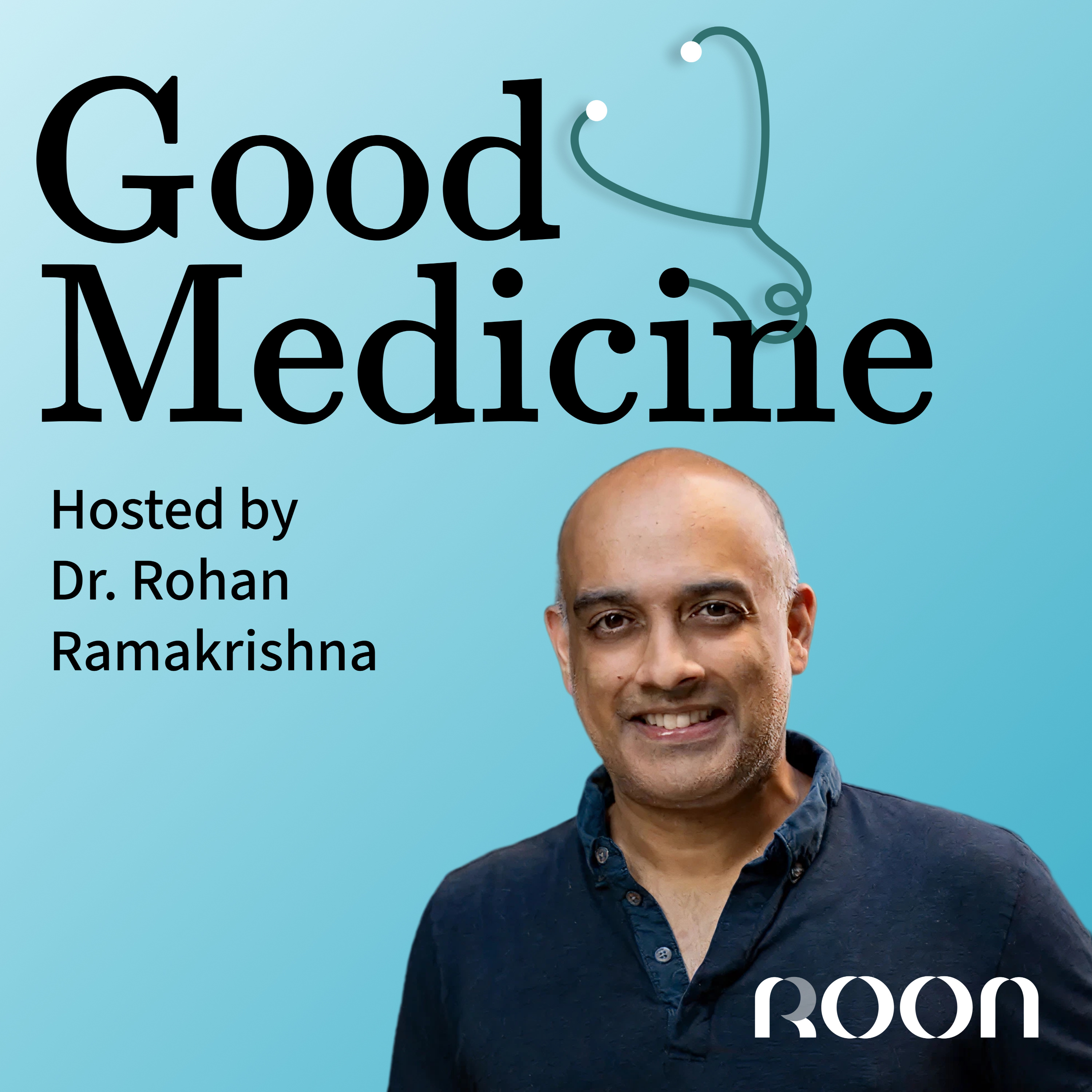
Good Medicine
by Rohan Ramakrishna
In a challenging healthcare landscape, what keeps doctors inspired? Welcome to Good Medicine, the podcast that reconnects you with the heart and humanity of medicine. We feature conversations with healthcare's most brilliant innovators and storytellers to uncover the essential attributes of great patient care. Join us to cut through the noise and rediscover the profound joy and impact of being a healer.
-
13
Dr. Mandy Cohen on Fixing the Broken Systems of Public Health
What does it actually take to fix a broken health system — and what happens when the progress you've built starts to unravel? Dr. Mandy Cohen, former CDC Director, former Secretary of the North Carolina Department of Health and Human Services, and longtime leader at the Centers for Medicare and Medicaid Services, joins Dr. Rohan Ramakrishna for a wide-ranging conversation on what it means to lead at the intersection of medicine, policy, and operations.Dr. Cohen traces her journey from accidental operator during the HealthCare.gov crisis to architect of one of the country's most ambitious social determinants of health programs in North Carolina — and ultimately to the helm of the CDC during its most consequential rebuilding effort in decades. She speaks candidly about the promise and limits of value-based care, the systemic importance of primary care–led ACOs, and why she's deeply concerned about the current state of vaccine infrastructure. She also shares her framework for building public trust — transparency, relationships, and results — and why getting the payment models right is the only way AI will actually improve health outcomes rather than just optimize revenue.New episodes are released every other week, wherever you get your podcasts. For more from Roon, visit: https://www.roon.com/ Sign up for our substack: https://rohanramakrishna.substack.com/ Find us on Instagram and X: @roondoctors If you have a question, comment, or suggestion for a future guest, please email us: [email protected](00:00) Intro(03:15) Welcome — Dr. Mandy Cohen(03:37) Why she went into public service(06:06) Discovering she was an operator: The HealthCare.gov crisis(08:30) The limits of ambition in government(10:40) Coalition building as a leadership tool(11:51) The origins of value-based care and CMMI(13:45) The case for primary care-led ACOs(16:31) Physician-led vs. hospital-led value programs(17:22) The complexity problem in programs like TEAM(19:10) Blood pressure control as a key intervention(20:25) Day one as NC Secretary of Health and Human Services(22:15) Rebuilding culture before setting priorities(23:30) Working across the aisle in North Carolina(25:11) The Healthy Opportunities Pilot: Social determinants at scale(26:53) Navigation as the highest-impact intervention(28:57) Behavior change and the limits of education programs(30:39) Coalition building for social determinants policy(33:26) Lessons that other states have learned from NC(34:13) Arriving at the CDC post-COVID(36:10) Modernizing siloed data systems(38:00) Rebuilding the CDC's lab infrastructure with private sector(40:01) Where pandemic preparedness stands today(42:55) The return of measles — and what it means(43:58) How Dr. Cohen rebuilt public trust during COVID(46:30) Trust in three parts: Transparency, relationships, results(49:05) Advising health systems on AI(51:00) Payment models and the AI trap(52:54) AI tools she's excited about(55:13) How health systems should evaluate AI vendors(58:31) Does Epic have too much power?(1:00:20) Paying for outcomes, not activity(1:03:22) Doctors building their own tools(1:04:42) Leadership philosophy for change management(1:08:30) Making hard calls that will upset people(1:10:54) Communicating under uncertainty(1:13:58) What the medical community should have done differently(1:17:17) Quick Hits: Mentors, books, and inspiring leaders(1:20:08) Guest recommendation for Good Medicine(1:20:39) Closing
-
12
Dr. Anupam Jena on on What Economics Can Teach Doctors
What if some of the most important forces in medicine have nothing to do with science? Dr. Anupam "Bapu" Jena—Harvard Medical School professor, practicing internist at Massachusetts General Hospital, and co-author of the bestseller Random Acts of Medicine—joins Dr. Rohan Ramakrishna to explore the hidden variables quietly shaping patient outcomes every day.Bapu is a physician-economist in the truest sense: someone who uses the tools of economic thinking—natural experiments, probabilistic reasoning, incentive structures—to expose what medicine often misses. In this conversation, they dig into why August-born children are 30% more likely to be diagnosed with ADHD, what a Jerusalem doctors' strike revealed about overtreatment, and why experienced medical doctors may actually produce worse outcomes than their younger peers. They also unpack the stubborn gap between what patients value—hope, dignity, time—and what payers are equipped to measure, and explore how AI is beginning to reshape clinical decision-making.Smart, surprising, and deeply grounded, this episode will change the way you see everyday medicine.New episodes are released every other week, wherever you get your podcasts. For more from Roon, visit: https://www.roon.com/ Sign up for our substack: https://rohanramakrishna.substack.com/ Find us on Instagram and X: @roondoctors If you have a question, comment, or suggestion for a future guest, please email us: [email protected](00:00) Intro and guest welcome(01:00) Why Bapu Jena is a unicorn in medicine(02:45) Preview: natural experiments, ADHD, value-based care(04:24) Meet Dr. Anupam Jena: physician, economist, author(05:09) Economics or medicine first? The origin story(06:46) The University of Chicago, a snowy day, and a fateful meeting(09:37) The counterfactual: what if Bapu had become a cancer biologist?(09:47) How economics changes the way Bapu practices medicine(11:13) Fever thresholds and probabilistic clinical thinking(12:45) Anchoring bias and cognitive forcing in diagnosis(15:11) Two economics lessons every physician should know(17:35) What is a natural experiment—and why does it matter?(19:38) Why observational data misleads us(21:52) Steve Levitt, Freakonomics, and the origins of quirky research(23:56) The flu shot timing experiment: does when you get it matter?(27:36) Morning vs. afternoon immunotherapy: separating mechanism from causation(31:01) ADHD and August birthdays: the school cutoff effect(33:48) Has the birth-month finding changed clinical practice?(35:21) Redshirting, school readiness, and professional athletes(37:26) The Jerusalem doctors' strike and the paradox of less care(40:26) Non-STEMI patients and the risk of doing too much(42:12) Does physician experience predict better outcomes?(45:50) Defining value in value-based care(48:19) The limits of what payers can measure(52:16) The track record of value-based care programs(56:05) How Bapu uses AI in research and clinical practice(59:49) Automation bias and the risks of clinical decision support(01:02:47) What's next: Spotify releases and fatal car crashes(01:04:34) Quick hits: mentors, podcasts, and student wisdom(01:06:10) Closing thoughts and farewell
-
11
Dr. Kedar Mate on AI & Scaling Life-Saving Interventions Across the Globe
What does it take to cure drug-resistant tuberculosis in a Lima resource-limited community, help reshape global HIV treatment policy, and then pivot to harnessing enterprise AI for the world's largest health systems? Dr. Kedar Mate has done all three. As the former president and CEO of the Institute for Healthcare Improvement and a co-founder of Qualified Health, Dr. Mate has spent his career proving that the biology of a wealthy patient and a poor patient are identical—and that the systems surrounding them don't have to be so different. In this conversation with Dr. Rohan Ramakrishna, Dr. Mate traces his formative work with Paul Farmer and Partners in Health, the pooled purchasing strategy that slashed the cost of life-saving TB and HIV medicines by up to 90%, and his role in expanding the Triple Aim into the Quintuple Aim by adding workforce well-being and health equity. He also makes the case that AI represents the most transformational force in healthcare since the internet—and explains why getting governance right is the difference between a breakthrough and a disaster.New episodes are released every other week, wherever you get your podcasts. For more from Roon, visit: https://www.roon.com/Sign up for our substack: https://rohanramakrishna.substack.com/Find us on Instagram and X: @roondoctorsIf you have a question, comment, or suggestion for a future guest, please email us: [email protected]:(00:00) Intro and guest overview (02:15) Meet Dr. Kedar Mate (04:00) Growing up between New Jersey and Mumbai (07:30) Brown University: a history thesis on Haitians and HIV (11:00) How Paul Farmer changed everything (15:30) Defining health equity in plain language (19:00) Partners in Health in Peru: treating MDR-TB (24:00) The pooled purchasing strategy that broke the price of TB drugs (29:30) Replicating the model for HIV: the birth of PEPFAR (33:00) What is PEPFAR, and why its funding cuts are catastrophic (37:00) Health equity success stories in the United States (41:00) The Iron Triangle: why quality, cost, and access were seen as enemies (44:00) Don Berwick and the Triple Aim (47:30) Adding workforce experience to make it the Quadruple Aim (50:00) Kedar adds health equity: the Quintuple Aim is born (53:30) Age-Friendly Health Systems: a Quintuple Aim in practice (57:00) Taking over IHI in the spring of COVID (61:00) What COVID taught us about collaborative learning at scale (64:30) There is no quality without equity (68:00) Targeted universalism: a framework for convincing skeptics (72:00) Why Kedar left IHI to co-found Qualified Health (75:30) AI as healthcare's hyperscaler (78:30) What Qualified Health is building for enterprise AI adoption (82:00) Lessons from the EHR era (84:30) Ethical AI and proportional risk governance (88:00) Quick hits: magic wands, mentors, and vaccines in Florida (92:00) Closing thoughts
-
10
Dr. Monica Bertagnolli on building a Learning Health System
What if the greatest risk in modern medicine isn't AI—but the fact that nobody is tracking whether our treatments actually work? Dr. Monica Bertagnolli, former Director of the National Institutes of Health and the National Cancer Institute, and newly elected member of the National Academy of Medicine, joins Dr. Rohan Ramakrishna to make the case for a true learning health system—one where every patient interaction generates knowledge that makes the next patient's care better.Dr. Bertagnolli reframes AI not as a threat to physician judgment, but as a diagnostic tool that finally makes personalized, evidence-based medicine possible at scale. She draws a compelling analogy between health data and credit cards: we accept the risk because the utility is real. And she issues a quiet challenge to the entire field—millions of Americans are being treated according to guidelines today, and almost no one is systematically following their outcomes to see if those guidelines actually worked.This is a conversation about trust, infrastructure, and what it means to truly learn from the patients we serve.New episodes are released every other week, wherever you get your podcasts.For more from Roon, visit: www.roon.com/Sign up for our substack: https://rohanramakrishna.substack.com/Find us on Instagram and X: @roondoctorsIf you have a question, comment, or suggestion for a future guest, please email us: [email protected].(00:00) Intro & Guest Background(00:42) Who Is Dr. Monica Bertagnolli?(02:53) Defining the Learning Health System(04:43) How AI Makes Learning Health Systems Possible(06:15) Why We Need Data from Millions of Patients(07:26) Data Safety, Trust, and the Sacred Patient Relationship(09:10) How Clinicians Can Rebuild Trust One Patient at a Time(10:35) The Courage It Takes to Trust an Institution(12:08) Infrastructure & EHR Networks: Where We Stand Today(13:44) Is the Technical Capability Already There?(14:52) AI Applications in Cancer Care Dr. Bertagnolli Is Most Excited About(16:17) Breast Cancer Guidelines and the Learning Health System in Action(18:03) Tracking Outcomes to Make AI and Guidelines Better(19:15) Risks and Unintended Consequences of AI in Medicine(20:25) The Cardinal Rule: Always Put the Patient First(21:29) Data Stewardship: Who Really Owns Health Data?(22:51) The Credit Card Analogy for Health Data Risk(24:52) Will AI Weaken Physician Creativity and Individualized Care?(26:17) The Scary Truth: Nobody Is Watching the Outcomes Today(27:26) Lightning Round(27:45) Most Impactful Mentor: Dr. Eugene Braunwald(29:20) Most Memorable Experience with a Politician(30:33) Book Recommendation: Ron Chernow's Mark Twain(31:01) Who Should Dr. Ramakrishna Interview Next?(31:35) Closing Remarks
-
9
Dr. Demetre Daskalakis on where public health goes from here
What happens when the people responsible for protecting public health are sidelined by politics? Dr. Demetre Daskalakis—former CDC division director, White House deputy coordinator for the national mpox response, and newly appointed chief medical officer at Callen-Lorde Community Health Center—has spent three decades at the intersection of infectious disease, activism, and policy. In this episode, he traces his journey from arriving in New York City at 17 during the height of the HIV/AIDS epidemic to leading America's mpox response and ultimately resigning from the CDC over the politicization of vaccine science. Dr. Daskalakis shares why he believes joy—not fear—should drive public health messaging, how his early days in the East Village shaped his approach to patient communication, and what the measles resurgence reveals about eroding institutional trust. A vital conversation on moral leadership in medicine.New episodes are released every other week, wherever you get your podcasts. If you're a US-based physician, continue this conversation on Roon: www.roon.comSign up for our substack: https://rohanramakrishna.substack.com/ Find us on Instagram and X: @roondoctors If you have a question, comment, or suggestion for a future guest, please email us: [email protected](00:00) Intro(00:37) Who is Dr. Demetre Daskalakis(03:55) Arriving in New York at 17 during the AIDS crisis(05:15) The AIDS Memorial Quilt and finding his calling(07:19) Learning bedside manner from drag queens(08:35) Translating complex science for patients and politicians(10:32) When politicians understand but choose not to act(11:49) Shock of transitioning to government leadership(13:30) Proudest achievement: Making HIV prevention about joy(15:40) Advice for physicians entering public health(17:02) The revolution in HIV treatment(19:49) PrEP access and health equity in America(21:06) When mpox arrived in the US(22:27) The mpox redemption story(26:36) Fighting misinformation and protecting LGBTQ communities(29:24) Why monkeypox became mpox and back again(31:40) Leading CDC immunization during measles resurgence(33:15) The dangerous myth of natural immunity(36:13) Vaccine coverage decline and close-knit communities(39:21) How to rebuild vaccine trust(40:33) How normal CDC vaccine policy works(45:16) When vaccine policy moved to Twitter(47:12) Career scientists on a hijacked plane(49:40) Why he returned to New York and Callen-Lorde(51:12) What everyone should know about Callen-Lorde(53:16) AI and the future of community health(54:24) Advising the Mamdani transition team(57:18) Any interest in running for office(58:22) Lightning round: Mentors, books, and final advice(01:01:24) Outro
-
8
Mark Cuban on Trust, Transparency, and Tearing Down Healthcare’s Opacity
Why does a $30 generic cost $900 at your pharmacy? Mark Cuban—entrepreneur, Shark Tank host, and founder of the Mark Cuban Cost Plus Drug Company—joins Dr. Rohan Ramakrishna to expose the hidden economics strangling American healthcare. Cuban breaks down his trust formula (transparency divided by self-interest), explains how high deductibles have turned hospitals into subprime lenders, and reveals the games pharmacy benefit managers play with rebates, GPOs, and biosimilars. He shares how Cost Plus Drugs launched with 111 medications and a simple 15% markup—and why the industry is terrified of what happens when he gets access to brand-name drugs. From modular manufacturing pods that could produce gene therapies in hospital parking lots to direct contracting that eliminates prior authorizations entirely, Cuban offers a blueprint for dismantling opacity. His message to physicians? You're underpaid, overworked, and dealing with mishigas that shouldn't exist. Here's how we fix it.New episodes are released every other week.For more from Roon, visit: roon.comSign up for our substack: https://rohanramakrishna.substack.com/ Find us on Instagram and X: @roondoctors If you have a question, comment, or suggestion for a future guest, please email us: [email protected].(00:00) Intro(03:30) Mark Cuban joins the show(03:48) First hustle: Baseball cards and garbage bags(05:15) Learning to sell at age 12(05:23) Broadcast.com origin story(06:39) Follow your effort, not your passion(08:13) Getting paid to learn after college(09:42) AI as the great equalizer for entrepreneurs(10:29) How a cold email led to Cost Plus Drugs(12:06) Building a pharmacy on radical transparency(13:03) Where the 15% markup came from(13:30) The trust formula: Transparency divided by self-interest(14:36) Why healthcare economics are so broken(16:14) Health insurance is not a proxy for healthcare(17:18) How hospitals became subprime lenders(18:57) Prior authorizations and the 97-year-old veterinarian(20:45) Facilities fees and the overhead spiral(22:45) Cost Plus Wellness and direct contracting explained(25:24) How hospitals should structure contracts(27:23) Negotiating as a cash-pay customer(28:29) The $64,000 ankle surgery bill(29:50) Inside Cost Plus drug manufacturing(31:55) Modular pods for gene therapy and biologics(33:32) Selling to hospitals through the Cost Plus Marketplace(34:25) Supply chain vulnerabilities and key starting materials(35:59) How Cost Plus stacks up against Amazon and Costco(38:07) Why CVS and Express Scripts aren't really transparent(39:38) The PBM that lied about using Cost Plus(41:09) Rebate GPOs: The hidden fee machine(43:46) Why Cost Plus can't get brand-name drugs(46:46) The flow of money on a $600 prescription(49:03) What happens if PBMs disappear tomorrow(51:20) GLP-1s and the direct-to-consumer shift(53:05) Stop using the big PBMs(54:37) Communication: The key ingredient in good medicine(56:19) Why medical AI will fragment into silos(59:24) Mark's message to doctors in 2025(01:01:58) Closing thoughts
-
7
Dr. Zeke Emanuel on the ACA, Bioethics, and Ice Cream for Longevity
What if the most effective longevity hack isn’t a supplement or a cold plunge, but a simple dinner party?Dr. Zeke Emanuel, oncologist, bioethicist, and key architect of the Affordable Care Act (ACA), joins Dr. Rohan Ramakrishna for a candid look at the intersection of medicine and politics. Dr. Emanuel reveals the gritty reality of passing legislation, explaining why "politics beats policy" and how the "scarce resource" framework he developed at the NIH shaped global COVID-19 vaccine distribution.They discuss the critical consequences of cutting Medicaid funding, the rise of medical misinformation, and why doctors must become more politically active to protect public health. Finally, Dr. Emanuel introduces his new book, Eat Your Ice Cream, challenging the modern obsession with biohacking. He argues that in a world fixated on optimization, fostering deep social connections is the ultimate prescription for a longer, happier life.New episodes are released every other week, wherever you get your podcasts. For more from Roon, visit: https://www.roon.com/ Sign up for our substack: https://rohanramakrishna.substack.com/ Find us on Instagram and X: @roondoctors If you have a question, comment, or suggestion for a future guest, please email us: [email protected](00:00) Intro: Dr. Zeke Emanuel (03:10) Beekeeping and the pursuit of new skills (04:50) Choosing policy over the lab (08:41) Redefining research ethics at the NIH (11:05) Allocating scarce resources: The COVID framework(17:35) Politics beats policy: Inside the Obama White House (19:40) Why malpractice reform failed (22:37) Frustrations with the ACA and bundled payments (27:12) The ACA’s biggest win: Saving lives via coverage (33:20) Why healthcare will dominate the 2032 election (34:55) The deadly consequences of cutting Medicaid (38:05) Future reform: Simplification and standardization (42:20) Vertical integration and antitrust enforcement (44:15) Combating misinformation and breaking algorithms (48:45) "Eat Your Ice Cream" and rejecting biohacking (52:40) The highest yield longevity hacks over 60 (57:50) Policy solutions for the loneliness epidemic (01:01:25) Communicating relative risk and vaccine safety (01:04:35) Lightning Round: Mentors and books (01:06:38) The "Bob Dylan" intro music (01:07:25) Life lessons from artisanal chocolate (01:09:40) Working for Rahm Emanuel? (01:10:45) Outro
-
6
Dr. Tom Frieden on The Formula for Better Health
What does it take to protect health at the scale of an entire city—or the world? Dr. Tom Frieden, former Director of the CDC and NYC Health Commissioner, operates at this massive scale. In this episode, he joins Dr. Rohan Ramakrishna to dismantle the "invisible" threats shaping modern medicine, from the "pus bucket" TB wards of 1990s New York to the high-pressure White House Situation Room during the Ebola crisis.Discussing his new book, The Formula for Better Health, Dr. Frieden breaks down his "See, Believe, Create" framework and the critical difference between regulation and the "nanny state." They dive deep into why hypertension remains the world’s deadliest—and most neglected—pathology, the failures of COVID-19 communication, and the "Big Six" lifestyle behaviors that actually determine longevity. Whether you are a clinician or a policymaker, this conversation offers a masterclass in how organized, rigorous action can save millions of lives.Timestamps:(00:00) Intro (02:09) From Philosophy Major to Medicine (04:54) Defining Public Health (06:12) The Father’s Question: "How Would You Know?" (08:00) Inside the Epidemic Intelligence Service (11:08) The 1990s NYC Tuberculosis Crisis (12:04) The "See, Believe, Create" Framework (17:32) The Story of Jorge and Christian (21:13) The Ebola "Table Drop" Moment (25:01) Inside the White House Situation Room (27:12) COVID-19 Failures and Incident Management (30:26) The Assault on the CDC (34:35) Restoring Public Trust (36:36) The Ethics of Mandates (42:14) The Role of the Physician in Public Health (45:34) Hypertension: The World's Silent Killer (49:26) The HEARTS Technical Package(51:01) Global Implementation Challenges (56:55) AI as a Member of the Care Team (58:39) The "Big Six" for Longevity(01:00:30) Social Connection and Dementia Risk (01:03:07) Microplastics and Environmental Toxins (01:05:23) Misaligned Incentives in Healthcare (01:08:19) Quick Hits (01:10:36) OutroNew episodes are released every other week, wherever you get your podcasts. For more from Roon, visit: https://www.roon.com/ Sign up for our substack: https://rohanramakrishna.substack.com/ Find us on Instagram and X: @roondoctors If you have a question, comment, or suggestion for a future guest, please email us: [email protected].
-
5
Dr. Bobby Mukkamala: Leading the AMA While Fighting Cancer
What happens when the President-elect of the American Medical Association becomes a patient overnight? In this episode, Dr. Rohan Ramakrishna sits down with Dr. Bobby Mukkamala, a longtime Flint-based ENT surgeon and incoming AMA President who was recently diagnosed with a brain tumor.Dr. Mukkamala shares the harrowing moment his symptoms began during a public speech and his rapid transition from surgeon to patient. He discusses why seeing risk percentages from the other side of the gown changes everything and argues that family support should be treated as a vital clinical intervention.The conversation then pivots to the critical work ahead for the AMA. They explore the fight to index Medicare payments to inflation, the crushing impact of administrative burnout, the erosion of private practice, and why protecting NIH research funding is a matter of life and death. This is a deeply personal and policy-focused look at the fragile state of our healthcare system.New episodes are released every other week, wherever you get your podcasts.For more from Roon, visit: https://www.roon.com/ Sign up for our substack: https://rohanramakrishna.substack.com/ Find us on Instagram and X: @roondoctors If you have a question, comment, or suggestion for a future guest, please email us: [email protected].
-
4
Ben Rein on Why Brains Need Friends
This week, Dr. Rohan Ramakrishna sits down with neuroscientist Dr. Ben Rein to unpack the physiological harm of loneliness and the neuroscience of social connection. They discuss how isolation creates chronic inflammation, why social media can erode empathy, and how building social connection creates cognitive reserve to protect our brains as we age.New episodes are released every other week, wherever you get your podcasts.For more from Roon, visit: https://www.roon.com/Sign up for our substack: https://rohanramakrishna.substack.com/Find us on Instagram and X: @roondoctorsIf you have a question, comment, or suggestion for a future guest, please email us: [email protected].
-
3
Chelsea Clinton on Reproductive Rights, Research Funding, and the Future of Healthcare
This week, Dr. Rohan Ramakrishna sits down with Chelsea Clinton—vice chair of the Clinton Foundation and Clinton Health Access Initiative—to unpack maternal health in America, the confusion around emergency-room care laws, and the risks of research funding cuts. They talk about what restrictive statutes are doing to patients and providers, how to support clinicians on the front lines, and the practical policy moves that would make care safer, sooner.New episodes are released every other week, wherever you get your podcasts.For more from Roon, visit: https://www.roon.com/Sign up for our substack: https://rohanramakrishna.substack.com/Find us on Instagram and X: @roondoctorsIf you have a question, comment, or suggestion for a future guest, please email us: [email protected].
-
2
Welcome to Good Medicine
As doctors, we navigate an increasingly complex healthcare landscape filled with administrative burden, regulatory pressures, and systems that often get in the way of patient care. Yet we persist because of what drew us to medicine in the first place: the privilege of healing, the joy of collaboration with brilliant colleagues, and the front-row seat to innovation.Good Medicine is a podcast about reclaiming what's essential in healthcare. Hosted by Dr. Rohan Ramakrishna, neurosurgeon and co-founder of Roon, each episode features honest conversations with physicians, researchers, and healthcare leaders who are shaping the future of medicine.New episodes are released every other week, wherever you get your podcasts.For more from Roon, visit: https://www.roon.com/Sign up for our substack: https://rohanramakrishna.substack.com/Find us on Instagram and X: @roondoctorsIf you have a question, comment, or suggestion for a future guest, please email us: [email protected].
We're indexing this podcast's transcripts for the first time — this can take a minute or two. We'll show results as soon as they're ready.
No matches for "" in this podcast's transcripts.
No topics indexed yet for this podcast.
Loading reviews...
ABOUT THIS SHOW
In a challenging healthcare landscape, what keeps doctors inspired? Welcome to Good Medicine, the podcast that reconnects you with the heart and humanity of medicine. We feature conversations with healthcare's most brilliant innovators and storytellers to uncover the essential attributes of great patient care. Join us to cut through the noise and rediscover the profound joy and impact of being a healer.
HOSTED BY
Rohan Ramakrishna
Loading similar podcasts...
URL copied to clipboard!