
PODCAST · religion
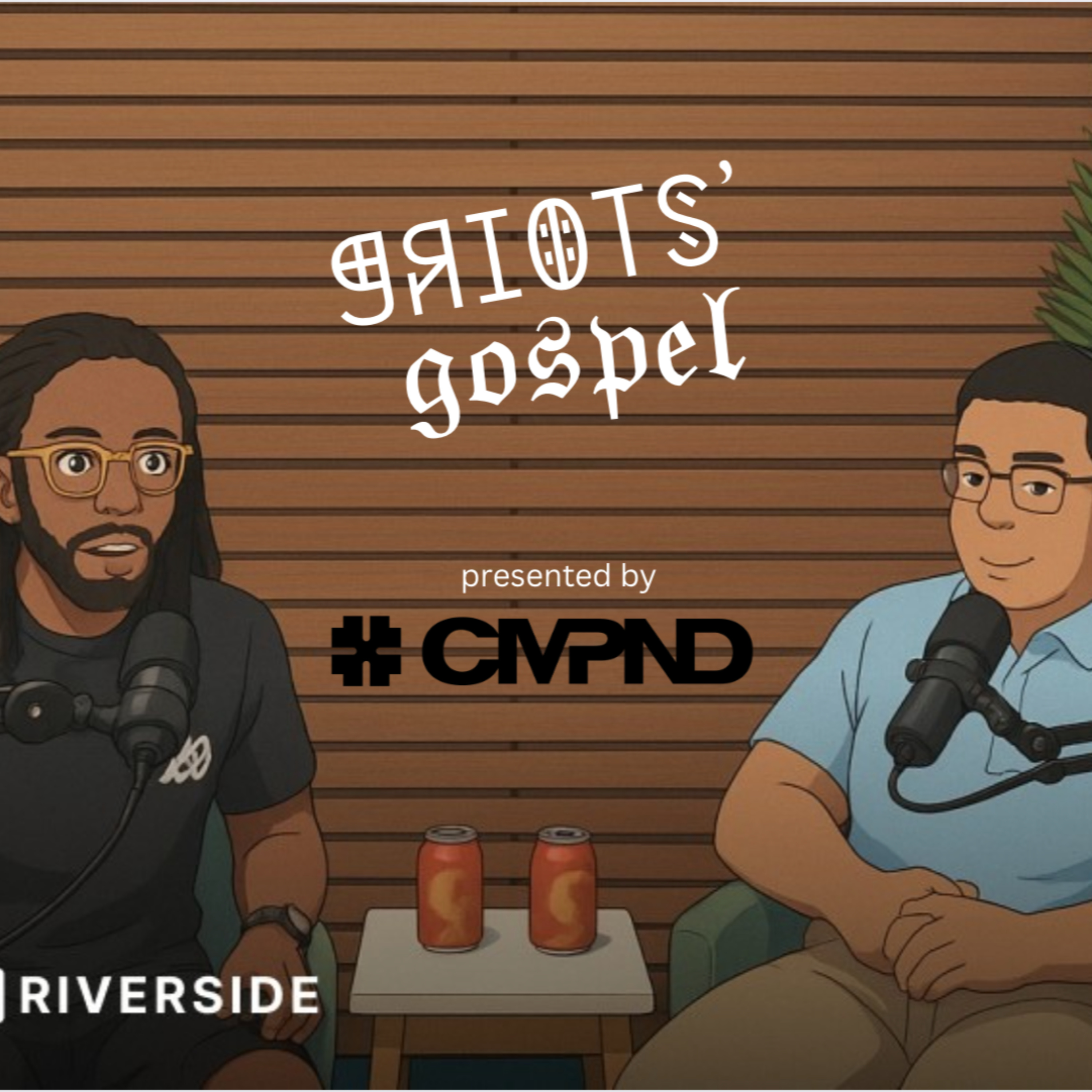
Griots' Gospel
by Jordyn Jones and Spencer Aubrey
Join educator Jordyn Jones and artist Spencer Aubrey as they attempt to “reconcile their culture to the Lord” by exploring the harmony between sociology, history, and The Text. Griots’ Gospel is an exploration of the ministry of reconciliation, focusing on what the ministry of Yeshua says about race, culture, and the ways we divide up the world. Have Questions? Email us at [email protected]’ Gospel is recorded at The CMPND in partnership with big.BEAR.jones.
-
27
Ep. 22 | A Modest Debrief
Join Jordyn Jones and Spencer Aubrey as they debrief Season Two's content and lay the track for what the show will become.
-
26
Ep. 21 | The Fullness of Our Here and Now | DEEP DIVE
Join Jordyn Jones and Spencer Aubrey as they discuss what they see happening in Winston-Salem as the Kingdom of Heaven reaches its fullness even now.
-
25
Ep. 20 | Kingdom is Here | DEEP DIVE
Join Jordyn Jones and Spencer Aubrey as they discuss Yeshua’s inbreaking kingdom in our backyard and how we deal with modern-day realities and culture.
-
24
Ep. 19 | A Winston-Salem Cultural | DEEP DIVE
Join Jordyn Jones and Spencer Aubrey as they continue to discuss what Yeshua’s mission to “the other side” says to us about our modern-day realities and how we deal with culture.
-
23
Ep. 18 | The Other Sides of Winston-Salem | DEEP DIVE
Join Jordyn Jones and Spencer Aubrey as they unpack what Yeshua’s mission to “the other side” says to us about our division in the Twin-City.Study ToolsMatthew 7:22 - 9:38(https://www.biblegateway.com/passage/?search=Matthew%207%3A22%20-%209%3A38&version=TLV)Luke 8:26 - 39(https://www.biblegateway.com/passage/?search=Luke%208%3A26%20-%2039&version=TLV)Matthew 15:21 - 39(https://www.biblegateway.com/passage/?search=matthew%2015%3A21-39&version=TLV)
-
22
Ep. 17 | How We Got Here | DEEP DIVE
Join Jordyn and Spencer as they finish out their historic timeline of Winston-Salem, making their way to our modern day.Review Timeline1918 A riot takes place in Winston-Salem targeting African Americans; violence erupts in the heart of the city as police try to protect an innocent African-American man from a mob of people attempting to take his life.1930Seventeen years from when William Darnell wins his very similar case, Winston-Salem is again divided into “urban suburbs” or zones. “In 1930 the City adopted a zoning ordinance to prohibit African Americans from moving into white neighborhoods.”1938Katie Bitting Reynolds Memorial Hospital was built for Black doctors to see Black patients; the Memorial Hospital, often called the “Katie B,” was the first publicly-operated facility to treat only African-American patients in Winston-Salem and the first to allow African-American physicians the ability to treat patients.1943A group known as the Factory 64, 64 R.J. Reynolds factory employees, mostly African-American women, organized their first sit-down strike of the R.J. Reynolds Tobacco Company. This group, with the help of Local 22 and aided by community support, demanded better wages and safer working conditions. Although short-lived, Factory 64’s 1943 and 1947 strikes saw success as compromises were made across all R.J. Reynolds’ Winston-Salem factories.1957 At 15, Gwendolyn Bailey became the first African American person to desegregate an all-white school in Forsyth County as she attended (and graduated from) R.J. Reynolds High School.1958The beginning of building projects like Interstate 40, and later U.S. Route 52, destroyed and displaced many middle-class African-American communities in favor of a transportation system for the growing city center.1960 Carl Matthews’ S.H. Kress Lunch counter sit-ins take place in Winston-Salem. After being refused service, Matthews organized eleven African-American students from Winston-Salem Teachers College, now Winston-Salem State University, and 10 white students from Wake Forest to join the protest On May 25, 1960, Winston-Salem became the first city in North Carolina to desegregate its lunch counters, Matthews himself became the first African American to be served at an integrated lunch counter in North Carolina.1969 Active until 1978, The Winston-Salem Black Panther Party formed as the first Black Panther chapter in the American South. As one of the most successful chapters in the region, through social programs like the Joseph Waddell People's Free Ambulance Service and their voter registration campaigns, saw the Black community of Winston-Salem bettered by their work.1974The Winston-Salem Chronicle newspaper was formed by Ernie Pitt with the help of Nigerian journalist Joseph N. C. Egemonye; their vow: to focus on events affecting the Black community of Winston-Salem, especially what other newspapers refused to cover. On several occasions, this commitment to the truth won them the John Russwurm Award for Best Black Newspaper in the United States.2007 Triad Cultural Arts, Inc. is founded.
-
21
Ep. 16 | The Beginning of Black Church | DEEP DIVE
Join Jordyn and Spencer as they unpack the origin of the African-American churches in Winston-Salem, North Carolina, and their role in creating the public schools of Forsyth County.Review Timeline1865May 21st, 1865 General Orders 32 announces the freedom of enslaved African Americans at The Brick Church.• Rev. Seth Clark of the Ohio 10th Calvary reads Military Order No.32 at the Brick Church announcing Emancipation. o "All persons in this state heretofore held as Slaves are now free."1867With fundraising help from Salem’s then-mayor Elias Vogler, a Freedman’s school is built on land negotiated for by the elders of Salem’s African-American church.1872Lots start being sold to Freedman, fostering the beginning of “Liberia,” what we know as Happy Hills.• Salem begins selling lots on the former Schumann Plantation to freed Men and Women establishing the neighborhood of Liberia. • By 1874, the area was known as Happy Hill. 1892While principal of the then-largest grammar school for African Americans in North Carolina and the first public school for African Americans in Winston, Simon G. Atkins set out to establish a college for Black students and a neighborhood that would help bring Black professionals to the city. This neighborhood, Columbia Heights, would serve as a good environment for Slater Industrial Academy, now Winston-Salem State University.1912As Black professionals and college students began to move to Winston, similar to the Salem trustees segregating people away from White neighborhoods, segregation ordinances were passed by Winston-Salem aldermen to make it unlawful for any person of color to live on or next to any street with a larger number of white folks. William Darnell fought this charge and, in 1914, the State Supreme Court determined these ordinances unconstitutional.1913St. Philips Moravian gets its official name. Winston & Salem become a twin-city.
-
20
Ep. 15 | Legislating the Heart | DEEP DIVE
Join Jordyn and Spencer as they discuss the legislation surrounding Black identity pre-Civil War and how that led to the building of North Carolina's oldest standing African-American church.Review Timeline1830Following the publication of Freedman’s Papers, laws on Black literacy became even stricter. 1831The Southampton Insurrection (Nat Turner’s Revolt or Rebellion) becomes the deadliest slave revolt in U.S. history.1837The first group of Cherokee leave the state of Georgia on the Trail of Tears.1840sBrother Byhan resumes reading lessons at the Sunday School in defiance of NC legislature.1847Pushed largely by the Fries Diaconie, all restrictions on the personal owning of enslaved individuals ends. 1856Salem ceases to operate as a Congregational Town (Theocracy) and becomes an incorporated North Carolina town.1861The Brick Church is erected. It is the only building alluding to the Confederate President on the cornerstone.1865May 21st, 1865 General Orders 32 announces the freedom of enslaved African Americans at The Brick Church.Study Tools1830/31A Bill to Prevent All Persons from Teaching Slaves to Read or Write, the Use of Figures Excepted (1830)"Act Passed by the General Assembly of the State of North Carolina at the Session of 1830—1831" (Raleigh: 1831).An Act Concerning Slaves and Free Persons of Color (Revised code, 1855). North Carolina General AssemblyBreen, Contributor: Patrick H. “Nat Turner’s Revolt (1831).” Encyclopedia Virginia, Virginia Humanities, 14 Nov. 2023, encyclopediavirginia.org/entries/turners-revolt-nat-1831/. 1837“Multi-State: Trail of Tears National Historic Trail (U.S. National Park Service).” National Parks Service, U.S. Department of the Interior, www.nps.gov/articles/trailoftears.htm#:~:text=Guided%20by%20policies%20favored%20by,Southeast%20in%20the%20early%201800s. Accessed 17 Jan. 2024.1847 Taylor, Gwynne Stephens. “Fries, Francis (1812-1863).” Edited by Catherine W. Bishir, North Carolina Architects and Builders - A Biographical Dictionary, NC State University, 2010, ncarchitects.lib.ncsu.edu/people/P000215. Albright, Frank P. “Fries, Francis (Franz) Levin.” NCpedia, NCPedia, 1986, www.ncpedia.org/biography/fries-francis-franz-levin.1865Currey, Craig Jeffrey. “The Role of the Army in North Carolina Reconstruction 1865-187.” University of North Carolina at Chapel Hill, UNC Chapel Hill, 1991, pp. 12–38.
-
19
Ep. 14 | The Birth of a Black Church | DEEP DIVE
Join Jordyn and Spencer as they discuss the beginning of the oldest African American church in North Carolina, and what it tells us the Kingdom of Heaven is like. Review Timeline1816People of African Descent, Black people, are no longer allowed in God’s Acre. Converts or not.Note that, following Peter Oliver, the only other Black person buried in God’s Acre is the child of Bodney and Pheobe, founding elders of St. Philips. Due to their consummate faith and service to the Moravian church, they are given this honor. 1818Sisters are no longer allowed to attend the Congregational Council in Salem.1820The Congregational Council holds a vote to “solve the Negro problem.” Following the February 24th vote, the resulting regulation removes Black people from trades, heavily restricts individual ownership of the enslaved, makes building dwellings for the enslaved against the rules, and, among other things, sees Black people forbidden from being in town after dark. 1822/23The “Negro” Congregation is formed. The Log Church is erected.1824Official enslaved marriages, even those by congregants, ceases. January 6th, 1824 Provinzial Helfer Conferenz1827St. Philips’ Sunday School, their literacy program, begins.This lasted from 1827-1831 when literacy laws became strict.1830Following the publication of Freedman’s Papers, laws on Black literacy became even stricter. Study Tools1816Sensbach, Jon F. A Separate Canaan: The Making of an Afro-Moravian World in North Carolina, 1763-1840. The University of North Carolina Press, 2012. 1818Hutton, J. E. “Book Three. The Rule of the Germans. Chapter VI. The Struggle in America, 1762–1857.” A History of the Moravian Church, Second ed., Christian Classics Ethereal Library, Grand Rapids, MI, 1909, pp. 303–308. Crews, C. Daniel. Neither Slave Nor Free: Moravians, Slavery and a Church That Endures. Moravian Archives, 1998. 1820Fries’ Record of Moravians in North Carolina Vol. 7 1809-1822 p.3446 1824Crews, C. Daniel. Neither Slave Nor Free: Moravians, Slavery and a Church That Endures. Moravian Archives, 1998.1830/31A Bill to Prevent All Persons from Teaching Slaves to Read or Write, the Use of Figures Excepted (1830)"Act Passed by the General Assembly of the State of North Carolina at the Session of 1830—1831" (Raleigh: 1831).An Act Concerning Slaves and Free Persons of Color (Revised code, 1855). North Carolina General AssemblyBreen, Contributor: Patrick H. “Nat Turner’s Revolt (1831).” Encyclopedia Virginia, Virginia Humanities, 14 Nov. 2023, encyclopediavirginia.org/entries/turners-revolt-nat-1831/.
-
18
Ep. 13 | Stumbling Stones in Salem | DEEP DIVE
Join Jordyn and Spencer as they discuss the divide between the Moravians of Winston-Salem and their Afro-Moravian brothers as they assimilate to American Culture.Review Timeline1791George Washington stayed in Salem’s Tavern while on his Southern Tour. In accordance with his long-held 1789 desire to tour every region of the United States, Washington takes a Spring (March 21 – June 4) tour of the southern states. “He took delight in the manufacturing skills of the artisans at Salem, North Carolina.”“Washington was impressed with the neat orderly appearance of the town as well as with the demeanor of its inhabitants. He considered it a well governed, hard-working community. The people of Salem were impressed with Washington’s simple, friendly manner, particularly with children.This coming shortly after his and Henry Knox’s fostering a series of Trade and Intercourse Acts to push Native Americans in assimilating with Anglo-Americans. 1800Peter Oliver orchestrates his emancipation with the help of Peter Lenhart and Samuel Stotz. Oliver is documented as “true to his calling and work, and he brought it about through diligence in his work to the point that he could buy himself free from his status of slavery.”Peter Oliver leverages the master-slave covenant to remain in posted bond to the Moravians first of Salem then in Bethabara. Calling on his "professional” connections, he is able to achieve an amazing goal: his emancipationThe Moravians were given permission to set up a mission among the Cherokee in Springplace, GA.This is their attempt to fulfill the mission [from God] cited as their reason for traveling to the colonies; they are going to once again attempt to proselytize to the Cherokee. 1810Peter Oliver is the last Black Moravian (adult) buried in God’s Acre.Note that following Peter Oliver, the only other Black person buried in God’s Acre is the child of Bodney and Pheobe, founding elders of St. Philips. Due to their consummate faith and service to the Moravian church, they are given this honor. 1816People of African Descent, Black people, are no longer allowed in God’s Acre. Converts or not.Following this, October 21st directive, no similar directives have been found for segregation in other graveyards. In general, however, across Wachovia Tract, between Hope, Bethabara, and Salem, only one Black burial after 1810 has been found. Priscilla, age 85 at the time of death, was buried at Hope in 1834, “perhaps as a last gesture of respect for a woman who had lived most of her life with white Moravians.”Study Tools1791Ebel, Carol. “Southern Tour.” George Washington’s Mount Vernon, The Papers of George Washington, 1998, www.mountvernon.org/library/digitalhistory/digital-encyclopedia/article/southern-tour/. McKown, Harry. “June 1791: George Washington Visits Salem, NC.” NC Miscellany, UNC, 1 June 2010, blogs.lib.unc.edu/ncm/2010/06/01/this_month_june_1791/. McClinton, Rowena, "The Moravian Springplace Mission to the Cherokees" (2010). University of Nebraska Press -- Sample Books and Chapters. 63. https://digitalcommons.unl.edu/unpresssamples/63, p21800“Luke Beckerdite and Johanna Brown Eighteenth-Century Earthenware from North Carolina: The Moravian Tradition Reconsidered.” Chipstone, Ceramics in America, 2009, www.chipstone.org/article.php/449/Ceramics-in-America-2009/Eighteenth-Century-Earthenware-from-North-Carolina:-The-Moravian-Tradition-Reconsidered. “A Brief History of the Moravian Church Southern Province.” The Southern Province Moravian Church in America, Moravian Archives, 6 Nov. 2018, www.moravian.org/southern/2018/05/a-brief-history-of-the-moravian-church-southern-province/. Smith, Rosamond C. “Steiner, Abraham Gottlieb.” NCpedia, NCpedia, 1994, www.ncpedia.org/biography/steiner-abraham-gottlieb. 1816Sensbach, Jon F. A Separate Canaan: The Making of an Afro-Moravian World in North Carolina, 1763-1840. The University of North Carolina Press, 2012.
-
17
Ep. 12 | An American Dream | DEEP DIVE
Join Jordyn and Spencer as they discuss the Moravian mission to North Carolina and the beginning of Afro-Moravian identity. Review Timeline1731Zinzendorf has his first contact with a “heathen” convert. The Mission to St. Thomas begins in the Caribbean. Zinzendorf’s personal philosophy that promoting the worth of all humanity allowed him to conceptualize the “heathen” in cultural, not racial, terms. His first contact with a “heathen” convert was in 1731 when he attended the coronation of Danish King Christian VI. He heard a baptized African slave, Anthony Ulrich, relate that he had a sister in St. Thomas, “one of the Carybee islands belonging to the Danes, who wanted very much to learn Christianity.” Implementing his plans to organize missions among “neglected peoples,” Zinzendorf sent the first set of Brethren missionaries, David Nitschmann and Leonard Dober, to St. Thomas in 1732 to preach among the African slaves.”“Zinzendorf’s personal mission philosophy emanated from his belief in the innate worthiness of all humans, and the application of this ideal came from earning esteem among the “heathen” with humility.”1753Bethabara is started.1759 Bethania is started.1766 Salem [‘s construction] is started.1769Sam, an enslaved man owned in Bethabara, aids the Single Brothers with Salem’s construction.Sam becomes the first enslaved person purchased by the Moravians in Wachovia.1738 - “Are not these blatant sins? What is to be done with this? It is not to be hoped that the whites will give up slavery. Because it seems to sit quite well with them that they can live in abundance and well-being and that the poor Negroes have to work for them as the most unfortunate animals. And when the kings and lords make laws that the slaves must be given free if they take on the Christian religion, as the laws are in Danish and English islands, then the matter is even worse, because then many Negroes would say, I want to become a Christian, when the work no longer befits him, and that would be a sad conversion if someone went from paganism to hypocritical and selfish Christianity.I don’t want to say anything about this, that precisely these selfsame laws are the reason that the Negroes’ masters simply refuse Negroes to become Christians and are therefore the greatest persecutors of the people who care about the Negro conversion.”“P.S. You would not want to understand my letter as if I were for such an establishment being set up, of which Friedrich Martin wrote, or for buying the freedom of the Moors. No, I am only of the opinion that one should consider the matter, otherwise I am more reluctant than inclined to advise in the matter, and I also counseled Friedrich Martin more against rather than for getting involved in the matter.”1771Johann Samuel, formerly Sam, becomes the first Afro-Moravian in Wachovia Tract.His conversion and baptism starts the “experienced identity” of enslaved yet converted Moravian captive Africans and African Americans.Study Tools1731McClinton, Rowena, "The Moravian Springplace Mission to the Cherokees" (2010). University of Nebraska Press -- Sample Books and Chapters. 63. https://digitalcommons.unl.edu/unpresssamples/63, p7“The Moravians: Missionaries in the West Indies.” Virgin Islands History, The Danish National Archive, 14 Dec. 2017, www.virgin-islands-history.org/en/history/colonial-power/the-moravians-missionaries-in-the-west-indies/. 1769Christina Petterson; Spangenberg and Zinzendorf on Slavery in the Danish West Indies. Journal of Moravian History 18 June 2021; 21 (1): 34–59. doi: https://doi.org/10.5325/jmorahist.21.1.0034
-
16
Ep. 11 | A Moravian Story | DEEP DIVE
Join Jordyn and Spencer as they discuss the origins of the Moravians and their faith, seeing how that sets the stage for modern-day North Carolina. Review Timline1619The first African slaves brought to America. 1680Initially enslavement is [officially] defined not by skin color but by religion. The Virginia General Assembly declared that "All servants imported and brought into this country who were not Christian in their native land shall be counted and be slaves.”1705Virginia ratifies the first comprehensive Slave-Codes, consolidating individual laws started as early as 1667 in parallel with those in Barbados.In 1667, the Virginia House of Burgesses enacted a law which didn't recognize the conversion of African Americans to Christianity despite a baptism.Peter Oliver’s Virginia context.1715 The North Carolina Slave Code of 1715 was ratified. Required enslaved people to carry a ticket from their enslaver whenever they left the plantation. The ticket stated where they were traveling and the reason for their travel. Peter Oliver’s North Carolina context.Prevented enslaved people from gathering in groups for any reason, including religious worship, and required white people to help capture escaped freedom-seeking enslaved people.St. Philips Church context.1727The Moravians, Unity of the Brethren, are born following the May 12 signing of The Brotherly Agreement.Study Tools1705William Waller Hening, ed., The Statutes at Large; Being a Collection of All the Laws of Virginia from the First Session of the Legislature, in the Year 1619, (Philadelphia: R. & W. & G. Bartow, 1823), 2:260; Chapter XLIX: An Act Concerning Slaves and Servants,” 447–463.Jack P. Greene, American Slavery, American Freedom: The Ordeal of Colonial Virginia, by Edmund S. Morgan, Political Science Quarterly, Volume 91, Issue 4, Winter 1976, Pages 742–743, https://doi.org/10.2307/2148833Browne-Marshall, Gloria J. (2020-09-01). "The Africans of 1619: Making Black Lives Matter in the Virginia Colony". The Journal of African American History. 105 (4): 655–662.1715“The Growth of Slavery in North Carolina.” Anchor, Slavery in North Carolina, www.ncpedia.org/anchor/growth-slavery-north#:~:text=Records%20do%20exist%20detailing%20the,whenever%20they%20left%20the%20plantation. Accessed 17 Jan. 2024. 1727Swearingen, Chet, and Phyllis Swearingen. “Moravian Revival of 1727 (Expanded Version).” Romans 10:15, Beautiful Feet, 17 Aug. 2022, romans1015.com/moravian-revival-2/.
-
15
Ep. 10 | We Are Back | DEEP DIVE
Join Jordyn and Spencer as they set the table for their discussion of the Moravians of Wachovia and the modern-day city of Winston-Salem, North Carolina. Review Timeline1619The first African slaves were brought to America. 1680Initially, enslavement is [officially] defined not by skin color but by religion. The Virginia General Assembly declared that "All servants imported and brought into this country who were not Christian in their native land shall be counted and be slaves.”1705Virginia ratifies the first comprehensive Slave-Codes, consolidating individual laws started as early as 1667 in parallel with those in Barbados.In 1667, the Virginia House of Burgesses enacted a law that didn't recognize the conversion of African Americans to Christianity despite a baptism.Peter Oliver’s Virginia context.1715 The North Carolina Slave Code of 1715 was ratified. Required enslaved people to carry a ticket from their enslaver whenever they left the plantation. The ticket stated where they were traveling and the reason for their travel. Peter Oliver’s North Carolina context.Prevented enslaved people from gathering in groups for any reason, including religious worship, and required white people to help capture escaped freedom-seeking enslaved people.St. Philips Church context.Study Tools1705William Waller Hening, ed., The Statutes at Large; Being a Collection of All the Laws of Virginia from the First Session of the Legislature, in the Year 1619, (Philadelphia: R. & W. & G. Bartow, 1823), 2:260; Chapter XLIX: An Act Concerning Slaves and Servants,” 447–463.Jack P. Greene, American Slavery, American Freedom: The Ordeal of Colonial Virginia, by Edmund S. Morgan, Political Science Quarterly, Volume 91, Issue 4, Winter 1976, Pages 742–743, https://doi.org/10.2307/2148833Browne-Marshall, Gloria J. (2020-09-01). "The Africans of 1619: Making Black Lives Matter in the Virginia Colony". The Journal of African American History. 105 (4): 655–662.1715“The Growth of Slavery in North Carolina.” Anchor, Slavery in North Carolina, www.ncpedia.org/anchor/growth-slavery-north#:~:text=Records%20do%20exist%20detailing%20the,whenever%20they%20left%20the%20plantation. Accessed 17 Jan. 2024.
-
14
Ep. 9 | Where We're Going | DEEP DIVE
Jordyn Jones and Spencer Aubrey have an outroduction conversation about what it has been like to record the season, how they’ve grown through the process, and what is up ahead.
-
13
Ep. 8 | "The Fullness of Time" | DEEP DIVE
Join Jordyn Jones and Spencer Aubrey as they conclude this session by examining what The Text has to say about the historical context of Yeshua’s ministry and what that can reveal about the ministry of cultural reconciliation.Study ToolsGalatians 4:1 - 9(https://www.biblegateway.com/passage/?search=galatians%204%3A1-9&version=TLV)Matthew 24:35 - 44(https://www.biblegateway.com/passage/?search=Matthew%2024%3A35%20-%2044&version=TLV)Matthew 1:20 - 2:2(https://www.biblegateway.com/passage/?search=Matthew%201%3A20%20-%202%3A2&version=TLV)Isaiah 7:1 - 17(https://www.biblegateway.com/passage/?search=isaiah%207%3A1%20-%2017&version=TLV)Matthew 2:1 - 2(https://www.biblegateway.com/passage/?search=matthew%202%3A1-2&version=TLV)Luke 1:5(https://www.biblegateway.com/passage/?search=luke%201%3A5&version=TLV)Luke 2:1-2(https://www.biblegateway.com/passage/?search=luke%202%3A1-2&version=TLV)
-
12
Ep. 7 | "Kingdom vs. Empire" | DEEP DIVE
Join Jordyn Jones and Spencer Aubrey as they discuss Yeshua’s view of The Kingdom of Heaven and how it opposes the Empire-Building of The World and the world’s use of coloniality. Study ToolsMatthew 7:22 - 9:38(https://www.biblegateway.com/passage/?search=Matthew%207%3A22%20-%209%3A38&version=TLV)Luke 8:26 - 39(https://www.biblegateway.com/passage/?search=Luke%208%3A26%20-%2039&version=TLV)Matthew 15:21 - 39(https://www.biblegateway.com/passage/?search=matthew%2015%3A21-39&version=TLV)
-
11
Ep. 6 | "The Other Side" | DEEP DIVE
Join Jordyn Jones and Spencer Aubrey as they unpack Yeshua’s mission to “the other side” of the Sea of the Galilee and what that speaks to about our ideas of race. Study ToolsMatthew 7:22 - 9:38(https://www.biblegateway.com/passage/?search=Matthew%207%3A22%20-%209%3A38&version=TLV)Luke 8:26 - 39(https://www.biblegateway.com/passage/?search=Luke%208%3A26%20-%2039&version=TLV)Matthew 15:21 - 39(https://www.biblegateway.com/passage/?search=matthew%2015%3A21-39&version=TLV)
-
10
Ep. 5 | Reconciliation | DEEP DIVE
Join Jordyn Jones and Spencer Aubrey as they have a tender conversation about authenticity, the ministry of reconciliation, and what lies at the heart of Yeshua that compels us to speak truth.
-
9
Ep. 4 | Race | abridged
Join Jordyn and Spencer as they abridge Episode 4.
-
8
Ep. 4 | Race | DEEP DIVE
Join Jordyn Jones and Spencer Aubrey as they use Stuart Hall and Paulo Freire’s work to unpack the concept of race as a tool for Empire in a culture of coloniality. Study ToolsThe Fateful Triangle: Race, Ethnicity, Nation by Stuart Hall(https://www.goodreads.com/en/book/show/34688911-the-fateful-triangle)Pedagogy of the Oppressed by Paulo Freire(https://www.goodreads.com/book/show/39314771-pedagogy-of-the-oppressed?ref=nav_sb_ss_1_27)
-
7
Ep. 3 | Coloniality | abridged
Join Jordyn and Spencer as they abridge Episode 3.
-
6
Ep. 3 | Coloniality | DEEP DIVE
Join Jordyn and Spencer as they discuss Aníbal Quijano’s concept of coloniality and how that bleeds into our construction of Empire. Study ToolsAníbal Quijano: Foundational Essays on the Coloniality of Power by Aníbal Quijano(https://www.goodreads.com/book/show/192747668-an-bal-quijano)Two Decades of Aníbal Quijano’s Coloniality of Power, Eurocentrism and Latin America by José Guadalupe Gandarilla Salgado, María Haydeé García-Bravo, Daniele Benzi(https://www.scielo.br/j/cint/a/9BxwGvYxjb6YWswTpddQ9Hm/?format=pdf)
-
5
Ep. 2 | Culture | abridged
Join Jordyn and Spencer as they abridge Episode 2.
-
4
Ep. 2 | Culture | DEEP DIVE
Join Jordyn and Spencer as they explore the inception of culture as a concept and how this metaphor harmonizes with Yeshua’s Sermon on the Mount. Study ToolsCicero’s Tusculan Disputations(https://www.gutenberg.org/files/14988/14988-h/14988-h)Patterns of Culture by Ruth Benedict(https://www.goodreads.com/book/show/973859.Patterns_of_Culture?from_search=true&from_srp=true&qid=pXpgz5RPsA&rank=2)
-
3
Ep. 1 | You Are Here | abridged
Join Jordyn and Spencer as they abridge Episode 1.
-
2
Ep. 1 | You Are Here | DEEP DIVE
Jordyn Jones and Spencer Aubrey have an introductory conversation about who they are, the world they exist in, and the chiasm they feel called to accomplish. Study ToolsThe BEMA Podcast(https://www.bemadiscipleship.com/episodes)Text in Us(https://creators.spotify.com/pod/profile/elle-grover-fricks6)
-
1
Griots' Gospel | Introduction
Who We Are.Have Questions? Email us at [email protected].
No matches for "" in this podcast's transcripts.
No topics indexed yet for this podcast.
Loading reviews...
ABOUT THIS SHOW
Join educator Jordyn Jones and artist Spencer Aubrey as they attempt to “reconcile their culture to the Lord” by exploring the harmony between sociology, history, and The Text. Griots’ Gospel is an exploration of the ministry of reconciliation, focusing on what the ministry of Yeshua says about race, culture, and the ways we divide up the world. Have Questions? Email us at [email protected]’ Gospel is recorded at The CMPND in partnership with big.BEAR.jones.
HOSTED BY
Jordyn Jones and Spencer Aubrey
CATEGORIES
Loading similar podcasts...
URL copied to clipboard!