
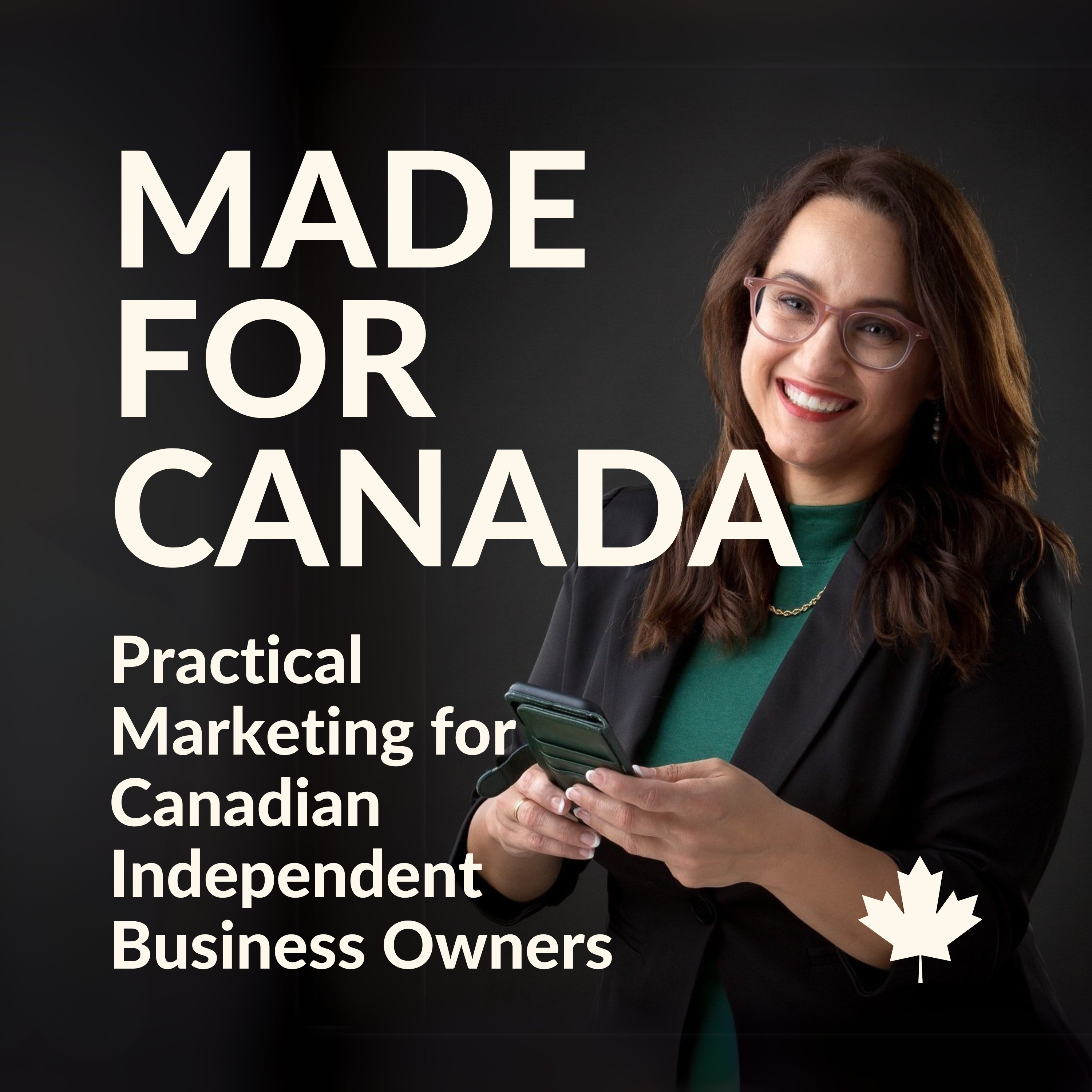
PODCAST · business
Made For Canada
by Cheyanne O'Driscoll
Practical Marketing for Canadian Independent Business OwnersA podcast for and about the people shaping Canada’s independent business economy—from small business owners to the support systems that help them grow. Grounded, practical, and proudly Canadian, it tells the truth about what it really takes to build small, build strong, and build for here.
-
44
The Missing Marketing Strategy You Need to Grow Your Small Business
You’ve built something that works.But when you try to grow your business, things don’t scale the way you expect.You invest in marketing—your website, your content, maybe even ads—but it doesn’t translate into consistent growth. Not in a way you can rely on.This episode breaks down why that happens.Most small business owners are trying to grow through market penetration—getting more of the right customers to choose them within the market they already serve. But instead of defining how that’s supposed to happen, they focus on increasing marketing activity.That’s where growth starts to stall.In this episode, you’ll learn how to think about growth more strategically, understand what’s actually missing from your current approach, and begin defining the go-to-market strategy required to move forward.In this episode, you’ll learn:Why marketing activity doesn’t automatically create business growthWhat market penetration actually means for small businessesThe key questions that start to define your go-to-market strategyJoin the email list to receive weekly episode updates and invitations to upcoming workshops and programs._________________________➡️ Explore the Ways to Work With Me page to access resources, join the email list, or book a 30min call with me.
-
43
Why Your Small Business Marketing Isn’t Turning Into Sales
Right now, many small businesses are putting real effort into their marketing—posting consistently, running promotions, and investing in visibility—yet still struggling to generate steady sales.The issue isn’t a lack of activity. It’s how marketing is being used.This episode breaks down the difference between transaction-based and relationship-based marketing, and why expecting immediate sales from individual campaigns often leads to inconsistent results. When marketing is built around pushing transactions instead of supporting how customers actually decide, it creates constant pressure without long-term momentum.You’ll learn how to shift from trying to generate sales in a single step to building a sequence that aligns with how people move from awareness to purchase—and why that shift is what creates more stable, predictable growth.In this episode, you’ll learn:Why your marketing efforts aren’t translating into consistent salesThe difference between transaction-first and relationship-based marketingHow mapping your client journey changes what your marketing should focus onJoin the email list to receive weekly episode updates and invitations to upcoming workshops and programs.➡️ Explore the Ways to Work With Me page to access resources, join the email list, or learn more about opportunities to work together.
-
42
Why AI Images Are Hurting Your Small Business Marketing (And What to Do Instead)
AI is making marketing faster, easier, and more polished—but for small businesses, that doesn’t always mean it’s more effective.In this episode, we look at a growing pattern: business owners using AI-generated visuals to represent their brand instead of showing real moments. While it feels efficient, it can quietly remove the one thing that actually drives trust and differentiation—your real, human presence.This isn’t about avoiding AI. It’s about understanding where it fits.Because small businesses don’t compete on scale or perfection. They compete on recognition, trust, and relationship. And when those signals disappear, the right customers can’t find or choose you.This episode will help you rethink how your marketing is showing up—and what it’s actually communicating.In this episode, you’ll learn:Why AI-generated visuals can reduce trust instead of building itThe difference between using AI for production vs replacing your brand’s personalityHow to evaluate whether your marketing feels real enough to be trustedJoin the email list to receive weekly episode updates and invitations to upcoming workshops and programs.____________➡️ Explore the Ways to Work With Me page to access resources, join the email list, or learn more about opportunities to work together.
-
41
Small Business Marketing Strategy: Stop Chasing Visibility
Many independent small businesses focus on increasing visibility. Posting more often, running ads, buying radio spots, or paying for local exposure. But despite these efforts, growth still feels inconsistent.This episode explores the difference between visibility and relevance, and why visibility alone rarely leads to stronger demand. Being seen does not automatically create memorability, preference, or differentiation. Relevance is what gives customers a reason to care, remember your business, and choose you when the time comes.This episode breaks down how small businesses often invest in exposure without first establishing meaning, and why relevance, not reach, is what makes marketing more effective. You’ll also hear how relevance shows up in everyday marketing decisions and how it changes the way you think about visibility.In this episode, you’ll learn:The difference between visibility and relevance in small business marketingWhy more exposure doesn’t always lead to growthHow relevance makes your business more memorable and easier to choose.➡️ Find links to my free Local Visibility Webinar, Full Day Local Visibility Workshop and my email list Ways to Work With Me
-
40
The Local Moat: Your Real Competitive Advantage in Marketing
Most small business owners don’t struggle with a lack of marketing ideas—they struggle with knowing which ideas are actually worth executing.In this episode of Made for Canada, Cheyanne O’Driscoll introduces the concept of the Local Moat—a practical framework for understanding your real competitive advantage as an independent business. Instead of trying to compete on reach, volume, or visibility, this episode explains how small businesses grow by strengthening their geographic presence, building relationships, and connecting to their local community.You’ll learn why most marketing advice doesn’t translate to small-scale businesses, how to think about marketing as something that builds a position over time, and why capturing existing demand is often more effective than trying to create new demand.If your marketing feels inconsistent or unclear, this episode will help you understand what it should actually be doing—and how to focus your efforts more strategically.In this episode, you’ll learn:• Why having more marketing ideas isn’t the solution• What the “Local Moat” is and how it shapes your strategy• How to evaluate your marketing based on what it’s buildingJoin the email list to receive weekly episode updates and invitations to upcoming workshops and programs.➡️ Explore the Ways to Work With Me page to learn more about the Local Moat, take the Growth Marketing Scorecard, or join the email list.
-
39
Small Business Marketing Systems: Moving Beyond Referrals and Word of Mouth
Most independent small businesses rely on referrals and word of mouth to bring in customers. For many, it’s the primary driver of demand—and for a time, it works.But referrals are not a marketing system.In this episode of Made for Canada, small business marketing strategist Cheyanne O’Driscoll breaks down the difference between marketing by chance and small business marketing systems. She explains why relying on referrals creates unpredictability, and why many growth-oriented businesses reach a point where it’s no longer enough.Drawing on early data from small business owners in Southeastern Ontario, this episode reframes referrals as validation—not a strategy—and introduces a simple way to understand whether your business is actually generating demand or just benefiting from it.This is a foundational shift for independent business owners who want more control over their growth, especially in a market where demand is harder to access.You’ll learn:Why referrals and word of mouth don’t create predictable growthThe difference between marketing by chance and a marketing systemWhat changes when you start reaching beyond your existing network➡️ Explore the Ways to Work With Me page to access the Growth Marketing Ladder Scorecard, join the email list, or learn more about opportunities to work together.
-
38
Why Most Small Business Owners Struggle With Marketing Consistency
discipline, but because the systems they’re trying to follow don’t match how their business actually operates.In this episode of Made for Canada, marketing strategist Cheyanne O’Driscoll breaks down the concept of founder-led marketing and explains why consistency becomes difficult when marketing is not designed around real capacity. Drawing on early data from small business owners in Southeastern Ontario, this episode reframes inconsistency as a structural issue — not a personal one.You’ll learn:Why most marketing advice assumes you have more capacity than you doWhat founder-led marketing actually means for your businessHow to identify where your current approach is misalignedJoin the email list to receive weekly episode updates and invitations to upcoming workshops and programs._______👉 Take the Small Business Marketing Survey and receive your copy of the report ➡️ Explore the Ways to Work With Me page to access resources, join the email list, or learn more about opportunities to work together.
-
37
Why Funnels and Email Systems Often Fail Small Businesses
Many small business owners invest time and money building marketing systems — funnels, email sequences, automation, and content strategies — expecting those tools to generate consistent sales.But when results don’t appear, the problem is often not the tools themselves.It’s the order they were built in.In this episode of Made for Canada, marketing consultant Cheyanne O’Driscoll explains why many businesses end up with what she calls messy marketing — a collection of disconnected tactics and systems built before the offer and messaging were validated.This conversation introduces a simple framework for understanding how marketing should actually develop alongside the offer:validate → systemize → scaleRather than treating marketing as something that can be purchased as a ready-made system, Cheyanne explains why marketing works best when it is built progressively to support the stage of offer development.You’ll learn:• Why many small businesses end up with disconnected marketing systems• What it actually means to validate an offer through real customers• Why marketing systems only work once messaging and sales patterns are provenIf your marketing efforts have ever felt scattered or overly complicated, this episode will help clarify why — and how approaching marketing in stages can simplify the process.Join the email list to receive weekly episode updates and invitations to upcoming workshops and programs.___________➡️ Explore the Ways to Work With Me page to access resources, join the email list, or learn more about opportunities to work together.
-
36
The Micro-Business Reality: Why Generic Marketing Advice Fails Independent Businesses
Micro-businesses make up the majority of businesses in the economy.In Canada, roughly 59% of businesses have fewer than five employees, and more than three quarters have fewer than ten. Yet most marketing advice is designed for companies with teams, budgets, and specialized departments.For many independent business owners, this creates confusion. The marketing frameworks they encounter assume a business structure that looks very different from their own.In this episode of Made for Canada, marketing consultant Cheyanne O’Driscoll explains what a micro-business actually is and why recognizing this category changes how marketing should be designed.This episode explores how micro-businesses operate, why their market position and operational realities differ from larger companies, and why marketing systems must be built specifically for the structure of the business.You’ll learn:• What defines a micro-business and how to recognize if your business fits this category• Why most marketing advice assumes a business structure that micro-businesses do not have• How marketing becomes manageable when it is designed around the real operating structure of the businessIf marketing has felt scattered or overwhelming in your business, this episode will help clarify why—and how a marketing system designed for micro-businesses changes the equation.Join the email list to receive weekly episode updates and invitations to upcoming workshops and programs._____________➡️ Explore the Ways to Work With Me page to access resources, join the email list, or learn more about opportunities to work together.
-
35
What Is Demand? Why Canadian Small Businesses Struggle with Sales in 2026
Nearly half of Canadian small businesses report insufficient demand as a barrier to growth. In the February 2026 Business Barometer from the Canadian Federation of Independent Business (CFIB), 49% of respondents listed weak demand as limiting sales or production.But when sales slow down, what does “demand” actually mean?In this episode of Made for Canada, marketing consultant Cheyanne O’Driscoll explains the economic definition of demand and why many established product and service businesses misdiagnose slower sales as a visibility problem.This episode breaks down the difference between interest and purchasing behavior, explains why demand exists at different levels, and shows how positioning and packaging affect whether your offer connects to real buyers.You’ll learn:• What demand actually means — and what it doesn’t• Why slower sales don’t automatically mean there’s no demand• How to evaluate whether your offer aligns with real purchasing behaviorIf growth has slowed in your business, this episode will help you determine whether the issue is visibility — or demand alignment.__________________➡️ Explore Ways to Work With Me to access resources, join my email list, or book a 30-minute conversation.
-
34
How to Increase Small Business Demand Without More Promotion
Most independent small business owners assume that when sales slow down, the solution is more marketing — more posting, more advertising, or more visibility. But increased promotion doesn’t solve a deeper misalignment between what a business sells and the job customers are actually trying to get done.In this episode of Made for Canada, marketing consultant Cheyanne O’Driscoll introduces the Jobs to Be Done framework in plain language and explains how demand doesn’t disappear — it shifts under new constraints. Using real examples from a historic local theatre and a catering company that adapted its format, this conversation shows how independent businesses can reconnect what they already offer to the demand that already exists.You’ll learn:•Why increased promotion often fails when demand feels slow• What “Jobs to Be Done” really means — and how it explains buying behaviour• How to evaluate and position one of your offers so it aligns more clearly with real demand_______________➡️ Explore the Ways to Work With Me page to access resources, join my email list, or book a 30-minute conversation.
-
33
The Inconvenience of Community: Your Advantage as a Small Business
Most independent business owners are told to compete on convenience — faster service, smoother systems, less friction. But that advice often puts independents in direct competition with scaled businesses built for transaction and efficiency.In this episode of Made for Canada, marketing consultant Cheyanne O’Driscoll breaks down the concept of the “inconvenience of community” and explains how independent businesses operate in a different arena. Drawing on Jobs to Be Done theory, early adopter strategy, and the local multiplier effect, this conversation reframes relational friction as a strategic advantage — and shows how to build an audience of conscious consumers who already value it.You’ll learn:• Why competing on convenience puts independent businesses in the wrong strategic position• How Jobs to Be Done explains why some customers intentionally choose relational exchange• Why activating early adopters is the smartest way to build a values-aligned audience_______________👉 Join the CO’ Marketing newsletter.
-
32
Why Execution Without Strategy Turns Marketing Into an Expensive Mistake
Many independent business owners assume marketing problems are caused by a lack of effort or consistency, when the real issue is that activity is happening without clear direction.In this episode of Made for Canada, Cheyanne O’Driscoll breaks down how execution gets mistaken for marketing, why visibility is often invested in too early, and how this turns marketing into an ongoing cost rather than a business asset.This conversation helps business owners understand what execution is actually responsible for — and what has to be decided before more time or money is put into marketing.You’ll learn:Why increased activity doesn’t automatically lead to salesWhat execution can and cannot do for revenueWhy outsourcing without clear decisions increases risk_______________👉 Join the CO’ Marketing newsletter.📆 Book a 30min chat.
-
31
Marketing Strategy for Small Businesses: In-Market vs Out-of-Market
Most independent small business owners struggle with small business marketing because tactics are used without a clear marketing strategy behind them.In this episode of Made for Canada, Cheyanne O’Driscoll explains the difference between in-market and out-of-marketbuyers, and how this distinction helps small businesses decide whether marketing should focus on short-term revenue or long-term growth.You’ll learn:Why marketing tactics fail without a clear strategyWhat in-market vs out-of-market means for small business marketingHow business goals should guide marketing focus_______________👉 Join the CO’ Marketing newsletter to know when new episodes are released. ❤️ Join us for the Fall in Love with Your Business Again Challenge February 9th-13th.
-
30
Defining Your Target Market as a Small Business: What Demographics Miss
Most independent small business owners are told to define their target market using demographics — age, income, and life stage — but that advice rarely explains how people actually decide to buy.In this episode of Made for Canada, small business marketing consultant Cheyanne O’Driscoll breaks down demographic, psychographic, and geographic targeting in plain language, showing how independent businesses are chosen based on why people buy, not just who they are. Using a simple local storm example, this conversation explains how shared geography creates shared priorities — and how understanding buying logic leads to clearer, more effective marketing.You’ll learn:• Why demographic targeting often breaks down for small and independent businesses• How psychographics explain buying decisions across age and income groups• How shared geography creates predictable shifts in priorities and purchasing behaviour_______________👉 Join the CO’ Marketing newsletter to access the 2026 Marketing Priority Planner and start planning with clarity
-
29
Small Business Marketing in 2026: When to Plan and When to Execute
Most Canadian small business owners spend the majority of their time working in their marketing — posting on social media, sending emails, and running promotions — without ever stepping back to work on their marketing.In reality, small and micro-businesses need marketing strategy more than large companies because their time, energy, and budgets are limited — and random marketing becomes expensive very quickly.In this episode of Made for Canada, small business marketing consultant Cheyanne O’Driscoll explains the difference between working in your marketing and working on your marketing, and why building a clear marketing rhythm is essential for sustainable growth.This conversation reframes marketing strategy as a practical planning discipline — not a corporate exercise — and shows how intentional planning helps small business owners reduce decision fatigue, improve consistency, and get better results from their marketing efforts.You’ll learn:• The difference between working in your marketing and working on your marketing — and why both are necessary• Why strategy leads to a clear plan — and a plan reduces daily decision fatigue• Three practical ways to build a sustainable marketing rhythm for the year ahead________________________👉 Join the CO’ Marketing newsletter to access the 2026 Marketing Priority Planner and identify three smart marketing goals based on your stage of business:👉 Book a 90min Consultation and start 2026 strong with a 90 Day Marketing Action Plan. Send me an email at [email protected]
-
28
Market Research for Small Businesses: Why Relationships Beat Big Data
Most Canadian small business owners assume market research is something only big companies can afford — surveys, focus groups, analysts, and reports.In reality, independent businesses have access to some of the highest-quality market research available because they work directly with their customers every day.In this episode of Made for Canada, small business marketing consultant Cheyanne O’Driscoll explains the difference between transactional marketing and relational marketing, and why relational marketing is a built-in advantage for independent and micro-businesses.This conversation reframes market research as a practical, relational discipline — not a corporate exercise — and shows why understanding your market deeply is one of the first steps in building a clear annual marketing plan.You’ll learn:• The difference between transactional and relational marketing — and why relationship matters more than scale for small businesses• Why independent businesses have more accurate market insight than large organizations• Three practical ways to use real customer interactions as market research when planning your year ahead_______________👉 Join the CO’ Marketing newsletter to access the 2026 Marketing Priority Planner and start planning with clarity.📊
-
27
Stop Buying Marketing: How Canadian Small Businesses Build What Actually Works
Most Canadian small business owners aren’t frustrated with marketing because they haven’t tried hard enough.They’re frustrated because marketing has been treated as something to buy, not something to build.In this episode of Made for Canada, small business marketing strategist Cheyanne O’Driscoll explains why so many independent businesses conclude that “marketing doesn’t work,” and how that belief is often a rational response to how marketing has been sold, executed, and measured.This conversation reframes marketing as a practical business asset.Not a reactive expense.And walks through what actually needs to be in place before ads, campaigns, or contractors can work reliably.You’ll learn:• Why buying marketing activities without structure leads to inconsistent results and wasted spend• The difference between treating marketing as an expense versus building it as an asset inside your business• How setting clear priorities and stage-appropriate goals reduces guesswork and restores trust in marketing_______________👉 Join the CO’ Marketing newsletter to access the 2026 Marketing Priority Planner and start planning with clarity.
-
26
Top 3 Marketing Mistakes by Canadian Small Businesses in 2025
Most Canadian small business owners aren’t failing at marketing because they’re not trying hard enough. They’re stuck because of a few planning mistakes that quietly undermine their efforts.In this episode of Made for Canada, small business marketing strategist Cheyanne O’Driscoll breaks down the three most common marketing mistakes independent businesses make. She also shares clear criteria for building a smarter, stage-appropriate marketing plan for 2026.You’ll learn:• Why marketing fails when it’s executed tactically without strategy or systems• How to align your marketing plan to your business stage — and stop building the wrong things too early• How simple, stage-appropriate data helps you iterate and improve instead of guessing👉 Join the CO’ Marketing newsletter to access the 2026 Marketing Priority Planner for free and start planning with clarity:
-
25
How to Choose the Right Marketing Goals for 2026 for Your Small Business
Most Canadian small business owners don’t struggle because they lack goals .They struggle because their goals aren’t grounded in the real context of their business.In this episode of Made for Canada, small business marketing consultant Cheyanne O’Driscoll breaks down why most marketing goals fail, how to set goals that actually match the stage your business is in, and how to think about 2026 with more clarity and direction.You’ll learn:• The three most common misconceptions small business owners have about marketing goals• Why goals need strategic context — not just aspiration• How your business stage shapes your marketing priorities• The difference between engine goals, stabilizer goals, and amplifier goals (and why choosing the wrong one stalls growth)• A grounded way to define your marketing direction for 2026This episode helps independent business owners, micro-businesses, and established service providers choose marketing goals that are realistic, achievable, and aligned with how small businesses actually work .Giving you a clearer, steadier path for the year ahead.👉 Join the CO’ Marketing newsletter for weekly strategy insights for Canadian small businesses
-
24
Marketing Skills Every Canadian Small Business Owner Needs
Most Canadian small business owners don’t need to hire out their marketing — you need to learn how to think like your own CMO.In this episode of Made for Canada, small business marketing strategist Cheyanne O’Driscoll explains why entrepreneurship is a trade, why marketing is one of the five core entrepreneurial skills, and why outsourcing only works once your strategy and systems are already in place.You’ll learn:Why microbusiness owners can’t separate the practitioner from the entrepreneurWhat the five core entrepreneurial skill sets are — and where marketing fitsThe difference between marketing strategy, systems, and skillsWhy clarity and internal capacity matter more than posting or paid adsThis episode gives independent business owners, micro-businesses, and solo entrepreneurs a clear way to build their marketing foundation with more confidence, structure, and long-term stability.➡️ Join my free Understanding Marketing training to learn simple, stage-based strategies that fit your business. 👉 Join the CO’ Marketing newsletter for weekly strategy insights for Canadian small businesses
-
23
Marketing Planning for Canadian Small Businesses in 2026
Most Canadian small business owners don’t need a more complicated marketing system — you need a clearer way to plan it.In this episode of Made for Canada, small business marketing strategist Cheyanne O’Driscoll breaks down how to build an annual marketing plan that fits your business stage and creates real stability in 2026.You’ll learn:Why annual planning matters more than individual tacticsHow your stage of business development shapes your marketing prioritiesA simple 3-step process to build a clear, usable planWhy internal marketing capacity is the real driver of long-term successWhat most business owners misunderstand about planning vs. systemizingHow to think about marketing as part of your business operations — not an add-onThis episode gives independent business owners, small businesses, and micro-businesses a practical way to move into 2026 with clarity, structure, and confidence.Next steps:👉 Join the CO’ Marketing newsletter for weekly strategy insights for Canadian small businesses💬 Book a 90-Minute 2026 Marketing Focus Consultation to clarify your priorities and set a clear plan for the year ahead.
-
22
Why Familiarity Sells: The Nostalgia Effect in Holiday Marketing
Canadian small business owners can use nostalgia and familiarity to build trust, connection, and stronger holiday marketing results.In this episode of Made for Canada, small business marketing strategist Cheyanne O’Driscoll breaks down the psychology behind the nostalgia effect , why people respond to what feels familiar in December , and how to apply it authentically in your marketing.You’ll learn:• How the brain links familiar cues with comfort, safety, and trust• Why nostalgia drives spending and loyalty during the holidays• Three practical ways to use it honestly — through real stories, community traditions, and shared memory👉 Join the November Content Lab to plan your December content https://cheyanne-s-site-1b67.thinkific.com/courses/copy-of-october-content-lab
-
21
Simple Holiday Marketing for Canadian Small Businesses
Most small business owners don’t need perfect marketing — you just need to start.In this episode of Made for Canada, small business marketing strategist Cheyanne O’Driscoll explains why marketing is a process, not a product, and how taking small, consistent action builds confidence and results.You’ll learn:•Why marketing skill only develops through motion — not planning• How even pros build testing and iteration into every strategy• Three simple actions to use this holiday season.Next steps:👉 Join the CO’ Marketing newsletter for weekly strategy insights for Canadian small businesses
-
20
Rethinking Marketing in 2026: Strategy, Plan, Execute, Systemize
Most Canadian small business owners don’t need more marketing ideas. You need a better way to manage them.In this episode of Made for Canada, small business marketing strategist Cheyanne O’Driscoll walks through the four-part sequence that brings clarity, rhythm, and measurable results to your marketing work in 2026.You’ll learn:• Why marketing belongs inside your business, not outside of it•The four stages that structure every effective project: Strategy, Plan, Execute, Systemize• Why most businesses systemize too soon — and how to know when you’re ready• How this approach helps small businesses stay steady through changing marketsNext steps:👉 Join the CO’ Marketing Newsletter for weekly updates on Made for Canada episodes, and ways to work together .💬 Book a 90-Minute 2026 Marketing Focus Consultation to clarify your priorities and set a clear plan for the year ahead.
-
19
2026 Flywheel 3/3: Retain Demand with Retention Marketing
Wrap up the 2026 Marketing Flywheel series and learn how depth helps independent businesses retain demand, build loyalty, and create long-term stability.In this episode of Made for Canada, Cheyanne O’Driscoll — Canadian small business marketing consultant — closes the Build Your 2026 Marketing Flywheel series with the final piece: Depth.After exploring Differentiation (attract demand) and Diversification (capture demand), this conversation focuses on what comes next . How to retain the demand you’ve already earned.Cheyanne explains why client and customer acquisition is the most expensive kind of marketing, and how retention systems are what keep your business stable when conditions change.You’ll learn:– Why retention is the most cost-effective growth strategy– The difference between transactional marketing and relational marketing– How to build depth into your customer relationships and offers– What systems help sustain trust, repeat sales, and referralsIt’s a straightforward look at how independent businesses can move beyond one-time transactions and start building depth, the kind of marketing that compounds._____________Complete the Marketing Flywheel Builder to identify your key opportunities and start designing a system that creates sustainable momentum for 2026.👉 Start Now
-
18
2026 Flywheel 2/3: Diversify to Capture Demand
Continue the 2026 Marketing Flywheel series and learn how diversification helps independent businesses capture demand and convert attention into revenue.In this episode of Made for Canada, Cheyanne O’Driscoll — Canadian small business marketing consultant — moves into the second part of the 2026 Marketing Flywheel: Diversification.Last episode focused on Differentiation . How to attract demand by showing up clearly and consistently in a value-conscious market. This episode builds on that foundation to explore what happens next: how to capture that demand once it’s been attracted.You’ll learn:– The difference between attracting attention and capturing demand– How to design offers that meet buyers at different readiness levels– Why channel variety supports consistency and cash flow– What diversification looks like for small and independent businesses in 2026It’s a practical look at how to turn your marketing from reactive to reliable, by structuring your system to convert interest into income._____________Complete the Marketing Flywheel Builder to identify your key opportunities and start designing a system that creates sustainable momentum for 2026.👉 Start Now
-
17
2026 Flywheel (1/3): Attract Demand with Differentation
Kick off the 2026 Marketing Flywheel series and learn how differentiation attracts real demand in a flat, value-conscious market.In this episode of Made for Canada, Cheyanne O’Driscoll — Canadian small business marketing consultant— kicks off a new three-part series on how to build your 2026 Marketing Flywheel.Cheyanne breaks down what’s happening in today’s market. Why conditions feel different. What’s driving slower buyer decisions. And how independent businesses can adapt by focusing on differentiation.This first part of the series looks at how to attract demand by getting clear about what you stand for, and how your business fits into a changing economy. It’s a practical, data-aware look at what it takes to stay visible and relevant in 2026.You’ll learn:– Why differentiation is the foundation of marketing momentum in 2026– The difference between standing out and staying relevant– How market saturation is changing what “competitive advantage” really means– What small businesses can do now to attract steady, qualified demand_____________Complete the Marketing Flywheel Builder to identify your key opportunities and start designing a system that creates sustainable momentum for 2026.👉 Start Now
-
16
Holiday Marketing in Canada: How Small Businesses Can Capture Peak Season Spending
Holiday marketing for Canadian small businesses — strategies to capture Q4 spending, show up early, and compete during Black Friday and beyond.The holiday season is Canada’s biggest buying period — but it’s also the most competitive.In this episode, Cheyanne O’Driscoll explains how small business owners can show up early and confidently to capture their share of the billions being spent across the country.You’ll learn:🎯 How Q4 consumer spending patterns actually work🎯 Why early visibility beats last-minute promotions🎯 The difference between noise and relevance in seasonal marketing🎯 What actions you can take this week to increase salesThis is your opportunity to build momentum, stay visible, and turn the holiday rush into steady revenue.➡️ Join the next Content Lab➡️ Get on my Email ListEmail List Sign Up:
-
15
Finding Customers Who Still Buy: Market Fit in a Slower Economy
In this episode of Made for Canada, Cheyanne O’Driscoll, Canadian small-business strategist and marketing consultant, explains why market fit is the foundation under every successful business — and why it matters more than ever in today’s value-conscious economy.With discretionary spending down and buyers becoming more selective, many small business owners are feeling the slowdown. Cheyanne breaks down what’s really happening, why “accidental” market fit is rare in this economy, and how to create it intentionally using her 3E Framework for independent businesses.You’ll learn:🔍 What “market fit” actually means — and how to recognize when your business has it.💡 How to adapt your offers to today’s value-conscious economy so customers keep buying.🧩 How to use the 3E Framework to simplify market fit for your independent business.Cheyanne shares real-world examples — including a new local thrift store that nailed its market fit with a clear price promise — and explains how Everyday, Experience, and Expertise businesses each create fit in their own way.Key insight:Market fit isn’t luck — it’s clarity. When you understand the job your customers hire you to do, your marketing becomes easier, your offers feel obvious, and your business becomes more resilient in any economy.Mentioned:CB Insights data: 40% of businesses fail for lack of market fit.The Jobs-to-Be-Done concept simplified for Canadian independents.🎓 Next step:Watch the free Understanding Marketing training — your foundation for building systems and strategies that create real market fit. Made for Canada: Marketing stories, systems, and skills for Canadian independent business owners.
-
14
The Problem With Plug-and-Play Marketing
Independent businesses don’t need borrowed funnels or one-size-fits-all frameworks. In this episode, Cheyanne O’Driscoll, Canadian small business strategist and marketing consultant, explains why plug-and-play systems keep owners stuck as consumers of marketing and how to invest in marketing that actually works.You’ll learn:– Why small business marketing has to be designed inside your business– The paradigm shift from buying marketing to investing in it– Three ways to invest in your own marketing: Strategy, Systems, and Skills➡️ Access my free Understanding Marketing Training ➡️ Ways to Work With Me
-
13
Canadian Independent Businesses: Your Marketing Advantage
Marketing a small business in Canada often feels overwhelming . Especially when traditional marketing advice seems built for big corporations with big budgets. In this episode, Cheyanne O’Driscoll, Canadian small business strategist, explains why classic marketing doesn’t fit today’s reality and how independent businesses can win by leaning into their natural advantages: local presence, personal relationships, and trust.You’ll learn:– Why traditional marketing feels out of reach for small businesses– What has changed in how customers actually make decisions– How Canadian independents can use relevance and connection as their advantage➡️ Join my free Understanding Marketing training to learn simple, stage-based strategies that fit your business. 🔔 Follow to listen to weekly Made For Canada episodes
-
12
October: The Last Window for High-Involvement Decisions
In this episode, Cheyanne O’Driscoll, Canadian small business strategist and marketing consultant, explains why October is the last clear window for buyers to make bigger, high-involvement decisions . And why that matters for your marketing.Working with anyone new, signing up for a package, or making a larger purchase all require focus and trust. October is the month when customers still have steady attention and budgets, before the holidays shift spending toward gifts and impulse buys.You’ll learn: – The difference between low-involvement and high-involvement purchases (and why it matters) – Why October is the natural month to win new customers and secure larger commitments – Three simple ways to make your offers decision-ready this October➡️ Build Your Core Marketing System with Me➡️ Join the next Content Lab
-
11
Your Holiday Sales Start Now
In this episode, Cheyanne O’Driscoll, Canadian small business strategist and marketing consultant, explains how campaigns fit into your core marketing system. And why holiday promotions are a critical part of building momentum.Your evergreen and monthly content keeps the lights on, but campaigns are what create energy, urgency, and direction. You’ll learn: – The difference between maintenance marketing and campaign marketing – Why campaigns are about intention, not just noise – Three steps you can take right now to design your holiday campaign☕️ Check out Cha Cha Tea Online➡️ Build Your Core Marketing System with Me➡️ Join the next Content Lab
-
10
The 3 Marketing Habits You Need to Reach Your Goals this Fall
In this episode, Cheyanne O’Driscoll, Canadian small business strategist and marketing consultant, explains why your marketing goals aren’t reached by strategy alone, and how building marketing habits is the real key to growth this fall.Marketing is something you have, when in fact it’s something you do. It belongs in your calendar the same way bookkeeping or client work does.You’ll learn:– Why so many small business owners fall into the “random acts of marketing” trap– How to reframe entrepreneurship as a trade with skills and habits you can build over time– The three marketing meetings that anchor consistent, effective marketing in your schedule➡️ Build Your Core Marketing System with Me➡️ Join the next Content Lab➡️ Apply for the 2026 Annual Marketing Plan Intensive (Exclusive to Previous Clients)
-
9
Playing in the Marketing Sandbox
In this soapbox episode, Cheyanne digs into one of the most overlooked pieces of the Marketing Stack: Go-to-Market strategy.She explains why small business owners need to move beyond being consumers of marketing products and start thinking like empowered decision-makers. It's time to put on your CMO hat and learn how to play in the sandbox of marketing!You’ll learn:Why “one-size-fits-all” rules in marketing are a red flag.The 6 market engagement strategies (penetration, creation, shaping, segmentation, arbitrage, and presence).How small business owners already hold the best field data for making marketing choices.If you’ve ever felt overwhelmed by rigid marketing advice, this episode is your reminder that you already know more than you think Marketing is a creative, empowering tool for you to leverage.➡️ Build Your Core Marketing System with Me➡️ Join the next Content Lab
-
8
Align Your Content with Buyer Psychology This September
If you’re a Canadian small business owner trying to figure out why some months your marketing feels like it lands and other months it falls flat, you’re not alone.In this episode, Cheyanne O’Driscoll, small business strategist and marketing consultant, explains the concept of Attention Windows — why your buyers only make decisions in certain cycles, and how September acts as a “mini-January” in consumer psychology.You’ll learn:– The most common mistake small businesses make when they market “out of season”– What the research says about consumer decision-making windows and the Fresh Start Effect– Why September is one of the most powerful re-engagement moments of the year– How to align your content with open windows so you stop posting into the void and start catching buyers when they’re ready➡️ Build Your Core Marketing System with Me➡️ Join the next Content Lab
-
7
Building a Viable Business in a Flattened Economy
If you’re a Canadian small business owner trying to keep your business viable in a sluggish economy, you’re not alone.In this episode, Cheyanne O'Driscoll, small business strategist and marketing consultant, explains what it really takes to build and maintain a viable business when the economy is flat, trust is low, and buyers are moving slower than ever.And what to do about it.You'll learn:– The five non-negotiable components of a viable business model– How economic contraction is changing buyer psychology and decision-making– What to focus on now to stabilize your revenue, simplify your operations, and protect your margin➡️ Build Your Core Marketing System with Me➡️ Join the next Content Lab
-
6
Selling in Slow Times: How Canadian Small Businesses Can Adapt Their Marketing Today
If you’re a Canadian small business owner wondering why your marketing isn’t getting the traction it used to, you're in good company. In this episode, Cheyanne O'Driscoll, small business marketing consultant, explains the underlying reasons behind the marketing slowdown many independent businesses are experiencing. And what to do about it.You'll learn:Why the current economic, social, and cultural shifts in Canada are impacting consumer behaviorHow this disconnect affects even good marketing strategiesWhat you need to do to realign your business communication with today’s market conditions➡️ Build Your Core Marketing System with Me➡️ Join the next Content Lab➡️ Get the Free Marketing Training
-
5
The Sales Fix Episode 3: Failure or Framing
Is your offer really failing—or is it just framed wrong?In this episode of The Sales Fix series, we’re unpacking the power of positioning and how small tweaks in timing, context, or messaging can flip a flop into a best-seller.You’ll hear examples of campaigns that don't change the product—just the framing—and can see significant shifts in results. Stop second-guessing your offer and start using strategic framing to make it land.Sign Up for the Sales Fix: How to Increase Your Marketing ROI as a Canadian Independent Business Owner Free 3 Day TrainingApply for the Campaign Bootcamp
-
4
Sales Fix Episode 2: Show the Value to Make the Sale
Are you stuck in the “if I build it, they will come” trap? In this episode of the Sales Fix series, we’re digging into why believing in your offer isn’t enough—you have to make its value crystal clear.You’ll learn how to use the Benefits Ladder to translate product features into audience-relevant benefits, whether you’re running an everyday business, offering an experience, or providing expertise-based services.Stop flooding your community with empty posts and start creating campaigns that actually connect and convert.Sign Up for the Sales Fix: How to Increase Your Marketing ROI as a Canadian Independent Business Owner Free 3 Day TrainingApply for the Campaign Bootcamp
-
3
Sales Fix Episode 1: The 3Ps of Sales for Small Businesses
You’ve been told to post more to drive sales—but is that really working? This episode of The Sales Fix breaks down the real reason visibility isn’t translating into revenue.Learn how to stop wasting time and start focusing on the 3 Ps of Sales—Prepare, Package, and Promote—to get more out of every marketing effort.Sign Up for the Sales Fix: How to Increase Your Marketing ROI as a Canadian Independent Business Owner Free 3 Day TrainingApply for the Campaign Bootcamp
We're indexing this podcast's transcripts for the first time — this can take a minute or two. We'll show results as soon as they're ready.
No matches for "" in this podcast's transcripts.
No topics indexed yet for this podcast.
Loading reviews...
ABOUT THIS SHOW
Practical Marketing for Canadian Independent Business OwnersA podcast for and about the people shaping Canada’s independent business economy—from small business owners to the support systems that help them grow. Grounded, practical, and proudly Canadian, it tells the truth about what it really takes to build small, build strong, and build for here.
HOSTED BY
Cheyanne O'Driscoll
Loading similar podcasts...
Frequently Asked Questions
How many episodes does Made For Canada have?
Made For Canada currently has 42 episodes available on PodParley. New episodes are automatically indexed when they're published to the podcast feed.
What is Made For Canada about?
Practical Marketing for Canadian Independent Business OwnersA podcast for and about the people shaping Canada’s independent business economy—from small business owners to the support systems that help them grow. Grounded, practical, and proudly Canadian, it tells the truth about what it really...
How often does Made For Canada release new episodes?
Made For Canada has 42 episodes. Check the episode list to see recent publication dates and frequency.
Where can I listen to Made For Canada?
You can listen to Made For Canada on PodParley by clicking any episode. We provide an embedded audio player for direct listening, and you can also subscribe via your preferred podcast app using the RSS feed.
Who hosts Made For Canada?
Made For Canada is created and hosted by Cheyanne O'Driscoll.
URL copied to clipboard!