
PODCAST · education
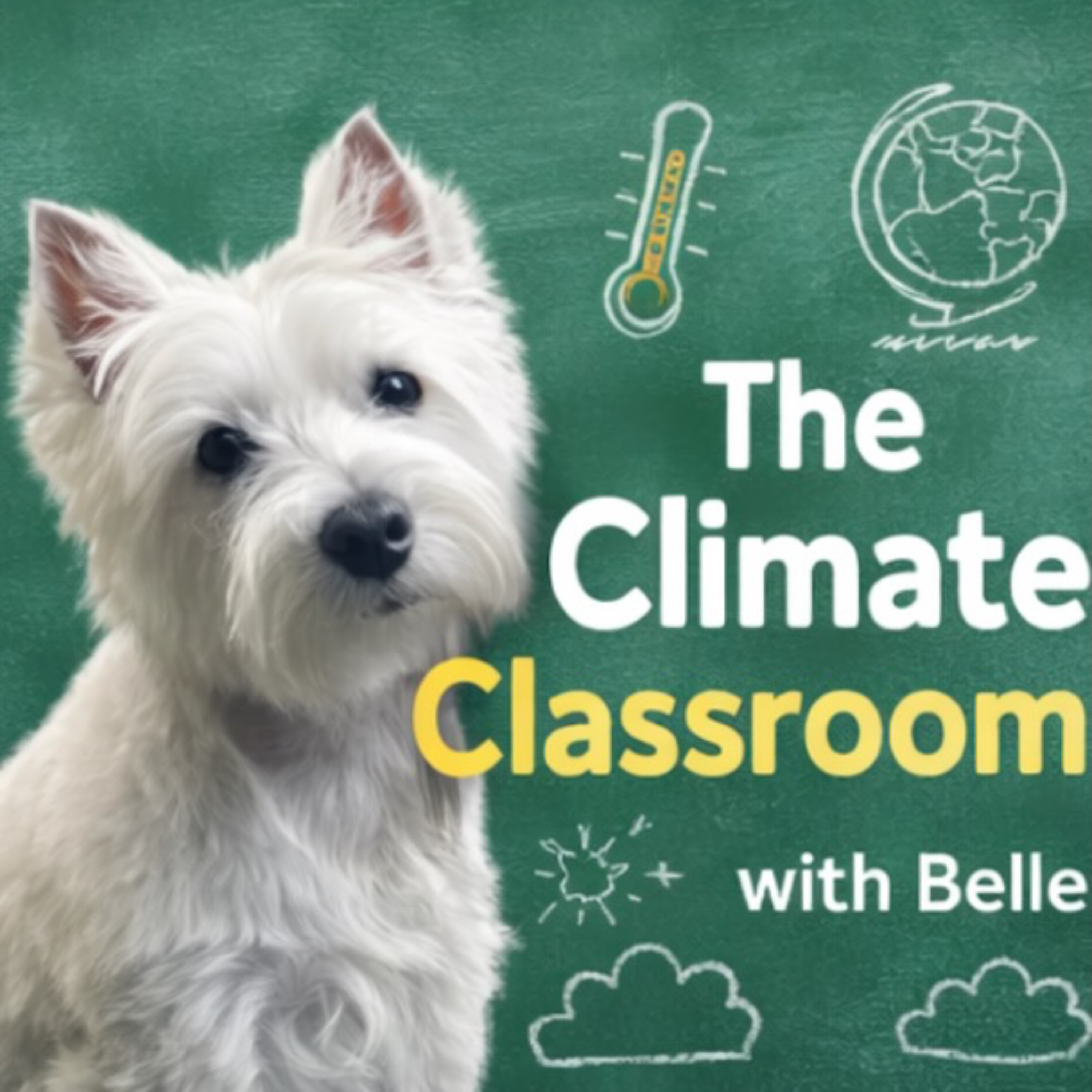
The Climate Classroom
by theclimateclassroom.org
A short weekly podcast that explains climate change clearly and calmly, without jargon. Each 12 minute episode takes one small part of the story – what we know, how we know it, and what it means – using trusted, peer-reviewed evidence. Made for families, the classroom, and curious listeners of any age. Listen on the school run, on your commute, or round the kitchen table.
-
13
11: Animals on the Move
Episode 11 Show Notes🎧 The Warming World: Animals in Changing Habitats🐾 Belle’s QuestionWhat happens when an animal’s habitat starts changing?📌 If you remember one thing: Every living creature has a natural home — its habitat. When climate changes that habitat, some creatures move, some struggle to survive, and some may disappear. But people can help protect, restore, and reconnect the habitats they depend on.🔍 What we coverWhat a habitat is — and why it is more than just a place.How climate change affects food, water, shelter, and breeding conditions.Why changing seasons can disrupt the timing of life.Why some creatures move — and why many cannot move easily.What happens when there is nowhere left to go.The idea of connectivity — and why fragmented landscapes make adaptation harder.🌟 One Bright ThingIf habitats are broken up, people can help stitch them back together.Small changes can help — hedgerows, wildflower strips, and wildlife crossings.And at a larger scale:Gondwana Link (Western Australia) — reconnecting fragmented bushland across 1,000 km, helping wildlife move and adapt as the climate warms.Weald to Waves (Sussex, UK) — linking woods, rivers, farmland, floodplains, downland and coast into a 100-mile nature recovery corridor, creating a more connected, living landscape.🔢 Key numbers mentionedAround 1 million animal and plant species threatened with extinction. (IPBES)73% avg. decline in monitored vertebrate wildlife populations post 1970 (WWF)1,000 kilometres — Gondwana Link wildlife corridor100 miles — Weald to Waves nature recovery corridor🧑🏫 Teacher NotesA habitat is the set of conditions that make life possible — food, water, shelter, space, and climate.Climate change can alter those conditions directly, and also indirectly through food supply, seasonal timing, breeding success, and movement routes.Key teaching idea:A place may still exist — but no longer function as a healthy habitat.Connectivity matters:When landscapes are fragmented, movement becomes harder, and adaptation becomes more difficult.📚 Sources & further readingIPCC, climate change impacts on ecosystems — https://www.ipcc.chNASA Climate, ecosystem changes — https://climate.nasa.govMet Office, climate change explained — https://www.metoffice.gov.ukIPBES (The Intergovernmental Science-Policy Platform on Biodiversity and Ecosystem Services) Global Assessment around 1 million species threatened with extinction. World Wildlife Fund 2024 Living Planet Report.– https://livingplanet.panda.orgGondwana Link project — https://gondwanalink.orgWeald to Waves — https://www.wealdtowaves.co.uk
-
12
Episode 10 – Heatwaves, Drought & Wildfire
🎧 Episode 10 — Heatwaves, Drought & Fire🐾 Belle’s QuestionWhy does climate change make heatwaves, droughts, and wildfires more likely?📌 If you remember one thingA warmer world increases the risk of more intense heat, faster drying, and conditions where fires can spread more easily.🔍 What we cover• The difference between a heatwave, a drought, and a wildfire• Why hotter air increases the chance of extreme heat• How warmth speeds up drying in soils and plants• Why drought risk rises in many regions• How fire needs three things: a spark, fuel, and the right weather• Why climate change raises risk rather than “causing” every event• Why some places may see fewer fires, but many see more dangerous conditions🌟 One Bright ThingSmarter ways to live with heat, drought, and fire are already working. Cities are planting more trees, using reflective materials, and designing “cooler” streets. Farmers are developing crops that cope better with dry conditions. And fire management is improving too — from early warning systems to controlled burns that reduce fuel before dangerous fire weather arrives. These are practical ways people are reducing risk and adapting to a warmer world.📊 Key numbers mentioned• Heatwaves are becoming more frequent and intense in many regions• Over the past decades, large areas of land have become drier on average• Food loss and water stress both increase during drought conditions• Wildfire risk depends on heat, dryness, and available fuel — not temperature alone👩🏫 Teacher NotesLearning objective: Understand how warming affects heat, water, and fire risk without assuming every event is “caused” by climate change.Keywords: heatwave, drought, wildfire, drying, risk, fuelDiscussion prompts:Why does hotter air lead to faster drying?What are the three ingredients needed for a wildfire?📚 Sources & further readingIPCC, Climate Change 2021/2023 reports https://www.ipcc.chMet Office, Heatwaves and climate change https://www.metoffice.gov.ukUNCCD, Global Land Outlook (drying trends) https://www.unccd.intNASA Climate, Wildfires and climate https://climate.nasa.gov
-
11
9. The Rising Sea - Warming oceans and melting ice
🎧 Episode 9 — The Rising Sea: Warming Oceans & Melting Ice🐾 Belle’s Question:Why is sea level rising even where there’s no ice nearby?📌 If you remember one thing:Sea level rises because warmer ocean water takes up more space, and melting land ice adds more water to the sea.🔍 What we cover:• Sea level rises in two main ways: warmer seawater expands, and melting land ice adds water to the ocean.• The biggest sea-level story is about glaciers and ice sheets on land, not floating sea ice.• Sea level rise is measured over time using tide gauges and satellites.• A higher average sea level makes coastal flooding and erosion more likely.• Salt water can also get into freshwater supplies, soils, wetlands, and farmland near coasts.• Low-lying island states such as Kiribati show why sea level rise is a serious human problem, not just a map problem.• Sea level rise has a “long memory”: even after warming stops increasing, the sea can keep rising for a long time.✨ One Bright Thing:In Maasbommel in the Netherlands, amphibious houses can float upward during floods. In Amsterdam, Schoonschip shows a low-carbon floating neighbourhood with solar panels, heat pumps, batteries and a smart grid. And in Tuvalu, about 8 hectares of new raised land have been created to help protect a very low-lying island country from future sea-level rise.🔢 Key numbers:• Since the early 1990s, global sea level has risen by about 10 centimetres — about the height of a coffee mug.• The sea is now rising more than twice as fast as it was in the 1990s.• Tuvalu has only about 25 square kilometres of land in total and a population of about 11,000.👩🏫 Teacher Notes:This episode explains sea-level rise as a physical response to warming, driven by thermal expansion and melting land ice. It also shows why sea-level rise matters through flooding, erosion, salinisation, and risks to low-lying islands such as Kiribati.📚 Sources & further reading:NASA Sea Level Change Team — global sea level and thermal expansion WMO — State of the Global Climate 2024 IPCC Special Report on the Ocean and Cryosphere World Bank Climate Knowledge Portal — Kiribati country profile Schoonschip Amsterdam
-
10
8: 🧊 Ice & Albedo: The Planet’s Mirror
🐾 Belle’s Question: Why does melting ice make warming happen even faster?📌 If you remember one thing: Ice helps cool Earth by reflecting sunlight — so when bright ice melts and darker land or ocean is revealed, the planet absorbs more heat.🔍 What we cover• What albedo means: how reflective a surface is. Bright surfaces reflect more sunlight; dark surfaces absorb more.• Why ice and snow matter so much: they are bright, reflective, and cover huge areas of the planet.• Why fresh snow reflects far more sunlight than darker surfaces such as ocean, soil, plants, or tarmac.• How melting ice can create a feedback loop: less bright ice means more dark surface exposed, which means more heat absorbed, which can mean more melting.• Why this matters especially in the Arctic, where the loss of snow and sea ice helps the region warm faster than the global average.• The important difference between sea ice and land ice:sea ice mainly matters here because of reflection;land ice matters for reflection too, but when it melts it also adds water to the ocean.🌟 One Bright Thing:Scientists and engineers are exploring ways to protect or work with Earth’s natural cooling principles.One idea being tested is whether thin sea ice can be made thicker in winter by pumping seawater onto the surface so it freezes into an extra layer. This is still experimental and not a substitute for cutting emissions — but it shows people trying to protect one of Earth’s natural cooling systems.And the same basic physics shows up in everyday life too: cool roofs and other lighter, more reflective building surfaces can stay much cooler than dark roofs in hot weather.🔢 Key numbers mentioned• Fresh snow can reflect about 80 to 90 percent of the sunlight that hits it.• Trees, plants and soil often reflect only about 10 to 30 percent.• Ice covers about 10 percent of Earth’s surface.• Glaciers and ice sheets cover about 10 percent of Earth’s land area.🧑🏫 Teacher NotesThis episode explains ice-albedo feedback in simple terms. The key teaching point is that climate change is not only about direct warming from greenhouse gases; it is also about feedbacks inside the Earth system that can amplify warming.Useful keywords: albedo, reflection, absorption, feedback, sea ice, land ice, Arctic.A simple classroom prompt is to compare light and dark surfaces in sunshine — for example clothing, cars, roofs, or playground materials — and connect that everyday experience to how ice and ocean behave differently.A second useful discussion point is the difference between sea ice and land ice. Many pupils assume all melting ice has the same effect. This episode helps separate the reflection story from the sea-level story and sets up Episode 9 clearly.📚 Sources & further readingIPCC — Cryosphere and polar amplification, Special Report on the Ocean and Cryosphere in a Changing Climate and AR6 assessment materialNASA Earth Observatory — Snow and ice reflectivity / albedo backgroundNSIDC — Arctic sea ice basics, seasonal change, and satellite monitoringhttps://nsidc.org/NOAA Climate.gov — Arctic change and sea ice explainershttps://www.climate.gov/U.S. Department of Energy — Cool roofs and reflective building surfaceshttps://www.energy.gov/EPA — Heat island effect and cool roofshttps://www.epa.gov/
-
9
7: The Ocean Engine
🎧 Episode 7 Show Notes🌊 Episode title: The Hidden Heat: Why the Ocean Takes the Hit🐾 Belle’s Question: If the planet is warming… where does most of the heat actually go?📌 If you remember one thing:The oceans absorb more than 90% of the extra heat — and that changes everything.🔍 What we cover• Why the ocean absorbs most of the extra heat trapped by greenhouse gases.• Why water can store so much heat, and why the ocean acts like Earth’s shock absorber.• Why ocean heat is not temporary: some stays in the system for decades or even centuries.• How the ocean also absorbs CO₂, making seawater less alkaline — a process called oceanacidification.• Why that matters for corals, oysters and other shell-building organisms.• How warming seas affect coral reefs, kelp forests, fish movements and oxygen levels.🌟 One Bright Thing:Blue carbon ecosystems — such as mangroves, seagrass meadows and salt marshes — can lockaway carbon, protect coasts and support wildlife and fisheries. They show that helping nature canalso help people. Offshore wind is another bright sign: cleaner electricity means less extra heat forthe ocean to absorb.🔢 Key numbers mentioned• The ocean has absorbed more than 90% of the excess heat in the climate system.• The ocean covers about 70% of Earth’s surface.• Coral reefs cover less than 1% of the ocean, but support about 25% of marine life.• Marine heatwaves have very likely doubled in frequency since 1982.• Global offshore wind capacity has grown rapidly in recent years.🧑🏫 Teacher NotesLearning objective:Pupils should understand that global warming is not just about warmer air: most excess heat isstored in the ocean, which affects sea life, sea level and the pace of climate change.Keywords:ocean heat, heat capacity, ocean acidification, coral bleaching, blue carbonDiscussion prompts:1. 2. Why might the ocean warming up be harder to notice than the air warming up?Why is it helpful to think of mangroves and seagrass as climate helpers as well aswildlife habitats?Extra teacher context:The global ocean has warmed steadily for decades and has absorbed more than 90% of theexcess heat trapped by greenhouse gases. The ocean also absorbs some of the extra CO₂ weproduce, which changes seawater chemistry and makes life harder for some corals and shell-building animals. This makes the ocean central to understanding how climate change works.📚 Sources & further reading• IPCC — Ocean warming, acidification and marine heatwaves Summary for Policymakers —IPCC Special Report on the Ocean and Cryosphere https://www.ipcc.ch/srocc/chapter/summary-for-policymakers/• NOAA — Ocean heat content and the ocean’s role in absorbing excess heat Ocean Heat —NOAA Global Ocean Monitoring and Observing Program https://globalocean.noaa.gov/the-ocean/ocean-heat/• NOAA NCEI – Global Ocean Heat and Salt Content — https://www.ncei.noaa.gov/access/global-ocean-heat-content/• NOAA Ocean Service — Coral reefs and why they matter Why are coral reefs important? —https://oceanservice.noaa.gov/education/tutorial_corals/coral07_importance.html UNEP —Blue carbon ecosystems and coastal protection Protecting & Restoring Blue CarbonEcosystems — UNEP https://www.unep.org/explore-topics/oceans-seas/what-we-do/protecting-restoring-blue-carbon-ecosystems• UNEP – Why protecting & restoring blue carbon ecosystems matters — https://www.unep.org/explore-topics/oceans-seas/what-we-do/protecting-restoring-blue-carbon-ecosystems/why-protecting• IRENA — Offshore wind growth Wind energy — IRENA https://www.irena.org/Energy-Transition/Technology/Wind-energy• IRENA – The Role of Offshore Wind in the Energy Transition — https://www.irena.org/Digital-content/Digital-Story/2024/Jul/The-Role-of-Offshore-Wind-in-the-Energy-Transition
-
8
6: The Super-Charged Sky Sponge
Show NotesHow can climate change mean bigger floods and worse droughts?In this episode, Graham and Belle explore how a warmer atmosphere acts like a bigger sponge - holding more water, releasing heavier rain, and also drying land out faster. They also look at “sponge cities”: places designed to soak up, store and slowly release rainwater using green roofs, rain gardens, permeable surfaces and wetlands.Belle's Question“If climate change means more water in the air... why can it also mean worse droughts?”If you remember one thing...Climate change is intensifying the water cycle. Warmer air can hold about 7% more water vapour for every 1C of warming, which can make heavy rainfall more intense - but warmer conditions can also dry out soils, plants, rivers and lakes faster.Key Ideas From This Episode• 1. A warmer sky is like a bigger spongeThe atmosphere’s moisture-holding capacity rises by about 7% per 1C of warming.• 2. The world is already much warmer than beforeLong-term global warming is currently estimated at about 1.34-1.41C above the 1850-1900baseline.• 3. A faster water cycle means stronger swingsClimate change does not create a new water cycle - it speeds up the one we already have,increasing the risk of heavier rain in some situations and worse drying in others.• 4. Dry regions can get drierWarmer air causes more evaporation and can hold more water vapour before condensation,helping explain why heat can worsen drought conditions.• 5. Some deserts sit under Earth’s dry air beltsMany major dry zones are linked to global circulation patterns around 30° north and 30° south.One Bright Thing - Sponge CitiesSponge cities are designed to absorb, store and slowly release rainwater using permeable pavements, rain gardens, green infrastructure and stormwater storage. Chinese sponge-cityprogrammes have included places such as Shanghai and Wuhan.Classroom discussion• Why might a warmer world bring both heavier rain and worse droughts? Discuss how a sky sponge and a faster water cycle can mean more intensive downpours in some places, while hotter conditions, dry soils, plants, rivers in others.• What is a sponge city? Can pupils spot places in their school or neighbourhood that could be redesigned to act more like a sponge? Examples, green roofs, rain gardens, permeable pavements, wetlands and parks that double as flood basinsSources & Further Reading• IPCC AR6 WG1 Chapter 8: Water Cycle Changes• WMO State of the Global Climate 2024 / March 2025 update• NOAA water cycle and drought explainers• World Bank materials on sponge cities and urban flood resilienceHave a question you'd like Belle to ask? Send it in at theclimateclassroom.org. with "the" at the start.
-
7
5: Trees, Carbon & Why Forests Matter
If trees help clean the air, what happens when we cut them down?In this episode of The Climate Classroom, Graham and Belle explore how forests store carbon, why deforestation is sometimes called a “double hit” for the climate, and whether we can make forests worth more alive than cut down.🌍 If you remember one thing:Forests are part of the planet’s carbon balance. Cutting them down releases stored carbon and removes one of nature’s best systems for pulling CO₂ back out of the atmosphere.✨ One Bright Thing:A new global idea — the Tropical Forests Forever Facility (TFFF) — aims to reward countries for protecting forests rather than clearing them.🎧 Have a question you’d like Belle to ask?Send it in at https://theclimateclassroom.org.🌱 Key Ideas From This Episode1️⃣ Trees store carbonThrough photosynthesis, trees take carbon dioxide from the air and turn it into wood, roots and leaves.A forest is therefore both:a carbon storeand a carbon remover2️⃣ Deforestation is a “double hit”When forests are cleared:• Stored carbon can be released into the atmosphereFuture carbon absorption disappearsLand-use change (mostly deforestation) produces about 10% of global CO₂ emissions.3️⃣ Forests hold enormous carbon reservesScientists estimate that the world’s forests store about 860 billion tonnes of carbon in their trees and soils.When forests disappear, some of that carbon returns to the atmosphere.4️⃣ Deforestation still happens at large scaleThe United Nations Food and Agriculture Organisation estimates that the world has been losing roughly 10 million hectares of forest each year in recent decades.That is an area roughly the size of Portugal every year.5️⃣ Forest protection could significantly reduce emissionsThe IPCC estimates that protecting and restoring forests could reduce global emissions by several billion tonnes of CO₂ per year.✨ One Bright ThingTropical Forests Forever Facility (TFFF)Today forests often earn money only when they are cut down.An international initiative — the Tropical Forests Forever Facility — aims to change that.The idea:• Countries and investors contribute money to a global fund• The fund invests in diversified assets• The investment income is used to reward countries that successfully protect tropical forestsSo the economics flips.Instead of forests earning money when they are destroyed…they can begin earning income by remaining intact.Responsible forestryNot all wood use destroys forests.The Forest Stewardship Council (FSC) certifies forests that are harvested at sustainable rates while protecting biodiversity, workers and communities.As of 2025:• more than 170 million hectares of forest are FSC-certified worldwide• over 68,000 supply-chain certificates track responsibly sourced timber products.📚 Sources & Further ReadingIPCC (2022)B.C. AR6 Working Group III — Mitigation of Climate Change, Land-use change and forest mitigation pathwaysFAO Global Forest Resources Assessment (2020 / 2024 update), Global forest area and deforestation trendsGlobal Carbon Project (2023/2024), Global carbon budget and land-use emissions estimatesBrazil UNFCCC Forest Reference Emission Level (FREL), Amazon carbon stock estimatesU.S. EPA Social Cost of Greenhouse Gases (2023), Estimates used to assess climate damage from emissionsForest Stewardship Council (FSC), Global forest certification dataCOP30 Brazil, Tropical Forests Forever Facility conceptWorld Bank, Forest and climate finance initiatives🧑🏫 Teacher Discussion Questions1️⃣ Why might a farmer clear forest even if it harms the climate?2️⃣ Why is deforestation sometimes called a “double hit”?3️⃣ What might make protecting forests financially attractive for countries and communities?4️⃣ How could international cooperation help protect tropical forests?5️⃣ Can you think of everyday products that come from forests?How might certification systems like FSC affect what we buy?
-
6
4: Methane: The Super-Powered Greenhouse Gas
🎧 Episode 4 — Show Notes🐾 Belle’s Question:If CO₂ is the problem… why do people worry about methane?📌 If you remember one thing:Methane traps much more heat than CO₂ — but it doesn’t last as long.🔍 What we cover• Why methane matters: it’s a very strong heat-trapping gas, but it stays in the atmosphere for a much shorter time than CO₂.• Where methane comes from (global picture): most human-caused methane comes from fossil fuels, farming, and waste.• Why landfills make methane: compost has oxygen; landfill often doesn’t — so different microbes break food down and produce methane.• Why cows are linked to methane: cows are ruminants with a multi-compartment stomach; methane from digestion mainly comes out as belching (enteric fermentation).🌟 One Bright Thing:Capturing landfill methane and turning it into electricity — with examples from the US, UK, and Australia.🌍 Global methane sources (UN Global Methane Assessment headline shares):• Oil & gas: ~23%• Coal mining: ~12%• Waste (landfills + wastewater): ~20%• Livestock (enteric + manure): ~32%• Rice cultivation: ~8%Source: UNEP press release summarising the Global Methane Assessment.🐄 Cows: burps vs fartsMost methane from cattle is released by belching (enteric fermentation), not flatulence.Source: NASA Climate FAQ.📊 Enteric methane as share of global human-caused GHG (CO₂e)A widely used summary estimate puts enteric methane from ruminants at about 5.5% of total global human-caused greenhouse-gas emissions (CO₂e).Source: Climate & Clean Air Coalition.⚡ Landfill gas → electricity (US)~16.5 billion kWh/year — roughly the electricity use of ~1.5 million homes.Source: Resources for the Future.🇬🇧 Landfill gas → electricity (UK)Landfill electricity generation fell below 3,000 GWh in 2023 (after 3,101 GWh in 2022).Homes comparison uses Ofgem typical household electricity use: 2,700 kWh/year.🇦🇺 Landfill gas → electricity (Australia)• Mugga Lane (ACT): ~50,000 MWh/year — ~10,800 homes (ACT Government).• Clayton (VIC): ~53 GWh/year — nearly 10,000 homes (EDL).🌟 One Bright Thing (episode takeaway)Landfills (and some farms) can capture methane and use it as biogas to generate electricity — turning a greenhouse-gas problem into useful energy, and cutting emissions at the same time.📚 Sources & further reading• UNEP – Global Methane Assessmenthttps://www.unep.org/news-and-stories/press-release/global-assessment-urgent-steps-must-be-taken-reduce-methane• NASA Climate FAQ – Cow belching vs flatulencehttps://science.nasa.gov/climate-change/faq/which-is-a-bigger-methane-source-cow-belching-or-cow-flatulence/• Climate & Clean Air Coalition – Enteric methane brochurehttps://www.ccacoalition.org/sites/default/files/resources/brochure_enteric-logos.pdf• Resources for the Future – Renewable Energy from Landfillshttps://www.resources.org/archives/renewable-energy-from-landfills/• Ofgem – Typical household electricity usehttps://www.ofgem.gov.uk/information-consumers/energy-advice-households/average-gas-and-electricity-use-explained• uSwitch – UK renewable electricity statistics (landfill series)https://www.uswitch.com/gas-electricity/studies/renewable-statistics/• ACT Government – Mugga Lane landfill gas-to-energyhttps://www.cityservices.act.gov.au/Infrastructure-Projects/tuggeranong/mugga-lane-landfill-gas-to-energy• EDL – Clayton landfill gas-to-electricityhttps://edlenergy.com/project/clayton/👩🏫 Optional Teacher Notes (1-minute prep)🎯 Learning objective: Students can explain why methane is powerful, why it’s shorter-lived than CO₂, and why landfill + cows are major methane sources.🔑 Keywords: methane, greenhouse gas, oxygen, microbes, compost, landfill, ruminant, rumen, enteric fermentation, biogas💬 Discussion prompts: 1. Why does compost usually not create lots of methane, but landfill can? 2. What’s one way a community can reduce methane from waste?
-
5
3: Not Just Cars: CO₂
ANCIENT CARBON—WHERE CO₂ COMES FROM (AND WHY IT MATTERS)IF YOU REMEMBER ONE THING:Climate change isn’t about CO₂ being “bad” — it’s about adding extra ancient carbonfaster than nature can remove it.When you’re stuck in a traffic jam, it’s easy to think: this must be what’s driving climatechange.Cars do matter — but this episode shows why they’re only part of a much biggercarbon story that began hundreds of millions of years ago.🐾 BELLE’S QUESTION“Is most CO₂ from cars… or something else?”⸻🌍 THE BIG IDEA (EXPLAINED SIMPLY)CO₂ is part of nature. Plants take it in, animals breathe it out, and oceans swap it withthe air. That natural carbon cycle leaves a thin greenhouse “blanket” that keeps Earthwarm enough for life.The problem is extra CO₂.Coal, oil, and gas are made from ancient plants and sea life buried and transformedover millions of years. When we burn fossil fuels, we unlock that ancient carbon andrelease it into the atmosphere very fast — far faster than natural systems can absorb itagain.That’s why CO₂ builds up, thickening Earth’s heat-trapping blanket.⸻🌱 ONE BRIGHT THINGPeople are starting to treat CO₂ as a material, not just a waste gas.Some companies inject captured CO₂ into fresh concrete, where it reacts and turns intoa solid mineral — locking carbon away permanently while reducing the need for somecement. Others are even using captured CO₂ to grow real diamonds in laboratories,atom by atom.These ideas don’t replace cutting fossil fuel use — not even close — but they showcarbon can be managed more intelligently.⸻🏫 QUICK QUIZ (FOR FAMILIES & CLASSROOMS)• Fossil fuels are carbon from last year’s plants — or ancient life stored underground?• True or false: Cars are the only big source of CO₂.• Finish the sentence: Nature absorbs some CO₂, but if we turn the tap up too high, thelevel still ________.🔔 FOLLOW & ASK BELLEIf this helped, follow The Climate Classroom on Spotify or Apple Podcasts — so thenext school-run episode arrives automatically.Got a question for Belle? Send it on Spotify, or at https://www.theclimateclassroom.org— with “the” at the start.—————READ MORE / FULL NOTES —————🎧 IN THIS EPISODE• CO₂ is a natural part of the carbon cycle• The natural greenhouse blanket keeps Earth from becoming a frozen snowball• Fossil fuels are ancient carbon from long-dead plants and marine life• Since the Industrial Revolution, humans have released that carbon extremely quickly• Major human CO₂ sources include:• Making electricity and heat• Transport• Industry (especially cement)• Deforestation and land clearing• Why CO₂ can build up even though nature absorbs some of what we emit📚 SOURCES & FURTHER READING (WITH LINKS)Atmospheric CO₂ (the Keeling Curve)• NOAA — Mauna Loa CO₂ record (official long-term measurements):https://gml.noaa.gov/ccgg/trends/Climate science assessments• IPCC — Sixth Assessment Report (AR6), Working Group I:https://www.ipcc.ch/report/ar6/wg1/Global temperature records• World Meteorological Organization (WMO) — State of the Global Climate reports:https://public.wmo.int/en/our-mandate/climate/wmo-statement-state-of-global-climateCement and industry emissions• International Energy Agency (IEA) — Cement and concrete sector emissions:https://www.iea.org/energy-system/industry/cementCO₂-mineralised concrete• Global Cement and Concrete Association — Carbonation and CO₂ curing overview:https://gccassociation.org/concretefuture/climate/🏫 FOR FAMILIES & CLASSROOMS (DISCUSSION PROMPTS)• Why does it matter that fossil fuels are millions of years old?• If nature absorbs CO₂, why can levels still rise?• Which analogy works best for you — a sink with a tap and drain, or putting extrablankets on the bed — and why?NEXT EPISODE: METHANE—THE SUPER-POWERED GREENHOUSE GAS 🐄 💨
-
4
2: Why is Earth Warming?
Why Is the Earth Warming? The Greenhouse Effect ExplainedIf you remember one thing: Earth warms until energy in = energy out — greenhouse gases slow the “heat out”.When the Sun warms Earth by day, where does that heat go at night — and why doesn’t it all escape to space? Today: the greenhouse effect, explained calmly and simply.🐾 Belle’s Question“Why doesn’t all the Sun’s heat just bounce back into space?”🌍 The big idea (explained simply)Sunlight mostly comes in as visible light. Earth mostly sends energy back out as infrared heat. Greenhouse gases (CO₂, methane, water vapour) absorb and re-emit some of that outgoing infrared, which slows heat escaping to space — so the surface warms until it reaches a new balance. Adding more greenhouse gas thickens the “blanket.”🌱 One Bright Thing (with links)• Stockholm Wood City: https://www.al.se/en/sickla/• White Arkitekter overview: https://whitearkitekter.com/news/kvarter-7-the-starting-point-for-the-unique-stockholm-wood-city/• Wonderwoods, Utrecht: https://wonderwoods.com/en/2025/02/14/wonderwoods-officially-opened-a-green-icon-for-utrecht/• Rodney Cook Sr. Park: https://www.tpl.org/our-work/cook-park• “Sponge city” explainer: https://www.preventionweb.net/news/sponge-city-how-san-salvador-using-nature-fight-floods🏫 Quick quiz (for families & classrooms)• Sun’s energy comes in mostly as what — and Earth sends energy out mostly as what?• Why is “CO₂ is only 0.04%” not a good argument that it can’t matter?🔔 Follow & Ask BelleIf this helped, follow The Climate Classroom on Spotify or Apple — it means the next school-run episode arrives automatically. And if you’ve got a question for Belle, send it on Spotify, or at www.theclimateclassroom.org — with “the” at the start.————— READ MORE / FULL NOTES —————🎧 In this episode• Earth’s temperature is an “in and out” energy balance (like a bath: tap + plug)• Sunlight warms the surface; the warm surface gives off infrared (heat radiation)• Greenhouse gases absorb and re-emit some infrared, including back down — like a blanket• Why “a tiny amount” of CO₂ can still matter, and where water vapour fits in• How we know this isn’t guesswork: lab physics, air measurements, and satellite “fingerprints”📚 Sources & further reading (grouped)Greenhouse effect basics• NASA — “What is the greenhouse effect?”: https://science.nasa.gov/climate-change/faq/what-is-the-greenhouse-effect/• UK Met Office — “Greenhouse gases” (shortwave/longwave explained): https://weather.metoffice.gov.uk/climate-change/greenhouse-gases• The Royal Society — “Basics of climate change” (energy in/out, IR): https://royalsociety.org/news-resources/projects/climate-change-evidence-causes/basics-of-climate-change/Shortwave vs longwave (“nerd note”)• Penn State (EARTH 103) — Blackbody radiation + Wien’s Law: https://courses.ems.psu.edu/earth103/node/1001• OpenStax — Blackbody radiation + Wien’s displacement law (clear explainer): https://openstax.org/books/university-physics-volume-3/pages/6-1-blackbody-radiationExtra anchors (for grown-ups)• NOAA (Keeling Curve): https://gml.noaa.gov/ccgg/trends/• IPCC reports: https://www.ipcc.ch/reports/• WMO climate updates: https://wmo.int/topics/climate
-
3
1: Weather vs Climate—What's the Difference?
What Is Climate? (and how is it different from weather?)If you remember one thing:“Weather is what you get. Climate is what you expect.”If today’s forecast says “heavy rain”, does that mean the climate has changed?This episode clears up the most common mix-up in climate conversations - calmly, simply, and without jargon.🐾 Belle’s Question“What’s the difference between weather and climate - aren’t they the same thing?”🌍 The big idea (explained simply)Weather jumps around day to day. Climate is the background pattern you see when you zoom out over many years. One hot day is weather; a long-term shift in averages - and the chances of extremes - is climate change.🌱 One Bright ThingBetter measurement saves lives. In Ahmedabad, India, improved heat warnings helped hospitals, schools, and communities prepare - with researchers estimating around 2,380 deaths avoided in 2014-2015 compared with a 2007-2010 baseline.🏫 Quick quiz (for families & classrooms)• Weather is: today and this week - or decades?• Climate is: tomorrow’s forecast - or the long-term pattern?• To spot real climate change, do scientists look at one unusual day - or many years of data?🔔 Follow & Ask BelleIf this helped, follow The Climate Classroom on Spotify or Apple Podcasts - it means the next school-run episode arrives automatically.Got a question for Belle? Send it on Spotify, or at https://www.theclimateclassroom.org - with “the” at the start.—– READ MORE / FULL NOTES —–🎧 In this episode• Weather means today and this week; climate means the long-term pattern (usually decades)• The simplest line: Weather is what you get. Climate is what you expect.• Why scientists often use about 30 years to spot real climate trends• How Earth is measured like a giant experiment: stations, ocean floats, balloons, satellites📚 Sources & further reading (with references)Context (WMO)• WMO press release confirming 2024 about 1.55 C above 1850-1900:https://public.wmo.int/news/media-centre/wmo-confirms-2024-warmest-year-record-about-155degc-above-pre-industrial-level• WMO State of the Global Climate 2024 publication page (report hub):https://public.wmo.int/publication-series/state-of-global-climate-2024Argo floats (upper-ocean measurements)• NOAA AOML Argo overview:https://www.aoml.noaa.gov/proj/argo/Weather balloons / radiosondes (upper-air measurements)• NOAA NCEI IGRA:https://www.ncei.noaa.gov/products/weather-balloon/integrated-global-radiosonde-archive• WMO Global Observing System:https://wmo.int/activities/global-observing-system-gos/global-observing-system-gosSatellites (weather & Earth observation)• NOAA / NESDIS Currently flying:https://www.nesdis.noaa.gov/our-satellites/currently-flying• EUMETSAT:https://www.eumetsat.int/about-eumetsatAhmedabad Heat Action Plan (One Bright Thing evidence)• Peer-reviewed evaluation (open access):https://pmc.ncbi.nlm.nih.gov/articles/PMC6236972/🏫 For families & classrooms (discussion prompts)• If weather jumps around, what kind of evidence would convince you the climate is changing?• Which analogy works best - football match vs season or page vs book - and why?
We're indexing this podcast's transcripts for the first time — this can take a minute or two. We'll show results as soon as they're ready.
No matches for "" in this podcast's transcripts.
No topics indexed yet for this podcast.
Loading reviews...
ABOUT THIS SHOW
A short weekly podcast that explains climate change clearly and calmly, without jargon. Each 12 minute episode takes one small part of the story – what we know, how we know it, and what it means – using trusted, peer-reviewed evidence. Made for families, the classroom, and curious listeners of any age. Listen on the school run, on your commute, or round the kitchen table.
HOSTED BY
theclimateclassroom.org
CATEGORIES
Loading similar podcasts...
URL copied to clipboard!