
PODCAST · history
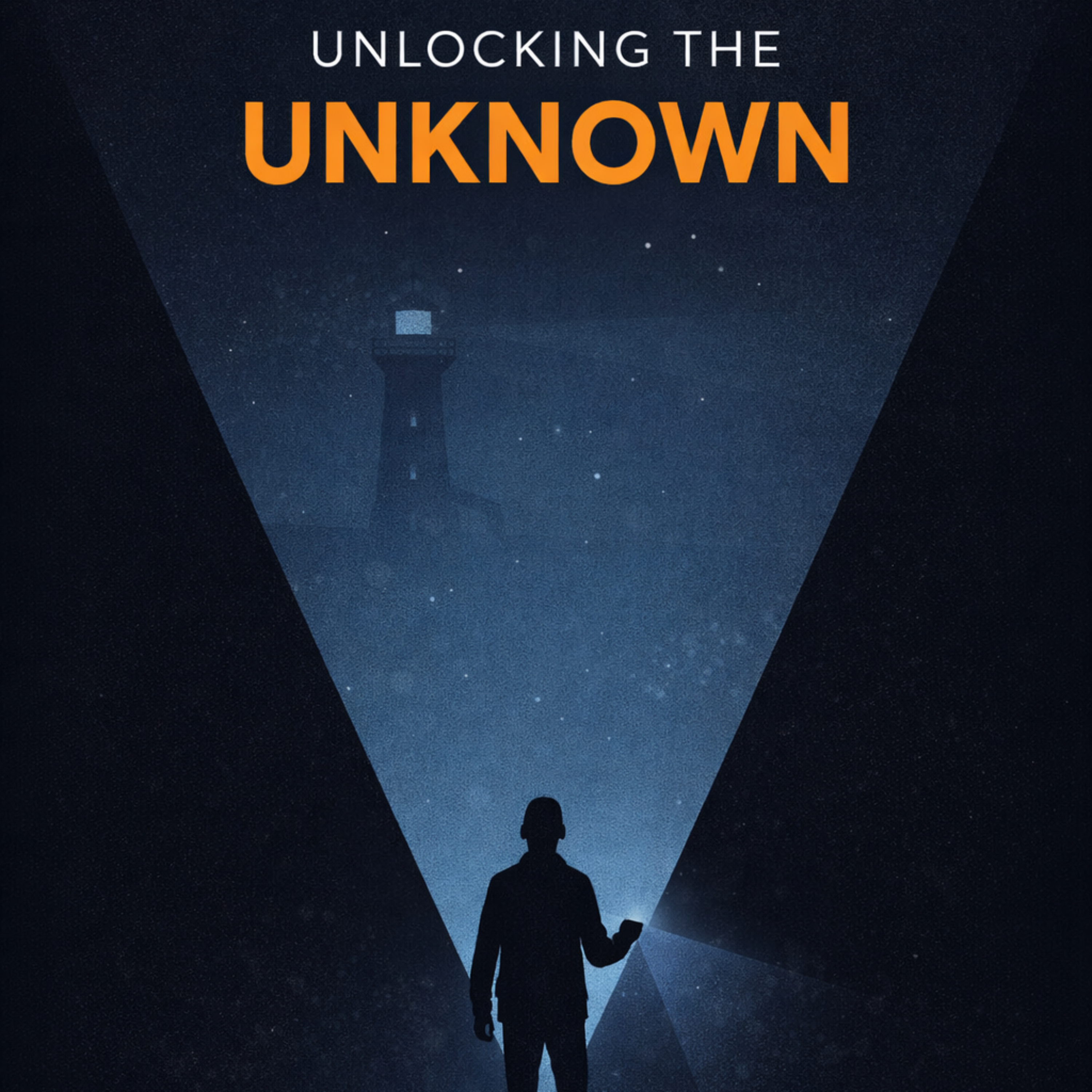
Unlocking the Unknown
by Atlas Gray
From vanished explorers and buried treasure to ancient legends and unexplained phenomena, each episode takes you deep into the world’s most compelling enigmas. We investigate the evidence, examine the theories, and follow the trails left behind by time.If you’re fascinated by lost civilizations, daring expeditions, unsolved disappearances, and the secrets history tried to forget — you’re in the right place.The truth is out there. Let’s go find it.
-
51
Lake Otjikoto: The Cursed Underwater Museum of Kaiser’s Lost Gold
Lake Otjikoto is a legendary Namibian sinkhole famously known as an underwater museum where retreating German forces submerged an arsenal of weapons during World War I. Local folklore describes the waters as bottomless and cursed, potentially hiding a lost safe containing six million gold Marks. Today, the site attracts technical divers and historians who explore its depths to uncover military artifacts, many of which are now preserved at the Tsumeb Museum.
-
50
The Truth Behind Captain Kidds Buried Treasure
Captain William Kidd was a 17th-century privateer whose conviction and public execution for piracy sparked enduring legends regarding hidden vast fortunes. While a small cache was recovered from Gardiner's Island for his trial, his story became a cornerstone of pirate lore, inspiring generations of treasure hunters. Modern maritime archaeology has uncovered verified remains like the Quedagh Merchant, even as organizations like UNESCO work to debunk more sensationalised treasure claims.
-
49
The Hunt for the Tasmanian Tiger
The thylacine, or Tasmanian tiger, was a large carnivorous marsupial that was driven to the brink of extinction by government-sponsored bounties and habitat loss, with the last known captive individual dying in 1936.While official records and some mathematical models suggest the species went extinct shortly after 1936, recent statistical analyses of sighting data propose it may have persisted in remote wilderness areas until the late 1980s or even the early 2000s.Despite ongoing searches by groups like the Thylacine Awareness Group of Australia, scientific experts maintain that there is no conclusive physical or DNA evidence to prove the species still exists, often dismissing modern sightings as misidentifications of common animals like pademelons
-
48
Billion Dollar Metals Under a Desert Myth
These sources chronicle the life and tragic search of Harold Lasseter for a legendary gold reef, detailing his final days through his own recovered diary and the often-contradictory testimonies of his expedition companions.They examine the legitimacy of the reef's discovery, highlighting suspicions of fraud involving figures like Bob Buck and the role of popular media in cementing the "Lasseter’s Reef" myth in Australian culture.Finally, the material provides technical geological records of actual mineral occurrences in the Arunta-Musgrave area, identifying significant modern deposits of nickel, copper, and vanadium rather than the promised gold.Would you like me to create a tailored report on the modern geological findings in the Arunta-Musgrave area compared to Lasseter's historical claims?
-
47
Scientific evidence in the DB Cooper case
On November 24, 1971, a man using the alias Dan Cooper hijacked a Northwest Orient flight, extorted $200,000 and four parachutes, and vanished after jumping into a storm over the Pacific Northwest.Modern scientific analysis has revealed rare earth elements like titanium on his discarded tie and springtime diatoms on ransom money found at Tena Bar, suggesting a suspect with an aerospace or Boeing background.Despite decades of scrutiny regarding prominent suspects like Sheridan Peterson, Robert Rackstraw, and Richard McCoy II, the identity of the skyjacker remains the only unsolved air piracy case in U.S. history.
-
46
From Cloning Scandals to Mammoth Proxies
Scientific initiatives are currently utilizing advanced cloning and CRISPR technology to attempt the de-extinction of species like the woolly mammoth, leveraging well-preserved remains discovered in the Siberian permafrost.These projects operate within a complex landscape of ethical debates, high-profile scientific misconduct scandals, and an incomplete international legal framework for regulating resurrected organisms.Proponents of rewilding argue that reintroducing megafauna through projects like Pleistocene Park could restore ancient grasslands and mitigate climate change by stabilizing carbon stores in the Arctic permafrost
-
45
Microscopic Plant Architecture and Historical Mysteries
In 1587, over 100 English settlers established a colony on Roanoke Island, but when Governor John White returned in 1590 after a three-year delay, he found the settlement abandoned and neatly dismantled.The only clues were the words "CROATOAN" and "CRO" carved into wood without an agreed-upon cross indicating distress, suggesting the group may have moved to live with friendly neighbors on nearby Hatteras Island.Leading theories propose that the colonists either perished due to a severe regional drought or assimilated into local Indigenous tribes, a possibility supported by recent archaeological evidence of English blacksmithing artifacts found in Native villages
-
44
Europe's First Superpower Swallowed by Time
The Minoans were Europe’s first advanced Bronze Age civilization, centered on the island of Crete and sustained by a vast maritime empire that facilitated sophisticated trade and diplomatic ties reaching Egypt and the Near East.This enigmatic culture is defined by its monumental, wall-less palace complexes like Knossos, vibrant frescoes celebrating nature and bull-leaping rituals, and the development of the earliest known European script, Linear A.Their eventual decline was a complex process triggered by catastrophic natural disasters, including the massive Thera eruption and resulting tsunamis, which destabilized their society and left them vulnerable to eventual conquest by the Mycenaean Greeks.Would you like me to create a tailored report detailing the various archaeological and scientific theories regarding the specific causes of the Minoan collapse?
-
43
The Blood Oath and the Hungarian State
The provided sources investigate the historical and mythological legacy of Attila the Hun, analyzing his 5th-century empire's role in the structural transformation of Europe and the enduring mystery surrounding his hidden burial site.They provide a comprehensive overview of Hungarian history and national identity, tracing the nation’s development from its nomadic migrations and the medieval Arpad dynasty to the 19th-century political challenges under Habsburg rule.Additionally, the materials document the cultural and spiritual connections between India and Hungary, specifically highlighting the legacy of scholar Alexander Csoma de Kőrös and the contemporary diplomatic and Vedantic activities of the Indian Embassy in Budapest.Would you like me to find more sources regarding a specific period of Hungarian history or the details of the search for Attila's tomb?
-
42
The Sheriff Who Built His Own Gallows
Henry Plummer was the elected sheriff of Bannack who was summarily hanged in 1864 by the Montana Vigilantes on unproven charges of secretly leading a murderous "road agent" gang known as the "Innocents".While early accounts portrayed the vigilantes as heroic civilizers, modern historians have challenged this narrative, suggesting the executions were potentially motivated by Republican elites seeking to eliminate a charismatic Democratic political rival.The definitive truth of Plummer's guilt remains irretrievable, yet his story persists through ghost stories and historical reenactments at Bannack State Park, where the jail he commissioned still stands today.Would you like me to create a tailored report summarizing the historiographical shift in how the Montana Vigilantes have been portrayed over the last 150 years?
-
41
Real WWII Secret Operations and Myths
These sources detail the Nazi regime’s vast array of secret operations, ranging from the massive Operation Bernhard counterfeiting scheme to their decentralized and ultimately unsuccessful nuclear research program.They also examine enduring myths and conspiracy theories, such as the Spear of Destiny relic and the purported antigravity device Die Glocke, which are often dismissed by modern historians as hoaxes or pseudoscientific legends.Finally, the material documents postwar efforts to recover hidden loot like Yamashita’s Gold and modern investigations into radioactive underground tunnel systems in Austria suspected of being secret wartime laboratories.Would you like me to create a tailored report on a specific secret mentioned here, such as the details of the nuclear research or the counterfeiting operation?
-
40
Why Heisenberg's B8 reactor failed
These sources investigate the history and myths of the Nazi nuclear program, presenting scholarly arguments that German scientists may have intentionally renounced success to prevent a bomb project while popular media investigations explore suspected secret underground facilities.The materials further detail Operation Epsilon, where interned physicists were surreptitiously monitored at Farm Hall to gauge their progress, and include modern forensics of the B8 reactor, which proved to be technically insufficient for achieving criticality.Finally, they feature declassified intelligence reports suggesting that Allied leadership once believed the Third Reich was close to deploying nuclear-armed intercontinental rockets, potentially contradicting later public narratives that the German project was a complete failure
-
39
3 line description
The provided sources detail the systematic looting of billions of dollars' worth of European art, gold, and religious artifacts by Nazi forces during World War II. They chronicle the discovery of vast hidden caches, such as the Merkers mine and the Hungarian "Gold Train," and the subsequent efforts of the "Monuments Men" to recover and return these treasures. Furthermore, the records examine the complex post-war legal frameworks and ongoing challenges involved in restituting stolen assets to Holocaust survivors and their heirs
-
38
Incan Mummies and Frozen Child Sacrifices
Inca mummification was a sophisticated practice of ancestor worship where royal remains, known as mallki, were treated as "sleeping ancestors" who retained their property, provided counsel to their successors, and participated in state ceremonies to maintain a link between past and present,,,,.The capacocha ritual involved the sacrifice of physically "perfect" children on high mountain peaks, where the extreme cold and aridity naturally preserved them as ice mummies that functioned as sacred mediators and symbols of imperial authority across the realm,,,,.Because these mummified ancestors embodied significant social and political power, Spanish colonial officials viewed them as a direct threat to public order and conducted a systematic campaign to destroy or hide the remains to suppress indigenous resistance and enforce a new religious hierarchy
-
37
How Teotihuacan Built an Apartment Metropolis
Teotihuacan was a massive pre-Columbian metropolis and ceremonial center in central Mexico that functioned as a multiethnic political and economic powerhouse during the Classic Period. The city’s urban landscape featured monumental structures like the Pyramids of the Sun and Moon alongside unique apartment compounds that housed a diverse population estimated to be between 100,000 and 150,000 residents. At its peak, it served as a primary hub for obsidian production and cultural interchange before suffering a selective, cataclysmic destruction of its civic center around 550 CE
-
36
From Ancient Tantra to Disneyized Shangri
Shangri-La originated as a fictional paradise in James Hilton’s 1933 novel Lost Horizon, which was inspired by the ancient Tibetan Buddhist myth of Shambhala, a hidden realm of peace and spiritual wisdom.To stimulate economic growth, the Chinese government officially renamed Zhongdian County to Shangri-La in 2001, transforming the remote region into a commercialized tourist hub characterized by themed architecture and "Disneyized" consumption patterns.Today, the region exists as a postmodern "hyper-reality" where visitors navigate a blend of authentic religious practices and staged performances, leading to ongoing debates about whether the "paradise" has lost its true authenticity to become a literal theme park
-
35
The Mystery of Columbus’s Divided Bones
Recent forensic DNA analysis conducted in Seville has definitively confirmed that the remains entombed in the cathedral belong to Christopher Columbus, although experts acknowledge that fragments of his bones may still reside in the Columbus Lighthouse in the Dominican Republic,,,Researchers have also applied cutting-edge genomic sequencing to commingled remains in a sealed crypt to reconstruct a four-generation lineage of the explorer's 17th–18th-century descendants, known as the Counts of GelvesThese ongoing investigations aim to clarify Columbus’s precise geographic and ethnic origins while resolving historical debates surrounding his legacy and the disputed discovery of his flagship, the Santa Maria.
-
34
Marcos and the $22 Billion Golden Buddha
Yamashita's Gold is the name given to vast treasures looted across Southeast Asia by Imperial Japanese forces and supposedly hidden in tunnel complexes in the Philippines during World War II. The legend is centered on the 1971 discovery of a solid gold Buddha by locksmith Rogelio Roxas, which was allegedly stolen by Ferdinand Marcos and later became the subject of a multi-billion dollar lawsuit. Some researchers argue the hoard was secretly recovered by the United States to finance covert "black gold" slush funds during the Cold War, though many historians dismiss the treasure's existence entirely
-
33
Elon Musk's Grandfather and the Kalahari Myth
The legend of the Lost City of the Kalahari began in 1885 when the showman William Leonard Hunt, also known as The Great Farini, claimed to have found massive stone ruins in the desert. This sensational report inspired decades of searches, including aerial expeditions by Joshua N. Haldeman, yet nearly thirty different groups failed to verify the existence of a hidden metropolis. By 1964, researcher A. J. Clement concluded that the "ruins" were actually natural formations of dolerite rock that had eroded into regular, block-like shapes mimicking man-made masonry
-
32
How fake hunters legalized rhino smuggling
The sources examine the deadly intersection of human migration and wildlife conservation, specifically detailing the consumption of Mozambican refugees by lions within the "Eden" of Kruger National Park.They analyze the escalating rhino poaching crisis, which is fueled by sophisticated international criminal syndicates and internal corruption that current legal frameworks struggle to contain.Additionally, they document the preservation of Tsonga-Shangaan cultural heritage through standardized traditional cuisine and the persistent legends surrounding historical treasures like the missing "Kruger Millions"
-
31
The Hidden Relics Beneath Constantine's Colum
Hagia Sophia and the Basilica Cistern rest upon a vast subterranean world of tunnels, crypts, and ancient waterways that preserve Istanbul's layered history. Modern researchers employ non-invasive technology to explore these hidden corridors for legendary religious relics, most notably fragments of the True Cross. These archaeological pursuits strive to uncover sealed chambers and forgotten vaults to bridge the gap between ancient faith and physical historical reality
-
30
Is Japan's Sunken Pyramid Manmade or Natural
The provided sources detail the reality series Expedition Unknown and its investigation into the Yonaguni Monument, a massive underwater rock formation off Japan featuring symmetrical, pyramid-like steps.This site is the focus of a long-standing scientific debate between researchers who believe it is a 10,000-year-old man-made city and geologists who argue it is a natural product of tectonic stress and erosion.While some researchers point to potential tool marks and stone artifacts found at the site as evidence of human construction, the true origin of "Japan’s Atlantis" remains one of the world’s great unsolved mysteries
-
29
Why Christopher Columbus has two tombs
Christopher Columbus was a 15th-century navigator and explorer credited with discovering a permanent route linking the shores of the Atlantic Ocean, an achievement that brought once-sundered peoples together in a single network of communication. While widely believed to have been born in Genoa, Italy, his precise origins remain a subject of long-standing debate and recent DNA investigation.Driven by what he believed was divine inspiration and a "grand idea" to reach the Indies by sailing west, Columbus secured Spanish royal sponsorship after being rejected by Portugal. In modern times, he is a deeply controversial figure, often characterized as either a providential hero who promoted civilization or a "villainous" conqueror responsible for the exploitation, enslavement, and decimation of indigenous populations.Though he never reached the mainland of what is now the United States, his 1492 voyage initiated the era of European colonization in the Americas. After centuries of mystery surrounding his travels after death, DNA analysis recently confirmed that his remains are entombed in the Seville Cathedral in Spain
-
28
The Nine Mile Hole treasure solution
Forrest Fenn, a Santa Fe art dealer, hid a million-dollar bronze chest of gold and jewels in the Rocky Mountains in 2010 to inspire outdoor adventure and provide hope during a recession,,,. To locate the treasure, thousands of searchers spent a decade deciphering nine clues contained within a 24-line poem published in Fenn's memoir, The Thrill of the Chase,,. The hunt, which tragically claimed five lives, concluded in 2020 when medical student Jack Stuef discovered the chest in a remote area of Wyoming
-
27
The Military Alias of Robin Hood
Beneath the city streets, a labyrinth of ancient sandstone caves unfolds,. From Isle of Wight archers to the Yorkshire tales the legend holds,. Nottingham remains the stage where Robin's timeless story is told
-
26
Staking Hearts in 21st Century Romania
Explore the chilling intersection of history and horror, where archaeologists uncover "vampire burials" bound by iron sickles and ritual stones to keep the restless dead within their graves.Follow modern-day investigations into the shadowy origins of the vampire myth, where ancient folklore and cinematic fantasy collide with the startling reality of 21st-century exorcism rituals.Discover how the legendary undead continue to govern the living, serving as a powerful gateway into national heritage, social order, and the enduring mystery of the unknown
-
25
Blackbeard Ran Piracy Like a Business
Edward Teach, better known as Blackbeard, was a notorious English pirate who commanded the heavily armed flagship Queen Anne's Revenge during the Golden Age of Piracy,,.After blockading Charleston and running his ship aground at Beaufort Inlet, he was killed in a 1718 battle at Ocracoke Inlet by forces led by Lieutenant Robert Maynard,,.Today, the Queen Anne’s Revenge Conservation Lab in North Carolina houses over 420,000 artifacts recovered from his shipwreck, serving as an "archaeological time capsule" of 18th-century maritime life
-
24
Why Genghis Khan’s Tomb Remains Hidden
Genghis Khan died in 1227 and demanded an unmarked burial to ensure his final resting place remained a secret for eternity.The Darkhad tribe guarded the "Forbidden Zone" of Burkhan Khaldun for 700 years, killing trespassers to honor the Khan’s final wishes.Despite modern searches using satellite imagery and archaeological expeditions, the exact location of the Great Khan's tomb remains a total mystery
-
23
The real King Arthur was Scottish
King Arthur is primarily regarded by modern academics as a mythological figure, though theories persist that he may be based on historical leaders like Lucius Artorius Castus or Artuir mac Áedán,,. His legend is deeply rooted in the landscapes of Scotland and Wales, with traditions linked to early Welsh poetry and specific sites such as Loch Lomond and Snowdonia,,,. The search for a "real" Arthur continues to bridge archaeology and popular culture, as researchers examine 5th-century evidence while media explorers investigate the enduring mysteries of his life
-
22
The 300 Ton Bell the River Swallowed
King Dhammazedi’s legendary 300-ton bronze bell was lost in 1608 when a Portuguese mercenary's raft sank at the confluence of the Bago and Yangon rivers near Monkey Point. While modern expeditions like Josh Gates’ have faced extreme conditions searching for the relic, other highly publicised recovery attempts have been criticised by historians and politicians as fraudulent "national shenanigans". Beyond the hunt for treasure, technical reports emphasize that continuous dredging and the repair of anchor vessels are critical to maintaining these same unstable channels for modern international commerce.
-
21
The Mystery of the Honjo Masamune
The provided materials explore the deep history and mysterious disappearance of the Honjo Masamune, a legendary samurai sword forged by Japan's greatest swordsmith. They also offer insights into martial arts philosophy and practice, including newsletters from the Aikido Center of Los Angeles and advertisements for traditional sword-forging workshops in Kyoto. Finally, the sources include TV listings and episode summaries for the show Expedition Unknown, documenting Josh Gates’ search for lost treasures and historical secrets
-
20
Why the Maya Bled for Rain
Ancient Maya ritual practices in caves were centrally focused on water control and agricultural fertility, involving offerings and human sacrifices intended to appease deities such as the rain god Chac,. During a severe Late Classic drought cycle, specialized "drought cults" developed, characterized by the deposition of large ceramic vessels and remains in remote, restricted subterranean locations,,. Scientific evidence from speleothems and archaeological records indicates that these prolonged environmental stressors were a major factor in the destabilization and eventual abandonment of southern lowland city-states
-
19
The sixty million dollar Beale Papers hoax.
The Beale ciphers consist of three 19th-century encrypted messages allegedly detailing a buried treasure of gold, silver, and jewels worth over $60 million in Bedford County, Virginia.While the second cipher was successfully decoded using the Declaration of Independence as a key to describe the treasure's vast contents, the exact location and the list of heirs remain unsolved.Scholars and cryptanalysts remain deeply divided on whether the account is a genuine historical mystery or an elaborate hoax, with some evidence suggesting the story may be a Masonic allegory
-
18
Morgans Starving Raid on Panama
Henry Morgan led a massive privateer army on a grueling 50-mile trek through the Panama Isthmus in 1671 to capture and sack the incredibly wealthy Panama City.The journey became a "starving raid" as Spanish scorched-earth tactics deprived the men of provisions, forcing them to survive by eating leaves, leather bags, and even dogs.Despite their extreme hunger, the force successfully routed the Spanish militia at the Battle of Mata Asnillos and plundered the city for millions in treasure.
-
17
How Viking sunstones revealed the sun
Viking sunstones were birefringent or dichroic crystals like Iceland spar that revealed the sun’s position by detecting light polarisation in the atmosphere. By rotating the stone to match the intensity of its double images or observe specific light patterns, navigators could pinpoint the sun's exact horizontal direction. This tool allowed for accurate navigation during heavy cloud cover, fog, or twilight when the sun was otherwise invisible to the naked eye
-
16
Tracking Paititi on the Road of Stone
Gregory Deyermenjian's quest for the legendary lost city of Paititi involved following an ancient Incan "Road of Stone" through the remote, high-altitude jungles of the Peruvian Amazon. These expeditions traversed rugged regions like the Plateau of Toporake and the Plateau of Pantiacolla to document previously unknown Incan remains. The search identified important Incan ruins and platforms along branches of this stone-paved route at sites such as the peak of Último Punto
-
15
The James-Younger Gang Journal
The James-Younger Gang Journal is a quarterly publication dedicated to preserving and promoting the true story of the gang, their families, and their Civil War guerrilla associates. It serves as a historical source of exchange for writers, historians, and family descendants to share research and project updates regarding this era of American history. Members use the journal to stay informed about field trips, museum support, and annual conferences held at locations significant to the gang's history
-
14
The Hunt for the Lost Amber Room
This script explores the history and 1941 theft of the Amber Room, a priceless cultural treasure that the Nazi regime systematically looted from the Catherine Palace and displayed as propaganda in Königsberg.It investigates the enduring mystery of the room's 1945 disappearance, weighing theories of its destruction by fire against the possibilities of it being hidden in secret tunnels, buried in alpine bunkers, or lost at the bottom of the Baltic Sea.The narrative concludes with the 2003 unveiling of a meticulously crafted replica in Russia, cementing the original's status as a haunting symbol of unresolved wartime trauma and lost history.
-
13
Echoes of the Khmer: The Jungle’s Silent Empire
Deep in the jungles of Cambodia, the ruins of the Khmer Empire hide secrets that have survived centuries of silence. This episode explores the rise of Angkor, the cosmic symbolism of its temples, the mysterious collapse of a powerful civilization, and the modern technology uncovering what the jungle tried to protect. The real “Temple of Doom” may not be a single structure — but the enduring mystery of an empire lost to time.
-
12
Amelia Earhart: The Sky Was Never the Limit
In 1937, pioneering aviator Amelia Earhart vanished over the Pacific Ocean during her attempt to fly around the world. Despite massive search efforts near Howland Island, neither she nor her navigator, Fred Noonan, were ever found. In this episode, we explore the final flight, the evidence, and the enduring mystery that still captivates the world.
-
11
Amelia Earhart: The woman who changed the horizon
In 1937, pioneering aviator Amelia Earhart vanished over the Pacific Ocean during her attempt to fly around the world. Despite massive search efforts near Howland Island, neither she nor her navigator, Fred Noonan, were ever found. In this episode, we explore the final flight, the evidence, and the enduring mystery that still captivates the world.
No matches for "" in this podcast's transcripts.
No topics indexed yet for this podcast.
Loading reviews...
ABOUT THIS SHOW
From vanished explorers and buried treasure to ancient legends and unexplained phenomena, each episode takes you deep into the world’s most compelling enigmas. We investigate the evidence, examine the theories, and follow the trails left behind by time.If you’re fascinated by lost civilizations, daring expeditions, unsolved disappearances, and the secrets history tried to forget — you’re in the right place.The truth is out there. Let’s go find it.
HOSTED BY
Atlas Gray
CATEGORIES
Loading similar podcasts...
URL copied to clipboard!