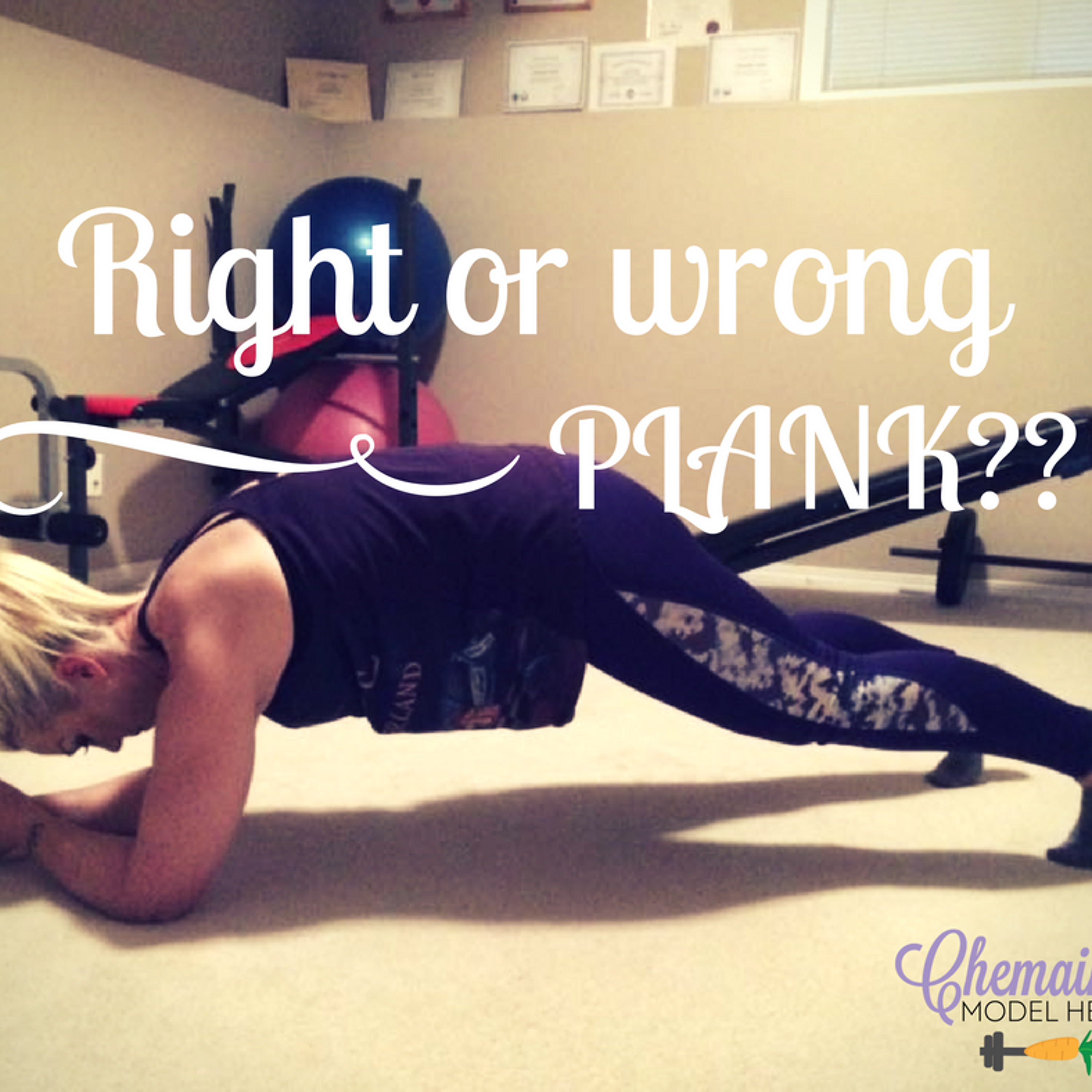
Good evening, it's Chamein from Chamein's Model Health here and welcome to my next podcast. So it is Monday, October 17, 2016. And last week I posted on my personal Facebook page a picture of a plank and a question underneath it was the right or wrong way to plank. Surprisingly or not surprisingly should I say the response I got for most people was that it was in fact the wrong way to plank.
And I just wanted to discuss that a little bit. So the picture that I posted was me in a plank position with a pelvic tilt and I had an arch through my torso and right through my lumbar and down through my tailbone with my tailbone inverted under towards my abdominals. So many people had posted wrong, wrong, wrong. I should have a neutral spine.
I need to get my hips down and so on and so on. So I just wanted to touch on that topic really quick. So I will admit that I have taught a plank wrong many times in the past because this is what I was taught for years in university and throughout all of my certifications. But after realizing my clients were not progressing or benefiting from this so-called right weight plank, I started to look into and research more into the real right weight plank and what would be the most beneficial weight plank for my clients.
So what I came across was that most of what I had learned from my university and certifications and other academia was not actually correct. The problem with what I was taught is that it's more of a hip flexor plank. So that neutral spine, hips down, flat back was causing tighter hip flexors and low back pain for most of my clients. So there is a little bit of stabilization with the core in this position but most of it is hip flexors and low back stabilization.
This is why a lot of my clients were experiencing pain or struggling in this position. They were not actually activating or recruiting their core muscles the way they should be or want it to be. So now I teach with a posterior tilt. I crunch the abs, I tuck under my tailbone, I squeeze my glutes, I pull back on my elbows and I push down through my heels.
This is my preferred way of teaching it now. It kind of looks like a reverse crunch. So this way actually maximizes abdominal accruement and minimizes hip flexors. This is better because most of the people I train have hip flexor dominance, especially my ladies and especially post pregnancy.
They are actually the clients that need more hip flexor or longer flexion work done on them. So even though in university on my certifications I was taught to limit range of motion in this area and keep everything in a balanced, braced neutral spine, I've now found that that is not as effective as the way I currently teach the plank. My clients seem to be getting better results and feeling that a lot more. This neutral spine or braced spine, it's not a natural movement.
It's not true to real life or how we move daily. Neutral spine is actually a hypothesis. It's a statement that's been put out there but it's not actually true to fact or there is no fact behind it. So it's just a few academics, part that this would be the right position to hold and recruit abdominal muscles best but it's not actually true.
And you can see it from yourself and if you recognize and pay attention to how you move in daily life, you'll see that actually this new way that I'm teaching planks now is actually more true to your daily life. And with this new range of motion, I mean I've never been afraid to get my clients to move in a full range of motion and that's actually how I've done most of my own results. I've always worked through a full range of motion and even when I correct people in the gym, I will tell them all the way down, all the way obvious, full range of motion. Not only will it get you better results but it also maintains or improves mobility which is very important especially for daily life.
So no, I'm not afraid to put people through full range of motion or even address and balance as if I see them. And when we know that our bodies move in all these different ranges of motion and planes in our daily life, then it makes sense that our spine does flex. You do bend over so you do need to be strong in the core and be able to move through all these different positions with the support, control and tension that you would expect from strong abdominal muscles. So in all, you do need to strengthen your spine through full extension and flexion but this form of plank, the one I demonstrated in the picture is a modified plank which recruits more abdominal muscles which support your spine and if you look at it's basically a modified cat cow.
So if you've been to any of my collatives classes, we do a lot of cat cow especially for spinal flexion. It's one of my favorites but this plank that I demonstrated is more of a modified cat cow brought into a plank. By teaching like this I'm showing people that we can't just train unilateral in one direction we need to be able to train in multiple planes to get the most benefit. So when I train people like this or I demonstrate the plank like this or get my clients to perform a plank like this, my aim is to get people stronger and improve range of motion and stability and flexion mobility across the whole core and spine.
So you get stronger in a broader range of positions and this of course is a safer way to train through all planes. So I hope I've clarified that a little bit more and if you want to take a look at that picture I think I will actually post it here. You can go over to my Facebook page to me and you will see that picture of how I teach a plank now. So have a great evening everyone.
Be sure to follow me and then next Monday if you would like me to cover a topic, subscribe to my Facebook page. It's really really specific but it has been on your mind. Just send me a message or comment below. Bye.