Good afternoon everybody and welcome to another episode of Find Your Model Health. The official podcast of Shameen's Model Health were those looking to optimize their long-term health and weight goals. I am Shameen Lini, I'm your host and the biohacker and fitness and nutrition expert. I wanted to thank you for joining me again for another episode and I hope you're all finding your routines now that we're all back in school.
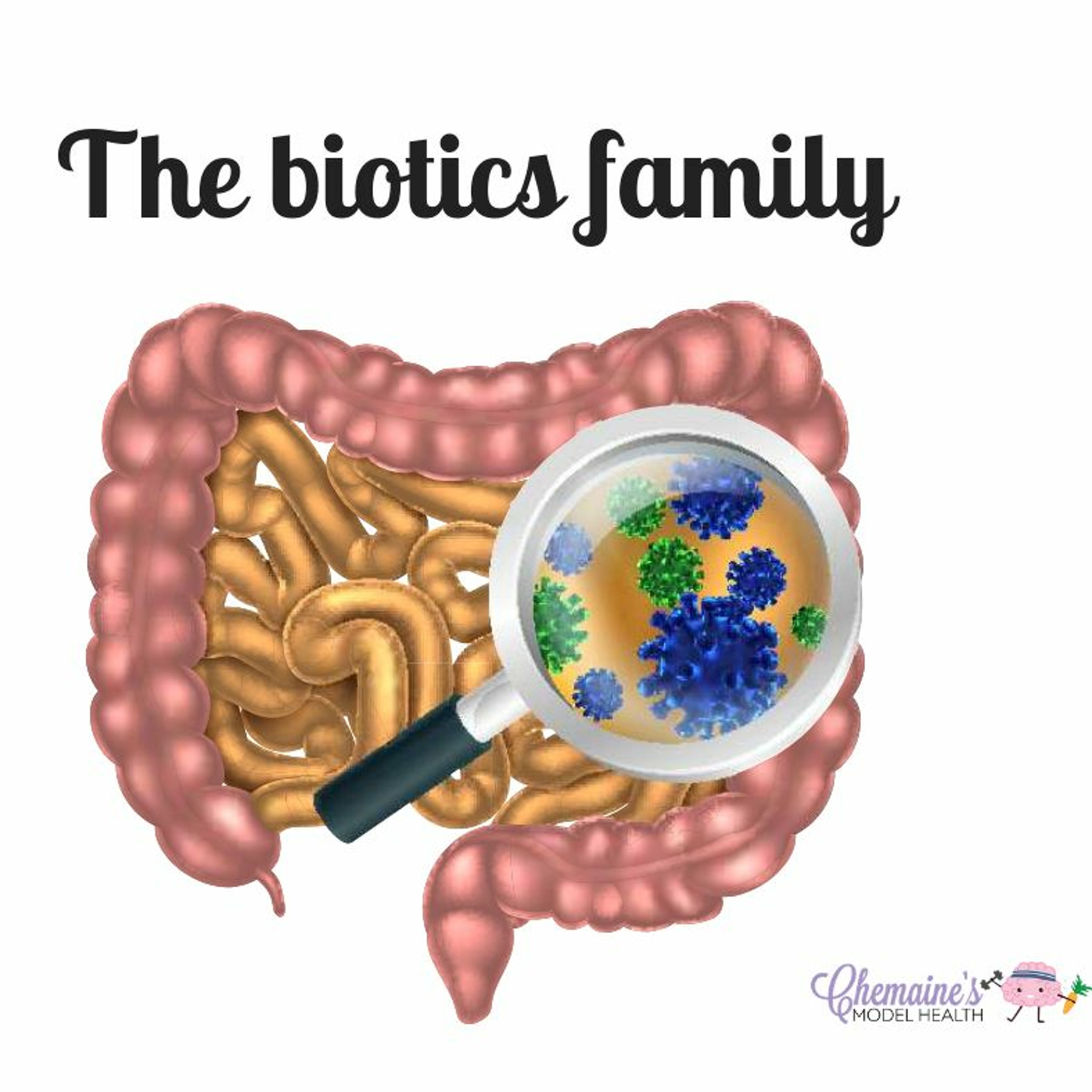
So this week's podcast was a request from a very dear client of mine who was asking me the difference between prebiotics and probiotics and why I talk about my biotics so much. Then when I happened to mention postbiotics, of course she said, could you just explain? All this in a podcast and here we are today. So we're looking at the biotics family.
When it comes to anything with biotics, it can be quite daunting to know which one to take. It's kind of a little bit like keeping up with the Kardashians in a sense. One kills careers, one tries to add good to the family but that just doesn't work. The other one kind of just feeds crack to the music industry and there's one that likes to modify things to win awards.
So this is how we kind of look at biotics. Biotics are best described as an organism which is living or once was living. But health has obviously blown off lately and it's become a very interesting topic in terms of research. There is so, so much coming about digestion and the gut now.
And in terms of research, the more it is studied, the more we are finding out about how much it has an impact on our health presently and in the long term as well. The ratio between human DNA to bacteria DNA is 100 to 1. This means that you are made up of 10 times more bacteria DNA than your own human DNA. So most of the bacterial cells are located within the stomach which is why gut health is so fascinating because lifestyle factors can have huge impacts on bacterial colonies and can determine things like allergies, diseases and if a person is overweight or lean.
And I've spoken about this in the past, the different types of bacteria that can determine if you're going to be overweight or you're going to be on the leaner side of things. So the more that we, the population or the scientific population have been forming the public on how important good health is the more we can try and enlighten people and help them make an impact and take control of their own health. And this is where these podcasts come in because it's all about helping people. It's just about changing the world for the better because sometimes unfortunately you don't always get the answers you're looking for when you're going down the road of conventional medicine.
So moving on, first we're going to look at antibiotics. So the most common and well-known biotic is antibiotics which are compounds which are produced by bacteria and fungi which can kill or compete with other microorganisms. So that you kind of have an antibiotic and you start a little war in your body and these antibiotics are going to be the stronger ones. Let's say they have more weapons and they win and they pretty much kill off everything in size.
The very first antibiotic discovered was back in 1928 by Alexander Fleming when he first noticed that his staff look at us within his Petri dish, they were dotted with mold and this led Alexander to experiment further and he then characterized the first antibiotic and named it of course penicillin. This discovery of course revolutionized the medical world and since developed and led to an abundance of different antibiotics created to treat infections and diseases, some for good, so maybe not so for good, that's another topic. But bacterial cells tend to build cell walls which is how penicillin works by blocking this process through dissolving the cell membranes. However, when antibiotics are being digested and going through the bloodstream killing bad bacteria, they're not very biased.
They also kill off the beneficial good bacteria too which is essential for your health and unfortunately in this day and age there's so many antibiotics being consumed worldwide that microorganisms are now becoming super books and we pretty much all have heard of super books. They have, these super books have built up a resistance to antibiotic use. This of course can create problems with the future and how we look at antibiotics and resistance will even work in the future. So there's your antibiotics.
So we'll look at probiotics next. Probiotics, once you've consumed a course of antibiotics, you usually are advised to consume probiotics after you've just killed off certain microorganisms. You need to rebuild up your gut flora. But let's be honest, if you've taken antibiotics, you've pretty much killed off everything in science.
But what people don't realize is that problems caused after an antibiotic aren't necessarily coming from the bacteria because after an antibiotic, you don't have bacteria. So these problems are usually coming from an overgrowth of yeast like candida which caused the problems I trushed. So side note, after I had my second child, I had a C-section and I was given antibiotics to prevent bacteria infections in the scar. But then of course I got a yeast infection from the antibiotics because they killed everything in science which allowed them, the fungi or the yeast to take over because there was nothing standing in its way.
There was no competition for the area. So the earliest stages of probiotics were discovered by Russian scientists named Ali Mechenoff in 1907. His research looks into the longevity of villages in the Cactus Mountains living in, these people were living into their hundreds and he discovered that their lifestyle choices determined their health and we know this now. But back then this was new and the food groups which were over-served or seen to be consumed were mostly fermented foods and yogurt on a daily basis.
And back then fermentation methods were more close, obviously were more close to natural and the same as their yogurt making process is not like nowadays. And it was believed that consuming these foods that would have contained live bacteria would help extend lifespan due to the benefits of adding bacteria to the good flora or supporting the good flora. So the concept behind probiotics is probiotics are live bacteria and yeast even which are marketed and I'll say that in inverted commas marketed as beneficial for the good flora to compare health benefits of the host. Probiotics are very interesting though there are various studies that have researched the consumption of probiotics and if they actually even have an impact on weight loss and weight gains we are seeing like I mentioned above there are certain bacterial species that do contribute to weight gain.
So for instance lactobacillus species seems to alter the good flora and not in a positive way. In the way we would rather not, lactobacillus seems to be more of a negative bacteria that can contribute to weight gain rather than weight loss. Probiotics also have been added to livestock feed for decades and research that looked at probiotic consumption within livestock shows that it's fed up the increase or the speed the animal grew at. Considering how we are going through a pandemic of obesity right now it's not something I generally recommend.
I generally don't recommend probiotics to people. I would rather go down the following roads where we look at some of the other biotics. Don't get me wrong probiotics can be beneficial if you have had a big bacteria die off from antibiotics like something major which has killed all the good and the bad then probiotics can be a good idea but also supporting the good with a lot of other stuff as well. So because of these studies showing that maybe probiotics do have that association with weight gain I generally don't recommend them.
I would rather follow a different protocol but now we're going to look at prebiotics. Prebiotics have been around since the 1990s. Scientists narrow down that a prebiotic is a food source which is not digestible by the stomach but is beneficial to the microorganisms living within the gastrointestinal tract. So your go books.
They are marketed to help stimulate the growth and the strength of these good bacteria. And this is someone to probiotics not being able to be broken down or digested and that way the good floor they can then make their way down to the large intestines where certain species can reside and then they all feed on these prebiotics to survive. So prebiotics have three general characteristics. Prebiotics need to withstand the environmental conditions within the stomach.
Prebiotics need the bacteria within the stomach to be able to ferment it so it needs to be broken down that way. And prebiotics need to be of benefit to the bacteria. Prebiotics tend to have a beneficial impact on aerobic microbes while having a negative impact on anaerobic microbes. So lactobacillus species from the prebiotics are like seeds which go through the digestive tract on altars to feed the growth of bacteria in the larger intestine.
Prebiotics can feed the production of fermocutes. These are another biode bacteria. They reside in the large intestine. The fiber from prebiotics can feed the production of fermocutes leading to an increase in weight gain.
So not to get confusing though. That line, the fiber from the prebiotics can feed the production or increase the growth of fermocutes. That would depend on their specific prebiotics. So it's specific dependence.
Some prebiotics don't feed fermocutes. So fermocutes are the ones that make us over waste. So next we're going to move on to postbiotics. So we've done prebiotics, the food, probiotics are the live bacteria.
Now postbiotics. Postbiotics, I like this because there's not a lot about it. It's a fairly recent new field of study. Postbiotics are the byproducts of bacteria.
And studies show, so like bacteria poop, bacteria waste. Studies are showing that they may have the ability to lower blood glucose and enable insulin to work better. They also might help with inflammation and genetic expression. And I love this concept because I teach this to my clients.
Although I have to repeat it a lot because the tyros understand, we do look at this and postbiotics, if you know anything about sirtune foods or sirtune proteins, you can tie sirt foods in perfectly to postbiotics in order to influence certain genetic expressions. So I really love postbiotics and how it looks at an area of nutrition that I really enjoy teaching. A 2014 report published in the Journal of Gastroenterology states, probiotics are a live non-pathogenic microorganisms present in the gut microbiota that confer benefits to the host for his or her health. Some of these beneficial effects are determined by secreted probiotic derived factors that recently have been identified as postbiotic mediators.
So basically what that is. So when we look at probiotics and how they work, we understand that probiotics are fed by prebiotics and then from the probiotics waste, we get postbiotics. So these are, they're poop basically. And it's slightly alive, just enough.
The same as our poop contains some bacteria, postbiotics will be an even smaller form of bacteria. So researchers now believe that for certain people suffering from inflammatory conditions, the use of postbiotics may be smart to use due to their ability to decrease inflammation and help maintain colonic and intestinal homeostasis. So postbiotics might be the next wave of supplements that's going to get used for better good health. So it's just something to keep an eye on.
So for the most part, postbiotics supplements are not widely available, especially compared to the number of probiotics on the market. But looking for postbiotic products, that include a number of different types of postbiotics, especially like short body chain acids, one of those being butyrase. If you do come across a postbiotic, that's kind of what you're looking for. So otherwise, when we look at sirtune foods, we're looking at how can we create our own postbiotics?
So how can we feed the probiotic certain foods that will give us postbiotics that will then go and give us a certain genetic expression that we want? Okay, so that was a lot. We're nearly done. We're going to move on to modbiotics.
Again, another favorite of mine. I love talking about modbiotics. So modbiotics, they're natural poisons found in nature. Modbiotics are so cool because you can eat foods that are very potent in modbiotics.
What they'll do is they're generally coated in a poison, but inside is the sweetness. So when we use modbiotics, we're usually using them to moderate the bacteria in the body. So modbiotics, they don't indiscriminate. They're not live organisms, like I said, and they don't feed the bad microorganisms necessarily or the bad bacteria.
They trick them. Modbiotics are antimicrobial, antifungal, antibacterial, and they will trick the bad bacteria. They are compounds which help kind of alter the ratios of good and bad bacteria within the gut. So they moderate.
Modbiotics contain the missing link in most people's diets, which are polyphenols. Polyphenols are that poison. Polyphenols are toxic to bad bacteria within the gut, and they help kill off or starve the bad bacteria. So what we do with modbiotics is they're coated in poison.
So let's look at, I like to use a blueberry as a concept. They're coated in poison. So that skin of the blueberry, sometimes you'll see a white mist on it, and it's a little bit bitter. That is the poison.
Then the inside, you have the sweets. We know bad bacteria feed off sugar. That's their thing. That's what helps them grow.
That's why they're so bad. That's how they make us fast. So when we have a modbiotic, what we're doing is we entice the bad bacteria out with our bit of sugar. So that's the sugar inside the blueberry.
Then when they start munching on the blueberry, they get poisoned by these polyphenols that's contained in the leaves and the skin and the stem and the seeds. So that's why we always want to make sure that if we can eat the skin, eat the skin, always get your fruit with seeds if you can, because this is the poison that's going to help moderate your weight. So then lastly, I wanted to just take a quick look at some symbiotics. Okay, symbiotic, in definition means working together.
So, symbiotic. In a digestive concept, symbiotics help to repair the gut lining, which is obviously one of the most critical things to happen. So, symbiotic is where you pair a prebiotic and a probiotic. So, the probiotic being the live bacteria, the prebiotic being the food, you put them both together, you ingest them in hopes that the bacteria in your current gut will feed on the prebiotic and release and strengthen the probiotic that's already contained in and therefore giving you more probiotics, which are stronger because they're feeding on the prebiotics.
So, symbiotics, they're composed of live microorganisms and they also are paired with your prebiotics or your foods then. So, probiotics and prebiotics in a form of synergism. And that's how they work. Not so popular to be honest, but they still do exist.
That's how all, well that is all the biotics. That's the biotics family and I hope that's helped you understand the differences between all of the most people only know about prebiotic and probiotic. But now we have seen, of course, we have antibiotics, prebiotic, probiotic, postbiotic, modbiotics and then the symbiotic process as well. So, as usual, if you feel you know anyone that will benefit from this, please share.
Sharing is caring. All we're trying to do is change the world, make it a better place for all of us. So thank you for listening and I will chat to you all next week. Bye bye.