#100 Intoxicating Eardrops 🎧
from Anticipating the Unintended Hosted by Pranay Kotasthane
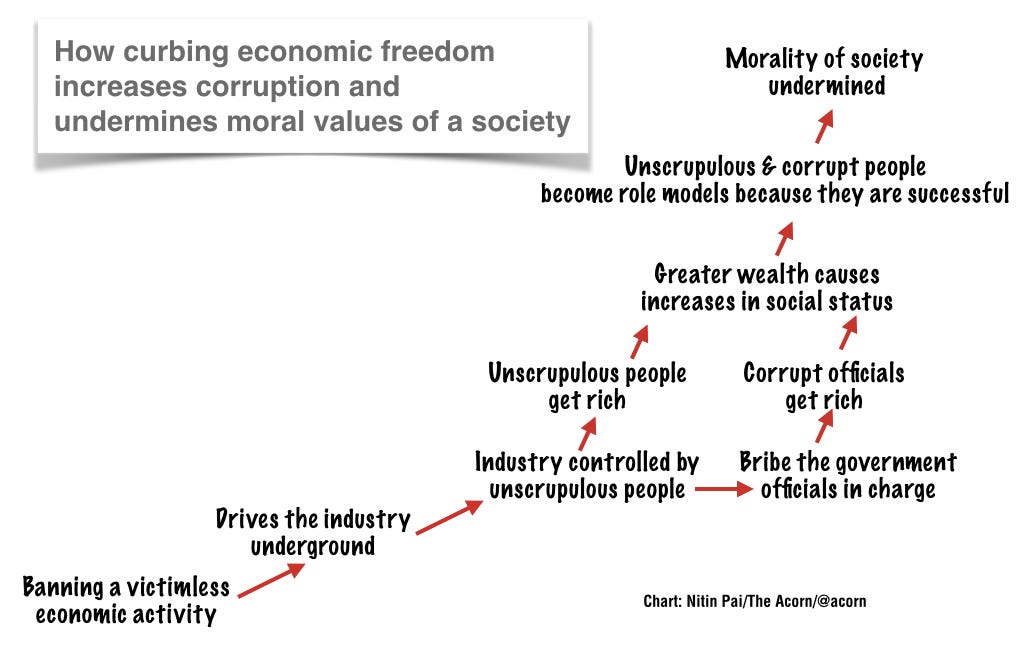
We have hit a century! Thank you for reading us. This newsletter is really a public policy thought-letter. While excellent newsletters on specific themes within public policy already exist, this thought-letter is about frameworks, mental models, and key ideas that will hopefully help you think about any public policy problem in imaginative ways. It seeks to answer just one question: how do I think about a particular public policy problem/solution? PS: If you enjoy listening instead of reading, we have this edition available as an audio narration on all podcasting platforms courtesy the good folks at Ad-Auris. PolicyWTF: Prohibition and Morality This section looks at egregious public policies. Policies that make you go: WTF, Did that really happen? — Pranay Kotasthane If one were to write a book chronicling bans on victimless crimes in India, the index entry for Morarji Desai would be a long one. After all, he holds the dubious distinction of turning lakhs of ordinary citizens into criminals by prohibiting two independent victimless crimes. The first ban, on alcohol, is rather well-known. The notorious Bombay Prohibition Act of 1949 was passed when Desai was the state’s Home Minister. To enforce the ban, the government created elaborate compliance machinery, misdirecting the limited policing capacity towards apprehending tipplers instead of protecting victims of other crimes. By the time this act was watered down in 1964, more than four lakh people had been convicted under Prohibition! The draconian law is well-documented in Rohit De’s excellent book The People’s Constitution. Read this, for instance: “The BPA granted vast powers to the police and Prohibition officers. It empowered Prohibition officers and all police officers to “enter at any time, by day or by night, any warehouse, shop, house, building, vessel, vehicle, or enclosed place in which [they have] reason to believe [that] intoxicants or utensils, apparatus or implements used for manufacturing intoxicants are kept.” They could also open packages and confiscate goods that they suspected of containing illicit liquor. Warrants were not required for arrests for any of these offenses or for searching premises. The BPA provided that people believed to have committed an offense under the act could be detained without trial and have their movements restricted. The Prohibition policy thus created a system that operated outside the penal code and the criminal procedure code that applied to most offenses.” [The People’s Constitution, Rohit De, page 45] The direct consequences of this PolicyWTF aren’t hard to anticipate. People either switched to alternatives that bypassed the law or started consuming a far worse quality of alcohol in the black market. For instance, De writes: By 1963 the Planning Commission was protesting the number of tinctures available in India. It pointed out that the British Pharmacopeia had reduced the number of tinctures from thirty-four in 1932 to fourteen in 1963, but the Indian Pharmacopeia of 1955 listed forty-two different tinctures. After interviewing leading medical representatives, the Planning Commission came to the conclusion that there was hardly any medical use of tinctures, which were outmoded and being replaced by modern drugs that were not alcohol-based. Spot checks revealed that several tinctures on the market were actually spurious, consisting solely of alcohol and a suitable coloring agent. Other manufacturers were producing eardrops and eyedrops with a large percentage of alcohol. The frustrated Planning Commission suggested that tinctures be abandoned for more modern medicine and that industrially produced eyedrops and eardrops be replaced by prescriptions that could be made by pharmacists. [The People’s Constitution, Rohit De, page 61] Says a lot about central planning. When there’s demand, supply finds a way out in imaginative ways that governments can’t clamp down easily. Desai’s second prohibition was on the sale and holding of gold, even in small quantities. It was this policyWTF that made smuggling of gold a lucrative profession. Here’s what the Directorate of Revenue Intelligence — a union government agency — observed in its Smuggling in India Report 2019-20: The economic reforms of 1990s witnessed the repeal of the Gold (Control) Act, 1968 that had prohibited the import of gold except for jewellery. The erstwhile statute had led to the emergence of a notorious network of gold smugglers during 1970s and 1980s. The economic reforms and liberalisation led to the imposition of a modest specific duty of Rs 300 on 10 grams in 2011-12 (increased from Rs 200 in 2010-11) on the imported yellow metal, bringing gold smuggling almost to a grinding halt. While both these policies had immediate adverse consequences, the general equilibrium effect was far worse: the successful and respected people in the society were the ones whose only competence was breaking the law. PS: Nitin Pai, on his blog, succinctly captures the general equilibrium effects of banning victimless crimes in this figure. Global Policy Watch: Student Loan Forgiveness and Friedman - RSJ The new Biden administration is expected to enact a student loan relief programme through legislation or an executive order when it assumes office later this month. There might even be a more comprehensive student loan reform on its agenda. The left-wing of the Democratic Party has made a case for a total student loan forgiveness for a long time now. Biden is a centrist, yet he might use the student loan relief proposal as a bargaining chip to rein in other more socialist ideas from them. It will be interesting to see if the administration merely forgives a part of the outstanding loan or it uses the student loan crisis to arrive at a more market-driven long-term solution to the problem of funding higher education and the role of government in education in general. Quantum Of Crisis There are about 45 million student loan borrowers who owed roughly USD 1.6 trillion in 2019. To put that in perspective, India’s total credit outstanding is in the same ballpark. On average, each borrower has over USD 34,000 outstanding credit. By some estimates, the Biden forgiveness proposal is to waive off USD 10,000 from this. That would mean a total waiver of about USD 500 billion. No small change even in the days where stimulus packages routinely run into trillions. So, what explains these eye-popping numbers that are unique to the US education system? Well, there are a few reasons. * Because the colleges can: There has been no disruption in the higher education model over the past two hundred years. The system is an oligopoly. The same set of universities have remained at the top through a combination of brand building, (alumni) network benefits and bigger endowments (that are tax-free). The price set at the top is high and everyone below the chain benchmarks to that price. As income inequality has grown, the price has gotten unaffordable at every level except the very top. * Student loans are expensive by design: There’s hardly any collateral to hold as security for a student who is getting started in life. These loans are largely unsecured, unlike a mortgage where the house is the underlying security for the banks. The possibility of a student getting a good job and paying back the loan is relatively lower than most other loan types. Added to this is the uncertainty about the final location of the student after he finishes off his education and the costs of tracking them down. It is no surprise the default rates of these loans are in excess of 10 per cent. These uncertainties are baked into the pricing of a student loan. They tend to be long-term and expensive. * Universities have no incentive to innovate: Why should they? They control their supply and keep college seats ‘scarce’. The admission rates of Ivy league schools have been coming down over the years. They are… This is a public episode. If you would like to discuss this with other subscribers or get access to bonus episodes, visit publicpolicy.substack.com
Embed this episode
No transcript yet.