#102 How To Tame Your Elephant?
from Anticipating the Unintended Hosted by Pranay Kotasthane
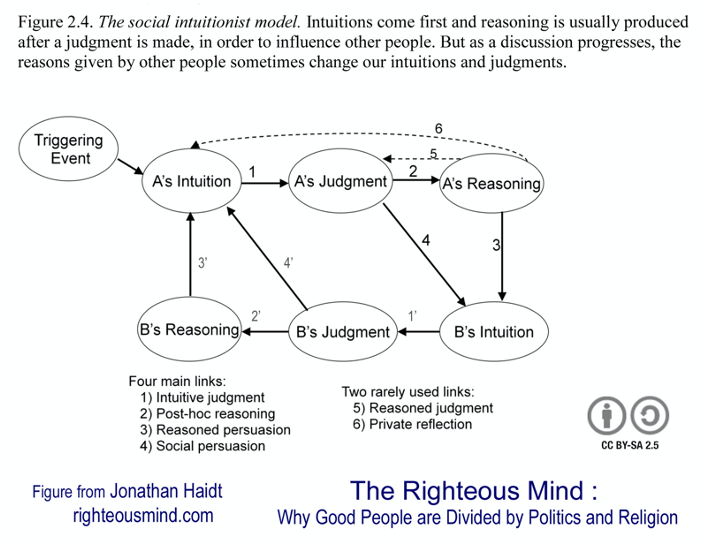
This newsletter is really a public policy thought-letter. While excellent newsletters on specific themes within public policy already exist, this thought-letter is about frameworks, mental models, and key ideas that will hopefully help you think about any public policy problem in imaginative ways. It seeks to answer just one question: how do I think about a particular public policy problem/solution? PS: If you enjoy listening instead of reading, we have this edition available as an audio narration on all podcasting platforms courtesy the good folks at Ad-Auris. If you have any feedback, please send it to us. A Framework a Week: The Basis of Morality Tools for thinking public policy - RSJ The other day at a dinner with a few friends (in our ‘bubble’) the topic of farm laws came up. The usual argument followed. Farmers need to be freed from the overbearing power of the state that has kept them poor for so long versus Ambani/Adani will take over and control food prices in future leaving nothing for the farmers or the consumers. Things were going according to the script till the issue of morality came up. Both sides were convinced they had the stronger moral argument to support them. Luckily, the dinner was served and good food quietened things down. This set me thinking about how we think about morality. Regardless of how we define political axes in India (left vs right, liberal vs conservative, statist vs free marketer), each side arrives at their ideology based on what they believe is morally right for the society. What’s the basis for our inherent self-righteousness and why does it differ among people? About Morality Jonathan Haidt in his superb book The Righteous Mind: Why Good People are Divided by Politics and Religiongoes deep into this question. When he was at graduate school, Haidt learnt about Kohlberg’s six stages of moral reasoning. This model (Kohlberg’s) developed in the early 60s held that moral reasoning which forms the basis for ethical behaviour evolves over six developmental stages. These six stages were broken into three levels: pre-conventional, conventional and post-conventional. Each stage was more evolved and better at responding to moral dilemmas than the last. Kohlberg’s six stages were: Level 1 (Pre-Conventional) * Obedience and punishment orientation * Self-interest orientation( What's in it for me?) Level 2 (Conventional) * Interpersonal accord and conformity( The good boy/good girl attitude) * Authority and social-order maintaining orientation( Law and order morality) Level 3 (Post-Conventional) * Social contract orientation * Universal ethical principles (Principled conscience) Haidt found something amiss in this model. It seemed too cerebral with the rational mind driving moral decisions. In 2001, he wrote The emotional dog and its rational tail where he presented the social intuitionist model as an alternative to the rationalist model. Haidt’s point was simple: moral judgment was widely believed to be caused by moral reasoning. Instead, he argued, we reach a moral judgment based on our intuitions that are shaped by moral and cultural factors (link 1 in the model below). We construct a scaffolding of moral reasoning after that to support our judgment (link 2). Judgments based on reason (link 5) and change in intuitions after private reflection (link 6) are quite rare. Theory Of Moral Intuition It is a far-reaching paper that helps explain a lot of things around us. What did Jefferson mean when he held certain truths as ‘self-evident’? Or, why do we now believe politics is downstream of culture? You can’t change politics unless you change culture. Why is this true? Or, why do you often end up in a political argument feeling frustrated that the other side doesn’t see your point of view which is moral or right? To Haidt, this is because of our moral intuition. We don’t know why something is wrong but we just know it’s wrong. Haidt defined moral intuition as: “..the sudden appearance in consciousness of a moral judgment, including an affective valence (good-bad, like-dislike), without any conscious awareness of having gone through steps of search, weighing evidence, or inferring a conclusion. Moral intuition is therefore the psychological process that the Scottish philosophers talked about, a process akin to aesthetic judgment: one sees or hears about a social event and one instantly feels approval or disapproval.” Haidt gave the elephant-rider metaphor to explain this. This is a metaphor to explain how our unconscious mind guides our conscious rational faculty. The elephant is the total of our intuitions and our unconscious influences. It is large and chooses its own path. The rational conscious mind is like the rider on the elephant. She thinks she is controlling the elephant but that isn’t true. “the mind is divided into parts that sometimes conflict. Like a rider on the back of an elephant, the conscious, reasoning part of the mind has only limited control of what the elephant does.” Only a very skilled rider can sometimes change the course of the elephant. That’s the reason only the really sharp minds on either ends of the political spectrum can intellectually and morally justify the intuitions of the masses and direct them to a political or social goal. As Haidt concludes in his paper: “The time may be right, therefore, to take another look at Hume’s perverse thesis: that moral emotions and intuitions drive moral reasoning, just as a surely as a dog wags its tail.” But this wasn’t enough. Why do we have different moral reasoning among us? Why do two brothers who grew up together in the same household often hold diametrically opposite political views? Our Moral Foundations Haidt (with others) built the moral foundation theory to explain the differences in moral valence among people. They argued humans have six universal moral foundations that develop in them over time depending on culture, social interactions and their own understanding of the world around them. They proposed the five foundations of morality and later added a sixth: 1) Care/harm: This foundation is related to our long evolution as mammals with attachment systems and an ability to feel (and dislike) the pain of others. It underlies virtues of kindness, gentleness, and nurturance. 2) Fairness/cheating: This foundation is related to the evolutionary process of reciprocal altruism. It generates ideas of justice, rights, and autonomy. [Note: In our original conception, Fairness included concerns about equality, which are more strongly endorsed by political liberals. However, as we reformulated the theory in 2011 based on new data, we emphasize proportionality, which is endorsed by everyone, but is more strongly endorsed by conservatives] 3) Loyalty/betrayal: This foundation is related to our long history as tribal creatures able to form shifting coalitions. It underlies virtues of patriotism and self-sacrifice for the group. It is active anytime people feel that it’s “one for all, and all for one.” 4) Authority/subversion: This foundation was shaped by our long primate history of hierarchical social interactions. It underlies virtues of leadership and followership, including deference to legitimate authority and respect for traditions. 5) Sanctity/degradation: This foundation was shaped by the psychology of disgust and contamination. It underlies religious notions of striving to live in an elevated, less carnal, more noble way. It underlies the widespread idea that the body is a temple which can be desecrated by immoral activities and contaminants (an idea not unique to religious traditions). 6) Liberty/oppression: This foundation is about the feelings of reactance and resentment people feel toward those who dominate them and restrict their liberty. Its intuitions are often in tension with those of the authority foundation. The hatred of bullies and dominators motivates people to come together, in solidarity, to oppose or take down the oppressor. This is a public episode. If you would like to discuss this with other subscribers or get access to bonus episodes, visit publicpolicy.substack.com
Embed this episode
No transcript yet.