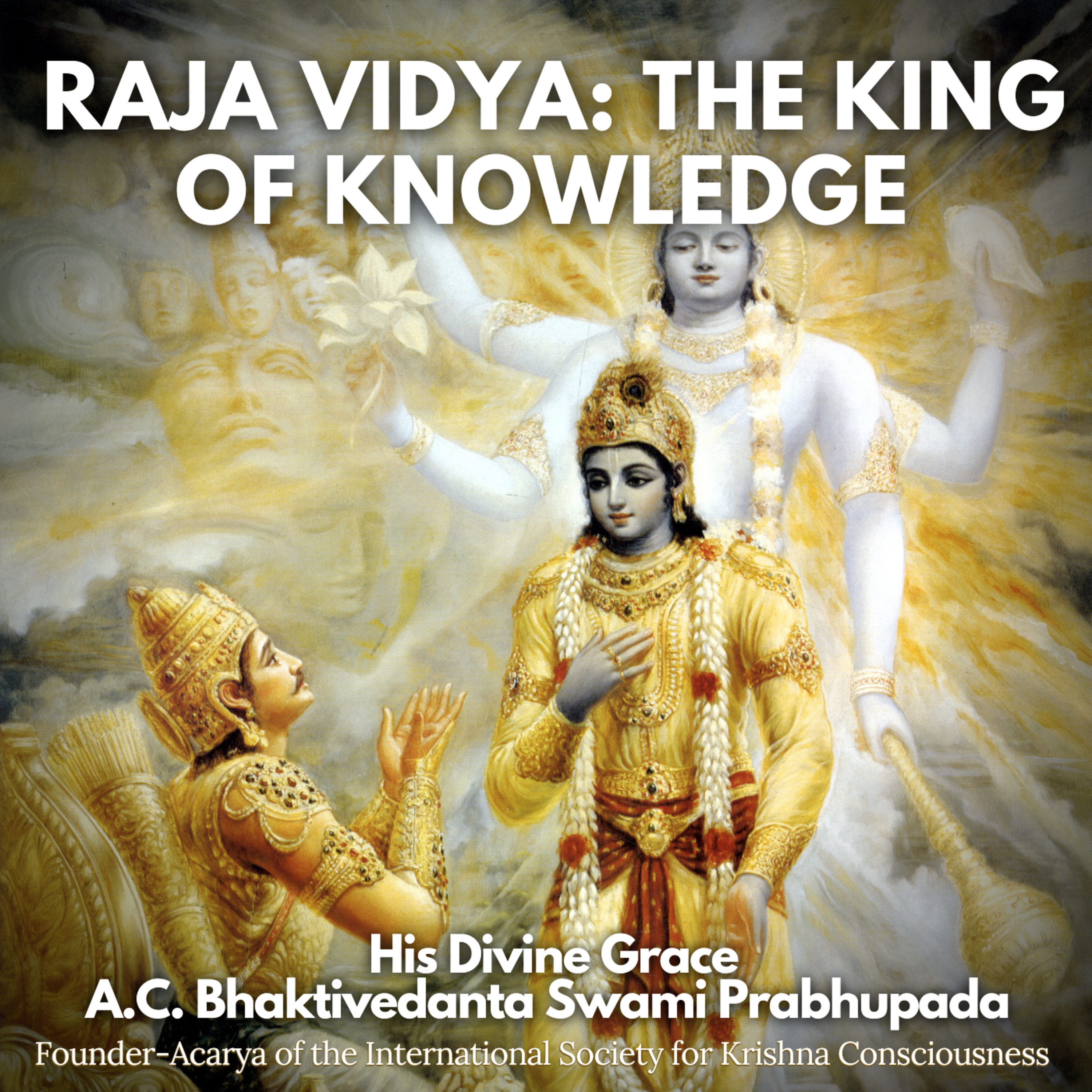
114 - Knowledge Is As Good As Its Source ("Raja Vidya: The King of Knowledge" pages 50-57) episode artwork

EPISODE · Dec 1, 2020 · 16 MIN

114 - Knowledge Is As Good As Its Source ("Raja Vidya: The King of Knowledge" pages 50-57)

from Sravanam Diaries · host Sulalita Devi Dasi

"According to the Vedas, there are three kinds of proof: pratyakṣa,  anumāna and śabda. One is by direct visual perception. If a person is  sitting in front of me, I can see him sitting there, and my knowledge of  his sitting there is received through my eyes. The second method,  anumāna, is auricular: we may hear children playing outside, and by  hearing we can conjecture that they are there. And the third method is  the method of taking truths from a higher authority. Such a saying as  "Man is mortal" is accepted from higher authorities. Everyone accepts  this, but no one has experienced that all men are mortal. By tradition,  we have to accept this. If someone asks, "Who found this truth first?  Did you discover it?" it is very difficult to say. All we can say is  that the knowledge is coming down and that we accept it. Out of the  three methods of acquiring knowledge, the Vedas say that the third  method, that of receiving knowledge from higher authorities, is the most  perfect. Direct perception is always imperfect, especially in the  conditional stage of life. By direct perception we can see that the sun  is just like a disc, no larger than the plate we eat on. From  scientists, however, we come to understand that the sun is many  thousands of times larger than the earth. So what are we to accept? Are  we to accept the scientific proclamation, the proclamation of  authorities, or our own experience? Although we cannot ourselves prove  how large the sun is, we accept the verdict of astronomers. In this way  we are accepting the statements of authorities in every field of our  activities. From newspapers and radio we also understand that such and  such events are taking place in China and India and other places all  around the earth. We're not experiencing these events directly, and we  don't know that such events are actually taking place, but we accept the  authority of the newspapers and radio. We have no choice but to believe  authorities in order to get knowledge. And when the authority is  perfect, our knowledge is perfect.." | Link to get  your own copy or read: www.biglink.to/rajavidya | Find us on social  media:  Facebook "Sravanam Diaries" | Instagram & Tumblr  @sravanamdiaries | Email:  [email protected]

Episode metadata supplied by the publisher feed · Published Dec 1, 2020

"According to the Vedas, there are three kinds of proof: pratyakṣa,  anumāna and śabda. One is by direct visual perception. If a person is  sitting in front of me, I can see him sitting there, and my knowledge of  his sitting there is received through my eyes. The second method,  anumāna, is auricular: we may hear children playing outside, and by  hearing we can conjecture that they are there. And the third method is  the method of taking truths from a higher authority. Such a saying as  "Man is mortal" is accepted from higher authorities. Everyone accepts  this, but no one has experienced that all men are mortal. By tradition,  we have to accept this. If someone asks, "Who found this truth first?  Did you discover it?" it is very difficult to say. All we can say is  that the knowledge is coming down and that we accept it. Out of the  three methods of acquiring knowledge, the Vedas say that the third  method, that of receiving knowledge from higher authorities, is the most  perfect. Direct perception is always imperfect, especially in the  conditional stage of life. By direct perception we can see that the sun  is just like a disc, no larger than the plate we eat on. From  scientists, however, we come to understand that the sun is many  thousands of times larger than the earth. So what are we to accept? Are  we to accept the scientific proclamation, the proclamation of  authorities, or our own experience? Although we cannot ourselves prove  how large the sun is, we accept the verdict of astronomers. In this way  we are accepting the statements of authorities in every field of our  activities. From newspapers and radio we also understand that such and  such events are taking place in China and India and other places all  around the earth. We're not experiencing these events directly, and we  don't know that such events are actually taking place, but we accept the  authority of the newspapers and radio. We have no choice but to believe  authorities in order to get knowledge. And when the authority is  perfect, our knowledge is perfect.." | Link to get  your own copy or read: www.biglink.to/rajavidya | Find us on social  media:  Facebook "Sravanam Diaries" | Instagram & Tumblr  @sravanamdiaries | Email:  [email protected]

PodParley-generated summary based on available episode metadata and transcript content.

NOW PLAYING

114 - Knowledge Is As Good As Its Source ("Raja Vidya: The King of Knowledge" pages 50-57)

0:00 16:35

No transcript for this episode yet

We transcribe on demand. Request one and we'll notify you when it's ready — usually under 10 minutes.

The (R)EV Diaries - EVs in Rural America Electric Cars - Electric Vehicles Ben Jones Electric Vehicles are everywhere. All major car manufacturers, from the highest-end performance brands to the lowest-end utilitarian family wagons, are working to produce an EV option for the marketplace. Battery capacity breakthroughs and concept cars shrouded in secrecy dominate the news. Here in America, public charging infrastructure is popping up… in big cities where consumers are realizing they can electrify their commute and save 70% on fuel costs. But what about small-town America? Ben Jones, an electrical engineer for an distribution cooperative in southeastern Kentucky believes so. He’s been exposed to EVs and charging infrastructure projects for his utility. Ben believes that EVs need to be in every town and the right combination of battery range and charging options make electric cars very attractive to rural inhabitants. But that was not always the case. The EV Diaries chronicle Ben’s conversion from skeptic to being a self-appointed EV ambassador. He talks about h THE VAMPIRE DIARIES Himanshi Naruka Hey guys, I just finished watching the show "The Vampire Diaries", I just loved it 😍 So now I have decided to read the books and take you all with me through this reading journey. ❤️ The Honey Badger Diaries Aaron van Wirdum in lockdown As coronavirus sweeps the globe......civil liberties are threatened......physical cash is abandoned......money printers go brrr......and bitcoin is halvening. My Ukrainian Heritage : Laryssa Ahimsa Media Laryssa Menkova shares a series of diaries exploring her Ukrainian Heritage. Throughout this series, Laryssa reflects on parts of her parents’ lives fleeing from Russia and settling in Ukraine, her travels in Ukraine, and her feelings about being a child of immigrant Ukrainian parents, set against the current realities of Russia’s invasion on Ukraine.

Frequently Asked Questions

How long is this episode of Sravanam Diaries?

This episode is 16 minutes long.

When was this Sravanam Diaries episode published?

This episode was published on December 1, 2020.

What is this episode about?

"According to the Vedas, there are three kinds of proof: pratyakṣa,  anumāna and śabda. One is by direct visual perception. If a person is  sitting in front of me, I can see him sitting there, and my knowledge of  his sitting there is received...

Can I download this Sravanam Diaries episode?

Yes, you can download this episode by clicking the download button on the episode player, or subscribe to the podcast in your preferred podcast app for automatic downloads.
URL copied to clipboard!