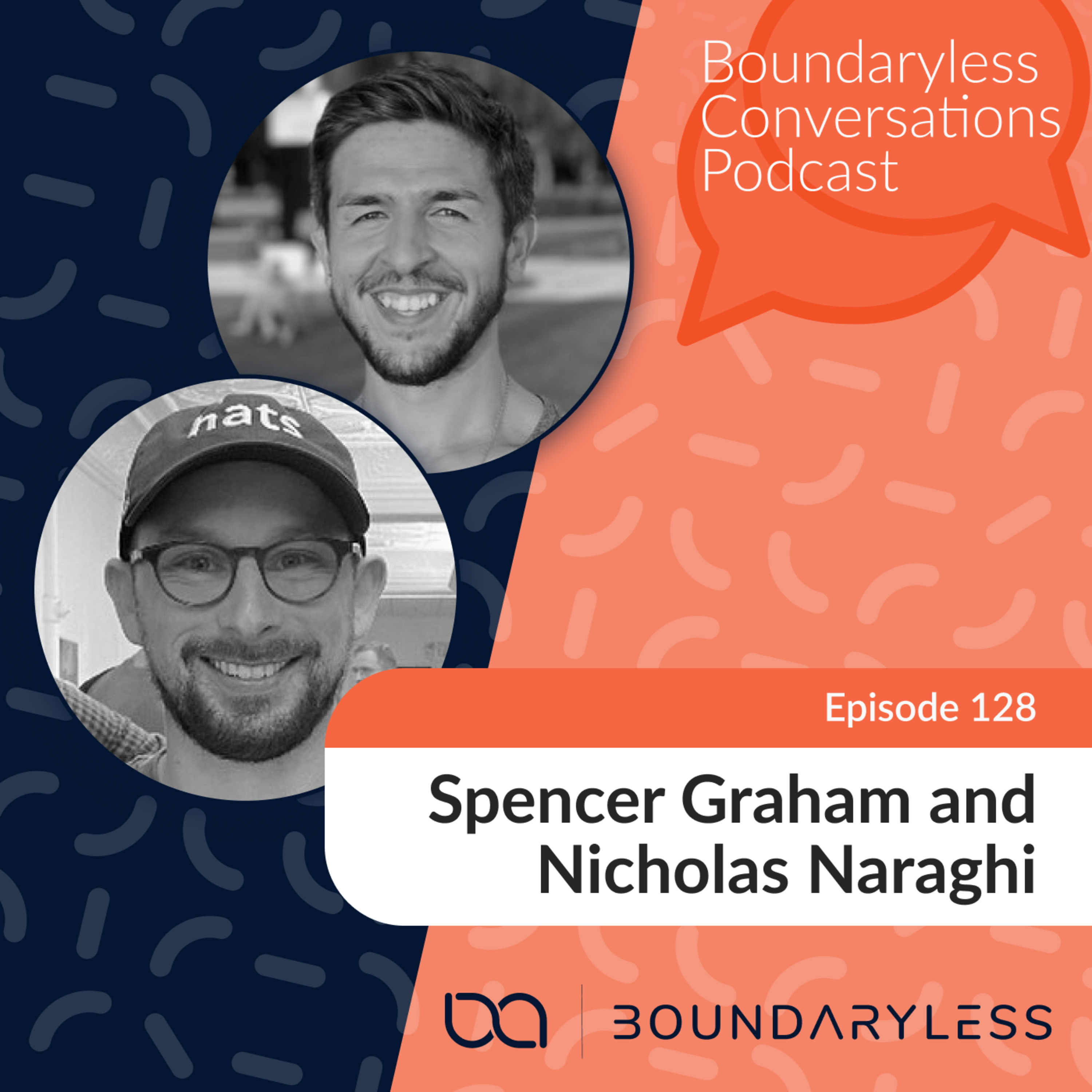
#128 - The Benefits of Programmable Organizations with Spencer Graham and Nicholas Naraghi (Hats Protocol) episode artwork

EPISODE · Nov 11, 2025 · 54 MIN

#128 - The Benefits of Programmable Organizations with Spencer Graham and Nicholas Naraghi (Hats Protocol)

from Boundaryless Conversations Podcast · host Boundaryless SRL

Spencer Graham and Nicholas Naraghi, co-founders of Hats Protocol, pioneering the design and experimentation of decentralised, programmable organisations, join us in this episode to explore how these new forms of collaboration can enable new ways to organise, govern, and create value collectively.They discuss the future of organisational design, including how AI agents can take on roles, how frameworks and reusable templates accelerate experimentation, and why adopting different role-based “Hats” can help individuals contribute meaningfully in new, decentralised ways.They also speak on how decentralisation can lower risk, increase system “hardness,” and improve predictability, while reflecting on what it means to distribute responsibility in a world where the boundaries of firms are increasingly fluid.Tune in to discover a more participatory way of organising that helps solve the principal-agent problem.Together, Spencer and Nicholas have been pioneering new ways of structuring DAOs and digital-native organisations, making roles programmable, modular, and resilient for several years now.In their work, they bring deep experience in building DAOs, governance frameworks, and infrastructure that allow organisations to operate with greater transparency, adaptability, and distributed decision-making.As we explore role-based structures to enable meaningful participation, we learn what it means to build adaptive systems capable of tackling complex challenges in a decentralised world.Key Highlights👉 Decentralised organisations reduce the cost of organising by embedding rules, roles, and incentives directly into software, minimising the need for traditional bureaucratic structures.👉 AI agents can take on organisational roles, augmenting human capabilities and enabling more modular, scalable coordination.👉 Lowering coordination costs increases the responsibility for individuals to participate meaningfully in organisational life.👉 Roles within organisations can be made programmable and modular, allowing for flexible experimentation and adaptation.👉 Reusable frameworks and templates accelerate organisational experimentation, letting groups test new coordination methods quickly.👉 Individuals may act like “micro-organisations” with AI agents representing them, but collaboration will always remain necessary for complex problem-solving.👉 Tokenisation and algorithmic governance allow individuals to earn ownership and rewards proportional to the value they create in an organisation.👉 Participating in decentralised organisations requires embracing uncertainty, both in outcomes and in coordination dynamics.Topics /chapters(00:00) The Benefits of Programmable Organizations(01:39) IntroducingSpencer Graham and Nicholas Naraghi (Hats Protocol)(03:35) From DAOs to Roles: The Birth of the HATS Protocol(10:11) The Principal-Agent Problem(15:00) Getting Buy-In on Protocols(22:03) Separating Tech from the Principal-Agent Problem(30:31) When Organizing Becomes Cheap: What New Organizations Will Emerge?(40:43) Uncertainty with Autonomy(46:05) Will “Organising” become a necessary skill?(49:05) Breadcrumbs and SuggestionsRemember that you can always find transcripts and key highlights of the episode on our website: https://www.boundaryless.io/podcast/protocol-HatsEpisode recorded on Oct 01, 2025Find out more about the show and the research at Boundaryless at https://boundaryless.io/resources/podcast/Get in touch with Boundaryless:Twitter: https://twitter.com/boundaryless_Website: https://boundaryless.io/contactsLinkedIn: https://www.linkedin.com/company/boundaryless-pdt-3eoMusicMusic from Liosound / Walter Mobilio. Find his portfolio here: https://blss.io/Podcast-Music

Spencer Graham and Nicholas Naraghi, co-founders of Hats Protocol, pioneering the design and experimentation of decentralised, programmable organisations, join us in this episode to explore how these new forms of collaboration can enable new ways to organise, govern, and create value collectively.They discuss the future of organisational design, including how AI agents can take on roles, how frameworks and reusable templates accelerate experimentation, and why adopting different role-based “Hats” can help individuals contribute meaningfully in new, decentralised ways.They also speak on how decentralisation can lower risk, increase system “hardness,” and improve predictability, while reflecting on what it means to distribute responsibility in a world where the boundaries of firms are increasingly fluid.Tune in to discover a more participatory way of organising that helps solve the principal-agent problem.Together, Spencer and Nicholas have been pioneering new ways of structuring DAOs and digital-native organisations, making roles programmable, modular, and resilient for several years now.In their work, they bring deep experience in building DAOs, governance frameworks, and infrastructure that allow organisations to operate with greater transparency, adaptability, and distributed decision-making.As we explore role-based structures to enable meaningful participation, we learn what it means to build adaptive systems capable of tackling complex challenges in a decentralised world.Key Highlights👉 Decentralised organisations reduce the cost of organising by embedding rules, roles, and incentives directly into software, minimising the need for traditional bureaucratic structures.👉 AI agents can take on organisational roles, augmenting human capabilities and enabling more modular, scalable coordination.👉 Lowering coordination costs increases the responsibility for individuals to participate meaningfully in organisational life.👉 Roles within organisations can be made programmable and modular, allowing for flexible experimentation and adaptation.👉 Reusable frameworks and templates accelerate organisational experimentation, letting groups test new coordination methods quickly.👉 Individuals may act like “micro-organisations” with AI agents representing them, but collaboration will always remain necessary for complex problem-solving.👉 Tokenisation and algorithmic governance allow individuals to earn ownership and rewards proportional to the value they create in an organisation.👉 Participating in decentralised organisations requires embracing uncertainty, both in outcomes and in coordination dynamics.Topics /chapters(00:00) The Benefits of Programmable Organizations(01:39) IntroducingSpencer Graham and Nicholas Naraghi (Hats Protocol)(03:35) From DAOs to Roles: The Birth of the HATS Protocol(10:11) The Principal-Agent Problem(15:00) Getting Buy-In on Protocols(22:03) Separating Tech from the Principal-Agent Problem(30:31) When Organizing Becomes Cheap: What New Organizations Will Emerge?(40:43) Uncertainty with Autonomy(46:05) Will “Organising” become a necessary skill?(49:05) Breadcrumbs and SuggestionsRemember that you can always find transcripts and key highlights of the episode on our website: https://www.boundaryless.io/podcast/protocol-HatsEpisode recorded on Oct 01, 2025Find out more about the show and the research at Boundaryless at https://boundaryless.io/resources/podcast/Get in touch with Boundaryless:Twitter: https://twitter.com/boundaryless_Website: https://boundaryless.io/contactsLinkedIn: https://www.linkedin.com/company/boundaryless-pdt-3eoMusicMusic from Liosound / Walter Mobilio. Find his portfolio here: https://blss.io/Podcast-Music

NOW PLAYING

#128 - The Benefits of Programmable Organizations with Spencer Graham and Nicholas Naraghi (Hats Protocol)

0:00 54:12

No transcript for this episode yet

We transcribe on demand. Request one and we'll notify you when it's ready — usually under 10 minutes.

That Hoarder: Overcome Compulsive Hoarding That Hoarder Hoarding disorder is stigmatised and people who hoard feel vast amounts of shame. This podcast began life as an audio diary, an anonymous outlet for somebody with this weird condition. That Hoarder speaks about her experiences living with compulsive hoarding, she interviews therapists, academics, researchers, children of hoarders, professional organisers and influencers, and she shares insight and tips for others with the problem. Listened to by people who hoard as well as those who love them and those who work with them, Overcome Compulsive Hoarding with That Hoarder aims to shatter the stigma, share the truth and speak openly and honestly to improve lives. The Small Business Startup School – Business Notes | Financial Literacy | Retail Psychology – For Professionals & Entrepreneurs The Small Business Startup School Inc. Starting or buying a small business? While personal circumstances may vary, business patterns remain timeless. On The Small Business Startup School, we explore strategies, insights, and practical solutions to help entrepreneurs confidently navigate their journey.Hosted by Ola Williams—a retail entrepreneur, fintech founder, and financial coach with over two decades of experience—this podcast marries financial awareness and retail psychology with optimism to deliver actionable takeaways.Join us to learn, grow, and connect as we uncover the keys to business success.Let’s continue to learn together and be encouraged to keep on connecting! DIOSA. Carolina Sanper This podcast is a sacred space created by Carolina Sanper where you connect with your inner wisdom and embody your magnetic feminine power.It is the realization that the mystical realm is where you plant the seeds of your desired reality.It is a portal to your true essence: awareness, presence, and receiving with ease. Welcome home, DIOSA. 🖤 XXX Tech by SOVRYN Dr. Brian Sovryn The crossroads between technology, sensuality, and metaphysics - and the longest running anarchist podcast in the world! Brought to you by Dr. Brian Sovryn.

Frequently Asked Questions

How long is this episode of Boundaryless Conversations Podcast?

This episode is 54 minutes long.

When was this Boundaryless Conversations Podcast episode published?

This episode was published on November 11, 2025.

What is this episode about?

Spencer Graham and Nicholas Naraghi, co-founders of Hats Protocol, pioneering the design and experimentation of decentralised, programmable organisations, join us in this episode to explore how these new forms of collaboration can enable new ways to...

Can I download this Boundaryless Conversations Podcast episode?

Yes, you can download this episode by clicking the download button on the episode player, or subscribe to the podcast in your preferred podcast app for automatic downloads.
URL copied to clipboard!