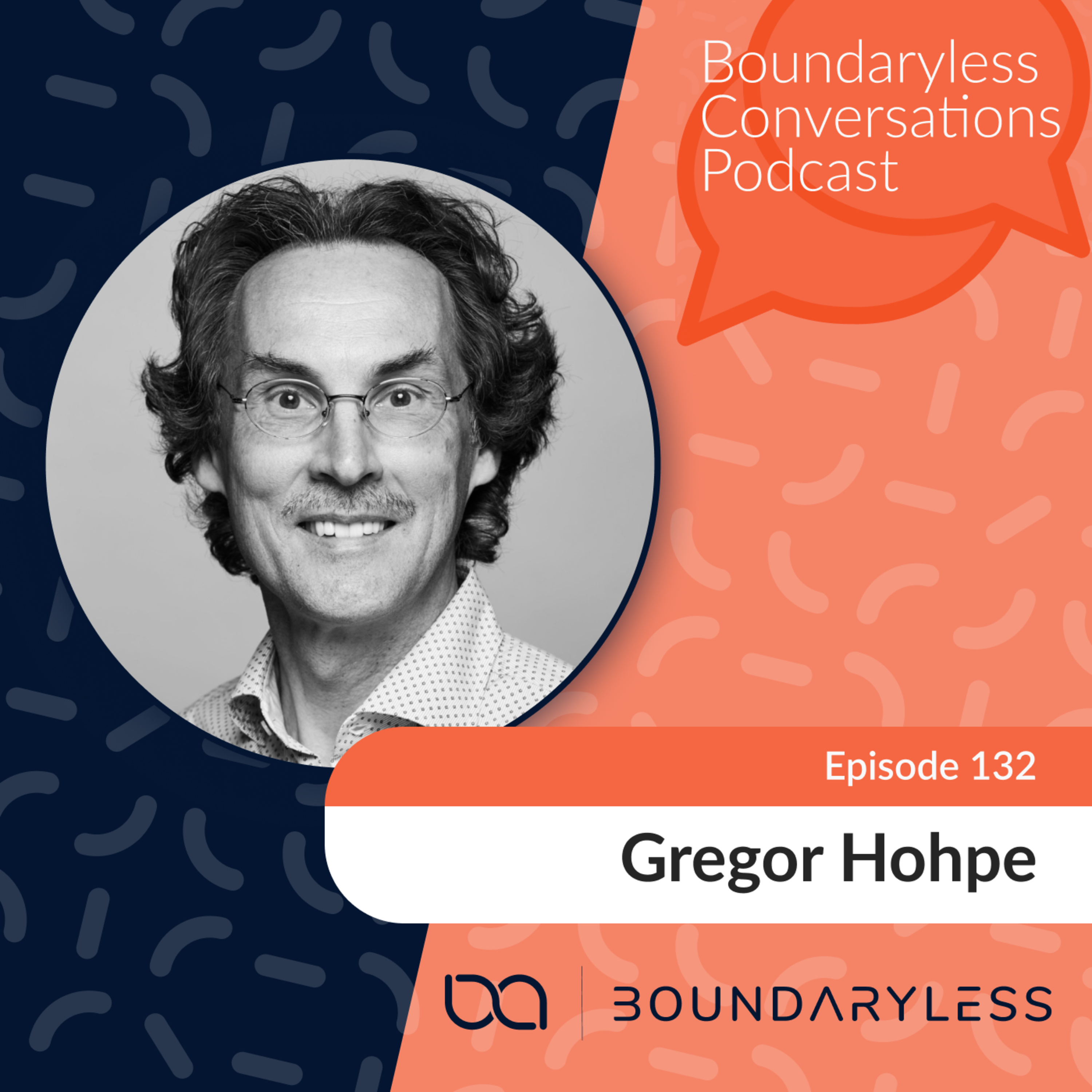
#132 - Enterprise Architecture: Selling Options for the Future, at a Cost - with Gregor Hohpe episode artwork

EPISODE · Jan 6, 2026 · 56 MIN

#132 - Enterprise Architecture: Selling Options for the Future, at a Cost - with Gregor Hohpe

from Boundaryless Conversations Podcast · host Boundaryless SRL

Gregor Hohpe - one of the world’s leading voices in enterprise architecture and platform thinking, and author of ‘The Software Architect Elevator’, ‘Enterprise Integration Patterns’ and ‘Platform Strategy’- joins us to dive into how enterprise architecture is about navigating the tradeoffs needed to enable future optionality in the organization.He reframes the architecture problem from a technical one to a practice of selling options, and unpacks why shared language and domain understanding along with strategic clarity matter more than ever now with GenAI.In this fast approaching future GenAI no longer makes it possible to hide organisational dysfunctions, it exposes them relentlessly: the question then is what leaders and architects can do about this.In this episode, we succeeded to bring in Gregor’s perspective on architecture as a strategic, systems-level discipline not as a technical practice.Drawing on his experience as a long-time advisor to large organisations navigating platform transitions, we explore how to bridge strategy and implementation, and how to create coherence across silos, enabling teams to make better decisions together.Join us as we discuss how architecture guides strategic choices and helps you build optionality.Key Highlights👉 Architecture can also be seen as a practice of selling options - enabling organisations to defer decisions and adapt as strategy and context evolve.👉 Optionality always comes with a cost: more flexibility introduces greater complexity, so architects must continually balance benefits against trade-offs.👉 Good architecture cannot be designed inside IT alone - it must be grounded in business intent, market direction, and strategic positioning.👉 Domain understanding shouldn’t live only with data teams - it requires joint meaning-making across business, tech, and architecture.👉 GenAI amplifies organisational dysfunction rather than fixing it - faster code and automation expose weak strategy, unclear domains, and siloed thinking.👉 Those who work only within narrow silos are the most replaceable; future-relevant capability lies in boundary-spanning, systems thinking, and cross-domain judgment.👉 As technology accelerates delivery, organisations must strengthen reflection, modelling, and decision-making - because the bottleneck shifts from building software to understanding what to build.👉 Shared ontologies and domain modeling are essential for collaboration and extensibility - without them, organisations struggle to integrate partners, ecosystems, and platforms.Topics /chapters(00:00) Enterprise Architecture: selling Options for the Future, at a Cost - INTRO(01:32) Introducing Gregor(03:06) Beyond Business vs Tech(07:35) How does organization attitude connect to its architecture?(16:12) Designing Architecture for Strategic Coherence(23:30) Creating Shared Ontologies(30:22) Changing the Narrative from Transactional to Conversational(43:47) How can organisations remain context-conscious?(50:53) Breadcrumbs and SuggestionsRemember that you can always find transcripts and key highlights of the episode on our website: https://www.boundaryless.io/podcast/hohpe-gregorEpisode recorded on Dec 01, 25Find out more about the show and the research at Boundaryless at https://boundaryless.io/resources/podcast/Get in touch with Boundaryless:Twitter: https://twitter.com/boundaryless_Website: https://boundaryless.io/contactsLinkedIn: https://www.linkedin.com/company/boundaryless-pdt-3eoMusicMusic from Liosound / Walter Mobilio. Find his portfolio here: https://blss.io/Podcast-Music

Gregor Hohpe - one of the world’s leading voices in enterprise architecture and platform thinking, and author of ‘The Software Architect Elevator’, ‘Enterprise Integration Patterns’ and ‘Platform Strategy’- joins us to dive into how enterprise architecture is about navigating the tradeoffs needed to enable future optionality in the organization.He reframes the architecture problem from a technical one to a practice of selling options, and unpacks why shared language and domain understanding along with strategic clarity matter more than ever now with GenAI.In this fast approaching future GenAI no longer makes it possible to hide organisational dysfunctions, it exposes them relentlessly: the question then is what leaders and architects can do about this.In this episode, we succeeded to bring in Gregor’s perspective on architecture as a strategic, systems-level discipline not as a technical practice.Drawing on his experience as a long-time advisor to large organisations navigating platform transitions, we explore how to bridge strategy and implementation, and how to create coherence across silos, enabling teams to make better decisions together.Join us as we discuss how architecture guides strategic choices and helps you build optionality.Key Highlights👉 Architecture can also be seen as a practice of selling options - enabling organisations to defer decisions and adapt as strategy and context evolve.👉 Optionality always comes with a cost: more flexibility introduces greater complexity, so architects must continually balance benefits against trade-offs.👉 Good architecture cannot be designed inside IT alone - it must be grounded in business intent, market direction, and strategic positioning.👉 Domain understanding shouldn’t live only with data teams - it requires joint meaning-making across business, tech, and architecture.👉 GenAI amplifies organisational dysfunction rather than fixing it - faster code and automation expose weak strategy, unclear domains, and siloed thinking.👉 Those who work only within narrow silos are the most replaceable; future-relevant capability lies in boundary-spanning, systems thinking, and cross-domain judgment.👉 As technology accelerates delivery, organisations must strengthen reflection, modelling, and decision-making - because the bottleneck shifts from building software to understanding what to build.👉 Shared ontologies and domain modeling are essential for collaboration and extensibility - without them, organisations struggle to integrate partners, ecosystems, and platforms.Topics /chapters(00:00) Enterprise Architecture: selling Options for the Future, at a Cost - INTRO(01:32) Introducing Gregor(03:06) Beyond Business vs Tech(07:35) How does organization attitude connect to its architecture?(16:12) Designing Architecture for Strategic Coherence(23:30) Creating Shared Ontologies(30:22) Changing the Narrative from Transactional to Conversational(43:47) How can organisations remain context-conscious?(50:53) Breadcrumbs and SuggestionsRemember that you can always find transcripts and key highlights of the episode on our website: https://www.boundaryless.io/podcast/hohpe-gregorEpisode recorded on Dec 01, 25Find out more about the show and the research at Boundaryless at https://boundaryless.io/resources/podcast/Get in touch with Boundaryless:Twitter: https://twitter.com/boundaryless_Website: https://boundaryless.io/contactsLinkedIn: https://www.linkedin.com/company/boundaryless-pdt-3eoMusicMusic from Liosound / Walter Mobilio. Find his portfolio here: https://blss.io/Podcast-Music

NOW PLAYING

#132 - Enterprise Architecture: Selling Options for the Future, at a Cost - with Gregor Hohpe

0:00 56:00

No transcript for this episode yet

We transcribe on demand. Request one and we'll notify you when it's ready — usually under 10 minutes.

That Hoarder: Overcome Compulsive Hoarding That Hoarder Hoarding disorder is stigmatised and people who hoard feel vast amounts of shame. This podcast began life as an audio diary, an anonymous outlet for somebody with this weird condition. That Hoarder speaks about her experiences living with compulsive hoarding, she interviews therapists, academics, researchers, children of hoarders, professional organisers and influencers, and she shares insight and tips for others with the problem. Listened to by people who hoard as well as those who love them and those who work with them, Overcome Compulsive Hoarding with That Hoarder aims to shatter the stigma, share the truth and speak openly and honestly to improve lives. The Small Business Startup School – Business Notes | Financial Literacy | Retail Psychology – For Professionals & Entrepreneurs The Small Business Startup School Inc. Starting or buying a small business? While personal circumstances may vary, business patterns remain timeless. On The Small Business Startup School, we explore strategies, insights, and practical solutions to help entrepreneurs confidently navigate their journey.Hosted by Ola Williams—a retail entrepreneur, fintech founder, and financial coach with over two decades of experience—this podcast marries financial awareness and retail psychology with optimism to deliver actionable takeaways.Join us to learn, grow, and connect as we uncover the keys to business success.Let’s continue to learn together and be encouraged to keep on connecting! DIOSA. Carolina Sanper This podcast is a sacred space created by Carolina Sanper where you connect with your inner wisdom and embody your magnetic feminine power.It is the realization that the mystical realm is where you plant the seeds of your desired reality.It is a portal to your true essence: awareness, presence, and receiving with ease. Welcome home, DIOSA. 🖤 XXX Tech by SOVRYN Dr. Brian Sovryn The crossroads between technology, sensuality, and metaphysics - and the longest running anarchist podcast in the world! Brought to you by Dr. Brian Sovryn.

Frequently Asked Questions

How long is this episode of Boundaryless Conversations Podcast?

This episode is 56 minutes long.

When was this Boundaryless Conversations Podcast episode published?

This episode was published on January 6, 2026.

What is this episode about?

Gregor Hohpe - one of the world’s leading voices in enterprise architecture and platform thinking, and author of ‘The Software Architect Elevator’, ‘Enterprise Integration Patterns’ and ‘Platform Strategy’- joins us to dive into how enterprise...

Can I download this Boundaryless Conversations Podcast episode?

Yes, you can download this episode by clicking the download button on the episode player, or subscribe to the podcast in your preferred podcast app for automatic downloads.
URL copied to clipboard!