#147 Bole Choodiyan, Bole Kangana?
from Anticipating the Unintended Hosted by Pranay Kotasthane
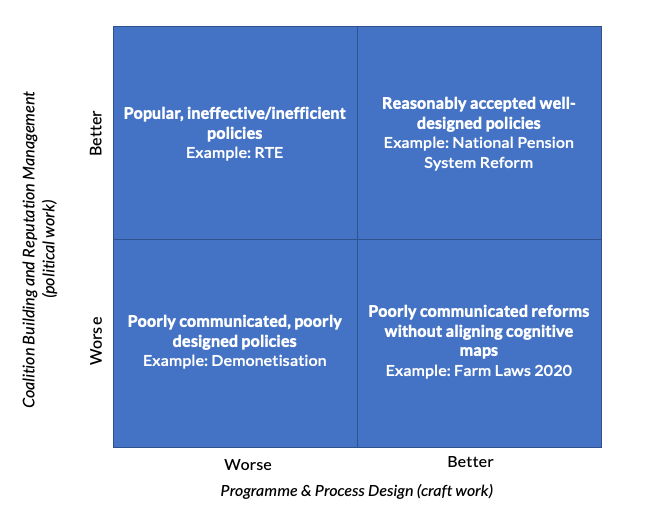
Not(PolicyWTF): Reforming Procurement (Sanjeev Kumar Must Be Smiling) Pleasant surprises in policymaking in India — RSJ Since we take great pleasure in highlighting policy screw-ups around here, it is only fair we appreciate measures that aren’t PolicyWTFs when they make an occasional appearance on our landscape like rare migratory birds. Last week we had one such sighting. (Deep breath). The Procurement Policy Division (PPD) in the Department of Expenditure (DoE) under the Ministry of Finance (MoF), Government of India (GoI) released the ‘General Instructions on Procurement and Project Management’. The press release reads: “These guidelines attempt to incorporate into the realm of Public Procurement in India, innovative rules for faster, efficient and transparent execution of projects and to empower executing agencies to take quicker and more efficient decisions in public interest. Some of the improvements include prescribing strict timelines for payments when due. Timely release of ad hoc payments (70% or more of bills raised) is expected to improve liquidity with the contractors especially Micro, Small and Medium Enterprises (MSMEs).” Importantly, it has this line too: “Alternative methods for selection of contractors have been permitted, which can improve speed and efficiency in execution of projects. In appropriate cases, quality parameters can be given weightage during evaluation of the proposal in a transparent and fair manner, through a Quality cum Cost Based Selection (QCBS), as an alternative to the traditional L1 system.” This is critical. In ‘appropriate cases’, from now on, quality of service will also be given weightage during evaluation of projects. It sounds absurd but it’s true. Quality wasn’t an explicit parameter for choosing suppliers in government contracts so far. So, yes, this is a reform. Bravo! Puraane Paap I have written about the tyranny of the L1 system and its pernicious effects before. From our edition #22 (Trishul: Ek ‘Tender’ Prem Katha): “The procurement of goods and services by the Government of India is still largely governed by the Contract Act 1872 and Sale of Goods Act, 1930 and General Financial Rules (GFR) that are amended periodically. The most prevalent mechanism of awarding a contract in government departments and PSUs over the last century has been the L1 system, also called the Least Cost Selection Method. There is a bit of history to this. The colonial government wasn’t too keen on spending a lot on projects in India. A minimal threshold of quality was all that was needed at the lowest cost. Though alternatives like the Quality and Cost Based System (QCBS) and Quality Based System (QBS) are being gradually adopted, the L1 system still holds sway after seven decades. Yes, we love our colonial past a lot that way. So, you could lie your way through the technical bid claiming excellent capabilities. Once you crossed that threshold, all you needed was some friendly insider who helped you price your bid lower than your rivals only marginally. Voila, you’re in business. Three problems arose out of this. First, since technical bids didn’t have a weightage, the projects were often won by less competent firms who ended up either not completing the project or did a shoddy job. Examples of this are visible all around us in government infrastructure projects. Second, it encouraged rent-seeking behaviour among public servants who had the information about rival bids. In that cult classic, Jaane Bhi Do Yaaro, municipal commissioner D’mello was playing two builders (Ahuja and Tarneja) to maximise his benefits till one of them bumps him off. Third, it led to crowding out of honest, competent players from the government tender market because they wouldn’t play ball.” What’s Changed? Anyway, I went through this 22-page document released by the department and a few things stand out. First, there are concrete measures identified to make it easy for suppliers dealing with the government. The guidelines suggest 75 per cent of payment due must be paid within 10 working days of the submission of the bill and the remaining within 28 working days. Beyond this, penal interest would apply. There’s also guidance on how government entities should operate when they get into legal disputes with their suppliers. The entities should not appeal against judgments of lower courts in routine matters and decision to appeal should be reviewed by a special committee that should consider both legal merits and the practical chances of success after doing a cost-benefit analysis. This will encourage those suppliers who have stayed away from government contracts because of the jhanjhat they entail. Second, a few other common bugbears of the government procurement process have been eliminated. For instance, the single bidder scenario in an open tender. Earlier the tender would be scrapped and a new one floated if there was only one bidder. This is no longer a necessary requirement and if the single bidder checks all the boxes, the process can continue with them to its conclusion. Also, the government entities can now quote a fixed budget for a project in the tender itself for the bidders to apply. This will take away the guesswork and protracted negotiations to get a bid under a budget that the government has in mind for specific time-bound projects. Finally, we have the Quality-cum-Cost Based Selection (QCBS) now allowed for procurement of works and non-consultancy service where the procurement has been declared Quality Oriented Procurement (QOP) by the competent authority and where the estimated value of the tender does not exceed Rs.10 crore. Even here, the weightage of non-financial parameters cannot exceed 30 per cent. This isn’t wholesale dumping of the L1 procurement system as it is made out to be but it is a continuation of the changes in the procurement process that started in 2017. And I hope as the confidence in this grows, we will phase out the L1 system completely and have a procurement framework that’s modern, not a colonial relic. p.s: There’s always a lot of life lessons to learn from any government gazette and this time I learnt the difference between ‘may’, ‘should’, ‘shall’ and ‘allowed’. I have reproduced it below for your enlightenment: “(i) Instructions containing ‘may’ are to be considered desirable or good practices which procuring entities/ project executing agencies are encouraged to implement but not mandatory. (ii) Instructions containing ‘should’ are required to be followed in general. However, there may be circumstances where it may not be practical/ desirable to implement them. In such cases, the concerned officer / agency may deviate by recording reasons in writing for not implementing the same (iii) Instructions containing ‘shall’ are mandatory; any deviation shall require (our take: note the meta level usage of shall here) relaxation of rules from the DoE (iv) Instructions containing ‘allowed’ indicate an optional course of action to be decided upon on merits” Aur kahan milega itna content! A Framework a Week: What’s a Policy Success? Tools for thinking public policy — Pranay Kotasthane Whatay coincidence! I also have something not-so-terrible to discuss. Rarer than sighting rare migratory birds. Anyways, it’s always fun to identify a policyWTF. The gotcha feeling is unmistakable. Policy watchers like us experience immense satisfaction in identifying governments’ stupidities. Moreover, limited state capacity in India means that policyWTFs surface at a daily cadence. Ideas that seemed great on paper regularly morph into egregious policies. As important as exposing government incompetence is in a democracy, we also realise the limits of analyses focusing on policy failures alone. The dominance of the language of incompetence and disillusionment with the State can lead to self-fulfilling prophecies. Fed only on a diet of policy failures, those of us who can afford, give up entirely on the State. Those who can’t afford, resign… This is a public episode. If you would like to discuss this with other subscribers or get access to bonus episodes, visit publicpolicy.substack.com
Embed this episode
No transcript yet.