
Traditionally, businesses have found new leads at trade shows. But in 2026, that model is changing. Fewer business owners can justify the expense of exhibiting or attending trade shows in expensive cities around the world when that money could go to the ever-increasing cost of doing business. That's where we come in.
Advertising on our podcast gives you a way to reach a niche audience of coffee business owners and professionals across the entire value chain, no matter where they are in the world. Our advertisers have reported generating leads from their very first ads. And podcast advertising on a Mapper Forward podcast lasts forever as new audiences discover our 1500 plus catalogue of episodes that reaches farther than a single trade show ever could. We offer three flexible pricing structures and accept payment in US dollars or select cryptocurrencies.
We'll work closely with you to create and tailor the ad so you don't have to stress about anything. Our pricing is very reasonable and targeted to give smaller businesses in the Mapper Forward community the opportunity to reach a large audience. If you're ready to amplify your brand's voice and connect with the right people and you share Mapper Forward's brand values, email us at support at mapperforward.org or DM us on social media. Check the show notes for all the details and let's conspire to each other's success today.
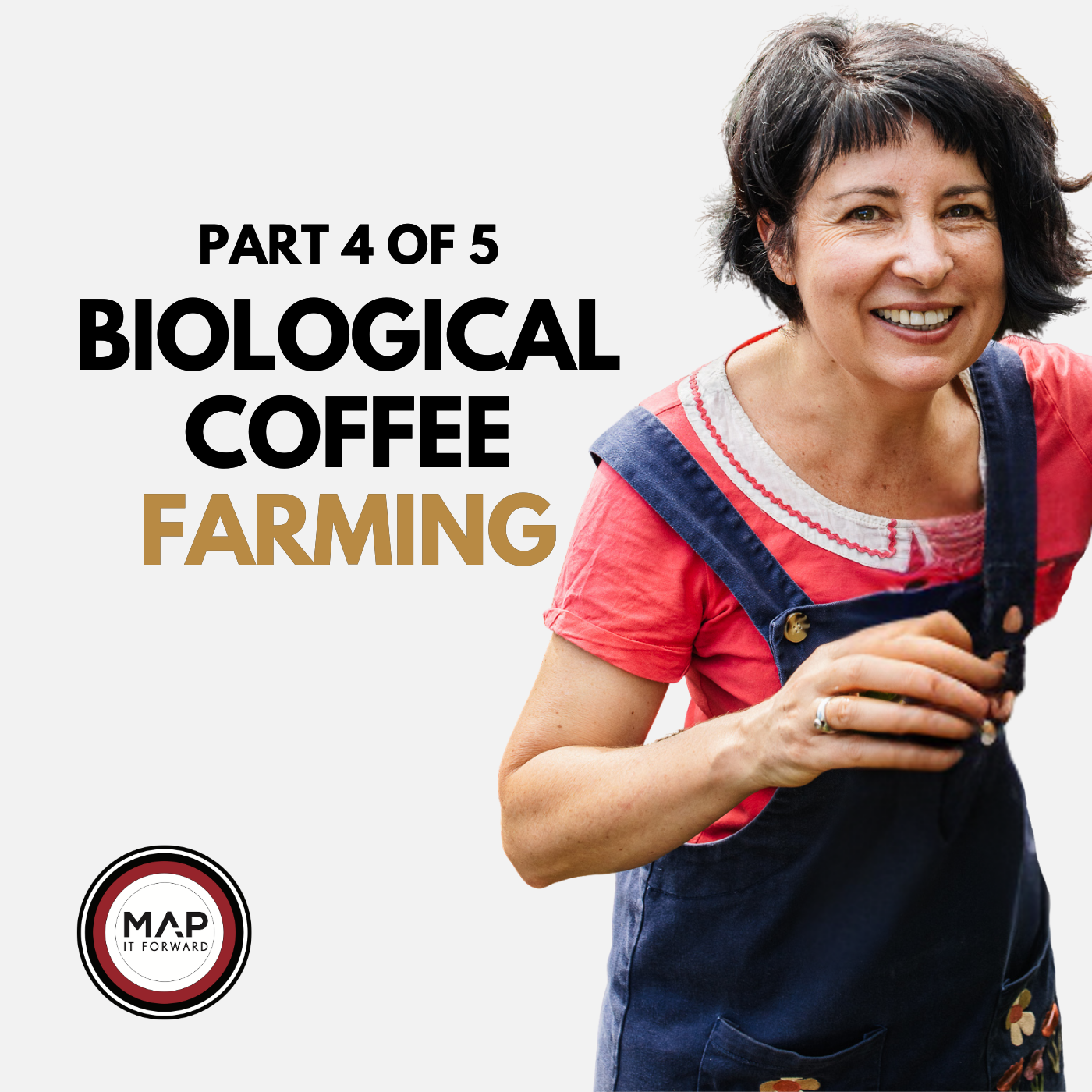
Welcome to the Daily Coffee Pro by Mapper Forward friends. I'm your host, Leah, Safa, and this is episode four of a wonderful five-part series with Bec from Zenfeld Coffee Farms and Roasted Coffee. We are talking about Australian grown coffee, and in this episode, we're going to talk about biological coffee farming and how it's linked to quality coffee. The floor is yours, madam.
Go ahead. Tell us all the things. Well, is it just wishful thinking that I think it's linked to quality coffee? I think it will be proven in the years to come.
And I'll give my first shout out to another podcast that I listen to regularly on biological farming, which is Regenerative Ag with John Kempf. So anyone who, yeah, who's into biological farming, go, yep, yep, yeah, he's the master. We know him. So I look up any biological farming podcast I can, but I certainly come around to listening to every episode he puts out.
And I remember, it was a few months ago, but he had a fellow talking and he said, I really believe that it will be within a couple of years that we'll be able to prove, as a consumer, go into a supermarket and you'll have some like an app or a little wand, a little handheld device, and you'll be able to look at, say, two bags of carrots. One might be organic and one might be regular, and you'll be able to weigh that it and it'll be some sort of laser beam, but we'll actually be able to tell the nutritional value of the two different types of carrots. So you can make the decision, do you want that one? That sounds like a dreamy, dreamy.
That's the nutrient density there compared to that one. So I can see that what we're working towards and what I believe in is really looking after the health of our soil and it does seem to relate to flavour. But they say organic food, for a lot of people, it isn't just woo-woo that the organic strawberry tastes better than the one that's sprayed. It is the microbial life in the soil unlocking that flavour potential for what can be produced in your soil.
So we've got naturally rich volcanic soil where we are, so I'm pretty chuffed that we've got this really good basis of worms. And you can see, you know, little critters, but this is the critters you can't see, the microbial life down there that is really going to make a difference with, as I say, unlocking the potential of nutrients to ship the nutrients up to the coffee trees in this case and right into the fruits, what we're after. How do we, how do we encourage that? Is the biological farming part, and we don't want to be woo-woo about it, we want to say, what can we do?
What we're going to do is encourage the life down there. So we can do that in a number of ways. We can add, we don't want to just keep spraying it with nasty herbicides and pesticides if we can avoid that. Now we're really selective with our herbicide.
I still have a herbicide and I've had to learn to get the recipe right so that I can occasionally pinpoint spray that ridiculous weed that keeps popping up and is really annoying me that I can't pull it out by hand. So I'm not a purist, but gosh, I spend a lot of time pulling out BC out. Meanwhile, we rarely do that. We aren't, you know, doing whole spray dresses or down roads to prepare our soil anymore.
Not for the, probably 25 years have we done that or maybe 30 years, really. We don't use any sprays on our trees. Well, that's just fortunate because we have no pests or diseases. So no nasty pesticides in Australia on our coffee production is amazing.
So that's the really good stuff. But let's talk about that microbial life down there. What we want to do to encourage it is give it more plants. We don't want that monoculture of just coffee trees, whatever the variety is and some type of grass.
We want to bring in more life. So we're adding a lot more things like what we call cover crops as biological farming. So part of that can be just allowing some different grasses to live, some weeds to live, but planting cover crops, what we're doing now, particularly planting for the new varieties that are coming or this season that I've started, we plant like a metre wide, it's probably close to a yard, a metre wide of the cover crops and we'll put a mix of plant species in there. And what that does, they say the different types of plant species will all bring out, they've got the idea of bringing the energy from the sun's rays, bringing it into the plant, turning it into sugars.
And the different, every plant has some relationship with microbes down there that their sugars will unlock them. So the idea is that we're putting more plants to unlock a greater diversity of microbial life and you're feeding them. And then they reciprocate and have synergies back to being able to bring their nutrient one will be that, you know, the legumes will help unlock the nitrogen potential. Others will lock out, bring out phosphorus.
Others have tiny trace elements of boro or something. So they unlock that potential and then make it available to the plant above. Keep going, lady. I'm sinking like a student absorbing.
And that's what I am. I'm a student of listening the last probably eight years now of discovering, you know, first the term, what does regenerative ag mean? So in plants, it's about, it was A, about growing more plants, B, adding compost. So we have wonderful compost piles.
And I say wonderful, I'm just so thrilled to be able to have access to some waste matter. And it started off with waste matter from some other farms and local processes. So I was very active in a local food group called Northern Rivers Food in our region, Northern Rivers. And at one of the sessions on sustainability, which absolutely makes me roll my eyes because I don't want to be sustainable.
I want to be better. You know, we want to grow better. If I wanted to be sustainable, that could have been, you know, less production than I've got now or less healthy trees than we have now. Less healthy soil, healthier waterways, all those good things that we build up well.
So one of the fellows put his hand up because the workshop organiser said, So in this group of about 20 food producers, what's your waste? Just think about your waste product. And it was a hemp foods company and they were able to process hemp seed, which had recently become legal in Australia for food production. And it turned, yeah, that's right.
Finally, we're a bit behind the eight ball. Us and New Zealand, I think, are the last to come on board. America still isn't there. America, for food production.
Oh, for food production, maybe. But for other production. Hemp, that was outlawed in America for a really long time. Yeah, there's that, yeah, good history with that.
Well, not good, bad history. Bad history. Pro-hemp growing. Yes, that's right.
Well, they got pulled back. It should have been something we've kept with going for, you know, 3000 years with the hemp production for food and fibre. So for food, it was being allowed, which was great. A new thing.
Turns out the hemp is tiny little seed. It's got a little shell around it. The shell is a waste product. So here's this food producer working out how to make the seed into a food oil or a skincare oil, either way.
But moving forward in food, oil and the seed to turn into like a breakfast cereal, for instance. So they've got this wasted huge bag, like bulk fertiliser bags of hemp seed husk. So I went, I'll have that. He's like seven minutes away.
So all we had to do was pay for the freight. And he comes around 12 bags of huge bulk bags of hemp seed husk. When we put it first on the ground and emptied it, we went, what do we do now? And then I let my chooks out of the yard and my four little chooks went out and they're just going crazy.
They just want to eat hemp seed. So it's obviously high protein. And it is. So hemp seed is known for high protein for humans to eat, for animals to eat, to eat the waste product.
So we had this hemp seed husk. Then we found guys with arborists were trimming trees along the side of our road. And I just walked down there and said, what do you want to do with the wood chips? They said, oh, actually Going cold turkey, wanted to be organic.
It's like, ah, the poor trees just go, where's my food? I'm used to my feed every day, you can't just take off. So it's a learning program, but it's, it's a joy. This is fascinating to me because we talk a lot about regenerative ag on this podcast and you, what you're talking about with regards, is it vermiculture?
The vermiculture is the, the, the worm, the worm compost. Right, right. That vermiculture that you put in the bottom of the plants reminds me of what they're doing with biochar. Have you heard of biochar?
Yeah. Is it the same thing? Yeah, yeah. Not the same thing, but it's, is it, is it a similar practice?
I think with biochar, yes, you can do it that way or you could just um sprinkle a little bit of biochar if we were to purchase it. It's something we're considering doing. You can do it as a practice. Why don't I make it?
Yeah, it is. It's just another, it's just another element of, um, having a fire, but without the oxygen, you know, you pump out the oxygen. Yeah, well said. Um, where you might put like we have, you know, like old iron roofing.
So you could put the old iron roofing on top of it of the fire to kind of squash the fire with less oxygen. So it burns slower. So the charcoal pieces are there with all of their little, apparently it's really about carbon, the charcoal, yeah, the honeycomb effect and the microbes want to live in it. It's like a little apartment block.
So they just love it for that reason. Whereas the vermiculture, yes, it's actually nutritious. The vermiculture is like a little, little pot of honey. You know, it's like yummy, yummy, good stuff.
That was why I was asking that question. I didn't know if it was like a similar thing to, to the, that honeycomb structure. Um, I haven't read about it for a while, but I think, yes, it's actually more on the actual nutrition side of thing, which is why a little bit goes a long way. Like you can add it and you can look up the, many videos where you can add a little bit of your compost to, um, like a compost tea.
So you can bubble water, have an aerator. We've done that only a couple of times. All these more projects we need to do on our weekends after the roasting business has had its week and John's done his programming. All right, we're going to plan a compost tea this week.
Yeah, get to vermiculture. We keep it going so we've got that access there to say, yes, now we're going to make up a compost tea. And then what you do with something like that, we might also add in, and we've got access to it, something called wood vinegar, where I gather, it's a bit like taking the biochar, the sort of, and someone who makes it is going to go, what are you doing saying that? But I think it's something like this where they actually got the slow pyrolysis, often of bamboo.
It's often done in Southeast Asia. And then they get that biochar and then somehow, somehow with adding vinegar, that will help that, help, help release the nutrients. So when we add wood vinegar as a very small amount in a, you know, huge containers of water and put it on as a spray, it's going to, um, help the trees help, help retain the microbial life. Um, what can I say?
I think it's more like a, um, defense mechanism. So it's not straight fertilizer, but it actually can help unlock other potential elements such as calcium. If we mix it with lime, we might be able to make a, yeah, a chelated lime compost tea. So yeah, all that's a bit, yeah, rabbit warren of good biological fun we can have.
Well, I know that you've been watching the Pedro Manga series. There's a whole episode on, uh, oh, listening, sorry. Um, there's a whole episode on biochar in there because he's a biochar specialist. So, um, he talks a lot about, he mentioned something that was really interesting.
He said, you know, biochar is so good at holding nutrients that if you, but, but slow releasing as well. And so if you spray fertilizers, chemical fertilizers and the biochar absorbs it, it could release that for years. If it's so, how did I miss that part? I was listening in the middle of the night.
Maybe I fell asleep. So it was really fascinating. Really, really fascinating because again, he's got a masters in it and bio, he's studied in biochar. And I think Pedro was saying, I heard something where he was suggesting that, um, it's linked with carbon credits, which I'm kind of holding up my fingers against.
Yeah. It's so funny you say that because somebody sent me a message yesterday saying that carbon credits are a scam and they're evil. And they are, that they had a lot of horrible things to say about them. You know, I'm somebody who's, I'm always trying to be open to the idea that we're not being fucked over and, uh, and scammed by corporates.
And then you turn around and you think, no, we are. This is just like yet another time that we are. Yep. Yep.
Years ago, we had a little bit of publicity about some of the biological ways that we were doing on our farm. And then I think there was in a magazine article. And then we had both oil companies and bankers approach us and say, oh, we would like to buy your carbon. I said, F off, you're not buying my carbon credits.
I'm not, I'm not even looking to sell them. I'm not even looking to get them rated. Unfortunately, we didn't go and get the baseline done in the really early part before we started doing more and more of our building on our car. So our carbon is like 12 to 13% when we got it tested last year.
I'm due to get it tested again, which is pretty high. That's a pretty high biological rate. They say if you're two to four, that's good. You're on the path of growth.
So we've, we've got that. Yeah, we've got some good nutrients there. Um, but we, you know, absolutely got challenges with our crop. And I, you know, if I see any yellowing leaves, I'm like, what have we got to do for that?
You know, you really want to get ahead of that. So we're not, we're not perfect. The biological systems aren't all proven or my balance for my farm. So it's really got to be farm related and, you know, and sure, we might put that and John Campbell say, you can add just a little, little portion of urea.
So that's your man-made nitrogen in a sense, um, into your foliar spray, but add the fish and seaweed, which we have. So we've got a, yeah, we've got another fellow that comes to our farm and he makes, uh, out of fish bones, the waste from the food co-op, local seaside food co-op, gathers the fish bones and he's learned to make the chelated, which is the available, you know, fish nutrients coming out in water. And then we can have that as a concentrate. And he also adds, uh, powdered seaweed these days because it's not really ethical to be taking all the seaweed from the beachside.
So he does buy it. Yeah. So we can have our own fish and seaweed based hydrolysates, wood vinegar, and yeah, I love it. Compost tea.
So good things, good things happening. Great things. We have one episode to go. Join us for that where we're going to talk about Australian estate coffee, a growing industry with research and access to new varieties.
So join us for the final episode of this series, guys. Peace, love and peanut butter. Have an amazing rest of your day. If you enjoyed this episode, consider supporting Mapper Forward, our guests and advertisers on social media.
Subscribe, hit the like button, leave a comment and share this episode with a friend. And if you'd like to support our work more directly, become a paid premium YouTube subscriber or Patreon backer to get early access to the show ad-free directly to your inbox each week. You can find links in the show notes.