#192 From Local to Global
from Anticipating the Unintended Hosted by Pranay Kotasthane
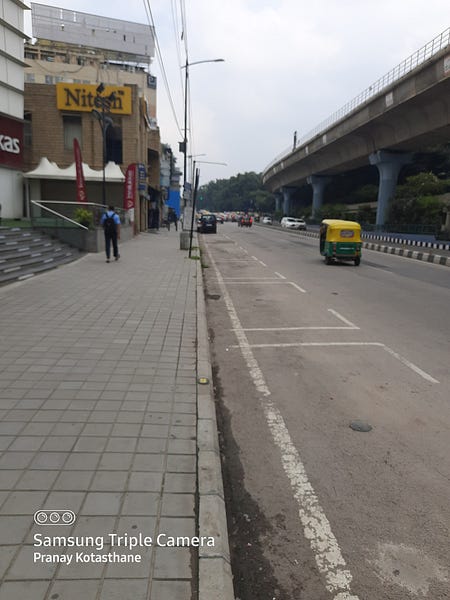
India Policy Watch: State Capacity, the Smart Parking Edition Insights on domestic policy issues — Pranay Kotasthane Public policy is all around us; observing the same public space over time can reveal much about public policy, implementation, and state capacity. So, I’ll try something different today. I will narrate the story of a parking policy reform, which I’ve observed closely over the last couple of years. In it are lessons for government contracting, deployment of technology, and public choice. Drop a reply if this story resonates with you or if you have other such anecdata in mind. The Pre-reform Situation MG Road is a busy thoroughfare in Bengaluru’s Central Business District. Well-known shops, pubs, restaurants, and offices line the road. As you can imagine, many office-goers and business owners commute to MG Road and park their vehicles next to the curb. On weekdays, finding a vacant parking space after 9 am is a sure-shot sign of divine intervention. Even though curbside parking is not chargeable nominally, scarcity causes Coasian transfers to originate. An informal cohort of unauthorised Parking Marshalls emerges. These marshalls help vehicle users negotiate parking in return for a fee. After multiple complaints about this “rent-seeking”, the city government puts up free parking boards and demarcates parking bays for two-wheelers and four-wheelers. A reduction in the real price of parking leads to increased demand. Office-goers rush towards the city centre earlier than usual. The threshold beyond which parking became an ordeal moves up to 8.30 am, after which people have to park about half a kilometre away in a designated paid parking. And since the Traffic Police have no capacity to enforce parking rules except once in a moon, you would usually encounter double-parked vehicles on MG Road, usually cabs. Some shops even employ valets to double-park customers’ cars, which are slid into vacant parking slots as soon as they become available. The motorable road width decreases because of these double-parked vehicles. It is quite a chaos. The Smart Parking Reform The paid parking reform had been mooted on several occasions but wasn’t politically palatable. Finally, the city government bit the bullet after the first COVID-19 wave. BBMP —the city municipal corporation—realised that its tax revenue sources had thinned. And with an ongoing hoarding ban and a newly launched GST, revenue generation options had narrowed further. That’s when the Overton Window for paid parking opened up. Given the lack of state capacity, BBMP doesn’t usually do parking enforcement itself. So it enters into a public-private partnership in which one company Central Parking Services (CPS), is granted a contract for parking on ten major roads in the city’s Central Business District for ten years. Reports suggest that BBMP expected Rs 31.56 crore annually through this arrangement. To prevent corruption, BBMP employs technology. Curbside parking spots are clearly marked and numbered. Sensors are installed on each slot to identify the presence or absence of a vehicle. Customers can book a parking slot on arrival via an app and pay seamlessly through UPI/card/or wallet. Parking kiosks are also installed on footpaths for people who don’t have the phone app. To encourage digital payments, cash payments are made costlier by 16.6%, i.e., Rs 30 in cash grants parking permission for 50 minutes, while the same amount paid digitally allows you to book a parking slot for 60 minutes. For a detailed account, see this Deccan Herald report. To help people transition, parking charges are waived for the first week of operations. Thereafter, cars have to pay Rs 30 per hour. Now, guess what would have happened? Can you anticipate the unintended consequences? Post-reform observations Pricing a resource according to its scarcity leads to a more efficient resource allocation. We saw that scarcity principle play out here. Soon enough, you could find a parking slot at any time of the day. The contractor employed several uniformed parking marshalls to prevent double-parking and unauthorised use. The same road you saw above now started looking as below: The story doesn’t end here, though. It’s not as if parking requirements are this elastic in the central business district, and it’s not as if the city has reliable public transport options. What really happened was the displacement of parked vehicles from MG Road to a nearby residential road and a parallel thoroughfare. To avoid paying the parking fee, people started parking vehicles on other roads, sometimes right under “No Parking” signs. These infractions were uncommon earlier as these roads were patrolled by traffic police vehicles. But with the enforcement contracted out to a company in the surrounding area, perhaps the incentive for the Traffic Police to patrol the area decreased, as public choice theory would predict. And so, while the parking situation on MG Road improved, other neighbouring roads became free parking lots, causing congestion and unchecked traffic rule violations. As for MG Road, the “smart” parking didn’t remain smart for long. The sensors for most parking slots stopped working soon. The app and the kiosks showed a parking slot as" “empty” if you parked a vehicle there. At other times, it showed unpaid bills of previous customers. On one occasion, the app asked me to pay a parking fee of Rs 18,290! Despite repeated calls to the grievance contact number, the contractor didn’t seem to be interested in getting these fixed. The profit motive would have suggested that the company would aggressively keep all sensors active, but that’s not how it played out. As public choice theory would predict, corruption didn’t go away. The situation was much better than in the past. Nevertheless, since the sensors weren’t working, the Parking Marshalls sensed an opportunity. The system allowed them to reset or extend the parking time limits at the kiosks. Some of them started striking side deals with regular commuters. The parking marshalls also enjoyed discretion in enforcing steep fines for overparking. Since there was no robust check to track fines, they could strike a deal with the customer instead of registering an official fine. Zooming Out The marginal benefits of the parking policy reform are greater than the marginal costs; hence, it should continue. But it is still a work in progress. Contracting out doesn’t obviate the need for enforcement entirely. My anecdata reiterates one important lesson in public policy: better contracting or procurement also requires state capacity. Without having built that muscle, contractors can easily take governments for a ride. As Chitgupi, Gorsi, and Thomas write in their LeapJournal article titled Learning by doing and public procurement in India: Procurement is an expertise. No government organisation can sporadically do this well. It is an expertise which can be built, albeit over many years. In any government organisation, people and processes can be organised to focus on this expertise, and to devote time and effort on the entire pipeline of government contracting. The process of developing this capability can be accelerated by bringing in people with this specialised expertise. Strengthening the entire life cycle is required to successfully spend budget amounts. But this is only the beginning of success in procurement where government can contract to deliver quality projects efficiently, on time and at low cost. Applications for the re-awesomed Post-Graduate Programme in Public Policy are now open. Check details here. Global Policy Watch: End Game Insights on global policy issues — RSJ Some recent inflation prints from the US and other developed markets suggest the central banks are winning the fight. In India, too, … This is a public episode. If you would like to discuss this with other subscribers or get access to bonus episodes, visit publicpolicy.substack.com
Embed this episode
No transcript yet.