#201 Blocking out the Sun
from Anticipating the Unintended Hosted by Pranay Kotasthane
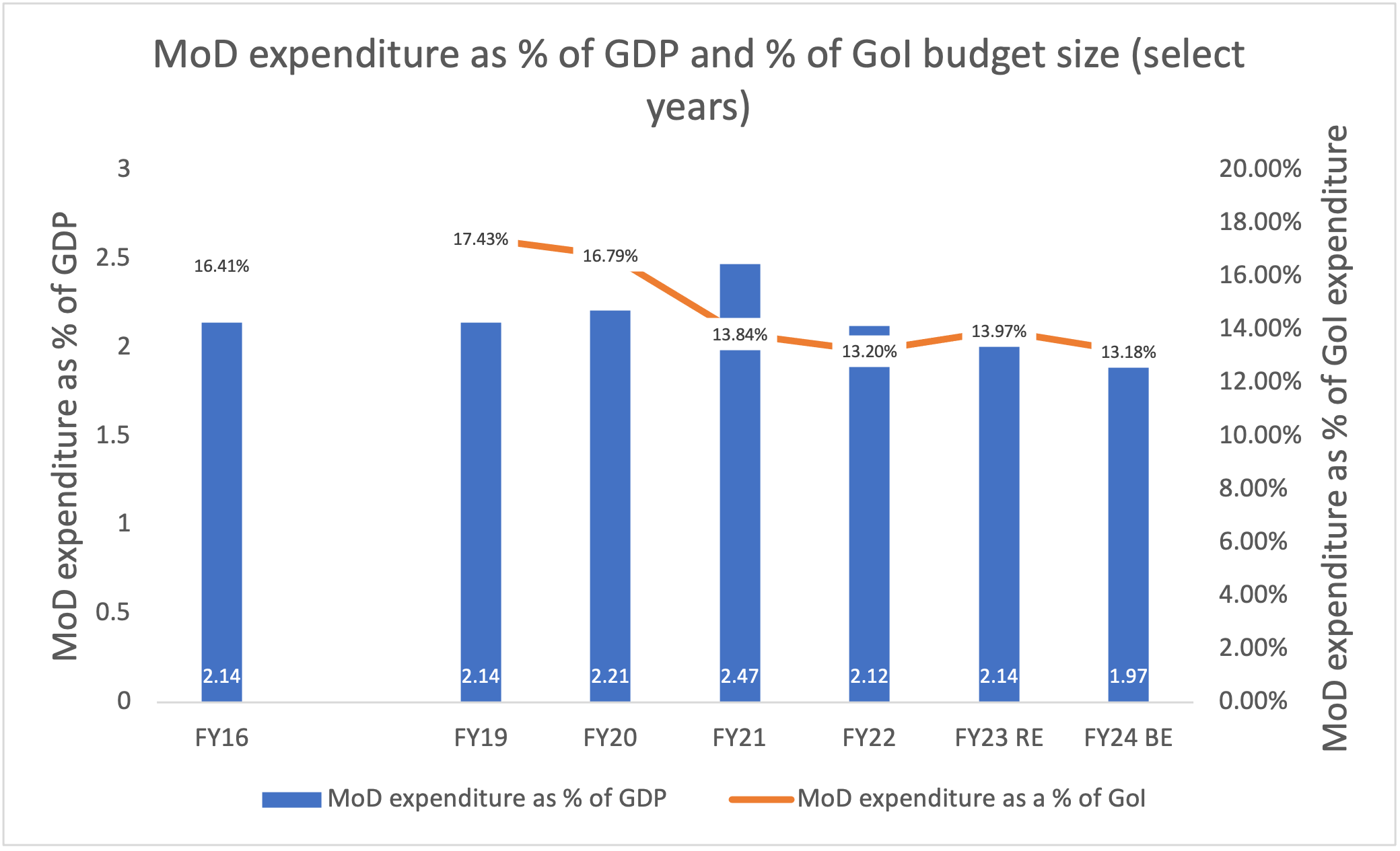
India Policy Watch #1: What Do Successive Defence Budgets Reveal? Insights on burning policy issues in India — Pranay Kotasthane (An edited version of this article was published in Hindustan Times on 13th Feb) Another defence budget zoomed past us on Feb 1. Since then, analyses have focused on how the defence spending for the coming year departs from the last year. Some have waved a red flag as defence spending has fallen below 2 per cent of GDP for the first time in many years. On the other hand, the defence ministry’s post-budget press release emphasised a 44 per cent increase in operational spending, which is expected to “close critical gaps in the combat capabilities and equip the Forces in terms of ammunition, sustenance of weapons & assets, military reserves etc.” The ministry also highlighted that the capital outlay for modernisation and infrastructure development has risen by a seemingly handsome 57 per cent over the last five years. How, then, do we make sense of these conflicting narratives? Comparing allocations with those in the previous year gives us a confusing picture. Every interest group can pull up a number from the budget to suit their pre-formed narrative. Taking a step back from these narratives, this article will show that this was another run-of-the-mill defence budget, just like the previous one was. Nothing in it indicates any significant change in the defence posture. Unlike Japan, which has announced a doubling of its military spending in the next five years, India’s approach is about gradually improving the operational efficiency of the armed forces. Looking under the hood This article looks at the defence expenditure over the last six budgets to make sense of the numbers. To put numbers into context, let’s use an earlier year (FY16). FY16 is a useful reference point as it predates two major developments: China’s visibly aggressive posture on the border and the budgetary commitments arising from the One Rank One Pension (OROP) scheme. Three observations follow from such an analysis. One, not only has defence spending fallen as a proportion of GDP, but it has also fallen as a percentage of government expenditure. In other words, defence has slipped in priority relative to non-defence functions (Figure 1). Two, the China challenge hasn’t led to any spectacular change in the composition of defence expenditure. Defence spending can be divided into four major components: salaries, pensions, capital outlay, and others. As Figure 2 shows, capital outlay was being squeezed by rising pension expenditure over the last few years. For two consecutive years (FY19 and FY20), more money was spent on pensions than on capital acquisition and modernisation. The balance has now been marginally restored since FY21, after the Galwan crisis flared up. Crucially, the rises in pension and capital expenditures have come at the cost of operational and maintenance expenditures, including ammunition stores (under the Others category). It is hence not surprising that the latest budget is trying to arrest this decline in combat capabilities. Three, this period has been relatively better for the Indian Navy in terms of capital expenditure. Since the procurement of new platforms happens over multiple years, a temporal view is useful in analysing how capital outlay is split between the three armed forces. Figure 3 suggests that the big change in the last four years is in the capital outlay for the Indian Navy, with the FY24 figure having doubled in absolute terms since FY20. The Big Picture By connecting these dots over the last five years, the picture that emerges is this: the government seems confident that China can be handled without a substantial rise in defence expenditure. The latest budget serves as a bellwether indicator for this claim. It was the first budget of the post-pandemic period, at a time when the economic prospects for India had improved considerably. The government achieved better-than-expected buoyancy in income taxes and GST in the current financial year, while the cooling of global fertilizer prices has led to a decline in the projected subsidy bill. Consequently, the government, for the first time in many years, had some fiscal room to play with. It has used that space to increase the overall capital outlay to Rs 10 lakh crore, almost three times the outlay in 2019-20. Despite this increase in the overall capital outlay, the defence budget resembles the middle overs of a one-day cricket match. From a financial savings perspective, there have been just two important changes over this period in the defence domain. The first was the announcement of the Agnipath scheme. It might reduce the pension burden, but these savings will reflect only after a decade-and-a-half. Other proposals, such as theatre commands, haven’t come to fruition yet. The proposal to create a non-lapsable fund for modernisation — a proposal the union government gave an in-principle agreement way back in Feb 2021, still hasn’t found a mention in the latest budget. Probably, the defence budget is the wrong place to infer India’s strategic posture against China. Perhaps, the government considers other tools of statecraft—diplomatic, economic, or non-conventional—more suitable for the purpose. This point needs deeper reflection. The discussions over the roles of these tools of statecraft currently operate under mistaken assumptions. Attempts at getting India into an anti-China alliance are spurned at the altar of “strategic autonomy”. The opponents seem to assume that India only needs to equip its armed forces with greater firepower. For too long, many parliamentary standing committees and defence organisations have gone hoarse trying to convince the government that defence expenditure should be raised to 3 per cent of GDP. If anything, the change is in the opposite direction. The defence budget trends are a reminder that the government does not prefer using the military instrument to outflank China. At best, it wants to equip the armed forces such that China’s incursions can be matched or repulsed. Given that there’s no significant increase in allocations for the Navy and the Air Force, it also means that the government is not considering an increased presence in the South China Sea. So, the military is being equipped to plug a vulnerability and not to gain an asymmetric political advantage over China. This line of thinking probably makes sense. There’s no point in matching China’s defence spending dollar-for-dollar. After all, the Indian armed forces are more adept at fighting at high altitudes. But this line of thinking should also make it apparent that India must develop capabilities in domains other than those involving force to inflict pain on China. The government should build a political consensus that closer relations with China’s adversaries are not a matter of choice but an imperative. That we need to double down on economic growth and technological upgrading if we are to constrain China’s hand in other domains. It also means that we shouldn’t be indiscriminately banning China’s investments in India; a better approach would be to make their companies in non-strategic domains more dependent on the Indian market. We will then have more tools in our kit to deploy if the situation on the border worsens. Each of these posture changes needs an updating of our priors and payoffs. For that to happen, it is necessary that the government comes clean about China’s incursions. Pretending that all’s well might give us false comfort, but they will also dissuade the strategic establishment from confronting the tough trade-offs in non-military domains. Without this pivot, we would merely rely on hope as a strategy. India Policy Watch #2: Through The Looking Glass Insights on burning policy issues in India — RSJ We talk ab… This is a public episode. If you would like to discuss this with other subscribers or get access to bonus episodes, visit publicpolicy.substack.com
Embed this episode
No transcript yet.