
EPISODE · Dec 21, 2025 · 17 MIN
235: Maternal H3K9 methyltransferases control aRMAE in C. elegans
from Base by Base · host Gustavo Barra
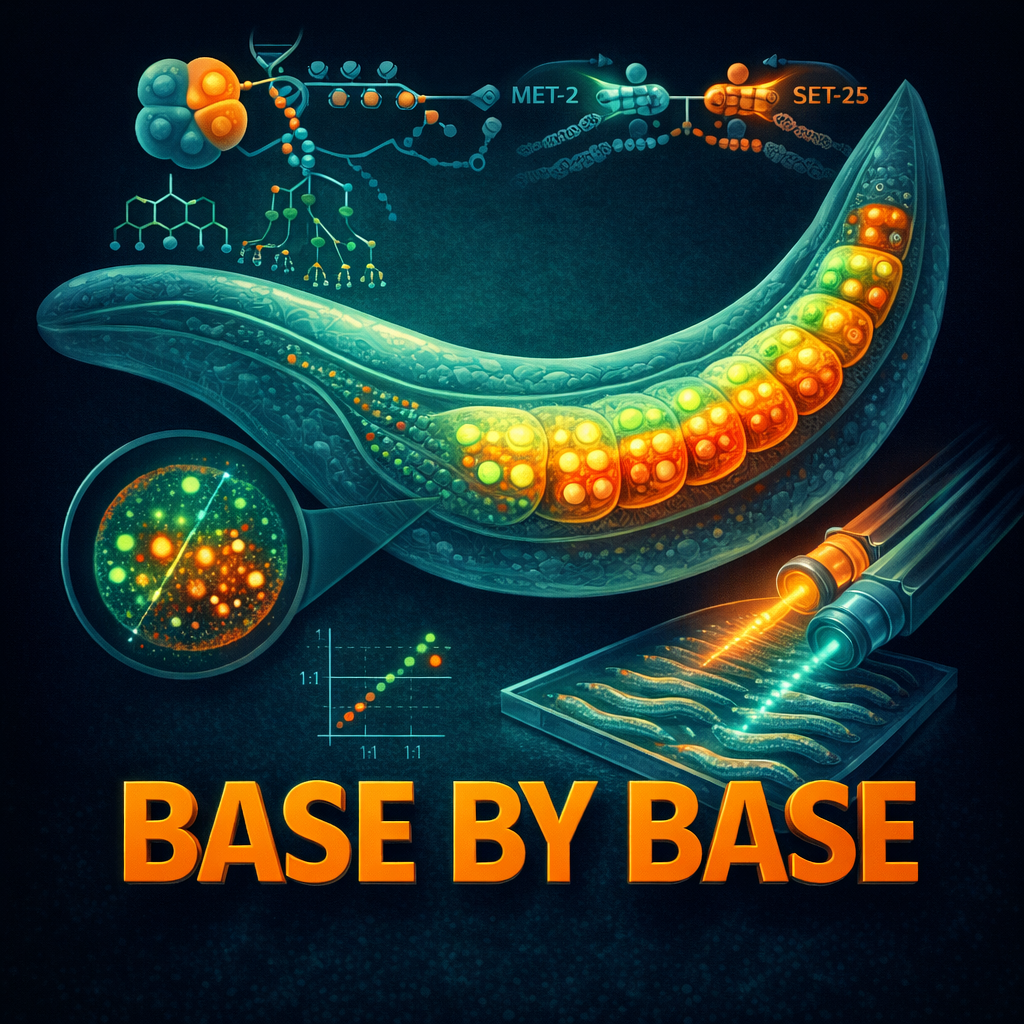
Sands et al., Nature Communications - Using dual-color reporters in C. elegans, the study shows maternal H3K9 methyltransferases MET-2 and SET-25 antagonistically regulate autosomal random monoallelic expression initiated in the early embryo. Key terms: histone-methyltransferase, aRMAE, MET-2, SET-25, c-elegans. Study Highlights: Dual-color fluorescent reporter alleles in C. elegans intestine cells enabled single-cell quantification of allele expression and a targeted screen for aRMAE regulators. MET-2/SETDB1, with LIN-65 and ARLE-14, acts maternally in the 8-cell E-cell to prevent monoallelic expression, while SET-25/SUV39 with HPL-2 and LIN-61 promotes allele silencing. Catalytic SET domains of both MET-2 and SET-25 are required for their opposing activities, and loss of MET-2 increases persistent but non-heritable monoallelic expression whereas loss of SET-25 causes biallelic expression. Reciprocal crosses and genetic interactions indicate these maternal H3K9 HMTs set early embryonic histone states that are propagated through somatic divisions to shape tissue-wide allele expression. Conclusion: Maternal MET-2 and SET-25 establish competing H3K9-related chromatin states in the early embryo that bias autosomal alleles toward persistent somatic monoallelic or biallelic expression Music: Enjoy the music based on this article at the end of the episode. Article title: Maternal histone methyltransferases antagonistically regulate autosomal random monoallelic expression (aRMAE) in C. elegans First author: Sands Journal: Nature Communications DOI: 10.1038/s41467-025-66501-5 Reference: Sands, B., Yun, S.R., Oshima, J. et al. Maternal histone methyltransferases antagonistically regulate autosomal random monoallelic expression (aRMAE) in C. elegans. Nat Commun (2025). https://doi.org/10.1038/s41467-025-66501-5 License: CC BY 4.0 International License Support: Base by Base – Stripe donations: https://donate.stripe.com/7sY4gz71B2sN3RWac5gEg00 Official website https://basebybase.com On PaperCast Base by Base you’ll discover the latest in genomics, functional genomics, structural genomics, and proteomics. Episode link: https://basebybase.com/episodes/maternal-h3k9-armae-c-elegans QC: This episode was checked against the original article PDF and publication metadata for the episode release published on 2025-12-21. QC Scope: - article metadata and core scientific claims from the narration - excludes analogies, intro/outro, and music - transcript coverage: Audited transcript sections describing MAE basics, the C. elegans reporter MAE assay, intrinsic noise as a MAE metric, the MET-2/SET-25 antagonism and cofactors, maternal deposition in the E-cell, catalytic SET-domain requirements, cross experiments, gene specificity, and translational implications. - transcript topics: Introduction to autosomal random monoallelic expression (aRMAE); C. elegans MAE reporter system with dual-color alleles (hsp-90); Intrinsic noise as a quantitative MAE measure; RNAi screen identifying H3K9 methyltransferases MET-2 and SET-25; Antagonistic roles of MET-2 (negative regulator) and SET-25 (positive regulator) of MAE; Cofactors LIN-65, ARLE-14, HPL-2, LIN-61 QC Summary: - factual score: 10/10 - metadata score: 10/10 - supported core claims: 8 - claims flagged for review: 0 - metadata checks passed: 4 - metadata issues found: 0 Metadata Audited: - article_doi - article_title - article_journal - license Factual Items Audited: - Autosomal random monoallelic expression (aRMAE) is probabilistic, persistent within a tissue, but not heritable across generations. - In C. elegans intestine, maternal MET-2 antagonizes SET-25 to regulate MAE; MET-2 promotes biallelic expression while SET-25 promotes m... Chapters (00:00:00) - How do maternal histone methyltransferases regulate DNA health? (00:05:14) - The epigenetic tug of war in the worm (00:09:11) - Maternal DNA silencing (00:14:27) - Half the Story
Embed this episode
Ready to play
235: Maternal H3K9 methyltransferases control aRMAE in C. elegans
No transcript for this episode yet
Similar Episodes
No similar episodes found.
Similar Podcasts
No similar podcasts found.