
EPISODE · Jan 10, 2026 · 19 MIN
255: Lipids, Ions and the AE1 Elevator
from Base by Base · host Gustavo Barra
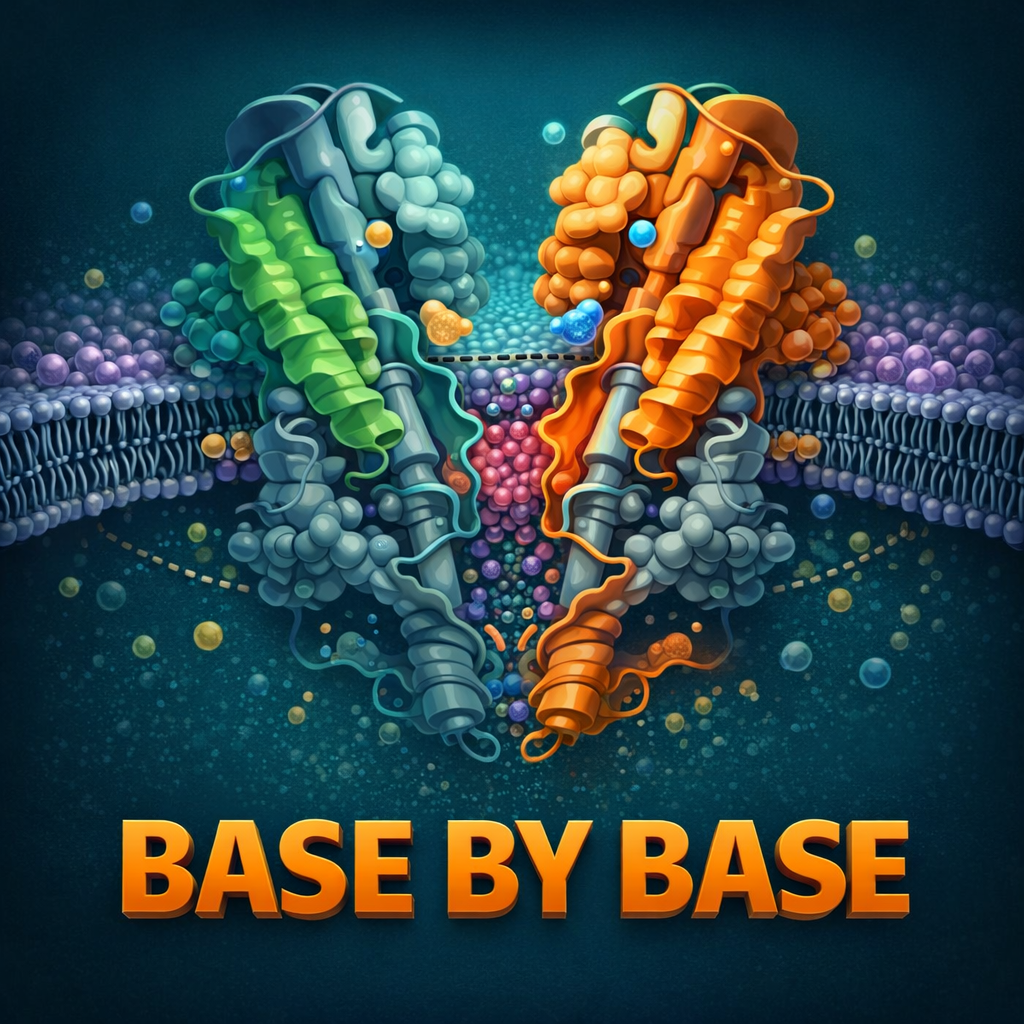
Chen T et al., Nature Communications - Cryo-EM structures, uptake assays, and molecular dynamics show that PIP2 lipids bind at the AE1 dimer interface and inhibit the OF⇌IF conformational transition while substrate binding lowers the transition barrier. Key terms: AE1, PIP2, bicarbonate transport, cryo-EM, molecular dynamics. Study Highlights: Three high-resolution cryo-EM states were solved: two inward-facing (IF1, IF2) and one outward-facing (OF). Proteoliposome uptake assays show that depleting or masking PIP2 increases HCO3– and I– transport. MD simulations identify recurring anion binding in the lumen with R730 as a key coordinating residue and estimate tighter HCO3– binding than Cl–. Enhanced-sampling free energy profiles reveal that HCO3– binding lowers the OF⇌IF barrier by ~3 kcal/mol while removing PIP2 lowers it by ~2 kcal/mol. Mechanistically, HCO3– stabilizes a transition-state conformation by promoting R730 contact with the scaffold domain. Conclusion: PIP2 stabilizes AE1 in a conformation that raises the transport transition barrier and inhibits activity, whereas substrate binding promotes the transition and facilitates transport. Music: Enjoy the music based on this article at the end of the episode. Article title: Impact of anionic lipids on the energy landscape of conformational transition in anion exchanger 1 (AE1) First author: Chen T Journal: Nature Communications DOI: 10.1038/s41467-025-66786-6 Reference: Chen T, Vallese F, Gil-Iturbe E, Kim K, Calì T, Quick M, Clarke OB, Tajkhorshid E. Impact of anionic lipids on the energy landscape of conformational transition in anion exchanger 1 (AE1). Nature Communications. 2025. https://doi.org/10.1038/s41467-025-66786-6 License: This episode is based on an open-access article published under the Creative Commons Attribution 4.0 International License (CC BY 4.0) – https://creativecommons.org/licenses/by/4.0/ Support: Base by Base – Stripe donations: https://donate.stripe.com/7sY4gz71B2sN3RWac5gEg00 Official website https://basebybase.com On PaperCast Base by Base you’ll discover the latest in genomics, functional genomics, structural genomics, and proteomics. Episode link: https://basebybase.com/episodes/pipt2-inhibits-ae1 QC: This episode was checked against the original article PDF and publication metadata for the episode release published on 2026-01-10. QC Scope: - article metadata and core scientific claims from the narration - excludes analogies, intro/outro, and music - transcript coverage: Audited the transcript sections describing AE1 elevator mechanism (TD/SD), R730 and ion binding, bicarbonate vs chloride affinity, PIP2 as a regulatory brake, energy landscape via BEUS/SMwST, cross-linking to trap IF, and the three-state (OF, IF1, IF2) structural context, plus functional uptake assays. - transcript topics: AE1 elevator mechanism (TD/SD architecture); R730 and luminal anion binding sites; Bicarbonate vs chloride binding affinities (Kd values); PIP2 binding site at the dimer interface and K743 salt bridge; PIP2 as molecular brake and its removal increasing activity; Energy landscape and conformational transitions (BEUS/SMwST) QC Summary: - factual score: 10/10 - metadata score: 10/10 - supported core claims: 8 - claims flagged for review: 0 - metadata checks passed: 4 - metadata issues found: 0 Metadata Audited: - article_doi - article_title - article_journal - license Factual Items Audited: - PIP2 binds at the AE1 dimer interface and inhibits the OF⇌IF conformational transition. - Substrate binding (HCO3−) lowers the transition barrier by ~3 kcal/mol. - PIP2 binding raises the transition barrier by ~2 kcal/mol; removal lowers it. - R730 is a key coordinating residue for bicar...
Embed this episode
Ready to play
255: Lipids, Ions and the AE1 Elevator
No transcript for this episode yet
Similar Episodes
No similar episodes found.
Similar Podcasts
No similar podcasts found.