
EPISODE · Jan 23, 2026 · 22 MIN
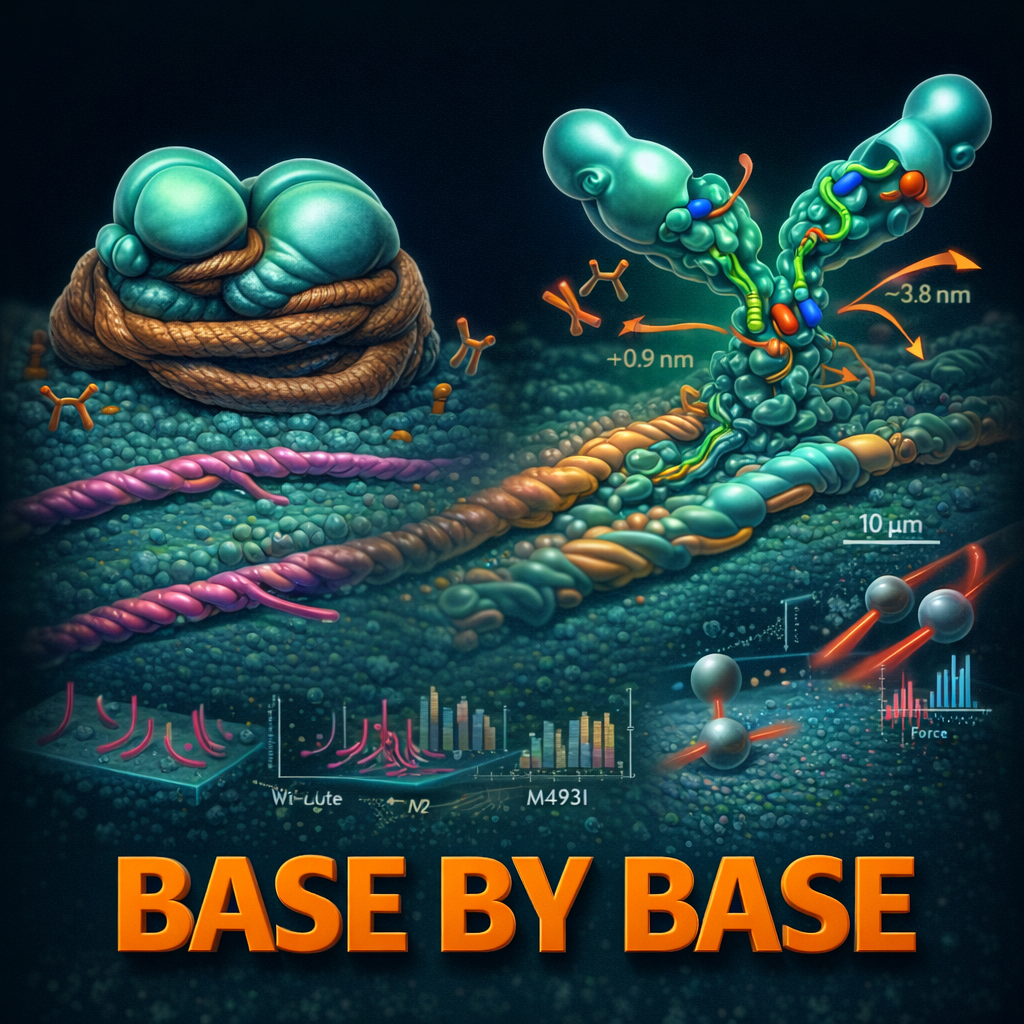
268: M493I in human β-cardiac myosin: SRX disruption, slow ADP release, and enhanced actin attachment
from Base by Base · host Gustavo Barra
Cail RC et al., Proc. Natl. Acad. Sci. U.S.A. 2025.122:e2521561122 - Recombinant human β-cardiac myosin M493I studied by optical trapping and stopped-flow kinetics disrupts the super-relaxed state and increases actin attachment and contractile force. Key terms: β-cardiac myosin, M493I, super-relaxed state, actin attachment, optical trap. Study Highlights:System: recombinant human β-cardiac heavy meromyosin (cHMM) expressed in C2C12 cells. Methods: ensemble actin gliding, stopped-flow kinetics, NADH ATPase, mantATP single-turnover, and single-molecule three-bead optical trap assays. Main results: M493I preserves Pi release and the two-step 4.7–5 nm working stroke but slows ADP release ~5-fold, doubles steady-state ATPase Vmax, reduces SRX occupancy (KSRX/DRX from ~0.33 to ~0.53), and prolongs actin attachment with increased high-force, long-duration interactions. Functional implication: the combined increase in DRX head availability and prolonged AM·ADP lifetimes produce higher sustained force and faster actin reattachment consistent with a mechanism for HCM hypercontractility and impaired relaxation. Conclusion:The M493I relay-helix mutation disrupts the SRX off state and, together with slowed ADP release and prolonged actin attachment, increases myosin head availability and force production, explaining its hypercontractile HCM phenotype. QC:This episode was checked against the original article PDF and publication metadata for the episode release published on 2026-01-23. QC Scope:- article metadata and core scientific claims from the narration- excludes analogies, intro/outro, and music- transcript coverage: Audited transcript sections covering the M493I mutation in the relay helix, SRX/DRX equilibrium and head availability, ADP release kinetics and duty ratio, actin gliding and power stroke, isometric high-force attachments, single-molecule actin reattachment dynamics, and mavacamten/therapeutic implications.- transcript topics: M493I mutation in relay helix and mechanistic role; SRX/DRX equilibrium and head availability; ADP release kinetics and duty ratio; Actin gliding velocity and power stroke; Isometric high-force attachments under hindering load; Single-molecule actin reattachment dynamics QC Summary:- factual score: 10/10- metadata score: 10/10- supported core claims: 6- claims flagged for review: 0- metadata checks passed: 4- metadata issues found: 0 Metadata Audited:- article_doi- article_title- article_journal- license Factual Items Audited:- M493I slows ADP release ~5-fold (ADP release ~12 s−1 vs ~69 s−1 for WT).- Actin gliding velocity reduced ~70% (WT ~1.6 μm/s; M493I ~0.46 μm/s).- SRX/DRX disruption: SRX/DRX equilibrium constant ~0.53 (M493I) vs ~0.33 (WT); DRX heads ~35% vs ~25%.- Duty ratio increases from ~0.017 (WT) to ~0.20 (M493I).- Power output under hindering load (0–10 pN) nearly twofold higher for M493I vs WT.- Single-molecule actin reattachment fastest component ~1.62 s−1 (M493I) vs ~0.83 s−1 (WT). QC result: Pass. Chapters (00:00:00) - Heart Hypertrophic Cardiomyopathy: The genetic puzzle(00:04:48) - Myosin motors: Do they Pull or Float?(00:07:50) - Heart Disease: M493I mutant causes heart to slow(00:12:16) - Heart dysrhythmias: The sticky insomniac motor(00:17:54) - Hold on Hold On
Embed this episode
NOW PLAYING
268: M493I in human β-cardiac myosin: SRX disruption, slow ADP release, and enhanced actin attachment
No transcript for this episode yet
Similar Episodes
No similar episodes found.
Similar Podcasts
No similar podcasts found.