
EPISODE · Jul 21, 2023 · 1H 1M
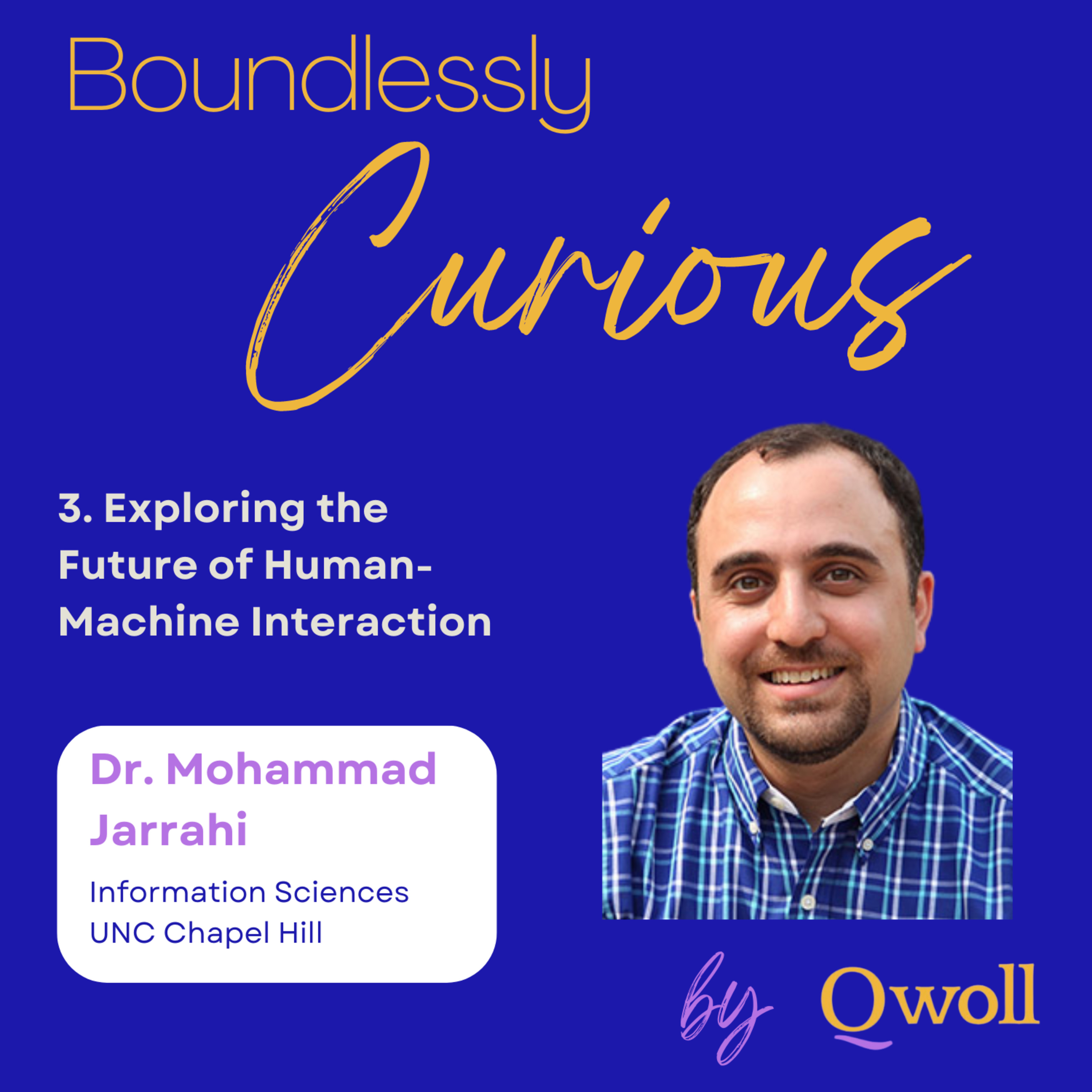
3. Exploring the Future of Human-Machine Interaction with Dr. Mohammad Jarrahi
from Boundlessly Curious by Qwoll · host Qwoll
Questions explored Why does systems thinking matter? What does the future AI - human relationship look like? Will AI replace or augment human skillsets? Where should I be investing my time and efforts as a 21st century knowledge worker? Summary Introducing Mohammad.. the importance of systems thinking (Min 1-6) In the early 2000s, Mohammad was a software developer but realized he needed a "more holistic understanding of the context” Systems don’t always work or get adopted and it all comes down to how technology interacts with its context of user, organizations and work context - this is called socio-technical behavior. Algorithms are “not neutral” - they redistribute power, so there is a political element to consider Understanding the Human-AI Relationship (Min 7-11) While systems will become “smarter and smarter,” there are specific parts of work which are human centric There is also an augmentation narrative, AI can augment us and we can augment it, in a sense we learn and develop together. We can get better together. Are we experiencing an economic transformation similar to the Industrial Revolution? (Min 12-20) Past experiences can be insightful and helpful for understanding the present.. it’s clear some jobs will be gone and in other cases new ones will be created The term AI has been around since 1956. It’s not a very new concept, but the form has changed. What is interesting is that now algorithms are learning from us, and gaining some tacit knowledge - knowledge which is usually gained though experience We need to change the way we work and we’re going to develop a symbiotic relationship with technology We can’t be fully reliant on algorithms, there’s going to be a ‘human in the loop’ for the foreseeable future (Min 21-35) One issue is the black box problem. As algorithms learn, they often can’t explain why they made a decision a certain way. People need to be held accountable. It’s ok if your Netflix recommendation makes an error, but if something actually fails, are our legal and governmental systems simply going to be OK with “sorry, the algorithm predicted that”? There’s also situations where holistic knowledge is needed: Emergency medicine: there’s lots of edge cases in the ER, you can’t just feed an algorithm Customer service: We’re human, we need and want a human touch. We want to be listened to and empathized with Crisis management: COVID hit, we hadn’t had a pandemic in 100 years, there was no data initially to tell policy makers what to do Executive decision making: we’re given lots of competing and not always quantifiable information. How do we decide which to pursue? How should we be adapting to develop a symbiotic relationship with technology? (Min 36-50) Give up things which are not in our competitive abilities, spelling bees and multiplication tables aren’t so important anymore; focus on where we have a competitive advantage - creativity, critical thinking, ethics, and soft skills. Improve AI literacy - understand the limits of the machine, and the capabilities; systems can ‘hallucinate’... understand that Use technology… you learn from experience, play around with and run tests with Chat GPT or other LLMs Developing socio-technical organizations - organizations where people are working effectively alongside AI systems are going to have the greatest advantages. Learning, development, and the future, how does it look? (Min 51-61) Emotional intelligence is critical If history provides us any lessons it’s that some of the highest payed jobs weren’t necessarily resilient to automation. We should be cautiously optimistic about the future: we’re bound to be liberated from mundane tasks, but at the same time we are just seeing the tip of the iceberg, there’s bound to be workplace change and emergent needs to re-skill
NOW PLAYING
3. Exploring the Future of Human-Machine Interaction with Dr. Mohammad Jarrahi
No transcript for this episode yet
Similar Episodes
Mar 26, 2026 ·1m
Jan 2, 2026 ·47m
Dec 21, 2025 ·46m