
EPISODE · Mar 2, 2026 · 22 MIN
305: Human cis-regulatory variants dissected by MPRA at single-nucleotide resolution
from Base by Base · host Gustavo Barra
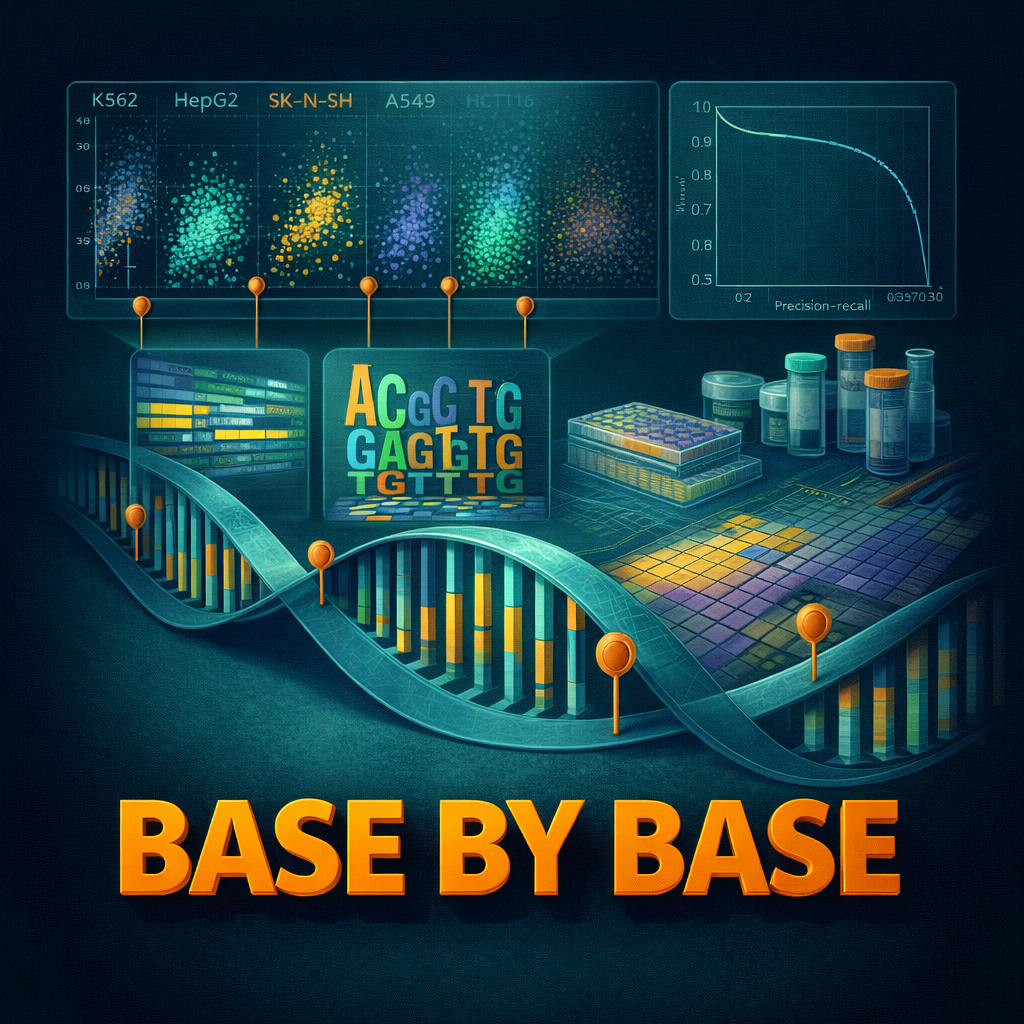
Siraj L et al., Nature, doi:10.1038/s41586-026-10121-6 - Using MPRA in five human cell types, the authors assayed 221,412 fine-mapped variants and identified 13,121 trait-associated regulatory variants (TARVs), mapping mechanisms at single-nucleotide resolution. Key terms: massively parallel reporter assay, trait-associated regulatory variants, saturation mutagenesis, transcription factor motifs, regulatory epistasis. Study Highlights:The study assayed 221,412 fine-mapped human GWAS and eQTL variants using a massively parallel reporter assay (MPRA) across five cell lines and performed saturation mutagenesis on 136 TARVs. MPRA identified 13,121 trait-associated regulatory variants (TARVs) and showed that emVar status within endogenous CREs improves precision for causal-variant prioritization. Saturation mutagenesis defined activity blocks, assigned transcription factors for 91% of previously non-canonical TARVs, and revealed that only 69% of TARVs disrupt known TF motifs. The authors also detected regulatory epistasis in ~11% of nearby variant pairs, demonstrating non-additive effects between cis variants. Conclusion:Large-scale MPRA combined with saturation mutagenesis systematically identifies and mechanistically annotates thousands of human trait-associated regulatory variants at single-nucleotide resolution, revealing motif-disrupting and non-canonical TF mechanisms and local epistasis. Music:Enjoy the music based on this article at the end of the episode. Article title:Functional dissection of complex trait variants at single-nucleotide resolution First author:Siraj L Journal:Nature, doi:10.1038/s41586-026-10121-6 DOI:10.1038/s41586-026-10121-6 Reference:Siraj L., Castro R.I., Dewey H.B., Kales S., Butts J.C., Nguyen T.T.L., Kanai M., et al. Functional dissection of complex trait variants at single-nucleotide resolution. Nature. https://doi.org/10.1038/s41586-026-10121-6 License:This episode is based on an open-access article published under the Creative Commons Attribution 4.0 International License (CC BY 4.0) - https://creativecommons.org/licenses/by/4.0/ Support:Base by Base – Stripe donations: https://donate.stripe.com/7sY4gz71B2sN3RWac5gEg00 Official website https://basebybase.com On PaperCast Base by Base you’ll discover the latest in genomics, functional genomics, structural genomics, and proteomics. Episode link: https://basebybase.com/episodes/mpra-human-regulatory-variants QC:This episode was checked against the original article PDF and publication metadata for the episode release published on 2026-03-02. QC Scope:- article metadata and core scientific claims from the narration- excludes analogies, intro/outro, and music- transcript coverage: Audited the transcript’s coverage of MPRA scale and variant coverage, TARV identification and counts, mechanistic categories (motif disruption and non-canonical mechanisms), saturation mutagenesis mapping, regulatory epistasis, recall/precision metrics, cell-type context, and translational HbA1c example.- transcript topics: MPRA scale and variant coverage; TARV identification and counts; Motif disruption as mechanism; Saturation mutagenesis mapping and activity blocks; Non-canonical TARV mechanisms; Regulatory epistasis in nearby TARV pairs QC Summary:- factual score: 10/10- metadata score: 10/10- supported core claims: 7- claims flagged for review: 0- metadata checks passed: 4- metadata issues found: 0 Metadata Audited:- article_doi- article_title- article_journal- license Factual Items Audited:- MPRA tested 221,412 fine-mapped trait-associated variants- Identified 13,121 TARVs with high precision- 69% of TARVs disrupt known transcription factor motifs- Saturatio...
Embed this episode
NOW PLAYING
305: Human cis-regulatory variants dissected by MPRA at single-nucleotide resolution
No transcript for this episode yet
Similar Episodes
No similar episodes found.
Similar Podcasts
No similar podcasts found.