
EPISODE · May 9, 2026 · 18 MIN
362: D614G Reshapes Spike Allostery and Speeds RBD Opening
from Base by Base · host Gustavo Barra
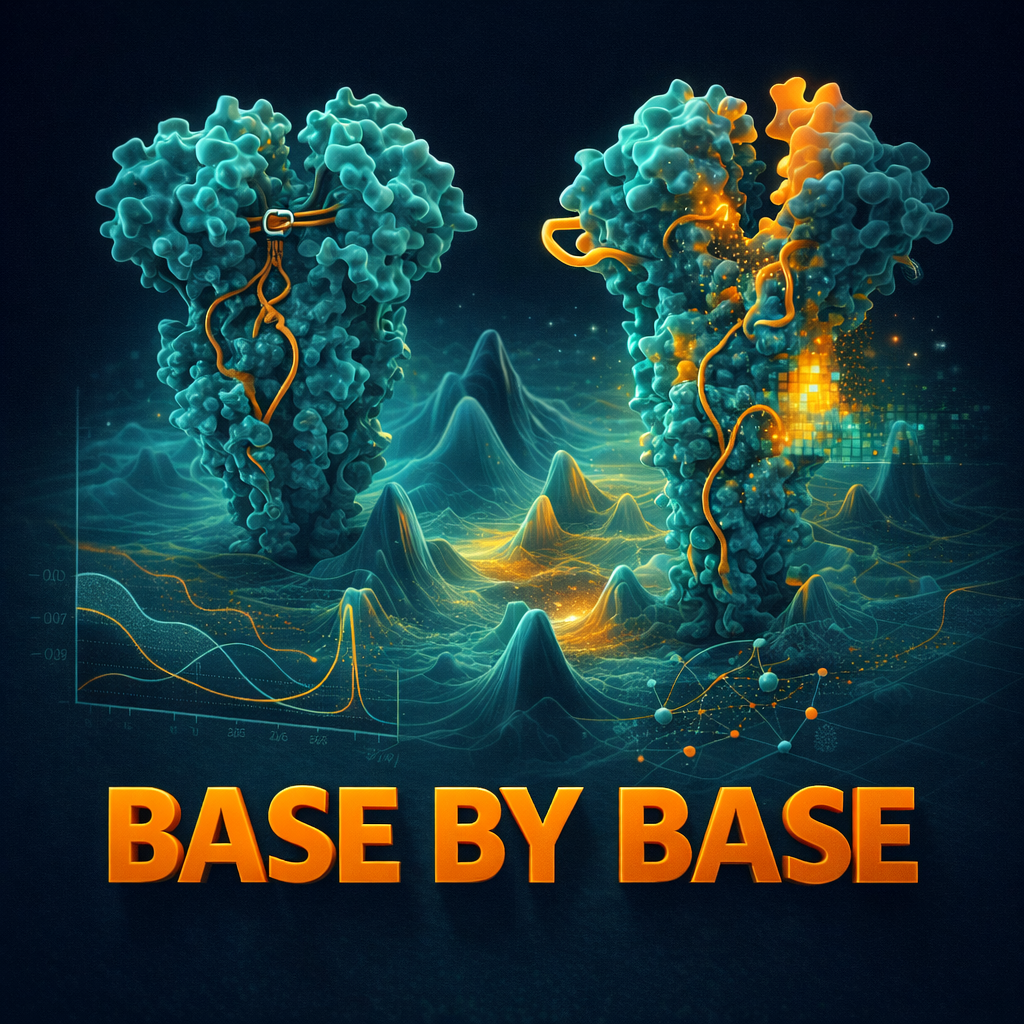
Kearns FL et al., PNAS - Simulations and HDXMS reveal how the D614G substitution alters internal communication in SARS-CoV-2 spike, enabling faster receptor-binding-domain opening through newly engaged allosteric pathways. Key terms: D614G, SARS-CoV-2 spike, RBD opening, allostery, weighted ensemble simulations. Study Highlights:Weighted ensemble simulations of Ancestral, Delta, and Omicron BA.1 spikes show distinct RBD opening landscapes and identify two S1 linkers (N2R and a previously underappreciated antiparallel R2N) that connect the NTD to the RBD. In the Ancestral spike a D614–K854 salt bridge constrains the R2N and must break before RBD opening; D614G abolishes that constraint, increasing local flexibility and enabling communication through both linkers. Delta and Omicron BA.1, both carrying D614G, open faster and use balanced N2R/R2N signaling; Omicron also forms a K856–D568 salt bridge and can adopt a unique “peel” conformation. Hydrogen–deuterium exchange mass spectrometry on VLPs confirms altered dynamics around the 614-proximal region consistent with the simulations. Conclusion:Ablation of the D614–K854 salt bridge by D614G relieves local frustration, opens an additional allosteric lane via the R2N linker alongside N2R, and accelerates RBD opening—providing a mechanistic link between the D614G substitution and increased infectivity; Omicron BA.1 further tunes this network with compensatory interactions. Music:Enjoy the music based on this article at the end of the episode. Article title:D614G reshapes allosteric networks and opening mechanisms of SARS - CoV - 2 spikes First author:Kearns FL Journal:PNAS DOI:10.1073/pnas.2504793123 Reference:Kearns FL, Bogetti AT, Calvó-Tusell C, et al. D614G reshapes allosteric networks and opening mechanisms of SARS-CoV-2 spikes. PNAS. 2026;123(19):e2504793123. doi:10.1073/pnas.2504793123 License:This episode is based on an open-access article published under the Creative Commons Attribution 4.0 International License (CC BY 4.0) – https://creativecommons.org/licenses/by/4.0/ Support:Base by Base – Stripe donations: https://donate.stripe.com/7sY4gz71B2sN3RWac5gEg00 Official website https://basebybase.com On PaperCast Base by Base you'll discover the latest in genomics, functional genomics, structural genomics, and proteomics. Episode link: https://basebybase.com/episodes/d614g-reshapes-allosteric-networks QC:This episode was checked against the original article PDF and publication metadata for the episode release published on 2026-05-09. QC Scope:- article metadata and core scientific claims from the narration- excludes analogies, intro/outro, and music- transcript coverage: Audited the spoken content for alignment with the PNAS article's core findings: D614G reshapes spike allostery, dual N2R/R2N pathways, D614-K854 salt-bridge dynamics, Delta/Omicron opening differences, Omicron peel state, and HDXMS corroboration; plus methodological details (WE/MA binning, glycans, and limitations).- transcript topics: D614G impact on RBD opening dynamics; Weighted Ensemble simulations (WE) and minimal adaptive binning (MAB); N2R and R2N flexible linkers as allosteric pathways; D614-K854 salt bridge role and congestion; Variant-specific opening pathways: Delta and Omicron; Omicron BA.1 peel state and K856-D568 salt bridge QC Summary:- factual score: 10/10- metadata score: 10/10- supported core claims: 6- claims flagged for review: 0- metadata checks passed: 4- metadata issues found: 0 Metadata Audited:- article_doi- article_title- article_journal- license Factual Items Audited:- D614G abolishes the D614-K854 salt bridge, increasing local flexibility and accelerating RBD opening via dual N2R and R2N l...
Embed this episode
Ready to play
362: D614G Reshapes Spike Allostery and Speeds RBD Opening
No transcript for this episode yet
Similar Episodes
No similar episodes found.
Similar Podcasts
No similar podcasts found.