
EPISODE · Jul 31, 2026 · 25 MIN
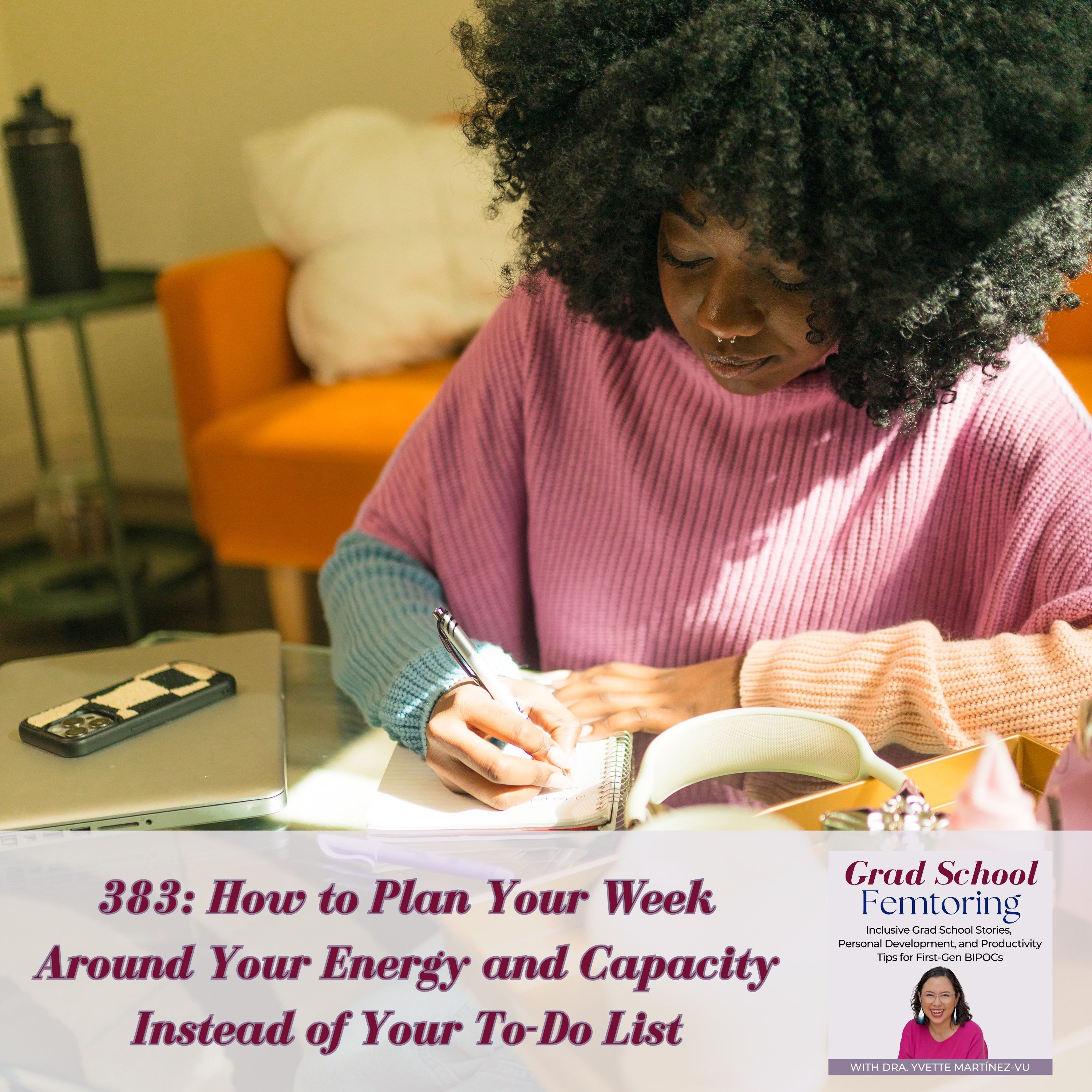
383: How to Plan Your Week Around Your Energy and Capacity Instead of Your To-Do List
from Grad School Femtoring: Inclusive Grad School Stories, Personal Development, and Productivity Tips for First-Gen BIPOCs · host Grad School Femtoring, LLC
In this episode of the Grad School Femtoring podcast, I introduce a different way to think about weekly planning by changing your focus from simply managing your time to understanding your energy and capacity. This episode is for students and professionals who feel like they're constantly falling behind despite having a planner, calendar, or productivity system. Drawing from patterns I see in coaching and my own lived experience, I explain why traditional planning often overlooks the realities of balancing work, caregiving, disability, chronic illness, neurodivergence, and other responsibilities that impact just how much capacity we have in any given week. I explore the differences between time, energy, and capacity and explain why recognizing these distinctions can help you create a more sustainable planning process. I also share a practical framework for planning your week around your current capacity, discuss the planning fallacy and why buffer time matters, and encourage you to reflect on the expectations you've inherited about productivity. My goal is to help you build a planning system that reflects your values, supports your wellbeing, and allows you to make meaningful progress on your goals without constantly measuring yourself against an idealized version of what you think you should be able to accomplish. In this episode, you will learn: How to distinguish between time, energy, and capacity when planning your week. Why traditional planning systems often lead to frustration, guilt, and unrealistic expectations. A capacity-aware planning process for prioritizing meaningful work more sustainably. How to match cognitively demanding tasks to your highest-energy periods. Why buffer time and recovery should be planned intentionally rather than treated as an afterthought. Reflective questions to help you build a planning system that aligns with your current reality and long-term goals. Work with me If you're feeling stuck in graduate school or navigating a major professional transition, I offer one-on-one coaching to help you build sustainable systems, clarify your priorities, and make meaningful progress toward your goals. Learn more about my services here: https://gradschoolfemtoring.com/coaching/ Free resource Download your Grad School Femtoring Resource Kit: https://gradschoolfemtoring.com/kit/ Explore more Listen to more episodes on Sustainable Productivity Strategies: https://gradschoolfemtoring.com/podcast_catergory/sustainable-productivity-strategies/ Support the podcast with a one-time or monthly donation: https://donate.stripe.com/bJedR8dGRcs6ewGdwq38401 Access transcripts and additional resources: https://gradschoolfemtoring.com/podcast/ Audio and transcript edited by Yessi Sanchez: https://www.linkedin.com/in/yessisanchez/ This podcast is a proud member of the Genuina Media network. The Grad School Femtoring Podcast is for educational purposes only and is not a substitute for therapy or other professional services. Hosted by Simplecast, an AdsWizz company. See pcm.adswizz.com for information about our collection and use of personal data for advertising.
Embed this episode
What this episode covers
In this episode of the Grad School Femtoring podcast, I introduce a different way to think about weekly planning by changing your focus from simply managing your time to understanding your energy and capacity. This episode is for students and professionals who feel like they're constantly falling behind despite having a planner, calendar, or productivity system. Drawing from patterns I see in coaching and my own lived experience, I explain why traditional planning often overlooks the realities of balancing work, caregiving, disability, chronic illness, neurodivergence, and other responsibilities that impact just how much capacity we have in any given week. I explore the differences between time, energy, and capacity and explain why recognizing these distinctions can help you create a more sustainable planning process. I also share a practical framework for planning your week around your current capacity, discuss the planning fallacy and why buffer time matters, and encourage you to reflect on the expectations you've inherited about productivity. My goal is to help you build a planning system that reflects your values, supports your wellbeing, and allows you to make meaningful progress on your goals without constantly measuring yourself against an idealized version of what you think you should be able to accomplish.
Ready to play
383: How to Plan Your Week Around Your Energy and Capacity Instead of Your To-Do List
No transcript for this episode yet
Similar Episodes
Similar Podcasts
No similar podcasts found.