
EPISODE · Sep 28, 2025 · 53 MIN
3I/ATLAS Update: JWST Reveals Its Composition | with Martin Cordiner
from John Michael Godier's Event Horizon · host John Michael Godier
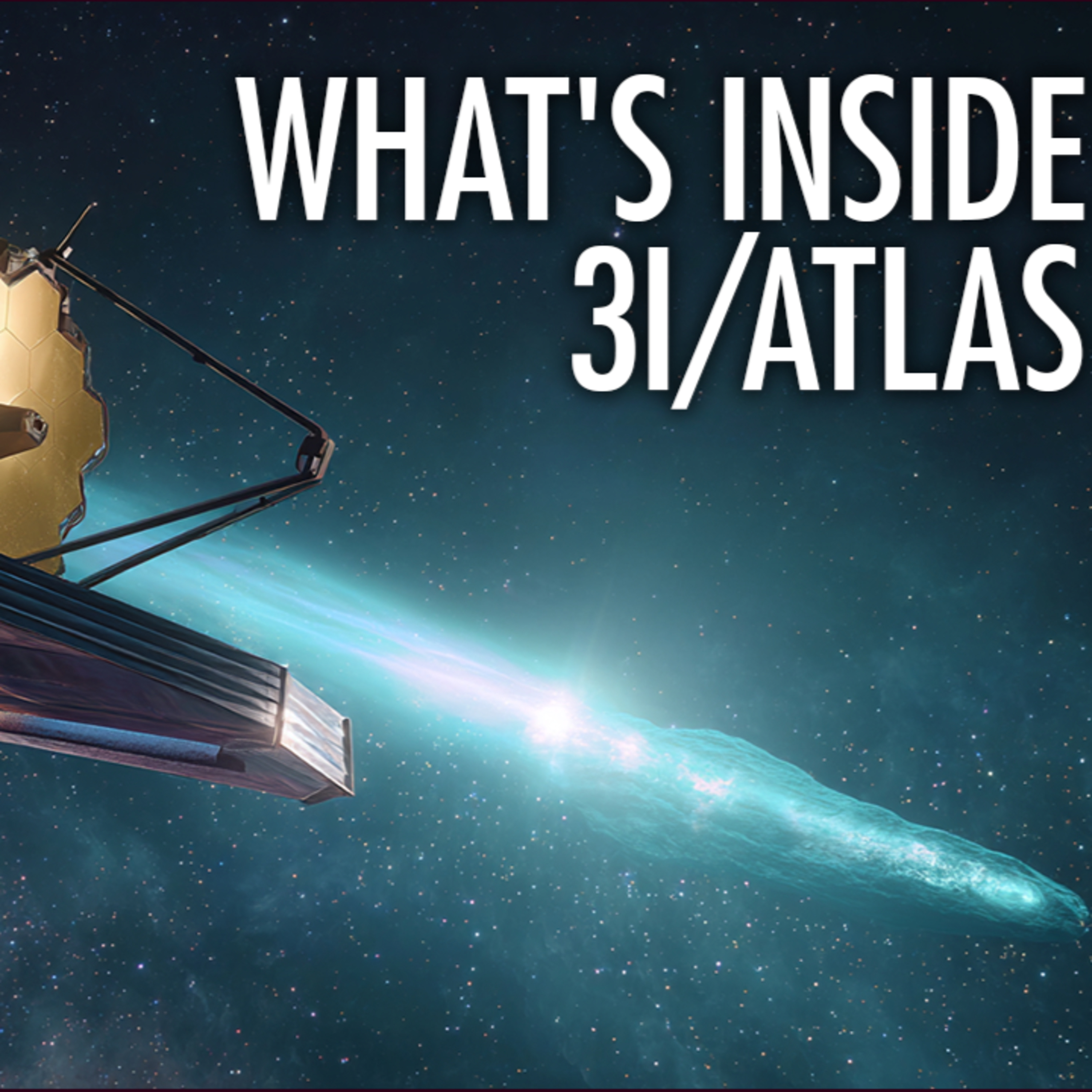
3I/ATLAS is the third known interstellar object to pass through our solar system, and the James Webb Space Telescope has now revealed details on it's chemistry and composition. Using Webb’s powerful infrared instruments, scientists detected the molecules and ices in its coma and tail, offering the most detailed look yet at the chemistry of an interstellar comet.In this interview, John Michael Godier speaks with NASA astrophysicist Martin Cordiner, lead author of the JWST study on 3I/ATLAS. They explore how Webb captured its spectrum, what was found in the outgassing material, and how this discovery compares with ‘Oumuamua and Borisov, the first two interstellar visitors. Could 3I/ATLAS be a relic from the galaxy’s “cosmic noon” billions of years ago, preserving the raw materials of planetary formation?By studying 3I/ATLAS, researchers hope to uncover clues about the origins of planets, the chemistry of other star systems, and the building blocks that may shape life across the Milky Way.Cordiner, Martin A., Nathaniel X. Roth, Michael S. P. Kelley, Dennis Bodewits, Steven B. Charnley, Maria N. Drozdovskaya, Davide Farnocchia, Marco Micheli, Stefanie N. Milam, Cyrielle Opitom, Megan E. Schwamb, & Cristina A. Thomas (2025). JWST detection of a carbon dioxide dominated gas coma surrounding interstellar object 3I/ATLAShttps://arxiv.org/abs/2508.1820900:00 – Introduction02:15 – What makes 3I/ATLAS unique among interstellar objects07:40 – How JWST was able to capture its spectrum14:20 – A carbon dioxide–dominated coma and what it means20:55 – Dust, ices, and the surprising chemistry of 3I/ATLAS27:10 – Comparing 3I/ATLAS with ‘Oumuamua and Borisov34:50 – A relic of “cosmic noon” and planetary formation42:30 – What interstellar comets teach us about habitability50:05 – Future missions and how spacecraft could study 3I/ATLAS56:30 – Final thoughts on interstellar visitors and what comes nextYouTube Membership: https://www.youtube.com/channel/UCz3qvETKooktNgCvvheuQDw/joinPodcast: hhttps://creators.spotify.com/pod/show/john-michael-godier/subscribeApple: https://apple.co/3CS7rjTMore JMG https://www.youtube.com/c/JohnMichaelGodierWant to support the channel?Patreon: https://www.patreon.com/EventHorizonShowFollow us at other places!@JMGEventHorizonMusic:https://stellardrone.bandcamp.com/https://migueljohnson.bandcamp.com/https://leerosevere.bandcamp.com/https://aeriumambient.bandcamp.com/FOOTAGE:NASAESA/HubbleESO - M.KornmesserESO - L.CalcadaESO - Jose Francisco Salgado (josefrancisco.org)NAOJUniversity of WarwickGoddard Visualization StudioLangley Research CenterPixabay
Embed this episode
NOW PLAYING
3I/ATLAS Update: JWST Reveals Its Composition | with Martin Cordiner
No transcript for this episode yet
Similar Episodes
No similar episodes found.
Similar Podcasts
No similar podcasts found.