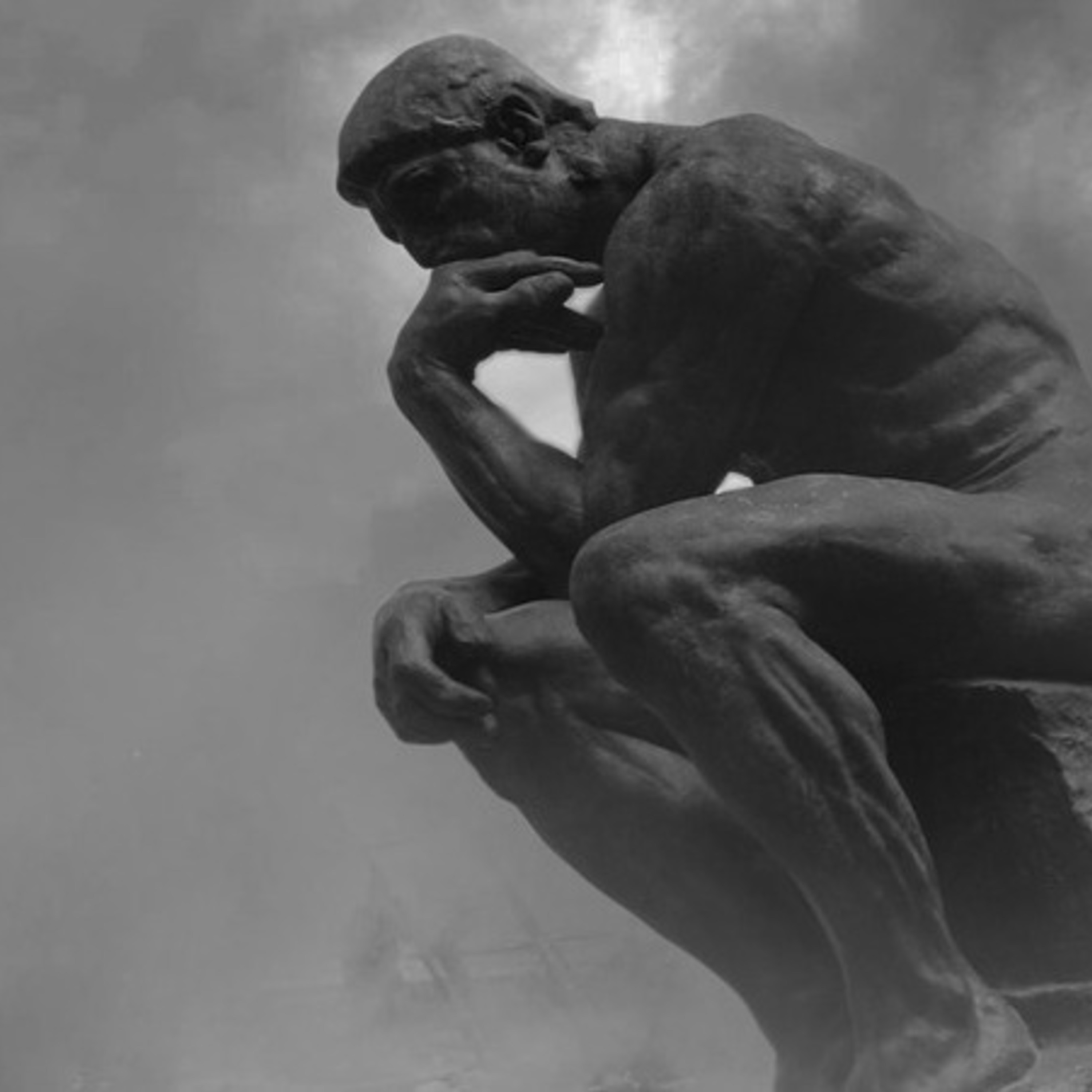
#48 (C&R Chap. 18) - Utopia and Violence episode artwork

EPISODE · Feb 24, 2023 · 1H

#48 (C&R Chap. 18) - Utopia and Violence

from Increments · host Ben Chugg and Vaden Masrani

You may, perchance, have noticed that the sweeping utopian movements of the past did not end well. And most of them involved an horrific amount of violence. Is this connection just chance, or is there something inherent to utopian thinking which leads to violent ends? We turn to Chapter 18 of Conjectures and Refutations where Popper gives us his spicy take. We discuss How do you "see" your early memories? Vaden corrects the record on a few points Rationality grounded in humility versus goal-oriented rationality If ends can be decided rationally How and if goal-oriented rationality leads to violence Working to reduce concrete evils versus working to achieve abstract goods ** Link to chapter **: https://sci-hub.ru/https://www.jstor.org/stable/20672078 Quotes A rationalist, as I use the word, is a man who attempts to reach decisions by argument and perhaps, in certain cases, by compromise, rather than by violence. He is a man who would rather be unsuccessful in convincing another man by argument than successful in crushing him by force, by intimidation and threats, or even by persuasive propaganda. Pg. 478 I believe that we can avoid violence only in so far as we practise this attitude of reasonableness when dealing with one another in social life; and that any other attitude is likely to produce violence—even a one-sided attempt to deal with others by gentle persuasion, and to convince them by argument and example of those insights we are proud of possessing, and of whose truth we are absolutely certain. We all remember how many religious wars were fought for a religion of love and gentleness; how many bodies were burned alive with the genuinely kind intention of saving souls from the eternal fire of hell. Only if we give up our authoritarian attitude in the realm of opinion, only if we establish the attitude of give and take, of readiness to learn from other people, can we hope to control acts of violence inspired by piety and duty. Pg. 479 In the latter case political action will be rational only if we first determine the final ends of the political changes which we intend to bring about. It will be rational only relative to certain ideas of what a state ought to be like. Thus it appears that as a preliminary to any rational political action we must first attempt to become as clear as possible about our ultimate political ends; for example the kind of state which we should consider the best; and only afterwards can we begin to determine the means which may best help us to realize this state, or to move slowly towards it, taking it as the aim of a historical process which we may to some extent influence and steer towards the goal selected. Now it is precisely this view which I call Utopianism. Any rational and non-selfish political action, on this view, must be preceded by a determination of our ultimate ends, not merely of intermediate or partial aims which are only steps towards our ultimate end, and which therefore should be considered as means rather than as ends; therefore rational political action must be based upon a more or less clear and detailed description or blueprint of our ideal state, and also upon a plan or blueprint of the historical path that leads towards this goal. Pg. 481-482 The Utopian method, which chooses an ideal state of society as the aim which all our political actions should serve, is likely to produce violence can be shown thus. Since we cannot determine the ultimate ends of political actions scientifically, or by purely rational methods, differences of opinion concerning what the ideal state should be like cannot always be smoothed out by the method of argument. They will at least partly have the character of religious differences. And there can hardly be tolerance between these different Utopian religions. Utopian aims are designed to serve as a basis for rational political action and discussion, and such action appears to be possible only if the aim is definitely decided upon. Thus the Utopianist must win over, or else crush, his Utopianist competitors who do not share his own Utopian aims and who do not profess his own Utopianist religion. Pg. 483 Work for the elimination of concrete evils rather than for the realization of abstract goods. Do not aim at establishing happiness by political means. Rather aim at the elimination of concrete miseries. Or, in more practical terms: fight for the elimination of poverty by direct means—for example, by making sure that everybody has a minimum income. Or fight against epidemics and disease by erecting hospitals and schools of medicine. Fight illiteracy as you fight criminality. But do all this by direct means. Choose what you consider the most urgent evil of the society in which you live, and try patiently to convince people that we can get rid of it. Pg. 485 But do not try to realize these aims indirectly by designing and working for a distant ideal of a society which is wholly good. However deeply you may feel indebted to its inspiring vision, do not think that you are obliged to work for its realization, or that it is your mission to open the eyes of others to its beauty. Do not allow your dreams of a beautiful world to lure you away from the claims of men who suffer here and now. Our fellow men have a claim to our help; no generation must be sacrificed for the sake of future generations, for the sake of an ideal of happiness that may never be realized. In brief, it is my thesis that human misery is the most urgent problem of a rational public policy and that happiness is not such a problem. The attainment of happiness should be left to our private endeavours. Pg. 485 It is a fact, and not a very strange fact, that it is not so very difficult to reach agreement by discussion on what are the most intolerable evils of our society, and on what are the most urgent social reforms. Such an agreement can be reached much more easily than an agreement concerning some ideal form of social life. For the evils are with us here and now. They can be experienced, and are being experienced every day, by many people who have been and are being made miserable by poverty, unemployment, national oppression, war and disease. Those of us who do not suffer from these miseries meet every day others who can describe them to us. This is what makes the evils concrete. This is why we can get somewhere in arguing about them; why we can profit here from the attitude of reasonableness. We can learn by listening to concrete claims, by patiently trying to assess them as impartially as we can, and by considering ways of meeting them without creating worse evils Pg. 485 I believe that it is quite true that we can judge the rationality of an action only in relation to some aims or ends. But this does not necessarily mean that the rationality of a political action can be judged only in relation to an _historical end._ Pg. 486 The appeal of Utopianism arises from the failure to realize that we cannot make heaven on earth. What I believe we can do instead is to make life a little less terrible and a little less unjust in each generation. A good deal can be achieved in this way. Much has been achieved in the last hundred years. More could be achieved by our own generation. There are many pressing problems which we might solve, at least partially, such as helping the weak and the sick, and those who suffer under oppression and injustice; stamping out unemployment; equalizing opportunities; and preventing international crime, such as blackmail and war instigated by men like gods, by omnipotent and omniscient leaders. All this we might achieve if only we could give up dreaming about distant ideals and fighting over our Utopian blueprints for a new world and a new man. Pg. 487 ** References ** EA Forum post showing data on forecasting accuracy across different time horizons: https://forum.effectivealtruism.org/posts/hqkyaHLQhzuREcXSX/data-on-forecasting-accuracy-across-different-time-horizons#Calibrations Vox article talking about PELTIV's: https://www.vox.com/future-perfect/23569519/effective-altrusim-sam-bankman-fried-will-macaskill-ea-risk-decentralization-philanthropy Contact us Follow us on Twitter at @IncrementsPod, @BennyChugg, @VadenMasrani Check us out on youtube at https://www.youtube.com/channel/UC_4wZzQyoW4s4ZuE4FY9DQQ Come join our discord server! DM us on twitter or send us an email to get a supersecret link Do you see your sweeping utopian blueprints in first person or third person? Send these blueprints over to [email protected] Image credit: Engin_Akyurt

You may, perchance, have noticed that the sweeping utopian movements of the past did not end well. And most of them involved an horrific amount of violence. Is this connection just chance, or is there something inherent to utopian thinking which leads to violent ends? We turn to Chapter 18 of Conjectures and Refutations where Popper gives us his spicy take. We discuss How do you "see" your early memories? Vaden corrects the record on a few points Rationality grounded in humility versus goal-oriented rationality If ends can be decided rationally How and if goal-oriented rationality leads to violence Working to reduce concrete evils versus working to achieve abstract goods ** Link to chapter **: https://sci-hub.ru/https://www.jstor.org/stable/20672078 Quotes A rationalist, as I use the word, is a man who attempts to reach decisions by argument and perhaps, in certain cases, by compromise, rather than by violence. He is a man who would rather be unsuccessful in convincing another man by argument than successful in crushing him by force, by intimidation and threats, or even by persuasive propaganda. Pg. 478 I believe that we can avoid violence only in so far as we practise this attitude of reasonableness when dealing with one another in social life; and that any other attitude is likely to produce violence—even a one-sided attempt to deal with others by gentle persuasion, and to convince them by argument and example of those insights we are proud of possessing, and of whose truth we are absolutely certain. We all remember how many religious wars were fought for a religion of love and gentleness; how many bodies were burned alive with the genuinely kind intention of saving souls from the eternal fire of hell. Only if we give up our authoritarian attitude in the realm of opinion, only if we establish the attitude of give and take, of readiness to learn from other people, can we hope to control acts of violence inspired by piety and duty. Pg. 479 In the latter case political action will be rational only if we first determine the final ends of the political changes which we intend to bring about. It will be rational only relative to certain ideas of what a state ought to be like. Thus it appears that as a preliminary to any rational political action we must first attempt to become as clear as possible about our ultimate political ends; for example the kind of state which we should consider the best; and only afterwards can we begin to determine the means which may best help us to realize this state, or to move slowly towards it, taking it as the aim of a historical process which we may to some extent influence and steer towards the goal selected. Now it is precisely this view which I call Utopianism. Any rational and non-selfish political action, on this view, must be preceded by a determination of our ultimate ends, not merely of intermediate or partial aims which are only steps towards our ultimate end, and which therefore should be considered as means rather than as ends; therefore rational political action must be based upon a more or less clear and detailed description or blueprint of our ideal state, and also upon a plan or blueprint of the historical path that leads towards this goal. Pg. 481-482 The Utopian method, which chooses an ideal state of society as the aim which all our political actions should serve, is likely to produce violence can be shown thus. Since we cannot determine the ultimate ends of political actions scientifically, or by purely rational methods, differences of opinion concerning what the ideal state should be like cannot always be smoothed out by the method of argument. They will at least partly have the character of religious differences. And there can hardly be tolerance between these different Utopian religions. Utopian aims are designed to serve as a basis for rational political action and discussion, and such action appears to be possible only if the aim is definitely decided upon. Thus the Utopianist must win over, or else crush, his Utopianist competitors who do not share his own Utopian aims and who do not profess his own Utopianist religion. Pg. 483 Work for the elimination of concrete evils rather than for the realization of abstract goods. Do not aim at establishing happiness by political means. Rather aim at the elimination of concrete miseries. Or, in more practical terms: fight for the elimination of poverty by direct means—for example, by making sure that everybody has a minimum income. Or fight against epidemics and disease by erecting hospitals and schools of medicine. Fight illiteracy as you fight criminality. But do all this by direct means. Choose what you consider the most urgent evil of the society in which you live, and try patiently to convince people that we can get rid of it. Pg. 485 But do not try to realize these aims indirectly by designing and working for a distant ideal of a society which is wholly good. However deeply you may feel indebted to its inspiring vision, do not think that you are obliged to work for its realization, or that it is your mission to open the eyes of others to its beauty. Do not allow your dreams of a beautiful world to lure you away from the claims of men who suffer here and now. Our fellow men have a claim to our help; no generation must be sacrificed for the sake of future generations, for the sake of an ideal of happiness that may never be realized. In brief, it is my thesis that human misery is the most urgent problem of a rational public policy and that happiness is not such a problem. The attainment of happiness should be left to our private endeavours. Pg. 485 It is a fact, and not a very strange fact, that it is not so very difficult to reach agreement by discussion on what are the most intolerable evils of our society, and on what are the most urgent social reforms. Such an agreement can be reached much more easily than an agreement concerning some ideal form of social life. For the evils are with us here and now. They can be experienced, and are being experienced every day, by many people who have been and are being made miserable by poverty, unemployment, national oppression, war and disease. Those of us who do not suffer from these miseries meet every day others who can describe them to us. This is what makes the evils concrete. This is why we can get somewhere in arguing about them; why we can profit here from the attitude of reasonableness. We can learn by listening to concrete claims, by patiently trying to assess them as impartially as we can, and by considering ways of meeting them without creating worse evils Pg. 485 I believe that it is quite true that we can judge the rationality of an action only in relation to some aims or ends. But this does not necessarily mean that the rationality of a political action can be judged only in relation to an _historical end._ Pg. 486 The appeal of Utopianism arises from the failure to realize that we cannot make heaven on earth. What I believe we can do instead is to make life a little less terrible and a little less unjust in each generation. A good deal can be achieved in this way. Much has been achieved in the last hundred years. More could be achieved by our own generation. There are many pressing problems which we might solve, at least partially, such as helping the weak and the sick, and those who suffer under oppression and injustice; stamping out unemployment; equalizing opportunities; and preventing international crime, such as blackmail and war instigated by men like gods, by omnipotent and omniscient leaders. All this we might achieve if only we could give up dreaming about distant ideals and fighting over our Utopian blueprints for a new world and a new man. Pg. 487 ** References ** EA Forum post showing data on forecasting accuracy across different time horizons: https://forum.effectivealtruism.org/posts/hqkyaHLQhzuREcXSX/data-on-forecasting-accuracy-across-different-time-horizons#Calibrations Vox article talking about PELTIV's: https://www.vox.com/future-perfect/23569519/effective-altrusim-sam-bankman-fried-will-macaskill-ea-risk-decentralization-philanthropy Contact us Follow us on Twitter at @IncrementsPod, @BennyChugg, @VadenMasrani Check us out on youtube at https://www.youtube.com/channel/UC_4wZzQyoW4s4ZuE4FY9DQQ Come join our discord server! DM us on twitter or send us an email to get a supersecret link Do you see your sweeping utopian blueprints in first person or third person? Send these blueprints over to [email protected] Image credit: Engin_AkyurtSupport Increments

NOW PLAYING

#48 (C&R Chap. 18) - Utopia and Violence

0:00 1:00:41

No transcript for this episode yet

We transcribe on demand. Request one and we'll notify you when it's ready — usually under 10 minutes.

Bible Read Me Charles Van Deursen Most people may have never read the Holy Bible from cover to cover for several good reasons. A couple of hinderances might be that the texts reflect an ancient culture and that much of it is not in chronological order. Here you will enjoy listening to a summary of daily portions of Scripture grouped in one week increments, chosen in the order that they occurred in history. By this time next year you will have gained a better understanding of the big picture of the Bible narrative as well as intriguing details that will help you to connect the events of ancient days with the life that you are now living. Just as wise King Solomon wrote, "There is nothing new under the sun," but many times it can be difficult to find the time to dig out and apply these nuggets of golden truth to your daily life.Charles Van Deursen presents the Scripture summaries in a literal, grammatical-historical context while using the language in the way that Christian Women’s Weight Loss | Faith, Food, Fitness Ondrea Lynn - Certified Personal Trainer and Nutrition Coach for Christian Women Are you tired of fighting the scale 24/7? Are you sick of fad diets that only get you temporary results? Do you wish you had an easy plan to follow so you don’t have to stress out about how to lose weight? Are you looking for a simple foundational weight loss framework that can fit into your busy day so it becomes a lifestyle? Do you wish you could workout in 15-minute increments instead of hours at the gym? Do you wish you have an exercise plan that gets you results while working out at home? Are you looking for ways to naturally speed up your metabolism? Do you want your pizza and spinach too? Are you ready to break free from binge eating, over eating, and sugar addiction? Are you ready to be free from past trauma and hurts that drive you to sabotage? Do you desire a stronger relationship with Jesus, even on your weight loss journey but unsure how that looks? Hey, I’m Ondrea Lynn and I’m so excited that you are here with me on Christian Women Weight Loss! I remember what Increments with Alishah Novin Alishah Novin Increments is a show for technologists about leveraging the in-between moments. Those moments you come up for air, and take a beat.They say music is about the space between the notes, and just like music - growth happens in those moments between projects. Increments won't always give you answers, but will create the space for you to find them Siblinghood of Recovery Angie Reno When I found out my son was deep in the throes of Substance Use Disorder (SUD), chaos became the norm. As each step became more challenging, the information on SUDs, treatment, healing, and basically everything that comes with an SUD Family crisis, became overwhelming. Inundated with so much information, I felt like I had crossed space and time and landed in a new world. I actually had: I had entered the world of Recovery. My goal through this Podcast is to condense what I learned into small increments, and provide anyone willing to listen a message of hope. The world of Recovery is filled with parents, children, and family members who walk together. We share what we learn, listen with heart, and provide a community of support. We are a Siblinghood of Recovery.

Frequently Asked Questions

How long is this episode of Increments?

This episode is 1 hour and 0 minutes long.

When was this Increments episode published?

This episode was published on February 24, 2023.

What is this episode about?

You may, perchance, have noticed that the sweeping utopian movements of the past did not end well. And most of them involved an horrific amount of violence. Is this connection just chance, or is there something inherent to utopian thinking which...

Can I download this Increments episode?

Yes, you can download this episode by clicking the download button on the episode player, or subscribe to the podcast in your preferred podcast app for automatic downloads.
URL copied to clipboard!