#92 India's Marathon 🎧
from Anticipating the Unintended Hosted by Pranay Kotasthane
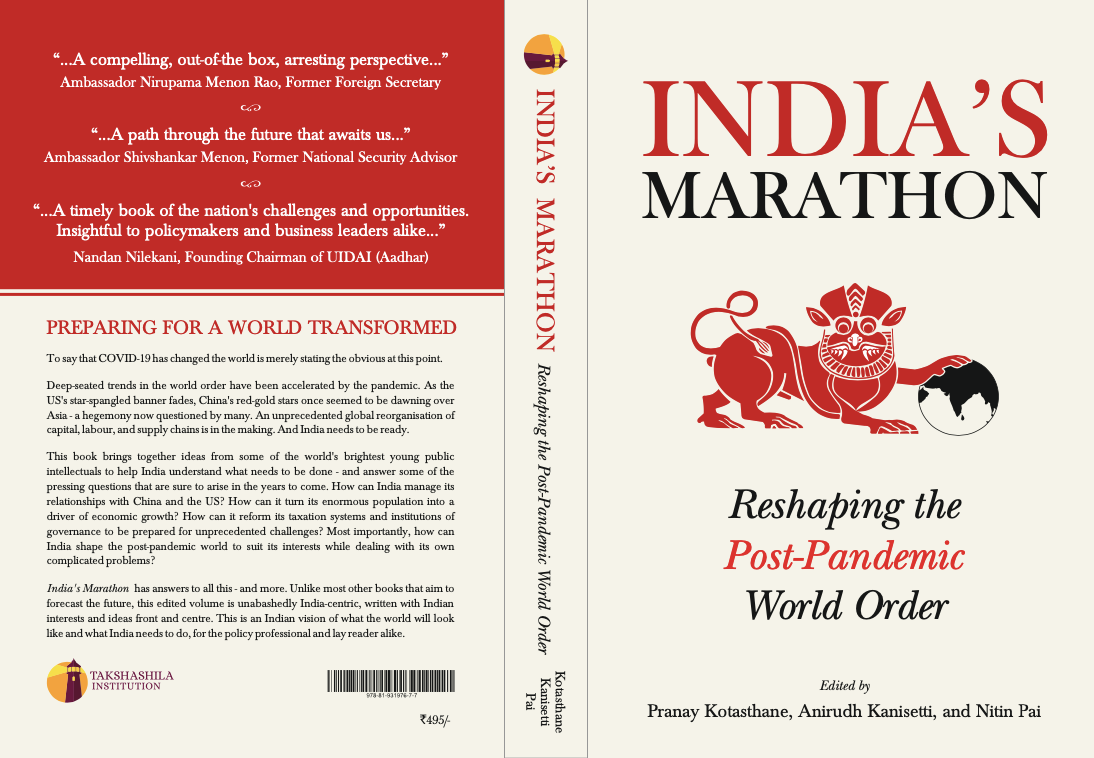
This newsletter is really a weekly public policy thought-letter. While excellent newsletters on specific themes within public policy already exist, this thought-letter is about frameworks, mental models, and key ideas that will hopefully help you think about any public policy problem in imaginative ways. It seeks to answer just one question: how do I think about a particular public policy problem/solution? PS: If you enjoy listening instead of reading, we have this edition available as an audio narration courtesy the good folks at Ad-Auris. If you have any feedback, please send it to us. New Book Out! — India’s Marathon: Reshaping the Post-Pandemic World Order — Pranay Kotasthane I’ve co-edited India’s Marathon — a collaborative effort that brings together bold ideas on India’s place in the changing world order from some of India’s finest young thinkers. (India’s Marathon, book cover by Anirudh Kanisetti) Don’t take my word for it. This is what Ambassador Shivshankar Menon writes in his foreword: “This volume poses questions which everyone wants answered but few dare to reply: how will the world order evolve and how can India deal with it? The Takshashila Institution has brought together some of the best minds to answer this question, and to give an Indian perspective on world order issues. Just for this the book deserves to be welcomed. This volume consists of coherent contributions from these scholars covering how India should manage its external relationships and the reforms that India needs to undertake domestically. … No reader would or should agree with everything in this book. I, for one, am not sure that India’s choice is between alignment and non-alignment any more, or that strategic autonomy is an unattainable goal for India. After all, strategic autonomy by one name or another is what all powers, even superpowers, seek. But this book would have served its purpose if it provokes thought and rational discussion about India’s place in the emerging world, whether it is ‘orderly’ or not. Despite the daunting world that seems likely, and the scale and scope of the necessary domestic reforms outlined in this book, I found it reassuring that so many contributors found it possible to rationally conceptualise these issues from an Indian perspective, and to map out a path through the dimly sensed future that awaits us.” Pranay Kotasthane, Anirudh Kanisetti, Nitin Pai (editors). India's Marathon (Kindle Locations 144-150). The Takshashila Institution. Kindle Edition. This Twitter thread lists all chapter ideas and contributors. It’s a stellar list, I tell you. Get your copy from Amazon India. Do give it a read! Global Policy Watch: Fukuyama (et al) And The ‘Middleware’ Solution To Social Media Monopolies — RSJ Twitter India did a first last week. It labelled a tweet by BJP IT cell head as ‘manipulated media’. It claimed the label was based on its Synthetic and Manipulated Media policy. This was a policy launched by it in February this year. The rule for its user states: “You may not deceptively share synthetic or manipulated media that are likely to cause harm. In addition, we may label Tweets containing synthetic and manipulated media to help people understand their authenticity and to provide context.” Curbing Digital Colonialism It is unclear if Twitter found no such tweets in India since February that satisfied the criteria for manipulate media. Surely, this wasn’t the first instance of false information shared by a blue-tick user in India. In any case, a beginning has been made and it will be interesting to see where and how far it will go with this. These steps are part of similar efforts by other social medial platforms to self-regulate themselves as they come under increasing government and regulatory scrutiny. There is a greater urgency among regulators around the world to curb the abuse of the dominant positions of the big tech platforms. EU pursued antitrust charges against Google for over a decade. In 2018, it fined it nearly $10 billion. But not much has come out of it. Google was left to devise its own measures to offer a level playing field to its rivals. Google continues to dominate the search-engine market in Europe with over 90 per cent market share. The U.S. Justice Department last month sued Google for violating federal antitrust laws in running its search and advertising business. Also, the US Congressional investigation into the power of Big Tech (Amazon, Apple, Facebook and Google) concluded in September this year with a voluminous 450-page report. The report indicts them in no uncertain terms: "These firms have too much power, and that power must be reined in and subject to appropriate oversight and enforcement. Our economy and democracy are at stake.” India hasn’t yet taken a concrete view about the dominance of Big Tech but there are rumblings. Last month, India’s antitrust regulator (CCI) opened an investigation against Google based on complaints from the start-up ecosystem. The practices of ‘forcing’ the app makers to exclusively use its billing system for in-app purchases and for bundling its payments app with Android smartphones sold in the country are under the regulatory lens. Last month, India brought all OTT platforms under the purview of its Information and Broadcasting ministry by changing the GoI (Allocation of Business) Roles, 1961. And it has been considering regulating the social media platforms and their content for a while now. Not The Usual Lens There are three key points that we have made about regulating Big Tech and social media platforms: * Antitrust regulators take the old Chicago school view to monopolies. This looks at monopolies through the economic lens of consumers and checks if they are being harmed by the dominance of monopolies. This is difficult to prove in case of Big Tech monopolies who provide most of their services for free and have deep customer loyalty. * The nature of these monopolies is quite different from those of the past. These players have appropriated huge amounts of data, run 2-sided platforms, have asymmetrical knowledge and power over their users, and can easily move into newer businesses based on these strengths. The traditional measures to curb the monopolies like breaking them up or stopping a line of business are difficult to implement. * Economic dominance is only one part of their power. It is the political dominance or the dominance of thought that can be more insidious. Like we wrote in edition #74, “the data and attention appropriation done through these platforms constrain our choices: we live in echo chamber of our opinions, we buy things that are suggested to us and we see a version of reality that’s tailor-made for us and that no one else is seeing. Often the term ‘digital colonialism’ is bandied about when talking about Big Tech. This lack of freedom to be oneself, discover things on our own and not be dispossessed of our right to choose is what colonialism is about.” * The current antitrust laws have nothing to manage this. In short, our view was the minimum acceptable price of Big Tech businesses to exist wasn’t zero. It was you. Your data and your liberty. In the normal course of events, politics would be about contestation of ideas and narratives in the political marketplace. And the best or the most acceptable idea would surface from this that would guide the polity. But social media platforms engineer a failure in these markets. The ideas that get pushed to your timelines haven’t won their duels in the marketplace of ideas. They have been programmatically fed to you. That program can be gamed. And Big Tech isn’t willing to solve this problem on its own. It took a long time to even acknowledge it is a problem. We had concluded edition #74 with these lines: “These are early days of policymaking in this area. There’s a need for deeper philosophical and sociological work in this space that will enable our thinking in how to legislate this.” A Novel But Half-formed Approach As if on cue … This is a public episode. If you would like to discuss this with other subscribers or get access to bonus episodes, visit publicpolicy.substack.com
Embed this episode
No transcript yet.