
EPISODE · Oct 14, 2026 · 24 MIN
A Journey through Enchanted Thresholds
from Someday Farm · host ShhDragon
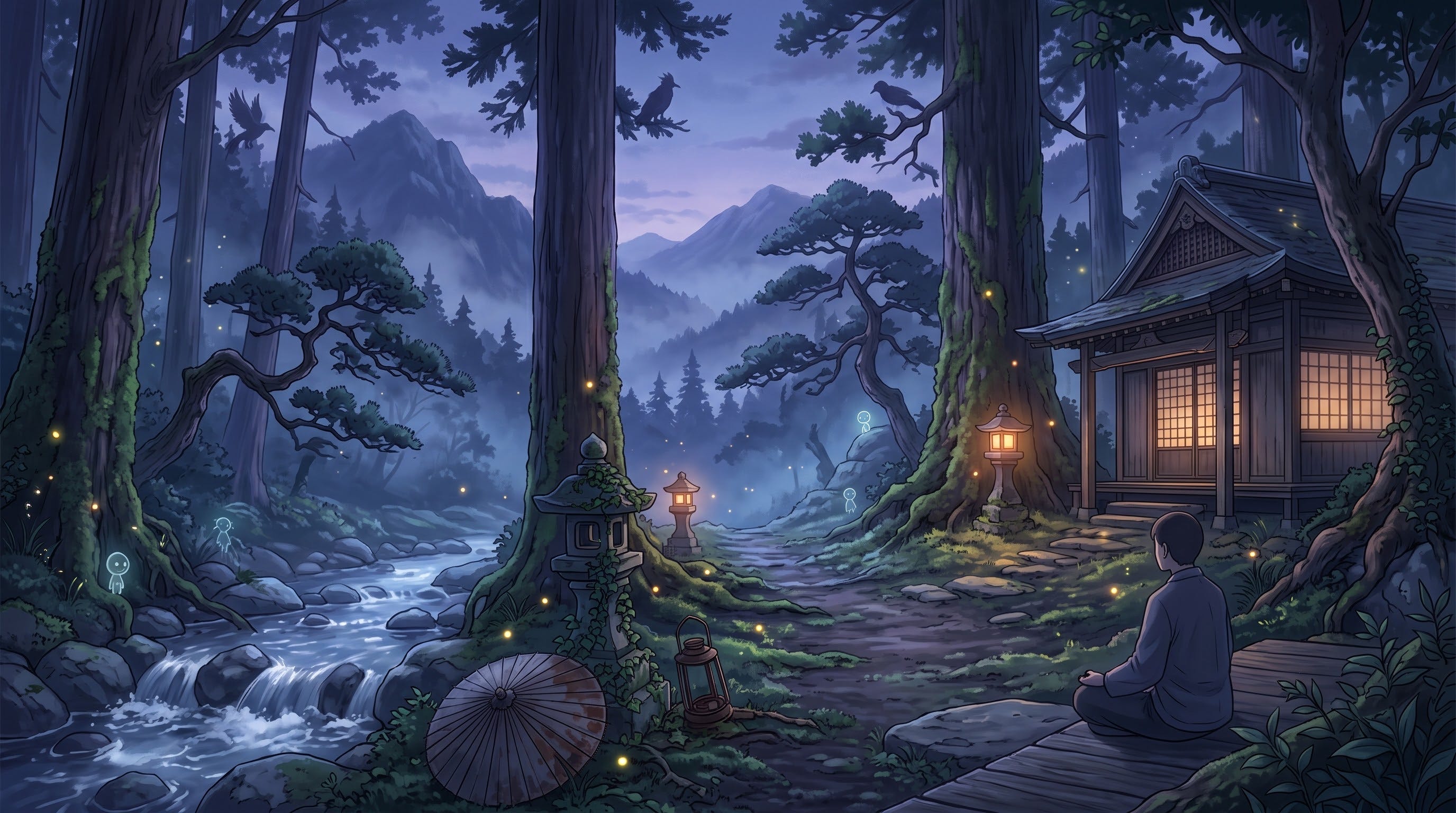
The Architecture of the Threshold: Yōkai, Animism, & the Enchanted Borderlands To enter the world of Japanese folklore is to step into a realm where the boundary between the seen and unseen remains perennially porous. Translating foreign concepts into English often flattens their nuanced philosophical weight, and few words suffer this fate as acutely as 妖怪, Yōkai (Apparitions, uncanny manifestations, or supernatural phenomena.) Rather than denoting a single class of monstrous creature, the term describes a broad existential category for the enigmatic forces operating along the fringes of ordinary perception. By examining the historical foundations, linguistic nuances, and philosophical dimensions of these phenomena, one uncovers an ancient orientation toward reality that views the world as inherently alive, relational, and profound. The term itself emerged into common usage during the Edo period, though the underlying phenomena stretch back into primordial folk traditions. Etymologically, 妖, Yō (Bewitched, alluring, or supernatural.) conveys a subtle power that pulls awareness away from mundane understanding. The second character, 怪, Kai (Wonder, anomaly, or mystery.) points to that which disrupts ordinary expectations. Joined together, the term denotes an uncanny mystery or a strange manifestation that eludes rational systematization. The roots of this worldview grow from three primary spiritual streams. The first and most foundational is Shintō animism, which recognizes 神, Kami (Spiritual essences, divine forces, or sacred presences.) residing within mountains, rivers, ancient trees, stones, and atmospheric phenomena. Within this animistic landscape, nature is not a passive backdrop for human activity but an active agent possessing distinct moods and boundaries. Crucially, not all natural forces are benevolent or tame. Some are mischievous, hungry, or alien to human interests. The recognition that natural phenomena possess their own autonomy laid the groundwork for personifying the mysterious corners of the physical world. The second stream consists of Classical Chinese folklore and Daoist narratives, which introduced tales of fox spirits, demonic scholars, and strange occurrences. These stories merged seamlessly with Japanese folk beliefs. The third stream, Mahāyāna Buddhism, introduced key psychological and metaphysical framework regarding illusion, karma, and the consequences of intense attachment. Within Buddhist pedagogy, manifestations often illustrated how human desire, jealousy, or unresolved grief could persist beyond physical death, creating ghost-like phenomena trapped in cyclic suffering. Rather than asking whether historical populations believed in these beings in a literal sense, it is far more revealing to examine the functions these narratives served. Prior to modern scientific frameworks, these accounts provided tangible forms for abstract mysteries. A sudden disappearance in the high peaks was attributed to the influence of 天狗, Tengu (Mountain spirits, wilderness guardians associated with pride.) Dangers lurking in treacherous rivers were personified by 河童, Kappa (Amphibious river beings, notorious tricksters demanding respect.) Strange creaks and shifting objects in an ancient home were understood through the presence of a spirit. Giving a name and shape to the unknown allowed communities to navigate frightening phenomena with structured respect. Simultaneously, these tales functioned as subtle moral instruction and psychological mapping. They taught caution around swollen rivers, reverence on isolated mountain tracks, and humility in the presence of natural power. The underlying warning was rarely a simple declaration of monster presence; rather, it was a call to heighten one’s attention to the environment. Psychologically, these figures externalized destructive internal states. The 鬼, Oni (Demons or ogres embodying destructive emotions such as rage and greed.) gave form to unchecked passions that threaten community harmony. Yet, in alignment with Mahāyāna views on transformation, even these fierce entities could achieve redemption through repentance, demonstrating that dark emotional states can be converted into spiritual wisdom. Perhaps the most philosophically profound examples are found in the 付喪神, Tsukumogami (Artifact spirits, household objects that acquire consciousness after long usage.) This concept posits that mundane objects, when cared for or used over decades, gradually absorb spirit and intent. An old lantern or a worn umbrella develops a subtle life of its own. This reflects an ecological form of spirituality grounded in gratitude, stewardship, and deep reverence for the material items that accompany human life over time. Central to all these accounts is the concept of liminality. These uncanny manifestations inhabit thresholds, appearing where stable categories break down: the boundary between village and wilderness, human and animal, light and dark, order and chaos. They manifest on mountain passes at dusk, bridges obscured by fog, or forgotten shrines along the shoreline. In Japanese aesthetic philosophy, this threshold space is intimately tied to 幽玄, Yūgen (Profound grace, subtle depth, and hidden mystery.) This perspective values that which remains partially concealed, recognizing that attempting to fully catalog or explain every facet of existence strips reality of its living depth. In stark contrast to traditional Western folk narratives that often organize the universe into an absolute cosmic battle between good and evil, these Japanese phenomena are fundamentally morally ambiguous. A single entity may prove playful, dangerous, deceptive, or protective depending entirely upon how a person approaches it. Reality is thus revealed as relational rather than absolute. When viewed through a contemplative lens, these traditional accounts function much like Zen riddles, disrupting rigid habits of perception. They remind us that the world is far richer and more complex than our rational categories suggest. The shadows and edges of our environment are not empty voids, but active participants in the unfolding mystery of existence. Music Cue: A Journey through Enchanted Thresholds an Animistic Guided Meditation through Enchanted Borderlands with Yōkai Preparation and Setting: Grounding in Absolute Safety Find a comfortable, supported position for this Guided Meditation. You may sit upright on a cushion or chair, or lie down if that allows your nervous system to fully settle. Rest your hands gently, allowing your shoulders to soften away from your ears. Before we begin our inner journey, know that you are completely safe here. This space is fully protected, grounded, and held. Whatever images, sounds, or subtle presences may arise across the landscapes of your mind cannot harm you. You are the conscious, enduring observer, resting in absolute safety. If at any point a sensation feels too intense, you can always anchor your attention back to the physical feeling of your body resting on the floor or cushion, or simply take a deep, grounding breath. Close your eyes gently, or cast a soft, un-focused gaze toward the floor. Take a long, slow breath in through the nose, filling your lower abdomen, your ribs, and your chest. Hold the breath for a quiet second at the top, and release it through your mouth with a long, sweeping sigh. Let every muscle in your face smooth out. Unclench your jaw. Relax your throat. Let your breathing return to its natural, unhurried rhythm. Step 1: Entering the Mountain Forest at Dusk Imagine now that you are standing at the edge of an ancient, mist-enshrouded mountain forest. The time is dusk, that liminal hour between day and night when the bright, clear light of ordinary vision begins to soften into cool indigo shadows. The air here is crisp and damp, carrying the rich scent of pine needles, wet granite, moss, and decaying Autumn leaves. Feel the cool air gently brushing against your skin. Listen to the distant, rhythmic murmur of a mountain stream flowing nearby. As you walk slowly along the winding dirt path, observe the landscape with deep, sensory attention. Notice how the sunlight filtered through the high canopy creates shifting patches of gold and deep violet across the forest floor. Komorebi. Some areas are brightly illuminated. Others are steeped in quiet shadow. Between them lie the edge places, the liminal spaces where light and dark meet and blur. Recognize that this mountain is not a passive backdrop. In the ancient spiritual tradition of Shintō, the natural world is animated by 神, Kami (Spiritual essences, divine forces, or sacred presences.) The mountain itself possesses agency, memory, and mood. The ancient trees are not merely wood; they are silent witnesses. The stones beneath your feet hold ancient memories. You are walking through a world that is alive, permeable, and thoroughly enchanted. Step 2: The Liminal Stream and the Lesson of Attention Your path leads you down toward the bank of a clear, rushing mountain river. Cool, blue-green water spills smoothly over smooth gray stones, creating swirling eddies and silvery foam at the edges. Touch the air near the water with your awareness, feel its cool mist upon your face. Here, along the banks where land and water meet, thresholds dominate. In traditional Japanese folklore, these liquid borders are inhabited by creatures such as the 河童, Kappa (Amphibious river beings, notorious tricksters demanding respect.) These presences remind us that spiritual forces are not always benevolent or tame. Some forces in nature and within the psyche are mischievous, dangerous, hungry, lonely, forgotten, or simply alien to our human ways. As you gaze at the swirling waters, remember your safety. You are safe here on the bank. The lesson of these threshold beings is never a simple warning that monsters are real. The deeper lesson is far more profound: pay attention. Heighten your senses. Respect the boundaries between the known and the unknown. Notice how a presence in nature or mind responds directly to how you approach it. If you approach with arrogance, the waters feel treacherous. If you approach with stillness, humility, and quiet reverence, the river reveals its deeper harmony. Step 3: The High Pass and the Unseen Presences Leaving the riverbank, follow the trail as it climbs steadily upward toward a high mountain pass. The wind whispers softly through the high cedar branches above. The air grows cooler, clearer, and thinner. Near the summit, high amongst the ancient, twisted pines, you enter the domain often associated with the 天狗, Tengu (Mountain spirits, wilderness guardians associated with pride.) You do not look for a physical form with direct, focused sight. Instead, you practice a subtle, peripheral awareness. Notice what lives at the edges of your perception. You might feel a sudden, subtle shift in the air pressure, a soft rustle of feathers high in the canopy, or an unexpected feeling of vast, solemn grandeur. This mountain presence touches the places within you where pride, spiritual ambition, or untamed wilderness reside. Work intentionally not to turn the direct, harsh spotlight of your analytical mind onto this subtle impression. If you stare directly at peripheral light, it dissolves into ordinary reality. Instead, keep your primary focus resting softly on your breathing, while leaving your wide, intuitive awareness open to the margins. Allow the mystery to remain partially concealed, honoring the philosophical principle of 幽玄, Yūgen (Profound grace, subtle depth, and hidden mystery.) A mystery fully explained or dissected becomes less alive. Let the mystery exist as it is. Step 4: The Childhood Home and the Threshold of Memory The mountain trail leads you gently downward now, winding into a peaceful, quiet valley bathed in twilight. Nestled in this valley stands a place intimately familiar to you: your childhood home, or an ancient dwelling from your early life. Walk up the path to the sliding wooden door or porch. Step inside the quiet, familiar rooms. Notice the specific sensory details: the warm scent of aged wood, the sound of familiar floorboards creaking softly underfoot, the way the fading evening light falls across a familiar table or corner. Here, in this threshold of memory, we encounter another dimension of the uncanny. In Japanese tradition, household objects that accompany us through long spans of time can absorb our intent and acquire spirit, becoming 付喪神, Tsukumogami (Artifact spirits, household objects that acquire consciousness after long usage.) Gaze softly at the old objects residing in this home: an old lantern, a worn clock, a favourite chair, or a long-forgotten utensil. Notice how these objects hold memories, identities, desires. Sometimes, when human beings cling too tightly to old desires, rigid identities, possessions, or grief, those attachments refuse to dissolve. They condense at the edges of our mind into curious, persistent manifestations. Safe in this moment of Guided Meditation, observe these lingering attachments with profound gentleness. You do not need to fight them or force them away. Simply acknowledge how anything that accompanies us through time acquires its own quiet, living presence. Step 5: The Gathering at the Edge of Perception Step out from the quiet old home, looking out over the garden as night falls softly. The stars begin to appear, one by one, in the deep indigo sky. Silent shimmers from the dark. In Japanese philosophy, uncanny manifestations are categorized as 妖怪, Yōkai (Apparitions, uncanny manifestations, or supernatural phenomena.) Remember that a Yōkai is less a specific creature and more an existential category for the mysterious forces inhabiting the edges of ordinary reality. They exist where categories break down: between village and wilderness, between human and animal, between life and death, between visible and invisible. Between my voice and your mind. Sit comfortably outside the old, familiar home, resting in complete, absolute safety. See the gardens. Feel the solid support beneath you. Feel your own calm and steady breath. From this safe vantage point, invite all the threshold places within your psyche to simply exist. There are places within you that are brightly lit. There are places that are dark. There are places where the light has dimmed from rare visits, and places you have closed off from the sunlight. And there are the liminal edges: not bright, not dark, but delicately illuminated like your own peripheral vision. Like this dusk. Allow the mysterious forces to linger at those edges. They may take familiar or fantastical forms. They may resemble a shapeshifting 狐, Kitsune (Fox spirits, intelligent shapeshifting beings.) embodying transformation and hidden identity. They may appear as playful, troubling, or strange figures. They may delight you, or they may temporarily worry you. Remind yourself: you are completely safe. The world within you is far stranger and richer than rational thought allows. Not because monsters lurk in the dark, but because the shadows themselves are participating in reality far more deeply than we usually notice. Open yourself to these mysteries. Open yourself to their indirect teachings. Open yourself to the profound, vibrant aliveness of all that is alive, and all that had previously seemed ordinary. (Pause for several moments of quiet, sensory meditation.) Integration and Return Slowly, deliberately, begin to bring your awareness back from the quiet valley and the ancient home. From the riverside, from the stars, from the garden. Take a long, deep breath into your chest, feeling the fresh air revive your physical form. Feel the weight of your physical body resting safely. Feel your feet, your legs, your spine, and your hands. Listen to the ordinary sounds of the room around you. As you return to the bright light of ordinary waking consciousness, carry the wisdom of the threshold with you. You do not need to explain every mystery. You do not need to solve every shadow. The world around you and the world within you are alive, permeable, and deeply enchanted. When you need guidance, simply remember the lesson of the edge places: slow down, settle into safety, and pay attention. Whenever you are ready, gently begin to move your fingers and toes. Roll your wrists and shoulders slowly. Take one last deep, refreshing breath, deep into the belly. Now, open your eyes, returning fully to the present moment. Arigatou gozaimasu. Thank you. This is a public episode. If you'd like to discuss this with other subscribers or get access to bonus episodes, visit shhdragon.substack.com/subscribe
Embed this episode
Ready to play
A Journey through Enchanted Thresholds
No transcript for this episode yet
Similar Episodes
No similar episodes found.