
EPISODE · Aug 19, 2026 · 7 MIN
AC 49. NEW BABYLON 《新巴比伦》| Track 01. No Map
from Palimpsest | 行间
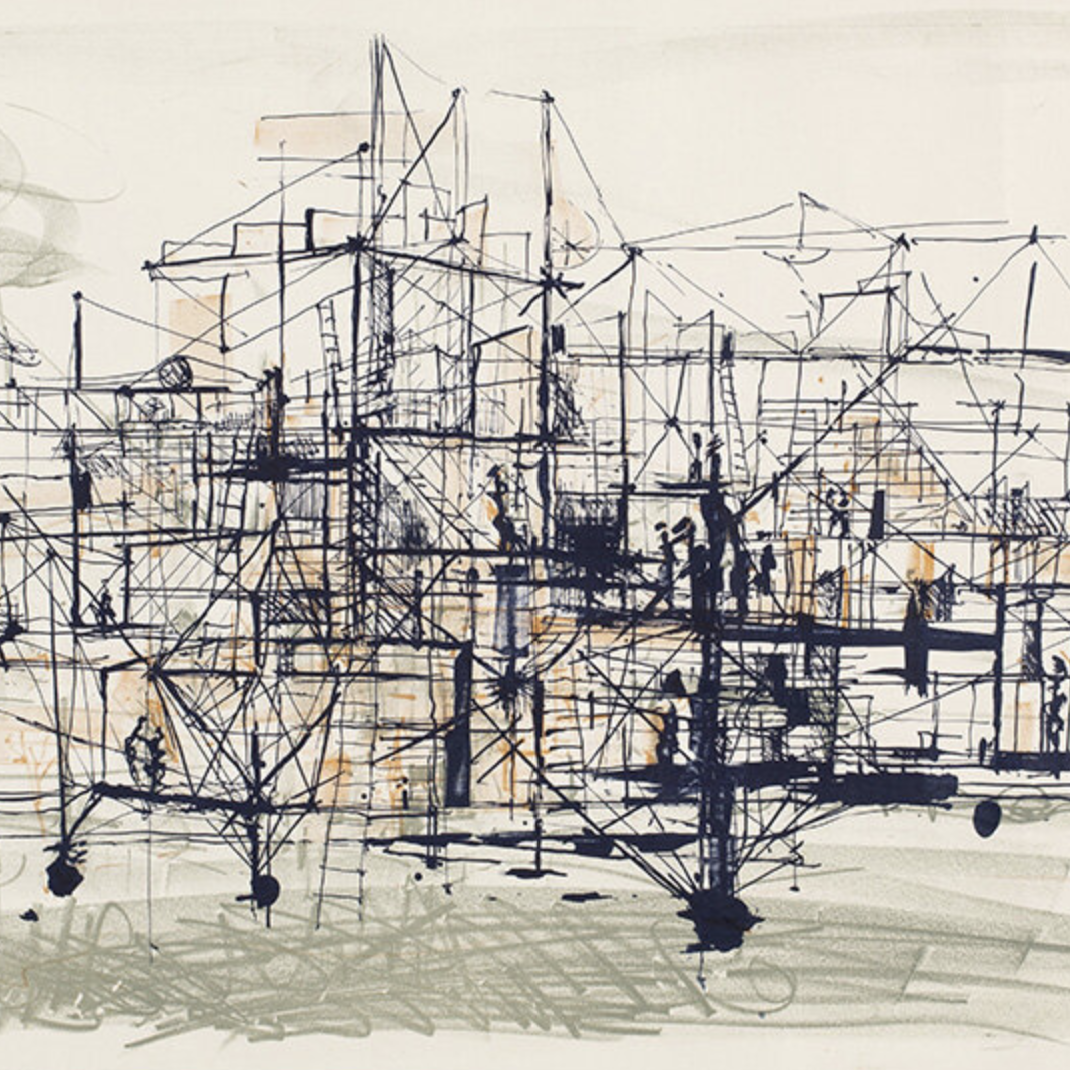
概念专辑《新巴比伦》NEW BABYLON人为什么要以这样的方式在城市里生活?城市究竟是做什么的?Why should people live in cities the way they do?What should a city be ultimately for?《新巴比伦》(New Babylon)是一张关于城市、漫游与游戏的概念专辑。巴比伦早已成为一种城市神话:它象征着巨大、繁荣、欲望、混乱,以及一个不断扩张、最终超越自身尺度的都市文明。这里的“New Babylon”则来自荷兰艺术家 Constant Nieuwenhuys 在 1956 至 1974 年间持续发展的同名乌托邦计划。二战之后的欧洲正在重建城市,但旧有的社会秩序和生活方式却已经发生断裂。Constant 认为,真正需要被重新思考的并不只是建筑,而是人为什么要以这样的方式生活,以及城市究竟应该服务于什么。Constant 最初是一名画家。他的早期绘画强调直觉、自发性、游戏和集体创造,但到了1950年代,他逐渐意识到画布已经不足以容纳一个正在剧烈变化的世界。与建筑师 Aldo van Eyck 的合作使他开始从“物体”转向“空间”,从绘画表面转向人的身体、感知和行动。1956年,他前往意大利北部的 Alba。在那里,他看到一群被迫离开城市中心的 Roma 家庭生活在河边一个临时搭建的聚居地。这个空间没有严密的规划,也没有永久性的建筑;材料被不断重新利用,边界可以移动,空间随着人的使用而变化。Constant 从这个临时聚落中看到了一种完全不同的城市逻辑:空间不是被规划之后才被使用,而是在使用的过程中不断被创造。Alba 成为了 New Babylon 的一个重要起点。Constant 后来将这种临时、集体、可变的居住方式转化为巨大的钢结构、悬浮平台、迷宫和可移动空间。他开始不再设计一栋栋建筑,而是在设计一种可以不断变化的城市框架。1958年前后,Constant 与 Situationist International 及 Guy Debord 的关系进一步将这种空间思想推向政治层面。他们批判现代城市把生活切割成工作、交通、住宅、消费等互不相连的功能区域,认为这种城市规划不仅控制身体,也塑造人的感知。与之相对的,是 dérive——漂流。人不再按照城市规定好的路线行走,而是让自己被街道、偶遇、声音、建筑和气氛牵引。城市因此不再是一张供人导航的地图,而成为一个由心理感受和身体运动构成的开放空间。Constant 与 Situationists 对于“城市应该如何改变”最终产生分歧。Constant 更坚持建造:他认为,如果新的社会关系真的可能存在,那么它必须获得新的空间形式。到1960年左右,他离开 Situationist International,却继续独立发展 New Babylon。New Babylon 最激进的假设,是一个 “劳动终结之后的城市”。Constant 借鉴 Johan Huizinga 的 Homo Ludens——游戏的人,设想自动化最终取代绝大部分必要劳动。当人不再需要把生命的大部分时间用于生产,一个新的问题便出现了:人自由之后,要做什么?Constant 的答案不是休息,而是游戏、创造、漫游和不断改变环境。New Babylon 因此不是一座完成之后供人居住的城市。它是一套覆盖整个地球的巨大网络,由悬浮的结构、平台和互相连接的空间组成。内部没有固定的功能,没有永久的墙壁,也没有唯一的路线。光线、声音、温度、材质甚至空间本身都可以不断改变。城市不再规定人的行为;城市成为人不断重新创造生活的工具。这也是这张专辑想要进入的地方。New Babylon 并不是关于一座未来城市的幻想。它更像是在问:如果城市不再要求我们工作、通勤、消费和服从既定路线,那么我们会如何漫游其中?而第一首歌 No Map,正是从这个问题开始。New Babylon is a concept album about the city, drifting, and play.“Babylon” is both an ancient city and an enduring urban myth: a symbol of scale, prosperity, desire, confusion, and a civilization whose expansion eventually exceeds its own limits. New Babylon, however, takes its name from the utopian project developed by Dutch artist Constant Nieuwenhuys between 1956 and 1974.After the Second World War, Europe was rebuilding its cities, while the social structures and habits that had organized everyday life were beginning to break apart. For Constant, the real question was not simply how to rebuild architecture, but why people should live in cities the way they do, and what a city should ultimately be for.Constant began as a painter and was a founding member of the avant-garde CoBrA movement. His early work embraced spontaneity, instinct, play, and collective creation. By the early 1950s, however, he increasingly felt that the canvas was too limited to contain the transformations taking place around him. His collaboration with architect Aldo van Eyck led him from objects toward environments, from surfaces toward the experience of bodies moving through space.In 1956, Constant travelled to Alba, in northern Italy. There he encountered Roma families who had been displaced from the center of the town and were living in an improvised settlement along the river. There was no rigid master plan and little sense of permanence. Materials were reused, boundaries shifted, and space was continuously adapted through collective use.Constant recognized in this settlement a radically different logic of urban space:Space does not have to be designed first and used afterward. It can be created through use itself.Alba became an important starting point for New Babylon. Constant translated the provisional and collective qualities of the settlement into vast steel frameworks, elevated platforms, labyrinths, and movable structures. He was no longer designing individual buildings. He was designing a framework for a city that could continuously transform itself.Around 1958, Constant's involvement with the Situationist International and Guy Debord gave this spatial thinking a sharper political dimension. Together, they criticized modern urban planning for dividing life into separate functional zones — work, housing, transportation, consumption — and argued that such environments shaped and controlled human behavior and perception.Against this was the Situationist practice of the dérive, or drift.Instead of following the routes prescribed by the city, one allows oneself to be drawn by streets, encounters, sounds, architecture, and atmosphere. The city ceases to be a map designed for navigation and becomes an open field of psychological and bodily experience.Constant and the Situationists eventually disagreed about how such a transformation should take place. Constant insisted on construction: if a new social reality was possible, it needed new spatial forms. By around 1960, he had left the Situationist International, but continued developing New Babylon independently.At the center of New Babylon lies its most radical hypothesis: the possibility of a city after the end of work.Drawing on Johan Huizinga's idea of Homo Ludens — the human being as player, Constant imagined a society in which automation would eventually replace most necessary labor. If people no longer had to spend most of their lives producing, a new question would emerge:What would we do with our freedom?Constant's answer was not simply leisure, but play, creativity, drifting, and the continuous transformation of one's environment.New Babylon is therefore not a finished city waiting to be inhabited. It is a planetary network of elevated structures, platforms, and interconnected spaces. Its interiors have no fixed programs, no permanent boundaries, and no single correct route. Light, sound, temperature, texture, and even the configuration of space can continuously change.The city no longer dictates behavior. It becomes a tool through which people continually reinvent their lives.This is where the album begins.The city can become a tape loop: repeating while subtly changing each time. It can become free jazz: without a predetermined route, yet generating new structures through improvisation. It can become mambo or a nursery rhyme: the body follows rhythm, and the street becomes a dance floor and a playground.New Babylon is therefore not simply a fantasy about a future city.It asks a more fundamental question:If the city no longer required us to work, commute, consume, and follow predetermined routes, how would we move through it?The first song, No Map, begins precisely there.--Track 01. No MapMama says,“Stay right here!”I say,“Yeah!”Then I disappear.Down the stairs,Out the door,My old shoesGo tap-tap-tap on the floor.Hey, little cat!Where you going?Wait for me!Oops—Big puddle!ONE, TWO, THREE!No map!No map!I don’t need one!Run this way,Then run that one!No map!No map!Look at me!I’m goingWhere I want to be!Bike by the wall,Ball in the street,Jump over the crackWith my little feet.Red light—Stop!Green light—GO!I’m so fastI’m a rocket, you know!No map!No map!No, no, no!Where am I going?I DON’T KNOW!Round the corner,Up the block,Kick my ballAgainst the wall—BANG!It comes back.I laugh.Again!My pocket’s gotA little stone.It’s my treasure.It’s my own.Maybe I’m hungry.Maybe I’m not.Maybe I’ll playTill Mama shouts:“HOME!”No map!No map!No way!I don’t knowWhat I’m doing today!Left foot,Right foot,Run, run, run!Bad day?Bye-bye!Here comes the sun!No map!No map!Come on, feet!Turn left!Turn right!Find something sweet!No map.No plan.Just me.Just me.Just me!一南 | Yinan前往小宇宙评论区与主播互动
Embed this episode
NOW PLAYING
AC 49. NEW BABYLON 《新巴比伦》| Track 01. No Map
No transcript for this episode yet
Similar Episodes
No similar episodes found.
Similar Podcasts
No similar podcasts found.