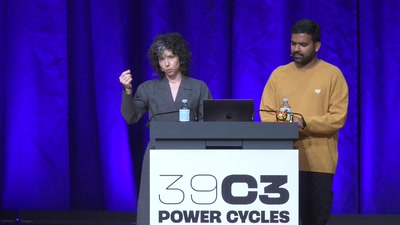
AI Agent, AI Spy (39c3) episode artwork

EPISODE · Dec 29, 2025 · 40 MIN

AI Agent, AI Spy (39c3)

from Chaos Computer Club - recent events feed · host Udbhav Tiwari, Meredith Whittaker

Agentic AI is the catch-all term for AI-enabled systems that propose to complete more or less complex tasks on their own, without stopping to ask permission or consent. What could go wrong? These systems are being integrated directly into operating systems and applications, like web browsers. This move represents a fundamental paradigm shift, transforming them from relatively neutral resource managers into an active, goal-oriented infrastructure ultimately controlled by the companies that develop these systems, not by users or application developers. Systems like Microsoft's "Recall," which create a comprehensive "photographic memory" of all user activity, are marketed as productivity enhancers, but they function as OS-level surveillance and create significant privacy vulnerabilities. In the case of Recall, we’re talking about a centralized, high-value target for attackers that poses an existential threat to the privacy guarantees of meticulously engineered applications like Signal. This shift also fundamentally undermines personal agency, replacing individual choice and discovery with automated, opaque recommendations that can obscure commercial interests and erode individual autonomy. This talk will review the immediate and serious danger that the rush to shove agents into our devices and digital lives poses to our fundamental right to privacy and our capacity for genuine personal agency. Drawing from Signal's analysis, it moves beyond outlining the problem to also present a "tourniquet" solution: looking at what we need to do *now* to ensure that privacy at the application layer isn’t eliminated, and what the hacker community can do to help. We will outline a path for ensuring developer agency, granular user control, radical transparency, and the role of adversarial research. The talk will provide a critical technical and political economy analysis of the new privacy crisis emerging from OS and application level AI agents, aimed at the 39C3 "Ethics, Society & Politics" audience. 1. Defining the Threat: The OS as a Proactive Participant (5 mins) We will begin by defining "Agentic AI" in two contexts - imbibed into the operating system and deployed via critical gateway applications such as web browsers. Traditionally, the operating systems and browsers are largely neutral enforcers of user agency, managing resources and providing APIs for applications to run reliably. We will argue that this neutrality is close to being eliminated. The new paradigm shifts these applications into a proactive agent that actively observes, records, and anticipates user actions across all applications.The prime example for this analysis will be Microsoft’s "Recall" feature, Google’s Magic Cue, and OpenAI’s Atlas. Politically, we will frame this not as a "feature" but as the implementation of pervasive, non-consensual surveillance and remote-control infrastructure. This "photographic memory" of and demand for non-differentiated access to everything from private Signal messages to financial data to health data creates a catastrophic single point of failure, making a single security breach an existential threat to a user's entire digital life. Ultimately, we hope to illustrate how putting our brains in a jar (with agentic systems) is effectively a prompt injection attack against our own humanity. 2. The Existential Threat to Application-Level Privacy (10 mins) The core of the talk will focus on what this means for privacy-first applications like Signal. We will explain the "blood-brain barrier" analogy: secure apps are meticulously engineered to minimize data and protect communications, relying on the OS to be a stable, neutral foundation on which to build. This new OS trend breaks that barrier. We will demonstrate how OS-level surveillance renders application-level privacy features, including end-to-end encryption, effectively useless. If the OS can screenshot a message before it's encrypted or after it's decrypted, the promise of privacy is broken, regardless of the app's design. We will also discuss the unsustainable "clever hacks" (like Signal using a DRM feature) that developers are forced to implement, underscoring the need for a structural solution. 3. An Actionable Framework for Remediation (20 mins) The final, and most important, part of the talk will move from critique to action. We will present an actionable four-point framework as a "tourniquet" to address these immediate dangers: a. Empower Developers: Demand clear, officially supported APIs for developers to designate individual applications as "sensitive" with the default posture being for such applications being opted-out of access by agentic systems (either OS or application based) (default opt-out) b. Granular User Control: Move beyond all-or-nothing permissions. Users must have explicit, fine-grained control to grant or deny AI access on an app-by-app basis. c. Mandate Radical Transparency: OS vendors and application developers must clearly disclose what data is accessed, how it's used, and how it's protected—in human-readable terms, not buried in legalese. Laws and regulations must play an essential role but we cannot just wait for them to be enforced, or it will be too late. d. Encourage and Protect Adversarial Research: We will conclude by reinforcing the need for a pro-privacy, pro-security architecture by default, looking at the legal frameworks that govern these processes and why they need to be enforced, and finally asking the attendees to continue exposing vulnerabilities in such systems. It was only due to technically-grounded collective outrage that Recall was re-architected by Microsoft and we will need that energy if we are to win this war. Licensed to the public under http://creativecommons.org/licenses/by/4.0 about this event: https://events.ccc.de/congress/2025/hub/event/detail/ai-agent-ai-spy

Agentic AI is the catch-all term for AI-enabled systems that propose to complete more or less complex tasks on their own, without stopping to ask permission or consent. What could go wrong? These systems are being integrated directly into operating systems and applications, like web browsers. This move represents a fundamental paradigm shift, transforming them from relatively neutral resource managers into an active, goal-oriented infrastructure ultimately controlled by the companies that develop these systems, not by users or application developers. Systems like Microsoft's "Recall," which create a comprehensive "photographic memory" of all user activity, are marketed as productivity enhancers, but they function as OS-level surveillance and create significant privacy vulnerabilities. In the case of Recall, we’re talking about a centralized, high-value target for attackers that poses an existential threat to the privacy guarantees of meticulously engineered applications like Signal. This shift also fundamentally undermines personal agency, replacing individual choice and discovery with automated, opaque recommendations that can obscure commercial interests and erode individual autonomy. This talk will review the immediate and serious danger that the rush to shove agents into our devices and digital lives poses to our fundamental right to privacy and our capacity for genuine personal agency. Drawing from Signal's analysis, it moves beyond outlining the problem to also present a "tourniquet" solution: looking at what we need to do *now* to ensure that privacy at the application layer isn’t eliminated, and what the hacker community can do to help. We will outline a path for ensuring developer agency, granular user control, radical transparency, and the role of adversarial research. The talk will provide a critical technical and political economy analysis of the new privacy crisis emerging from OS and application level AI agents, aimed at the 39C3 "Ethics, Society & Politics" audience. 1. Defining the Threat: The OS as a Proactive Participant (5 mins) We will begin by defining "Agentic AI" in two contexts - imbibed into the operating system and deployed via critical gateway applications such as web browsers. Traditionally, the operating systems and browsers are largely neutral enforcers of user agency, managing resources and providing APIs for applications to run reliably. We will argue that this neutrality is close to being eliminated. The new paradigm shifts these applications into a proactive agent that actively observes, records, and anticipates user actions across all applications.The prime example for this analysis will be Microsoft’s "Recall" feature, Google’s Magic Cue, and OpenAI’s Atlas. Politically, we will frame this not as a "feature" but as the implementation of pervasive, non-consensual surveillance and remote-control infrastructure. This "photographic memory" of and demand for non-differentiated access to everything from private Signal messages to financial data to health data creates a catastrophic single point of failure, making a single security breach an existential threat to a user's entire digital life. Ultimately, we hope to illustrate how putting our brains in a jar (with agentic systems) is effectively a prompt injection attack against our own humanity. 2. The Existential Threat to Application-Level Privacy (10 mins) The core of the talk will focus on what this means for privacy-first applications like Signal. We will explain the "blood-brain barrier" analogy: secure apps are meticulously engineered to minimize data and protect communications, relying on the OS to be a stable, neutral foundation on which to build. This new OS trend breaks that barrier. We will demonstrate how OS-level surveillance renders application-level privacy features, including end-to-end encryption, effectively useless. If the OS can screenshot a message before it's encrypted or after it's decrypted, the promise of privacy is broken, regardless of the app's design. We will also discuss the unsustainable "clever hacks" (like Signal using a DRM feature) that developers are forced to implement, underscoring the need for a structural solution. 3. An Actionable Framework for Remediation (20 mins) The final, and most important, part of the talk will move from critique to action. We will present an actionable four-point framework as a "tourniquet" to address these immediate dangers: a. Empower Developers: Demand clear, officially supported APIs for developers to designate individual applications as "sensitive" with the default posture being for such applications being opted-out of access by agentic systems (either OS or application based) (default opt-out) b. Granular User Control: Move beyond all-or-nothing permissions. Users must have explicit, fine-grained control to grant or deny AI access on an app-by-app basis. c. Mandate Radical Transparency: OS vendors and application developers must clearly disclose what data is accessed, how it's used, and how it's protected—in human-readable terms, not buried in legalese. Laws and regulations must play an essential role but we cannot just wait for them to be enforced, or it will be too late. d. Encourage and Protect Adversarial Research: We will conclude by reinforcing the need for a pro-privacy, pro-security architecture by default, looking at the legal frameworks that govern these processes and why they need to be enforced, and finally asking the attendees to continue exposing vulnerabilities in such systems. It was only due to technically-grounded collective outrage that Recall was re-architected by Microsoft and we will need that energy if we are to win this war. Licensed to the public under http://creativecommons.org/licenses/by/4.0 about this event: https://events.ccc.de/congress/2025/hub/event/detail/ai-agent-ai-spy

NOW PLAYING

AI Agent, AI Spy (39c3)

0:00 40:31

No transcript for this episode yet

We transcribe on demand. Request one and we'll notify you when it's ready — usually under 10 minutes.

LIGHTS, CAMERA, SMILE! Creatives Club Media Lights, Camera, Smile, is a podcast for anyone with a dream to share something with the world, out of the overflow of themselves - be it their mind, their heart, their personalities, and much more. Each of us are alive in this moment in time, with an innate ability to have ideas and create various things to benefit both ourselves and the people around us for a reason, and here, you will find the encouragement, the inspiration, and the motivation to do just that. Hosted by Cicily, founder of Creatives Club, she dives into various topics surrounding creativity and business. Exploring entrepreneurship for creatives in a corporate reality, sharing tips and tricks in a media centered company, answering questions regarding what a creative actually is are just a few of the things discussed on this podcast. Be encouraged to create for yourself as Cicily gets vulnerable by pivoting the camera to herself for the first time.To submit questions for Cicily to answer, or have her address certain t The PFN Cincinnati Bengals Podcast Pro Football Network The PFN Cincinnati Bengals Podcast is where you can stay up-to-date with the latest news and analysis on the Cincinnati Bengals! Our hosts, industry experts Jay Morrison and Dallas Robinson, provide weekly coverage of all the latest rumors and updates about the Bengals. Don’t forget to follow the show to receive new episodes directly in your podcast feed and leave a rating and review to let us know your thoughts. Piramidi Club The Bitcoin Butcher La Migliore Pizza di Firenze IT IS WHAT IT IS with SHALLZ - SHALLY ZOMORODI Shally Zomorodi What?  "It is what it is" with ShallZ – Shally ZomorodiWhen? WeeklyHow long? 35 minutesEvery week, Mother of 4, wife, morning TV news anchor and ultimate hostess, Shally Zomorodi talks about life - its up's and downs and how to stay on track in her weekly podcast, ‘It is what it is.’  Known for her high energy, infectious smile and ability to see the cup as half full Shally talks about all things in life and how to work through its challenges. From parenting, marriage, friendships, current events to how to smile when it just seems impossible ‘It is what it is’ is the perfect podcast to help inspire you to dance through the rain.

Frequently Asked Questions

How long is this episode of Chaos Computer Club - recent events feed?

This episode is 40 minutes long.

When was this Chaos Computer Club - recent events feed episode published?

This episode was published on December 29, 2025.

What is this episode about?

Agentic AI is the catch-all term for AI-enabled systems that propose to complete more or less complex tasks on their own, without stopping to ask permission or consent. What could go wrong? These systems are being integrated directly into operating...

Can I download this Chaos Computer Club - recent events feed episode?

Yes, you can download this episode by clicking the download button on the episode player, or subscribe to the podcast in your preferred podcast app for automatic downloads.
URL copied to clipboard!