
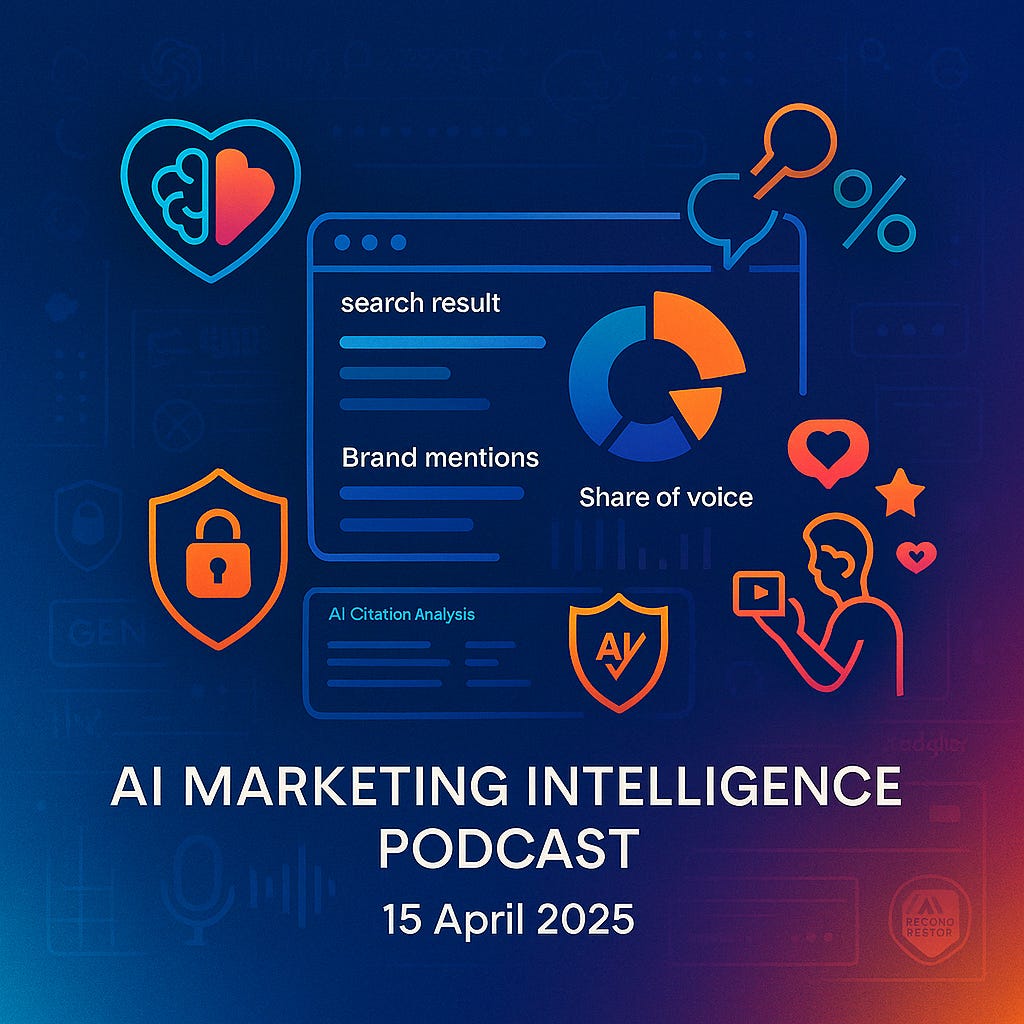
EPISODE · Apr 15, 2025 · 9 MIN
AI Marketing Pulse: Key Developments from Monday, 14th April 2025
from Daily Marketing Insights Podcast · host Jon
Yesterday's marketing news highlighted a significant pivot in how brands must approach visibility in an AI-dominated search landscape. New measurement frameworks for tracking brand presence across AI platforms emerged alongside revelations that keyword targeting is rapidly becoming obsolete in favour of emotional and intent-based strategies. Meanwhile, Google's recent algorithm changes continue to impact content citation patterns, creating new opportunities for marketers who adapt quickly.Story #1: How to Track Visibility Across AI PlatformsSearch Engine Land | 14th April 2025 https://searchengineland.com/how-to-track-visibility-across-ai-platforms-454251What Happened: Maria Georgieva, SEO expert at Payhawk, published a comprehensive guide on measuring brand visibility within AI search platforms, introducing new metrics beyond traditional rankings and traffic. The article explains how AI has fundamentally changed what it means to be "visible" in search results, requiring marketers to track mentions, citations, and share of voice across different AI tools.Why It Matters: Traditional SEO metrics are becoming insufficient as AI increasingly mediates search experiences. Links and rankings still matter, but they're no longer the full picture. Now, it's about mentions, citations, and whether your brand even shows up in the conversation. This shift demands new measurement frameworks that most SEO tools haven't yet incorporated.Suggested Actions:* Begin tracking AI-specific visibility metrics including mentions, citations, and share of voice across platforms like ChatGPT, Perplexity, and Gemini.* Evaluate the quality of mentions (are you listed as the top recommendation or buried in a list?) rather than just counting appearances.Story #2: Is Keyword Targeting as Impossible as Spinning Straw into Gold?Search Engine Land | 14th April 2025 https://searchengineland.com/is-keyword-targeting-as-impossible-as-spinning-straw-into-gold-454205What Happened: Industry veteran Greg Jarboe published an analysis arguing that keyword targeting, once a cornerstone of digital marketing strategy, is rapidly losing effectiveness. The article suggests that in 2025, marketing success increasingly comes from understanding user intent, behavioural patterns, and emotional relevance rather than keyword matching.Why It Matters: The paradigm shift challenges foundational marketing practices. In an era driven by machine learning and AI, it's more important than ever to "optimize" content for the searcher's intent. These days, fewer ads target the specific keywords that people use, and more ads target their "interests." This approach requires a fundamental rethinking of content strategy and audience targeting.Suggested Actions:* Shift focus from keyword research to intent research, incorporating behavioural signals and emotional triggers.* Develop content that addresses emotional needs, with research showing that 82% of consumers purchase items specifically to enhance emotional wellness.Story #3: Google AI Overview-Organic Ranking Overlap Drops After Core UpdateSearch Engine Land | 14th April 2025 https://searchengineland.com/google-ai-overviews-spike-march-2025-core-update-453841What Happened: New data reveals that content appearing in Google's top 10 organic search results is now less likely to be cited in AI Overviews following the March 2025 core update. This represents a significant shift in how Google selects sources for its AI-generated summaries, creating both challenges and opportunities for digital marketers.Why It Matters: This change creates potential opportunities for websites that previously struggled to rank in traditional top 10 results. Earlier research from Semrush showed that while the average AI Overview had 11 citation links, there was only a 20-26% overlap between AI citations and links in the top 10 SERP positions for the same query.Suggested Actions:* Audit your website's presence in AI Overviews separately from organic rankings.* Create targeted content specifically designed to be citation-worthy in AI results, focusing on authority and unique insights rather than just SEO optimization.Story #4: Advertisers Reject Google's Campaign Against California's Privacy BillSearch Engine Land | 14th April 2025 https://searchengineland.com/What Happened: A coalition of advertisers has publicly rejected Google's lobbying efforts against California's new privacy legislation, instead advocating for consent-driven customer relationships. The advertisers argue that businesses should embrace transparent data practices rather than fighting against increased privacy protections.Why It Matters: This represents a significant shift in advertiser attitudes toward data privacy, with major brands increasingly aligning themselves with consumer privacy interests rather than opposing regulation. The stance suggests a growing recognition that consent-based marketing is becoming essential for sustainable business practices.Suggested Actions:* Audit your data collection practices in preparation for stricter privacy regulations.* Develop strategies for building explicit consent into marketing operations, focusing on value exchange rather than covert data collection.Story #5: Creator-Led Content Outperforming Traditional AdsSearch Engine Land | 14th April 2025 https://searchengineland.com/What Happened: New research shows that creator-led marketing content is significantly outperforming traditional polished advertisements across multiple metrics. Marketers are increasingly shifting budget from conventional advertising to collaborations with creators who bring authenticity and established audiences.Why It Matters: The trend represents a fundamental shift in how brands allocate media budgets and create content. As consumers increasingly seek authenticity, traditional highly-produced advertising is losing effectiveness compared to more genuine creator-driven approaches.Suggested Actions:* Evaluate opportunities to incorporate creator partnerships into your marketing mix.* Develop frameworks for measuring creator content performance beyond basic engagement metrics.Story #6: HubSpot Launches AI Search Grader ToolHubSpot | April 2025 https://www.hubspot.com/ai-search-graderWhat Happened: HubSpot has released a new free tool called AI Search Grader that analyzes brand visibility, sentiment, and share of voice across AI search platforms including ChatGPT, Perplexity, and Gemini. The tool provides marketers with a comprehensive analysis of their brand's performance in AI-generated search results.Why It Matters: As more consumers shift to using AI search engines for information, understanding brand presence in these platforms becomes critical. If your brand is not visible or well-represented in AI search engine results, you could miss out on opportunities to engage with your potential audience and customers.Suggested Actions:* Use the free AI Search Grader tool to assess your current brand visibility in AI search.* Develop a dedicated AI search optimization strategy based on identified gaps and opportunities.Comprehensive SummaryThe marketing landscape is experiencing a profound transformation as AI reshapes how consumers find information and how brands measure success. Yesterday's developments highlight several interconnected trends that marketers must navigate in 2025:First, the metrics that matter are evolving beyond traditional SEO measurements. As Maria Georgieva's research demonstrates, visibility now encompasses whether a brand appears in AI-generated answers, how it's cited, and its share of voice relative to competitors. This requires new measurement frameworks and tools that most platforms haven't yet incorporated.Simultaneously, the strategies that drive success are shifting from keyword-centric approaches to those centered on user intent and emotional connections. Greg Jarboe's analysis reveals how machine learning has fundamentally changed targeting, making emotional resonance and intent understanding more valuable than keyword matching.The March 2025 Google core update further complicates matters by reducing the overlap between traditional search rankings and AI Overview citations. This creates both challenges and opportunities - websites that struggled to rank in the top 10 may find new visibility through AI citations, while top-ranked sites may lose prominence if they're not optimizing for citation worthiness.Privacy concerns continue to reshape the advertising landscape, with major advertisers now aligning themselves with consumer privacy interests rather than opposing regulation. This signals a recognition that consent-driven marketing is becoming essential rather than optional.The rise of creator-led content over traditional advertising reflects changing consumer preferences for authenticity over polish. Brands that adapt by incorporating genuine creator voices into their marketing mix are seeing superior performance across multiple metrics.Tools like HubSpot's AI Search Grader demonstrate the industry's response to these shifts, offering new ways to measure and optimize for AI presence. As consumers increasingly rely on AI interfaces to mediate their information consumption, understanding and optimizing for these channels becomes a competitive necessity.Key Takeaways* Develop new measurement frameworks that track brand visibility across AI platforms, including mentions, citations, and share of voice.* Shift from keyword targeting to intent and emotion targeting, recognizing that machine learning has fundamentally changed how content and ads reach consumers.* Create separate strategies for traditional SEO and AI citation optimization, as the March 2025 core update shows these are increasingly separate visibility channels.* Embrace consent-driven marketing practices in anticipation of stricter privacy regulations and changing consumer expectations.How-To Spotlight: Optimizing for AI VisibilityMaria Georgieva's guide on measuring AI visibility provides a practical framework:* Identify your key measurement metrics - Choose from mentions (brand appears in AI responses), citations (brand is explicitly cited as a source), share of voice (percentage of relevant responses that mention your brand), and quality of mentions (position and context of mentions).* Set up systematic measurement - Create a repeatable process for prompting AI systems with relevant queries and tracking responses over time.* Compare performance across platforms - Different AI models pull from different data sources and respond differently to prompts. Track platform-specific visibility to identify opportunities.* Analyze prompts that trigger mentions - Understanding which user intents surface your brand helps optimize messaging and identify new positioning angles.* Develop a citation strategy - AI models favor content that is authoritative, factual, and frequently cited by others. Create content specifically designed to earn citations from both human and AI sources.Subscribe to our daily updates: https://indexify.substack.com/ and listen to our podcast: https://indexify.substack.com/podcast Get full access to Jon’s Substack at indexify.substack.com/subscribe
Embed this episode
Ready to play
AI Marketing Pulse: Key Developments from Monday, 14th April 2025
No transcript for this episode yet
Similar Episodes
No similar episodes found.