
EPISODE · Apr 7, 2025 · 11 MIN
AI Marketing Pulse: Key Developments from Sunday, April 6, 2025
from Daily Marketing Insights Podcast · host Jon
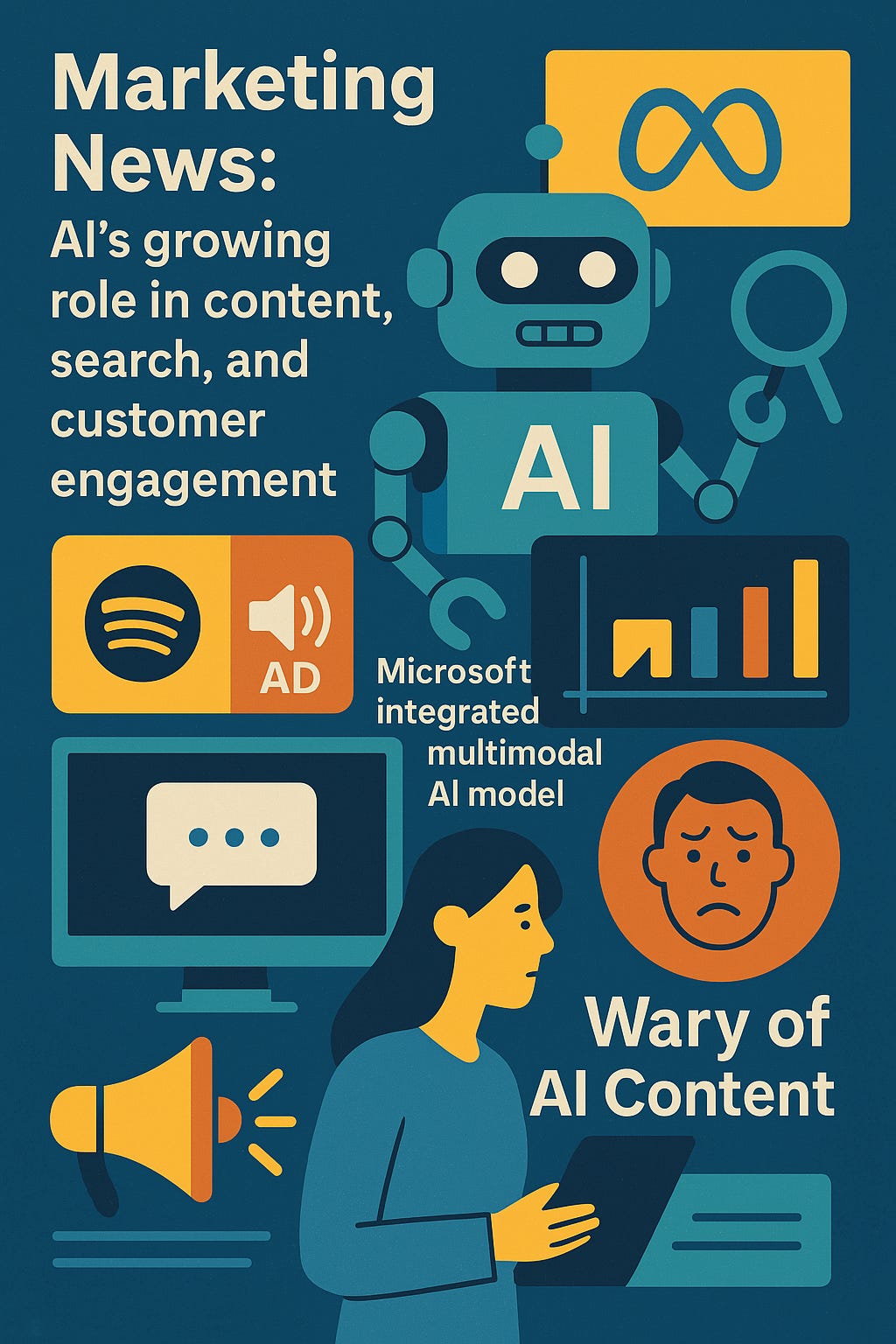
Sorry I'm a bit later than usual with today's newsletter! Had a busy weekend, including running a 54 kilometre race at the weekend 😅. Now back to business...Today's marketing news highlights AI's growing role in content, search, and customer engagement. Spotify unveiled an AI-driven ad platform, Microsoft integrated conversational AI into Bing search, and Meta open-sourced a powerful new multimodal AI model. Meanwhile, studies show consumers and the public remain wary of AI content, underscoring the need for transparent, strategic implementation in marketing.Story #1: Spotify Officially Launches Ad Exchange, New AI Tools, and MoreFull Title: Spotify Officially Launches Ad Exchange, New AI Tools, and More – Digital Music News, 4 April 2025 Publication Date: 4 April 2025What Happened:Spotify "doubled down on its advertising expansion by launching…a fresh ad exchange and a collection of AI tools", formally unveiling them at its Advance event. The Spotify Ad Exchange opens the platform's audio ad inventory to programmatic buyers, while new AI tools help advertisers create and target ads more effectively.Why It Matters:For marketers, Spotify's move represents the growing integration of AI in adtech. AI-driven ad creation and audience targeting can significantly improve campaign efficiency on audio platforms. As streaming services expand ad offerings, brands have fresh opportunities to reach engaged listeners with personalised content.Suggested Actions:Experiment with Spotify's Ad Exchange for programmatic audio ads. Leverage the AI tools (e.g. for auto-generated ad copy or audience segments) to optimise messaging for Spotify's free-tier listeners. Monitor performance closely – AI can enhance ad relevance, but human oversight ensures brand voice and context align.Read the original articleStory #2: Microsoft Launches Copilot Search in BingFull Title: Microsoft Launches Copilot Search in Bing – Search Engine Journal, 4 April 2025 Publication Date: 4 April 2025What Happened:Bing's new Copilot Search combines an AI-powered summary at the top of results with links to sources for verification. Users can type natural language queries and receive a concise answer generated by Bing's GPT-4-based AI, with the option to expand or see full web results. This rollout follows Microsoft's integration of OpenAI technology across its products.Why It Matters:This marks a significant shift in search engine UX. Marketers must understand that searchers may get instant answers (with citations) rather than clicking through to websites. SEO strategies should adapt: focusing on providing content that AI summaries will draw from (ensuring accurate snippets) and optimising for Bing's growing user base. It also underscores Google's competition in search – Bing's innovation pressures Google's own AI features.Suggested Actions:Test your key search queries on Bing Copilot to see how your content is summarised or cited. Ensure your site's SEO is strong for Featured Snippet-like AI answers – use clear, factual paragraphs that Bing can easily digest. Consider adjusting content to address conversational questions directly. Additionally, keep an eye on Bing's traffic share; if Copilot gains popularity, allocating some SEM budget to Bing Ads could yield high ROI as fewer competitors may be optimising there.Read the original articleStory #3: Studies Reveal Consumers Easily Detect AI-Generated ContentFull Title: Studies Reveal Consumers Easily Detect AI-Generated Content – Search Engine Journal, 3 April 2025 Publication Date: 3 April 2025What Happened:Two separate studies were published examining consumer perceptions of AI-created media. Key findings: the majority of readers and viewers recognise AI content, and older decision-makers (45–65) are especially critical of it. Almost half of consumers surveyed (40.4%) said they'd view brands more negatively if they use a lot of AI-generated content, while only ~10% would view them more favourably. In short, "writers and brands aren't sneaking AI-generated content past readers".Why It Matters:This is a wake-up call for content marketers enthusiastically adopting generative AI. Brand trust and authenticity are at stake. If customers feel content is robot-made, it may erode engagement and brand perception. Marketers targeting B2B or older demographics should be particularly cautious, as these audiences are both adept at spotting AI and prone to distrust it. The research underscores that while AI can boost productivity, human creativity and transparency remain crucial.Suggested Actions:Use AI creation tools sparingly and strategically. For public-facing content, prioritise human touch: let AI handle drafts or data analysis, but have humans refine tone and add unique insights. Be transparent when appropriate – if AI assists in content, a brief note can preempt skepticism. Double down on quality control: ensure AI content is vetted for accuracy and originality to avoid the "cheap AI" feel. Finally, consider mixing formats – for instance, if AI helps write an article, include human elements like personal anecdotes or design a human-curated infographic, reinforcing authenticity.Read the original articleStory #4: Public vs. Experts: Big Gap in AI Optimism, Pew Survey FindsFull Title: Public vs. Experts: Big Gap in AI Optimism, Pew Survey Finds – PCMag, 5 April 2025 Publication Date: 5 April 2025What Happened:Pew's study surveyed both artificial intelligence researchers and everyday U.S. adults about AI's future. The results: experts are largely optimistic, citing AI's benefits in efficiency, healthcare, etc., whereas most non-experts are anxious about job losses, privacy, and societal disruption. Notably, even among AI specialists, optimism varied by gender – male experts were far more bullish on AI's upsides than female experts. The public's top concerns included AI's influence on jobs and elections (over 90% see negative impacts in elections).Why It Matters:Marketers need to bridge the "AI trust gap." If you're rolling out AI-based services or campaigns, your tech-savvy team might be confident in the innovation, but your customers may not share that confidence. Messaging that simply touts AI's greatness could backfire with a skeptical public. Instead, education and empathy are key. This also indicates potential regulatory and reputational challenges – public wariness can lead to calls for stricter oversight on AI uses (like data handling or deepfakes), directly affecting marketing practices.Suggested Actions:When introducing AI-driven features (chatbots, personalisation engines, etc.), communicate benefits in relatable terms, not just tech marvels. Show customers how AI helps them (faster service, better recommendations) to alleviate fear. Provide easy opt-outs or human support alternatives to those uncomfortable with AI. Gathering feedback is crucial: conduct surveys or social listening to gauge audience sentiment about AI in your offerings. Internally, ensure diverse perspectives (including women in tech teams) are considered when assessing AI initiatives – the differing optimism levels even among experts suggest blind spots to avoid. By proactively addressing concerns and highlighting human oversight, marketers can build trust in an AI-enhanced future.Read the original articleStory #5: Shipping Giant Invests €100M in AI Partnership for Customer ServiceFull Title: Shipping Giant Invests €100M in AI Partnership for Customer Service – Reuters, 6 April 2025 Publication Date: 6 April 2025What Happened:CMA CGM (the world's third-largest container shipper) and Paris-based Mistral AI unveiled a major collaboration aimed at boosting efficiency with home-grown AI. The shipping company will fund Mistral up to €100M to integrate the startup's AI tools. Initial targets include slashing response times for the 1 million customer emails CMA CGM's support team handles weekly, by using AI assistants to help route and answer queries. Mistral's tech will also be applied to CMA CGM's media outlets (like news channel BFM TV) for automated fact-checking of content. The CEOs of both firms touted this as a win for European AI innovation amid global tech tensions.Why It Matters:This story exemplifies AI's expanding role beyond Big Tech – into traditional industries and customer experience. Marketers should note that even B2B/logistics companies are embracing AI to improve client interactions. Faster customer service through AI can elevate satisfaction and brand reputation in any sector. It also signals that competitive advantage is increasingly tied to AI capabilities: CMA CGM is effectively future-proofing its business and differentiating on service. For marketing teams, having ops or support powered by AI can become a selling point (e.g. "quick, 24/7 responses"). Additionally, the partnership highlights a trend of enterprises partnering with specialized AI startups to accelerate adoption, rather than building everything in-house.Suggested Actions:Evaluate repetitive, high-volume customer touchpoints (emails, chats, FAQs) where AI assistants could improve speed and consistency. Pilot an AI chatbot or email triage system on a subset of inquiries; measure response times and customer feedback. If your organisation lacks AI expertise, consider partnerships or SaaS solutions (as CMA CGM did) – align with a vendor who understands your industry's nuances. Importantly, keep humans in the loop for oversight: use AI to augment human support, not replace it entirely, so complex or sensitive issues still get the human touch. Finally, marketers should collaborate with customer service teams when rolling out AI support, ensuring the brand voice and empathy carry through in AI-driven interactions.Read the original articleStory #6: Meta Open-Sources Multimodal Llama 4 ModelsFull Title: Meta Open-Sources Multimodal Llama 4 Models – Reuters, 5 April 2025 Publication Date: 5 April 2025What Happened:Late Saturday, Meta (Facebook's parent) announced its next-gen AI model "Llama 4". It comes in two versions: Llama 4 Scout and Llama 4 Maverick, touted as Meta's "most advanced models yet". These models are multimodal, meaning they can ingest and output different data types (text, images, etc.), unlike most earlier text-only LLMs. Meta is releasing both under an open-source license, inviting researchers and developers to build upon them. They also teased Llama 4 Behemoth, an upcoming larger model intended to serve as a "teacher" for future AI training. This move comes as Meta reportedly spent $65 billion this year on AI infrastructure, racing to keep up with rivals like OpenAI and Google.Why It Matters:For digital marketers and AI developers, open-source models mean more innovation and customisation. Unlike closed models (e.g. OpenAI's GPT-4), Llama 4 can be fine-tuned for specific business needs without as many restrictions. Marketers could soon see a wave of new AI tools built on Llama 4 – from content creation assistants that handle images and text simultaneously, to analytics tools that interpret mixed media. Multimodality is a game-changer: imagine AI that can draft ad copy, generate a product photo, and even produce a voiceover, all in one system. Meta's open approach might also lead to cost-effective AI solutions (no API fees). However, open source also means responsibility for ethical use: companies adopting Llama 4 must implement guardrails for accuracy and appropriateness.Suggested Actions:Tech-savvy marketing teams should follow projects built on Llama 4 – there may be early opportunities to pilot tools for content generation, social media management or AV production using this model. If you have developer resources, you might even fine-tune Llama 4 on your own data (e.g. train it on your product info to create a custom chatbot). Start brainstorming use cases where a multimodal AI could streamline your workflow (for example, generating draft social posts with images included). On the flip side, update your AI governance policies: open models can be powerful but unpredictable, so establish guidelines on their use (fact-check outputs, avoid sensitive content generation, etc.). By embracing open-source AI cautiously, marketers can stay at the cutting edge without courting disaster.Read the original articleIn-Depth Analysis: AI's Growing Influence and the Road AheadThe above developments underscore an overarching trend: AI is rapidly weaving itself into every facet of marketing and digital business, from creative production and customer outreach to the underlying tools and platforms we rely on. A few key themes emerge:1. Mainstream Platforms Turning to AIEstablished marketing channels are being supercharged with AI capabilities. Spotify's launch of an AI-enhanced ad exchange demonstrates that even traditionally human-driven domains (like creative advertising and media buying) are embracing automation and machine learning. Similarly, Microsoft's integration of Copilot AI into Bing search shows that AI-generated content (in this case, answer summaries) is becoming a standard feature, not a novelty. For marketers, this means the playing field is evolving – those who learn to leverage these AI augmentations (be it using Spotify's new tools for finely targeted audio ads, or optimising content for AI-driven search results) will have an edge. The cost of ignoring AI in these platforms is rising, as competitors who do adapt will capture audience attention more efficiently.2. Cautionary Signals – Trust and PerceptionIt's not all enthusiasm; the research on consumer and public perceptions of AI throws a dose of cold water on unchecked AI optimism. The fact that a large portion of consumers can detect AI content and may lose trust in brands using it is a critical insight. This indicates that marketers must use AI thoughtfully – audiences still value human authenticity. Likewise, the Pew survey's gap between expert and public opinion on AI suggests potential disconnects in messaging. Tech companies (and by extension, marketing teams promoting AI-driven products) often assume consumers will welcome innovation that experts laud, which is clearly not always the case. Therefore, effective communication around AI is becoming as important as the technology itself. Education, transparency, and addressing fears will need to accompany any AI rollout in marketing or customer experience.3. Big Investments for Big ReturnsOn the flip side of skepticism, we see companies investing heavily in AI's promise. The CMA CGM–Mistral partnership, with its €100M commitment, is a bold bet that AI will significantly improve operational efficiency and customer satisfaction. Meta's billions poured into AI R&D and the open-sourcing of Llama 4 underscore that major players view AI as a long-term strategic asset, not a short-term experiment. For the marketing industry, these moves herald a future where AI capabilities could become a competitive differentiator. Just as fast internet or mobile-friendly design became standard over time, AI-driven personalisation, chatbots, and content generation might soon be baseline expectations from consumers. Marketers should anticipate this and, where feasible, invest in building their own AI competencies – whether through partnerships, hiring talent, or training existing teams.4. The Intersection of AI and StrategyAnother takeaway is that implementing AI is not just a tech upgrade, but a strategic endeavour. Christopher Penn's discussion on deductive vs. inductive reasoning in AI strategy (from his Almost Timely newsletter) illustrates that organisations need a framework for deciding where AI can be most useful. Many businesses are dabbling with obvious use cases (e.g. auto-writing social media posts), but the real gains may come from less glamorous applications like automating internal processes, improving data analysis, or enhancing customer service workflows (exactly what CMA CGM is targeting). In essence, a successful AI adoption requires aligning AI's strengths to business goals – a lesson marketers and business leaders are digesting in 2025. The news of this week shows both trial (e.g. Bing trying AI in search, seeing how users react) and conviction (Meta and CMA CGM going all-in), indicating that we're in a period of active learning and adjustment.Looking ahead, we can expect acceleration on all these fronts. AI models will continue to get more powerful and accessible (especially with open-source contributions), meaning smaller companies can deploy advanced AI without prohibitive costs. At the same time, public opinion and regulatory scrutiny will shape how freely marketers can use AI – we may see guidelines on labeling AI-generated content or industry standards for AI ethics emerging to address the trust gap. Marketers stand at the crossroads of innovation and responsibility: those who find the right balance will not only captivate consumers with personalised, efficient experiences, but also earn their long-term loyalty by respecting the human element. In summary, the trend is clear – AI in marketing is moving from experimental to essential, and navigating its opportunities and challenges will be a defining skill set for marketing professionals in 2025 and beyond.Key Takeaways for Marketers* Blend AI with Human Touch: Leverage AI tools (for ads, content, customer service) to scale your marketing, but don't remove the human element. Maintain transparency about AI use and have human oversight to ensure quality and trust. This hybrid approach maximises efficiency without alienating your audience.* Adapt SEO and Content Strategies to AI Search: With search engines like Bing integrating AI answers, optimise your content for both algorithms and AI summarisation. Provide clear, factual information in your copy that AI can pick up, and continue to focus on authority and relevance – these will drive whether your brand is featured in those AI-driven results.* Monitor Audience Sentiment on AI: Keep a pulse on how your target customers feel about AI through surveys, feedback, and social listening. If you plan to introduce an AI-driven feature (chatbot, personalisation, etc.), craft messaging that addresses common fears (privacy, job displacement, etc.) and highlights the benefits. An informed and comforted customer is more likely to embrace your AI innovations.* Upskill and Partner for AI Advantages: Don't wait to build AI capability. Invest in training your team on new AI marketing tools (from ad platforms to analytics) so you can use them ahead of competitors. Where appropriate, consider partnerships with AI firms or vendors – as seen with CMA CGM, a smart collaboration can accelerate your AI journey and yield rapid ROI in improved customer experience.How-To Spotlight: Implement AI in Marketing (Without Losing Customer Trust)Implementing AI can supercharge your marketing – but it must be done carefully to maintain credibility. Here's a step-by-step guide to integrate AI into your marketing workflow while keeping consumers on side:* Start Behind the Scenes: Begin by using AI for internal support tasks rather than direct customer-facing content. For example, deploy AI to analyze data, generate reports, or draft internal outlines. This lets your team reap AI's efficiency benefits (faster research, number-crunching, etc.) without immediately raising external concerns about "robot-made" content.* Humanise the Output: When you do use AI for content creation (blog posts, social media captions, image generation), always have a human in the loop. Treat AI output as a first draft. Let your content team edit for tone, accuracy, and brand voice. This ensures the final material feels authentic and high-quality – studies show consumers respond better to polished, human-reviewed content over raw AI text.* Be Transparent (Selectively): Decide when and how to disclose AI involvement. As a rule of thumb, if AI directly creates something significant that your audience will see, consider a brief disclosure. For instance, an email might note "Assisted by AI" in the footer. Honesty can preempt the feeling of being "tricked" and can actually boost trust if framed properly ("we use cutting-edge tools to serve you better"). However, there's no need to over-share – use discretion so the message remains focused on benefits, not the sausage-making.* Test Audience Comfort Levels: Gradually introduce AI-driven elements and gather feedback. You might A/B test an AI-written vs. human-written social post to see engagement differences. Solicit feedback via surveys ("How do you feel about our new chatbot service?"). This data will highlight if your customers are noticing or caring about the AI aspect. If sentiment is positive or neutral, you can confidently expand AI use; if negative, invest more in communication and refinement.* Iterate and Educate: Based on feedback, refine your approach. Maybe your audience is fine with AI product recommendations but hates AI-written thought leadership articles – adjust accordingly. Educate your customers about the value of the AI features you deploy. For example, explain that your AI recommendation engine means they see products they truly want faster. By focusing on user benefit and keeping an open dialogue, you turn AI implementation into a collaborative improvement rather than a top-down change.By following these steps, you can harness AI to enhance your marketing efficiency and personalisation while keeping your audience's trust intact. The key is a balanced approach: AI is a tool, and like any tool, its effectiveness comes down to the craftsman. Blend innovation with empathy, and you'll navigate the AI revolution with marketing success.Subscribe to our daily updates: https://indexify.substack.com/ and listen to our podcast: https://indexify.substack.com/podcast Get full access to Jon’s Substack at indexify.substack.com/subscribe
Embed this episode
Ready to play
AI Marketing Pulse: Key Developments from Sunday, April 6, 2025
No transcript for this episode yet
Similar Episodes
No similar episodes found.