
EPISODE · May 9, 2025 · 11 MIN
AI Marketing Pulse: Key Developments from Thursday, May 8, 2025
from Daily Marketing Insights Podcast · host Jon
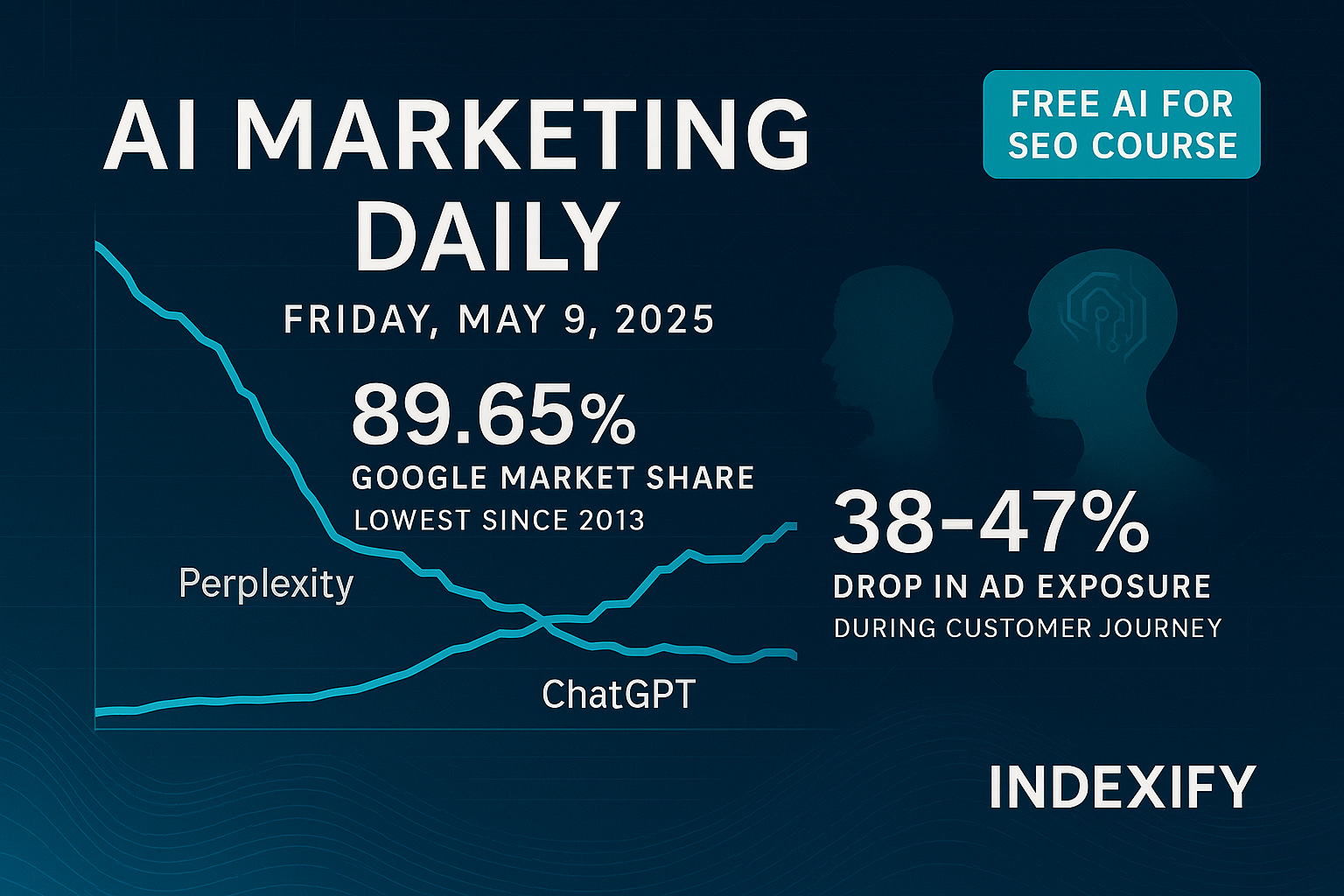
Today's briefing examines how AI platforms are fundamentally reshaping search and advertising, with new data showing Google's market share falling to its lowest point in over a decade. We explore the impact of AI Overviews on entertainment, travel, and restaurant queries; analyse how AI agents are changing consumer journeys; and provide critical insights about what these transformations mean for your marketing strategy. We also share important news about AI influencer risks to brand reputation.A Note to Our ReadersWhile we typically focus exclusively on news published within the last 24 hours, today's newsletter includes some slightly older but highly relevant developments (all published within the past week). This expanded scope ensures you receive the most comprehensive analysis of current AI marketing trends that will impact your immediate decision-making. All publication dates are clearly marked for transparency.Story #1: How AI Is Changing Search and Advertising - New Market Share Data ReleasedPublication: DigidayDate: May 8, 2025 (Yesterday)URL: https://digiday.com/marketing/in-graphic-detail-how-ai-is-changing-search-and-advertising/What Happened: According to newly released StatCounter data, Google's global search market share fell to 89.65% in April 2025 — the lowest since 2013. Meanwhile, AI search platforms continue gaining traction, with Google's AI Overviews now reaching 1.5 billion monthly users. The report also reveals that Perplexity grew from 2.5 million monthly searches in January 2024 to 20 million by December, while an estimated 37.5 million daily search-like queries now flow through ChatGPT.Why It Matters: This data provides concrete evidence of the gradual shift away from traditional search engines towards AI-mediated information discovery. For marketers, this represents both a threat to established traffic acquisition channels and an opportunity to engage with emerging AI platforms. The report indicates this transition is accelerating faster than many anticipated, making adaptation an urgent priority.Suggested Actions:* Develop separate strategies for traditional search and AI platforms, recognising their different optimisation requirements* Begin testing visibility in emerging AI search platforms like Perplexity and ChatGPT to understand what content performs wellStory #2: AI Influencer Marketing Poses Risks to Brand Trust, New Research FindsPublication: Northeastern University NewsDate: May 8, 2025 (Yesterday)URL: https://news.northeastern.edu/2025/05/08/ai-influencer-marketing-brand-trust/What Happened: Research published yesterday by Northeastern University found that AI-powered influencers pose a greater risk to brand reputation than their human counterparts. The study, led by associate professor Sian Joel-Edgar, concludes that when virtual influencers fail to deliver on product promises or experience issues, consumers are more likely to blame and distrust the brand itself rather than the AI personality, unlike with human influencers where blame is often shared.Why It Matters: As brands increasingly experiment with virtual influencers to reduce costs and maintain control over messaging, this research highlights significant reputational risks that may outweigh the benefits. The findings suggest that while AI influencers might seem like an innovative marketing approach, they fundamentally change how consumers assign responsibility for negative experiences.Suggested Actions:* Approach AI influencer partnerships with caution, ensuring robust crisis management plans are in place* Consider hybrid approaches where AI influencers are clearly associated with human brand representatives who can share accountabilityStory #3: NEA Hands Social Media Remit to FiftyFull for Clean & Green SingaporePublication: MARKETECH APACDate: May 8, 2025 (Yesterday)URL: https://marketech-apac.com/nea-hands-social-media-remit-to-fiftyfull-for-clean-green-singapore/What Happened: Singapore's National Environment Agency (NEA) has appointed FiftyFull as its social media agency for the Clean & Green Singapore (CGS) initiative. The agency will be responsible for creating AI-enhanced, culturally relevant content across various platforms to drive environmental awareness and community engagement. This follows a competitive pitch where FiftyFull's AI-driven creative approach demonstrated superior ability to personalise environmental messaging.Why It Matters: This partnership exemplifies how government agencies are embracing AI-powered marketing to enhance public engagement on critical issues. The collaboration highlights the growing importance of combining AI capabilities with culturally nuanced content creation, setting a benchmark for how public sector marketing can leverage technology while maintaining authentic connections with citizens.Suggested Actions:* Study FiftyFull's approach of combining AI efficiency with cultural relevance as a model for balancing automation and authenticity* Explore how similar AI-enhanced approaches might improve engagement for public information campaigns in other sectorsStory #4: AI Max for Search Campaigns Officially LaunchesPublication: Inside AdWords (Google)Date: May 6, 2025 (Earlier this week)URL: https://blog.google/products/ads-commerce/google-ai-max-for-search-campaigns/What Happened: Google has officially launched AI Max for Search campaigns, bringing advanced Gemini-powered capabilities to search advertising. The system introduces smart search term matching that expands keyword targeting based on the context of advertisers' assets and landing pages, plus improved asset optimisation that dynamically generates ad creative tailored to specific user queries.Why It Matters: This significant update signals Google's strategic pivot away from rigid keyword matching towards more conversational, intent-based advertising. Marketers will need to adapt to a system where AI interprets both user intent and advertiser offerings more holistically, moving beyond traditional keyword strategies that have defined search marketing for decades.Suggested Actions:* Begin testing AI Max for Search in parallel with traditional campaigns to measure performance differences* Ensure landing pages contain rich, detailed information that AI systems can interpret to better match your ads with relevant queriesStory #5: In Graphic Detail: AI Agents Could Cause 38-47% Drop in Ad Exposure During Customer JourneyPublication: DigidayDate: May 8, 2025 (Yesterday)URL: https://digiday.com/marketing/in-graphic-detail-how-ai-is-changing-search-and-advertising/What Happened: A recent eMarketer report cited in yesterday's Digiday article estimates that AI agents could cause a 38% drop in ad exposure during the discovery phase of the consumer journey, a 47% decrease during consideration, and a 30% reduction at conversion. This is leading marketers to shift focus toward optimising product feeds and direct integrations with AI agents instead of relying solely on paid ads.Why It Matters: These figures represent a potential seismic shift in digital advertising effectiveness. The traditional model of intercepting consumers with ads during their search and consideration process may become significantly less viable as AI agents increasingly mediate these interactions, requiring brands to fundamentally rethink how they achieve visibility in an AI-first environment.Suggested Actions:* Invest in direct integrations with emerging AI platforms and ensure product data is structured for AI consumption* Develop measurement frameworks that capture brand mentions and recommendations within AI systems rather than focusing exclusively on traditional ad impressionsComprehensive Analysis: The AI-Mediated Marketing LandscapeThe most significant insight from our research this week is clear: AI isn't just changing marketing tools—it's fundamentally reshaping how consumers discover and interact with brands. The StatCounter data showing Google's declining market share, coupled with the rise of AI search platforms, provides concrete evidence that the information discovery paradigm is shifting more rapidly than many anticipated.This transformation is creating several interrelated challenges for marketers:First, the traditional search engine optimisation approach—focused on ranking for specific keywords in traditional search engines—is becoming just one component of a more complex visibility strategy. Brands now need to consider how they appear in AI-generated answers, whether their products are recommended by AI agents, and how they maintain visibility when consumers increasingly rely on AI intermediaries rather than direct brand interactions.Second, the advertising model itself faces disruption. The eMarketer projection of significantly reduced ad exposure across the consumer journey suggests that traditional digital advertising may become less effective as AI agents increasingly mediate purchasing decisions. This doesn't mean advertising will disappear, but rather that it may need to evolve toward influencing AI systems or creating strong brand associations that survive the AI filtering process.Third, even seemingly innovative approaches like AI influencers carry new risks. The Northeastern University research on brand trust highlights that employing virtual influencers may fundamentally change how consumers assign responsibility for negative experiences, potentially increasing brand vulnerability rather than reducing it.For marketers, these developments necessitate a dual focus: optimising for today's reality while preparing for an accelerating transition to AI-mediated discovery and decision-making. This means investing in both traditional SEO and emerging AI optimisation techniques, developing content that serves both human readers and AI knowledge systems, and reconsidering how advertising budgets are allocated across an increasingly fragmented attention landscape.Key Takeaways* AI's impact on search is accelerating — With Google's market share at its lowest point in a decade and AI search platforms gaining traction, brands must develop parallel strategies for traditional and AI-mediated search.* Ad effectiveness faces significant challenges — As AI agents increasingly mediate consumer journeys, traditional digital advertising may see reduced visibility, requiring new approaches to reaching consumers through AI systems.* Virtual influencers carry hidden risks — Research shows that AI influencers may actually increase brand vulnerability, as consumers attribute failures more directly to the brand rather than the virtual personality.* AI-enhanced creativity remains valuable — As seen in the NEA's partnership with FiftyFull, combining AI capabilities with human creativity and cultural understanding creates compelling engagement opportunities.How-To Spotlight: Optimising for AI Search VisibilityA recent WordStream guide (published May 1, 2025) shares practical approaches for gaining visibility in AI search platforms based on analysis of successful content patterns. The key recommendations include:* Focus on comprehensive answers — AI systems prioritise content that thoroughly addresses specific questions rather than content optimised for keyword density.* Structure content for data extraction — Clear headings, numbered lists, and tabular data make information more accessible to AI systems and increase the likelihood of being referenced.* Emphasise E-E-A-T signals — Experience, expertise, authority, and trustworthiness remain critical factors in AI systems' evaluation of content quality.The guide particularly emphasises that while traditional SEO still matters, AI search often prioritises different signals, requiring a more nuanced approach to content development and optimisation.To help marketers implement these AI advances, we've launched a free beta version of our AI for SEO course at https://seoaicourse.indexify.co/ - get access now while it remains free during the beta period.Subscribe to our daily updates: and listen to our podcast: https://indexify.substack.com/podcast Get full access to Jon’s Substack at indexify.substack.com/subscribe
Embed this episode
Ready to play
AI Marketing Pulse: Key Developments from Thursday, May 8, 2025
No transcript for this episode yet
Similar Episodes
No similar episodes found.