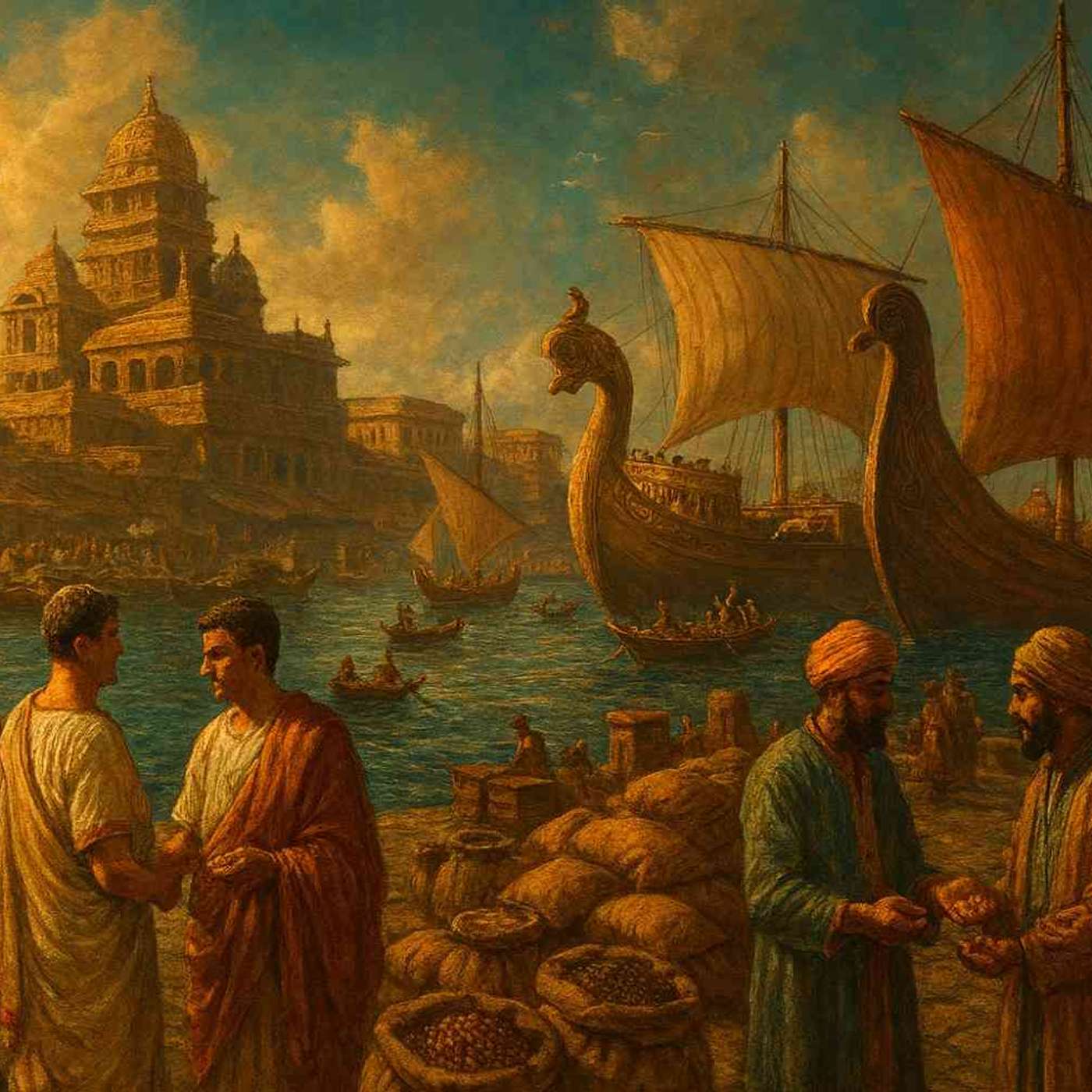
Ancient India Trade Routes: The 2000-Year-Old Document That Proves Vasco da Gama Did Not Discover India episode artwork

EPISODE · May 16, 2026 · 23 MIN

Ancient India Trade Routes: The 2000-Year-Old Document That Proves Vasco da Gama Did Not Discover India

from Incredible India Travel | Social Impact & Culture Tours · host 5 Senses Tours | Cultural Experiences & Social Impact Guides

In 1498 Vasco da Gama sailed around the Cape of Good Hope, crossed the Indian Ocean and arrived at the port of Calicut on the Kerala coast.Western history calls this the discovery of India.There is a 2000-year-old document that destroys this claim completely.It was written in approximately 60 CE by a Greek-speaking Egyptian merchant who had almost certainly made the journey himself. It is called the Periplus of the Erythraean Sea. And it describes in specific, practical, commercially detailed language the ports, the goods, the merchants and the monsoon navigation of an India that was trading simultaneously with Rome, Arabia, China, Persia and East Africa fifteen centuries before Vasco da Gama appeared on the horizon at Calicut.When Vasco da Gama arrived at Calicut the Arab navigators who had helped him find his way across the Indian Ocean already knew the ancient India trade routes intimately. They had been sailing them for centuries. The ruler of Calicut received Vasco da Gama with polite curiosity rather than the astonishment of a people encountering the outside world for the first time. The merchants in the port had seen foreigners before. Many of them. For a very long time.What Vasco da Gama discovered was not India. What he discovered was a sea route from Europe to a place that the rest of the world had already been trading with for over a thousand years. The discovery was significant for Europe. It was entirely irrelevant to India.The Periplus of the Erythraean Sea proves this with the authority of two thousand years of documented history.In this episode we take you on the complete journey through ancient India's most extraordinary trade routes, from the port of Barygaza at the mouth of the Narmada River in Gujarat that had been trading with Egypt before Rome existed as a city, to Muziris on the Kerala coast where Roman gold arrived and Indian pepper departed in quantities so enormous that Pliny the Elder complained they were destabilising the Roman economy, to Poompuhar on the Tamil Nadu coast where the Tamil epic Silappatikaram describes a city so cosmopolitan that merchants from Rome, Arabia, China and Southeast Asia lived alongside Tamil traders simultaneously, to Arikamedu near Puducherry where Roman Arretine pottery the premium tableware of the Roman aristocracy is still coming out of the ground two thousand years after the Roman merchants who brought it there left it behind.We tell the complete story of each ancient India trade route port, the goods that were traded there, the merchants who came from across the known world to conduct their business, the monsoon winds that made the journey possible and the extraordinary evidence that archaeology has produced to confirm what the Periplus documented in words.And we explain why every single one of these ancient India trade route ports is a real visitable destination in India today.What You Will Discover in This EpisodeWhat the Periplus of the Erythraean Sea actually is, why a Greek-speaking Egyptian merchant was writing a commercial handbook about Indian ports in 60 CE and why this single document is the most powerful rebuttal of the Vasco da Gama discovery myth ever writtenWhy Hippalus, the Greek merchant credited with discovering the monsoon trade winds, almost certainly learned about them from Indian sailors who had been using them for centuries to cross the Indian Ocean in both directions, and what the Periplus itself says about large Indian vessels off the coasts of East Africa and ArabiaThe full story of Barygaza, the ancient India trade route port now known as Bharuch in Gujarat, that the Periplus describes as the principal distributing centre of western India, whose commercial history goes back to the days of the Pharaohs and whose trade connections extended simultaneously to Egypt, Rome, Persia, Arabia and East AfricaWhy the Periplus warns ancient ship captains about the dangerous tidal bores at the mouth of the Narmada River at Bharuch, how local pilots would come out to meet arriving vessels and guide them in safely, and what specific goods the local ruler expected as gifts and was most interested in purchasingThe extraordinary story of Muziris on the Kerala coast, the ancient India trade route port established by at least 3000 BCE that Tamil poets described as the city where Roman ships arrived with gold and departed with pepper, and why Pliny the Elder complained in Rome that the Indian pepper trade was draining Roman gold reserves at a rate that threatened the imperial economyWhat the excavations at Pattanam near Kodungallur in Kerala have produced since 2006, including Roman amphorae, Mediterranean glass beads and a ring with a portrait of a Roman emperor, and what this physical evidence tells us about the commercial intensity of the ancient India trade routes through the Kerala coastThe sunken city of Poompuhar on the Tamil Nadu coast, the ancient Kaveripattinam described in the Periplus and in the Tamil epic Silappatikaram as one of the most cosmopolitan cities in the ancient world, where merchants from Rome, Arabia, China and Southeast Asia lived alongside Tamil traders and where marine archaeologists have discovered submerged structures at depths of up to 70 metres beneath the Bay of BengalThe Roman trading post at Arikamedu near Puducherry, where excavations have produced Roman Arretine ware, amphorae, lamps, glass and coins confirming the presence of Roman merchants living and trading on the Bay of Bengal coast of South India in the first and second centuries CETamralipti in West Bengal, the ancient India trade route port from which Emperor Ashoka sent his Buddhist missionaries to Sri Lanka in 250 BCE and from which the Chinese pilgrim Fa-Hien departed for China after years of studying Buddhist texts in India, carrying the manuscripts that would shape the development of Chinese Buddhism for centuriesThe extraordinary hidden heritage of the Maharashtra coast, where the ancient India trade route ports of Sopara, Kalyan and Chembur described in the Periplus are now buried beneath the suburbs of modern Mumbai, and why sitting in Mumbai traffic knowing that the Greek merchant who wrote the Periplus knew these places by name transforms the ordinary into something genuinely remarkableWhy the monsoon winds, the pepper trade, the Roman gold, the Buddhist missionaries and the Tamil poets together create a picture of ancient India as the most cosmopolitan, most commercially connected and most globally integrated civilisation in the ancient world, and why this picture is almost entirely absent from the way India presents itself to international touristsHow every ancient India trade route port in the Periplus is a real visitable destination today and how 5 Senses Tours brings the complete story to life for international travellers through expert guided heritage experiences across the full arc of the Indian coastline from Gujarat to BengalExperience the Ancient India Trade Routes With 5 Senses ToursEvery port described in this episode is standing in India right now. The mouth of the Narmada at Bharuch. The backwaters of Kerala near Kodungallur. The Bay of Bengal coast near Puducherry. The soil of Tamil Nadu from which Roman pottery continues to emerge. The river at Tamluk in West Bengal from which Ashoka's missionaries sailed to Sri Lanka.Ancient India's trade routes are not history in the sense of something finished and gone. They are geography. The same coastline. The same river mouths. The same monsoon winds. And the same extraordinary cultural depth waiting for the traveller who arrives with the complete story.Our Kochi tours bring the Muziris story to life through the complete Pattanam and...

In 1498 Vasco da Gama sailed around the Cape of Good Hope, crossed the Indian Ocean and arrived at the port of Calicut on the Kerala coast.Western history calls this the discovery of India.There is a 2000-year-old document that destroys this claim completely.It was written in approximately 60 CE by a Greek-speaking Egyptian merchant who had almost certainly made the journey himself. It is called the Periplus of the Erythraean Sea. And it describes in specific, practical, commercially detailed language the ports, the goods, the merchants and the monsoon navigation of an India that was trading simultaneously with Rome, Arabia, China, Persia and East Africa fifteen centuries before Vasco da Gama appeared on the horizon at Calicut.When Vasco da Gama arrived at Calicut the Arab navigators who had helped him find his way across the Indian Ocean already knew the ancient India trade routes intimately. They had been sailing them for centuries. The ruler of Calicut received Vasco da Gama with polite curiosity rather than the astonishment of a people encountering the outside world for the first time. The merchants in the port had seen foreigners before. Many of them. For a very long time.What Vasco da Gama discovered was not India. What he discovered was a sea route from Europe to a place that the rest of the world had already been trading with for over a thousand years. The discovery was significant for Europe. It was entirely irrelevant to India.The Periplus of the Erythraean Sea proves this with the authority of two thousand years of documented history.In this episode we take you on the complete journey through ancient India's most extraordinary trade routes, from the port of Barygaza at the mouth of the Narmada River in Gujarat that had been trading with Egypt before Rome existed as a city, to Muziris on the Kerala coast where Roman gold arrived and Indian pepper departed in quantities so enormous that Pliny the Elder complained they were destabilising the Roman economy, to Poompuhar on the Tamil Nadu coast where the Tamil epic Silappatikaram describes a city so cosmopolitan that merchants from Rome, Arabia, China and Southeast Asia lived alongside Tamil traders simultaneously, to Arikamedu near Puducherry where Roman Arretine pottery the premium tableware of the Roman aristocracy is still coming out of the ground two thousand years after the Roman merchants who brought it there left it behind.We tell the complete story of each ancient India trade route port, the goods that were traded there, the merchants who came from across the known world to conduct their business, the monsoon winds that made the journey possible and the extraordinary evidence that archaeology has produced to confirm what the Periplus documented in words.And we explain why every single one of these ancient India trade route ports is a real visitable destination in India today.What You Will Discover in This EpisodeWhat the Periplus of the Erythraean Sea actually is, why a Greek-speaking Egyptian merchant was writing a commercial handbook about Indian ports in 60 CE and why this single document is the most powerful rebuttal of the Vasco da Gama discovery myth ever writtenWhy Hippalus, the Greek merchant credited with discovering the monsoon trade winds, almost certainly learned about them from Indian sailors who had been using them for centuries to cross the Indian Ocean in both directions, and what the Periplus itself says about large Indian vessels off the coasts of East Africa and ArabiaThe full story of Barygaza, the ancient India trade route port now known as Bharuch in Gujarat, that the Periplus describes as the principal distributing centre of western India, whose commercial history goes back to the days of the Pharaohs and whose trade connections extended simultaneously to Egypt, Rome, Persia, Arabia and East AfricaWhy the Periplus warns ancient ship captains about the dangerous tidal bores at the mouth of the Narmada River at Bharuch, how local pilots would come out to meet arriving vessels and guide them in safely, and what specific goods the local ruler expected as gifts and was most interested in purchasingThe extraordinary story of Muziris on the Kerala coast, the ancient India trade route port established by at least 3000 BCE that Tamil poets described as the city where Roman ships arrived with gold and departed with pepper, and why Pliny the Elder complained in Rome that the Indian pepper trade was draining Roman gold reserves at a rate that threatened the imperial economyWhat the excavations at Pattanam near Kodungallur in Kerala have produced since 2006, including Roman amphorae, Mediterranean glass beads and a ring with a portrait of a Roman emperor, and what this physical evidence tells us about the commercial intensity of the ancient India trade routes through the Kerala coastThe sunken city of Poompuhar on the Tamil Nadu coast, the ancient Kaveripattinam described in the Periplus and in the Tamil epic Silappatikaram as one of the most cosmopolitan cities in the ancient world, where merchants from Rome, Arabia, China and Southeast Asia lived alongside Tamil traders and where marine archaeologists have discovered submerged structures at depths of up to 70 metres beneath the Bay of BengalThe Roman trading post at Arikamedu near Puducherry, where excavations have produced Roman Arretine ware, amphorae, lamps, glass and coins confirming the presence of Roman merchants living and trading on the Bay of Bengal coast of South India in the first and second centuries CETamralipti in West Bengal, the ancient India trade route port from which Emperor Ashoka sent his Buddhist missionaries to Sri Lanka in 250 BCE and from which the Chinese pilgrim Fa-Hien departed for China after years of studying Buddhist texts in India, carrying the manuscripts that would shape the development of Chinese Buddhism for centuriesThe extraordinary hidden heritage of the Maharashtra coast, where the ancient India trade route ports of Sopara, Kalyan and Chembur described in the Periplus are now buried beneath the suburbs of modern Mumbai, and why sitting in Mumbai traffic knowing that the Greek merchant who wrote the Periplus knew these places by name transforms the ordinary into something genuinely remarkableWhy the monsoon winds, the pepper trade, the Roman gold, the Buddhist missionaries and the Tamil poets together create a picture of ancient India as the most cosmopolitan, most commercially connected and most globally integrated civilisation in the ancient world, and why this picture is almost entirely absent from the way India presents itself to international touristsHow every ancient India trade route port in the Periplus is a real visitable destination today and how 5 Senses Tours brings the complete story to life for international travellers through expert guided heritage experiences across the full arc of the Indian coastline from Gujarat to BengalExperience the Ancient India Trade Routes With 5 Senses ToursEvery port described in this episode is standing in India right now. The mouth of the Narmada at Bharuch. The backwaters of Kerala near Kodungallur. The Bay of Bengal coast near Puducherry. The soil of Tamil Nadu from which Roman pottery continues to emerge. The river at Tamluk in West Bengal from which Ashoka's missionaries sailed to Sri Lanka.Ancient India's trade routes are not history in the sense of something finished and gone. They are geography. The same coastline. The same river mouths. The same monsoon winds. And the same extraordinary cultural depth waiting for the traveller who arrives with the complete story.Our Kochi tours bring the Muziris story to life through the complete Pattanam and...

NOW PLAYING

Ancient India Trade Routes: The 2000-Year-Old Document That Proves Vasco da Gama Did Not Discover India

0:00 23:28

No transcript for this episode yet

We transcribe on demand. Request one and we'll notify you when it's ready — usually under 10 minutes.

Breaking News Show | eTurboNews Juergen Thomas Steinmetz News is relevant to the global travel and tourism industry, human rights and global issues.Breaking news when it happens and only from the source. Solving for Change MOBIA Technology Innovations Solving for Change welcomes business and technology leaders to share stories of bold business transformation within complex organizations. In an era when technology and markets are changing around businesses, the key to staying competitive is to evolve in response to those changes.  MOBIA’s Mike Reeves and Marc LeBlanc investigate business transformation, deconstructing the challenges, ambitions, and market disruptions that drive companies to embark on transformation journeys, and exploring their unique approaches to achieving meaningful outcomes.  What sparks leaders to pursue business transformation? How do they overcome the challenges along the way? What are the keys to creating enduring change?  Through in-depth conversations with business and technology leaders, Mike and Marc answer these questions and explore how businesses evolve by pulling four key transformation levers: people, process, technology, and culture. Cool Story Bro TheSneakyBros Welcome to *Cool Story Bro*, a dynamic podcast hosted by TheSneakyBros, where gaming takes center stage. Join us for engaging discussions, insights, and stories about your favorite games and gaming culture. Tune in for an entertaining exploration of the virtual world! RAISING THE BAR MUSICHYPEBEAST The RAISING THE BAR Podcast is dedicated to providing a fresh and unconventional broadcast platform for the biggest names in music and entertainment.The interview insight provided by the staff of MUSICHYPEBEAST separates us from the pack. The passion of RAISING THE BAR podcast is fueled by Millennial Music culture. Hosted on Acast. See acast.com/privacy for more information.

Frequently Asked Questions

How long is this episode of Incredible India Travel | Social Impact & Culture Tours?

This episode is 23 minutes long.

When was this Incredible India Travel | Social Impact & Culture Tours episode published?

This episode was published on May 16, 2026.

What is this episode about?

In 1498 Vasco da Gama sailed around the Cape of Good Hope, crossed the Indian Ocean and arrived at the port of Calicut on the Kerala coast.Western history calls this the discovery of India.There is a 2000-year-old document that destroys this claim...

Can I download this Incredible India Travel | Social Impact & Culture Tours episode?

Yes, you can download this episode by clicking the download button on the episode player, or subscribe to the podcast in your preferred podcast app for automatic downloads.
URL copied to clipboard!