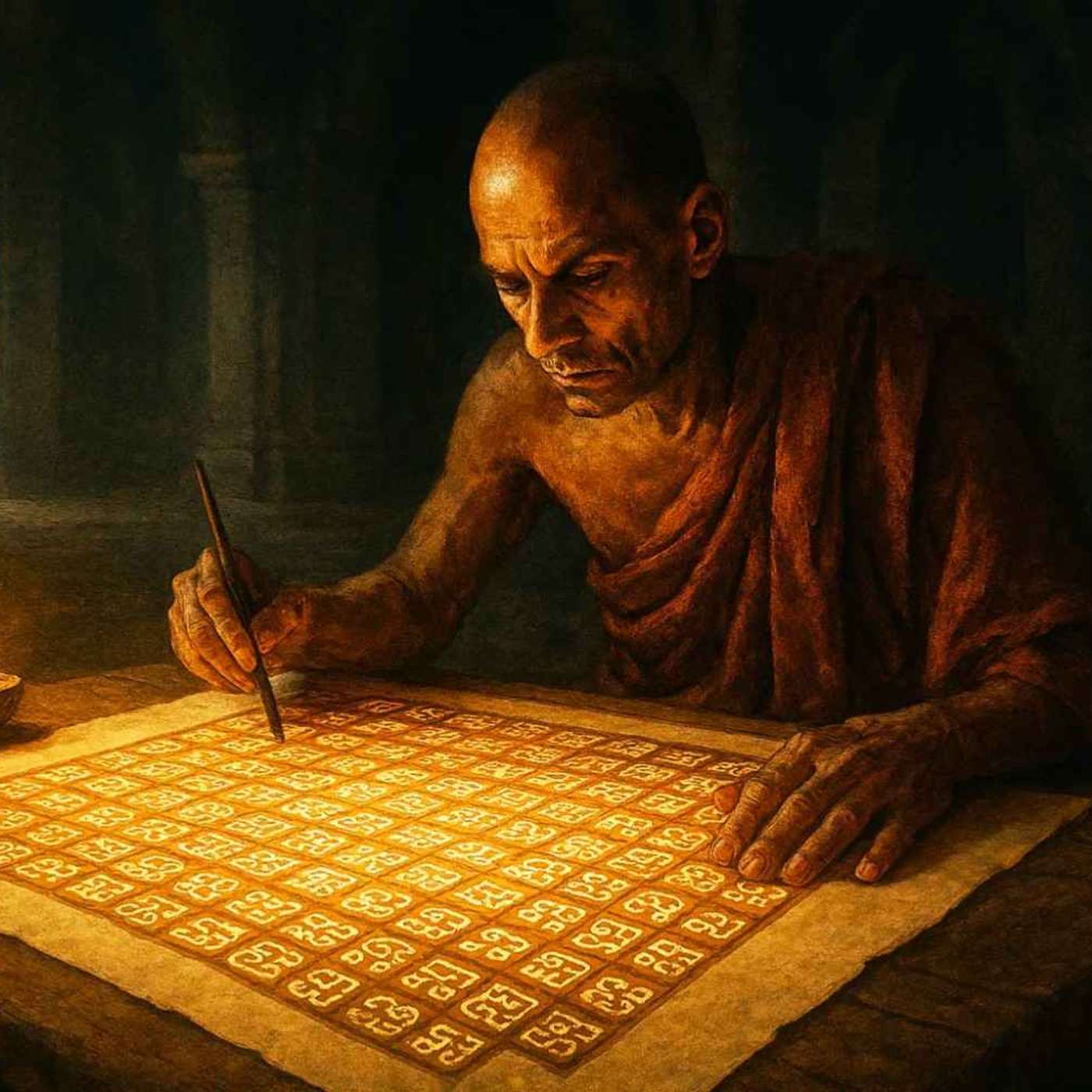
Ancient Karnataka Mathematicians: They Invented Calculus Before Europe Was Ready episode artwork

EPISODE · May 28, 2026 · 20 MIN

Ancient Karnataka Mathematicians: They Invented Calculus Before Europe Was Ready

from Incredible India Travel | Social Impact & Culture Tours · host 5 Senses Tours | Cultural Experiences & Social Impact Guides

Europe discovered calculus in the 17th century.A mathematician from Bijapur in Karnataka had described its foundational concepts five hundred years earlier.Europe developed modern algebra in the Renaissance.A Jain mathematician working under a Rashtrakuta king in Karnataka had already written the most comprehensive algebra textbook in the ancient world.Europe credits the decimal system to the Arabs.A mathematician from Karnataka was the first person in recorded human history to write numbers using the Hindu decimal system with a circle for zero.And in a monastery somewhere in ancient Karnataka, a Jain monk was constructing a 600,000-verse literary work encoded entirely in numerical ciphers, using substitution and transposition matrices so sophisticated that modern cryptographers have identified them as precursors to contemporary block cipher encryption. After a thousand years the work has still not been fully decoded.Four scholars. One Indian state. Contributions to mathematics, astronomy, algebra, calculus, cryptography and the decimal system that changed the intellectual history of the world.In this episode we tell the complete story of all four ancient Karnataka mathematicians and the extraordinary heritage landscape where their work was done.We begin with Bhaskara I, the 7th-century mathematician who was the first person in recorded human history to write a zero as a circle, the single most consequential notational innovation in the history of mathematics. Every calculation performed on every computer, every smartphone and every financial system on earth traces directly to the moment Bhaskara I placed a small circle in a Sanskrit manuscript in Karnataka in 629 CE.We continue with Mahavira, the 9th-century Jain mathematician who worked at the court of the Rashtrakuta king Amoghavarsha and wrote the Ganitasarasangraha, the first text in recorded human history devoted entirely to mathematics. Mahavira was the first person to separate mathematics from astrology and astronomy and present it as an independent intellectual discipline deserving treatment on its own terms. The modern university mathematics department owes its institutional existence to this act of intellectual separation performed in Karnataka in 850 CE.We tell the extraordinary story of Kumudendu Muni, a Jain monk who was a contemporary of Mahavira at the same Rashtrakuta court and who wrote a 600,000-verse literary work encoded entirely in Kannada numerals. The Siribhoovalaya, as it is called, uses 27 by 27 numerical matrices with substitution and transposition ciphers that modern cryptographers have identified as structurally related to contemporary block cipher encryption systems. Only three of its twenty-six chapters have been decoded after a thousand years of existence. The rest of its content, which is believed to include knowledge of mathematics, chemistry, physics, metallurgy, astronomy, medicine and history, remains locked inside the numerical matrices of a monk who died in ancient Karnataka over a thousand years ago.And we reach the peak of the entire Karnataka mathematical tradition with Bhaskara II, born in Bijapur in 1114 CE, the greatest mathematician of medieval India. Bhaskara II described foundational concepts of differential calculus, including instantaneous velocity, the derivative and functions approaching limits, five hundred years before Isaac Newton and Gottfried Leibniz. He stated that division by zero produces infinity nine hundred years before the mathematics of limits was formally developed. He named his most beloved mathematical textbook after his daughter Lilavati and wrote it as if speaking directly to her, creating the most accessible and the most beautiful mathematical text of the 12th century in the process.What You Will Discover in This EpisodeHow Bhaskara I became the first person in recorded human history to write a zero as a circle in a Sanskrit manuscript in Karnataka in 629 CE and why this single notational innovation is the foundation of every number system, every calculation and every digital technology used anywhere in the world todayWhy Bhaskara I's insistence on proving mathematical rules rather than simply using them on the authority of predecessors makes him genuinely modern in his mathematical methodology and why this demand for demonstrated proof rather than inherited authority is the epistemological foundation of modern scienceThe complete story of Mahavira and the Ganitasarasangraha of 850 CE, the first text in recorded human history devoted entirely to mathematics, and why the act of separating mathematics from astrology and astronomy was an intellectual claim of extraordinary significance whose consequences are still visible in the structure of modern academic mathematicsWhy Mahavira was the first mathematician to state explicitly that the square root of a negative number exists and why this claim, made in Karnataka in the 9th century, anticipates the imaginary number theory that European mathematicians would not formally develop until seven centuries laterThe complete extraordinary story of Kumudendu Muni and the Siribhoovalaya, the 600,000-verse work written entirely in numerical characters using 27 by 27 matrix ciphers that modern cryptographers have formally identified as precursors to contemporary block cipher encryption systems at the Indian Science Congress in 2020Why only three of the twenty-six chapters of the Siribhoovalaya have been decoded after a thousand years of existence and what the decoded sections suggest about the extraordinary range of scientific and literary knowledge encoded in the remaining twenty-three chapters that are still locked inside their numerical matricesThe complete story of Bhaskara II and his foundational contributions to calculus, five centuries before Newton and Leibniz, including his description of instantaneous velocity, his understanding of functions approaching limits and his statement that division by zero produces infinityThe poignant story of Lilavati, Bhaskara II's daughter, the pearl from her nose ring that fell into the water clock and stopped the auspicious moment of her wedding from being marked, and the extraordinary mathematical textbook her father wrote in her name to console her, the most advanced mathematics in the world in the 12th century addressed to a woman as if in personal conversationThe extraordinary connection between the four ancient Karnataka mathematicians and the Rashtrakuta dynasty's architectural achievement at the Ellora Caves, where the Kailashnath Temple carved from a single cliff face was commissioned by the same king who patronised Mahavira and Kumudendu MuniHow 5 Senses Tours brings the complete ancient Karnataka mathematicians heritage trail to life for international travellers through expert guided experiences across Bijapur, the Rashtrakuta heartland, the Ajanta and Ellora caves and the complete Deccan heritage circuitExperience the Ancient Karnataka Mathematicians Heritage Trail With 5 Senses ToursEvery place described in this episode is still standing in India today. The landscape of Bijapur where both Bhaskara I and Bhaskara II were born. The Rashtrakuta heartland of Gulbarga where Mahavira wrote the first mathematics textbook and Kumudendu Muni encoded his extraordinary cryptographic masterpiece. The Ellora Caves where the Kailashnath Temple stands as the architectural expression of the same cultural tradition that produced four of the most significant mathematicians in human history.Our Aurangabad tours cover the complete Deccan heritage circuit including the Ellora Caves, the Ajanta Caves and the complete Rashtrakuta heritage landscape at

Europe discovered calculus in the 17th century.A mathematician from Bijapur in Karnataka had described its foundational concepts five hundred years earlier.Europe developed modern algebra in the Renaissance.A Jain mathematician working under a Rashtrakuta king in Karnataka had already written the most comprehensive algebra textbook in the ancient world.Europe credits the decimal system to the Arabs.A mathematician from Karnataka was the first person in recorded human history to write numbers using the Hindu decimal system with a circle for zero.And in a monastery somewhere in ancient Karnataka, a Jain monk was constructing a 600,000-verse literary work encoded entirely in numerical ciphers, using substitution and transposition matrices so sophisticated that modern cryptographers have identified them as precursors to contemporary block cipher encryption. After a thousand years the work has still not been fully decoded.Four scholars. One Indian state. Contributions to mathematics, astronomy, algebra, calculus, cryptography and the decimal system that changed the intellectual history of the world.In this episode we tell the complete story of all four ancient Karnataka mathematicians and the extraordinary heritage landscape where their work was done.We begin with Bhaskara I, the 7th-century mathematician who was the first person in recorded human history to write a zero as a circle, the single most consequential notational innovation in the history of mathematics. Every calculation performed on every computer, every smartphone and every financial system on earth traces directly to the moment Bhaskara I placed a small circle in a Sanskrit manuscript in Karnataka in 629 CE.We continue with Mahavira, the 9th-century Jain mathematician who worked at the court of the Rashtrakuta king Amoghavarsha and wrote the Ganitasarasangraha, the first text in recorded human history devoted entirely to mathematics. Mahavira was the first person to separate mathematics from astrology and astronomy and present it as an independent intellectual discipline deserving treatment on its own terms. The modern university mathematics department owes its institutional existence to this act of intellectual separation performed in Karnataka in 850 CE.We tell the extraordinary story of Kumudendu Muni, a Jain monk who was a contemporary of Mahavira at the same Rashtrakuta court and who wrote a 600,000-verse literary work encoded entirely in Kannada numerals. The Siribhoovalaya, as it is called, uses 27 by 27 numerical matrices with substitution and transposition ciphers that modern cryptographers have identified as structurally related to contemporary block cipher encryption systems. Only three of its twenty-six chapters have been decoded after a thousand years of existence. The rest of its content, which is believed to include knowledge of mathematics, chemistry, physics, metallurgy, astronomy, medicine and history, remains locked inside the numerical matrices of a monk who died in ancient Karnataka over a thousand years ago.And we reach the peak of the entire Karnataka mathematical tradition with Bhaskara II, born in Bijapur in 1114 CE, the greatest mathematician of medieval India. Bhaskara II described foundational concepts of differential calculus, including instantaneous velocity, the derivative and functions approaching limits, five hundred years before Isaac Newton and Gottfried Leibniz. He stated that division by zero produces infinity nine hundred years before the mathematics of limits was formally developed. He named his most beloved mathematical textbook after his daughter Lilavati and wrote it as if speaking directly to her, creating the most accessible and the most beautiful mathematical text of the 12th century in the process.What You Will Discover in This EpisodeHow Bhaskara I became the first person in recorded human history to write a zero as a circle in a Sanskrit manuscript in Karnataka in 629 CE and why this single notational innovation is the foundation of every number system, every calculation and every digital technology used anywhere in the world todayWhy Bhaskara I's insistence on proving mathematical rules rather than simply using them on the authority of predecessors makes him genuinely modern in his mathematical methodology and why this demand for demonstrated proof rather than inherited authority is the epistemological foundation of modern scienceThe complete story of Mahavira and the Ganitasarasangraha of 850 CE, the first text in recorded human history devoted entirely to mathematics, and why the act of separating mathematics from astrology and astronomy was an intellectual claim of extraordinary significance whose consequences are still visible in the structure of modern academic mathematicsWhy Mahavira was the first mathematician to state explicitly that the square root of a negative number exists and why this claim, made in Karnataka in the 9th century, anticipates the imaginary number theory that European mathematicians would not formally develop until seven centuries laterThe complete extraordinary story of Kumudendu Muni and the Siribhoovalaya, the 600,000-verse work written entirely in numerical characters using 27 by 27 matrix ciphers that modern cryptographers have formally identified as precursors to contemporary block cipher encryption systems at the Indian Science Congress in 2020Why only three of the twenty-six chapters of the Siribhoovalaya have been decoded after a thousand years of existence and what the decoded sections suggest about the extraordinary range of scientific and literary knowledge encoded in the remaining twenty-three chapters that are still locked inside their numerical matricesThe complete story of Bhaskara II and his foundational contributions to calculus, five centuries before Newton and Leibniz, including his description of instantaneous velocity, his understanding of functions approaching limits and his statement that division by zero produces infinityThe poignant story of Lilavati, Bhaskara II's daughter, the pearl from her nose ring that fell into the water clock and stopped the auspicious moment of her wedding from being marked, and the extraordinary mathematical textbook her father wrote in her name to console her, the most advanced mathematics in the world in the 12th century addressed to a woman as if in personal conversationThe extraordinary connection between the four ancient Karnataka mathematicians and the Rashtrakuta dynasty's architectural achievement at the Ellora Caves, where the Kailashnath Temple carved from a single cliff face was commissioned by the same king who patronised Mahavira and Kumudendu MuniHow 5 Senses Tours brings the complete ancient Karnataka mathematicians heritage trail to life for international travellers through expert guided experiences across Bijapur, the Rashtrakuta heartland, the Ajanta and Ellora caves and the complete Deccan heritage circuitExperience the Ancient Karnataka Mathematicians Heritage Trail With 5 Senses ToursEvery place described in this episode is still standing in India today. The landscape of Bijapur where both Bhaskara I and Bhaskara II were born. The Rashtrakuta heartland of Gulbarga where Mahavira wrote the first mathematics textbook and Kumudendu Muni encoded his extraordinary cryptographic masterpiece. The Ellora Caves where the Kailashnath Temple stands as the architectural expression of the same cultural tradition that produced four of the most significant mathematicians in human history.Our Aurangabad tours cover the complete Deccan heritage circuit including the Ellora Caves, the Ajanta Caves and the complete Rashtrakuta heritage landscape at

NOW PLAYING

Ancient Karnataka Mathematicians: They Invented Calculus Before Europe Was Ready

0:00 20:10

No transcript for this episode yet

We transcribe on demand. Request one and we'll notify you when it's ready — usually under 10 minutes.

Breaking News Show | eTurboNews Juergen Thomas Steinmetz News is relevant to the global travel and tourism industry, human rights and global issues.Breaking news when it happens and only from the source. Solving for Change MOBIA Technology Innovations Solving for Change welcomes business and technology leaders to share stories of bold business transformation within complex organizations. In an era when technology and markets are changing around businesses, the key to staying competitive is to evolve in response to those changes.  MOBIA’s Mike Reeves and Marc LeBlanc investigate business transformation, deconstructing the challenges, ambitions, and market disruptions that drive companies to embark on transformation journeys, and exploring their unique approaches to achieving meaningful outcomes.  What sparks leaders to pursue business transformation? How do they overcome the challenges along the way? What are the keys to creating enduring change?  Through in-depth conversations with business and technology leaders, Mike and Marc answer these questions and explore how businesses evolve by pulling four key transformation levers: people, process, technology, and culture. Cool Story Bro TheSneakyBros Welcome to *Cool Story Bro*, a dynamic podcast hosted by TheSneakyBros, where gaming takes center stage. Join us for engaging discussions, insights, and stories about your favorite games and gaming culture. Tune in for an entertaining exploration of the virtual world! RAISING THE BAR MUSICHYPEBEAST The RAISING THE BAR Podcast is dedicated to providing a fresh and unconventional broadcast platform for the biggest names in music and entertainment.The interview insight provided by the staff of MUSICHYPEBEAST separates us from the pack. The passion of RAISING THE BAR podcast is fueled by Millennial Music culture. Hosted on Acast. See acast.com/privacy for more information.

Frequently Asked Questions

How long is this episode of Incredible India Travel | Social Impact & Culture Tours?

This episode is 20 minutes long.

When was this Incredible India Travel | Social Impact & Culture Tours episode published?

This episode was published on May 28, 2026.

What is this episode about?

Europe discovered calculus in the 17th century.A mathematician from Bijapur in Karnataka had described its foundational concepts five hundred years earlier.Europe developed modern algebra in the Renaissance.A Jain mathematician working under a...

Can I download this Incredible India Travel | Social Impact & Culture Tours episode?

Yes, you can download this episode by clicking the download button on the episode player, or subscribe to the podcast in your preferred podcast app for automatic downloads.
URL copied to clipboard!