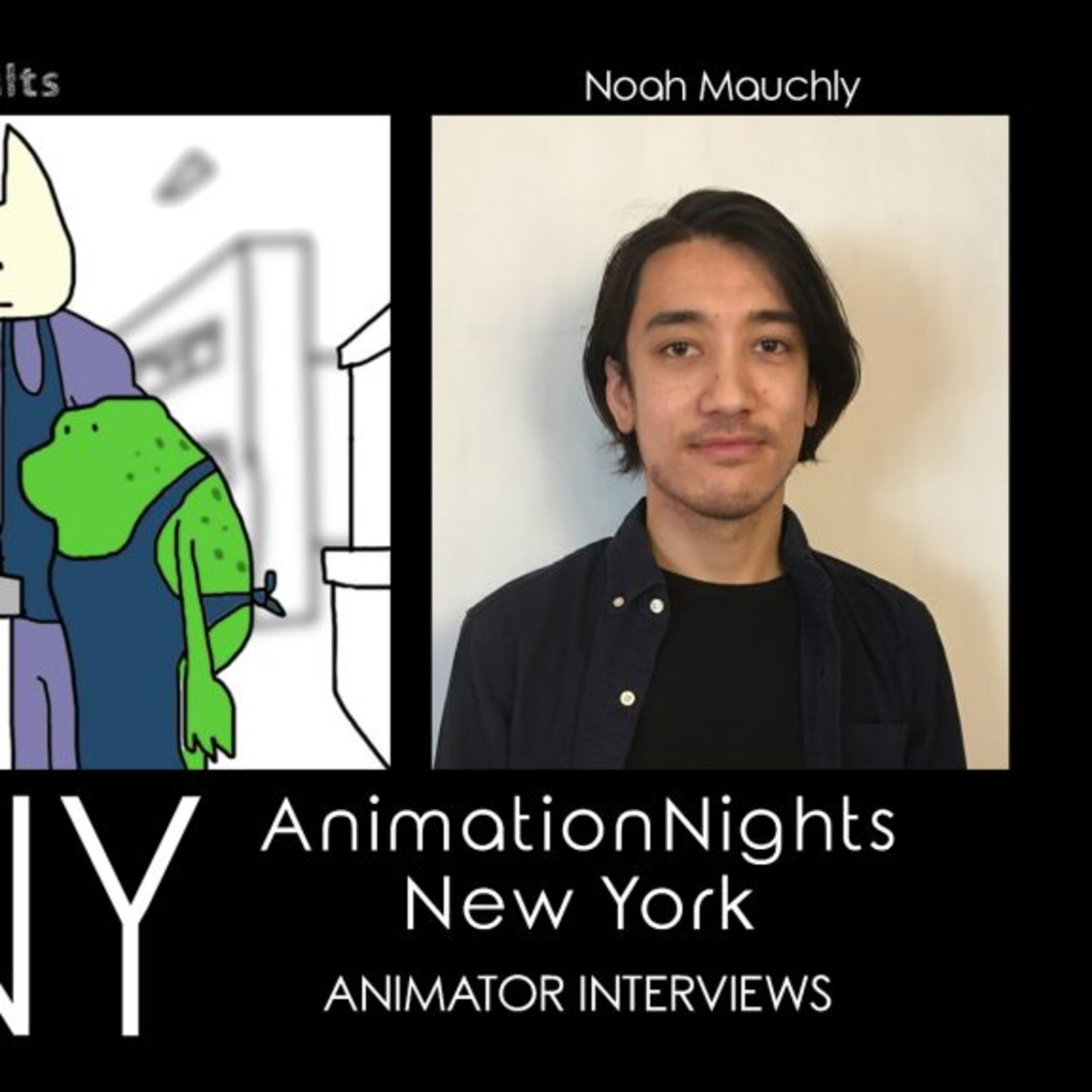
Welcome to another episode of Animator Interviews. My name is Evan Vernon. I'm a contributor at Animation for Adults, as well as Animation Nights New York, also known as Annie. For those new to Annie, we are a monthly screening event and yearly festival that celebrates the very best in animation talent. Our artists come from all across the globe, and many have had their work featured at Cannes, Annecy, and other prominent festivals. We receive thousands of submissions each year, and each year we screen just 20 at our annual VestaFest. Today we're discussing one of those 20. Noah Mockley is with me now.
Noah is an American artist known for his deep, human themes and minimalistic style. Noah's animated short, Mouse, was chosen by our jury as a Best of Fest winner film. Drawn during COVID, the film takes a raw look at relationships, following a lone, introverted mouse as he wrestles with fear, shyness, and an inability to connect with others. Noah entered production with very few supplies and was forced to draw the whole 20-minute short with nothing but a computer mouse. Make no mistake, though, the film's animation is part of its charm, its rough, repressed look and apt reflection of Mouse's troubled psyche.
Today, Noah has kindly agreed to discuss this short in his artistic career. Noah, thanks for coming. We want to talk about Mouse, but tell us about yourself first. What got you into animation? So, I mean, drawing was just one of those things that I always was drawn to do. Like, I can't really pinpoint when I started drawing. It was just always something that I was doing. And I guess I get creative gene a lot from my dad, so that might have some bearing on that. But what really drove me to become an animator was...
i'd always liked animation i always like cartoons but the thing that really like sort of set it all in motion i think was when i first saw um spirited away the yazaki film for the first time because it was on um cartoon network they're showing like some of his uh films and i had never heard of it i the only real anime i was familiar with was like pokemon and stuff like that so um seeing that movie and even just like seeing it on the small like tv we had at the time um Well, there's a little bit of a story to it where my friend saw the movie before I did. And I was like, oh, have you heard of this movie? It's going to be on TV. It looks really interesting just from what I saw on the commercials. And he was like, oh, that movie's awful. It's like scary. It makes no sense. It's like, you know, it's cruel. There's just like an evil witch and she's trying to kill this girl. And I was like, it just made me more curious because I was like sort of, you know, I didn't really know what to expect. But like if he didn't like, I guess, condemn it that much, then it might not be that curious. But like it really drove me to check it out. So I watched it with my mom and just seeing animation that.
you know well done that like beautiful yeah but all but that mixed with the like empathy you felt for the characters and just like this sheer sense of like understanding of um you know what it's like to be 10 years old and that sort of thing yep was so just powerful to me like my mom and i were just looking at each other like this is like we could recognize that like history was being made for us right and then they're just seeing that movie um it was like an atom bomb went off my head because and um you know it was just so uh I empathize so much with everything that was happening. And it felt for the first time when I was watching an animated film that really felt like it was spoken to me rather than like, you know, speaking at me and just sort of like giving me a bunch of colorful images. Like the emotion was the first time I really felt emotion like that on a film in general. So after that, I think that was like sort of the germ that really just started to make me think like, what can you do with animation? If I can see how far, you know, emotionally animation can like bring you, you know, what else is there to be had from it? So that just, that's what really sparked my curiosity and then seeing all those other films and then it just branched off watching them.
not just animated films, but live action films in general, than just falling in love with filmmakers and movies and that sort of thing. Yeah, you said something really powerful right there, Noah. Beautiful stories are stories that speak to you, not at you. I can't think of a better way to put it. And you can kind of see that same pathos, that same understanding of the human experience in Maus, in this beautiful film that you've created. The visual style might contrast with Adam Miyazaki, but on an emotional level, the overlap is definitely there. So I'm not surprised you've cited him as an influence.
So tell us about Mouse then a bit. Where did this story come from? It's very interesting for those listening in. It's a 20-minute film, one of our longer, almost kind of like a mid-length movie. But it follows this very quiet, introverted character, the eponymous Mouse, as he kind of goes about his daily life and struggles with emotional repression, this fear to interact with people and initiate genuine human contact. But yeah, Noah, give us some background. What inspired this?
Really, it started off because I wanted to give myself a sense of direction during the pandemic because I had just graduated from college and it sort of cut my studies off kind of abruptly. And I had to leave my I was going to college in the UK and I had to leave all my friends who I was living with to move back with my parents here in the US. And yeah, I just wanted some something to like. uh you know give me a sense of direction and i was like might as well use this degree to some use so um but the thing is i didn't have any real like i was leaving all the materials i normally use to make a film behind to the uk and i was just sort of like what do i actually have i have this computer mouse and i have photoshop like i can in theory make a film just those yeah so um you know uh after just like kind of deciding that um and embracing the fact that it won't look great um that's when things just sort of started to fall in place it's like all right well if i'm animating it with a mouse uh the main character should probably be a mouse then um and i was you know that was you know i didn't have like any real plan on what the story was going to be or that that was all just like sort of the like initial things that i was thinking of like well if i do make a film like these should probably be the elements um but i was just like thinking the thing that was like most um
I guess uh relevant to me at that time was the fact that it was locked down and I couldn't really find part-time job even so I was really just like here in my room all day um yeah without anybody you know to and I mean the thing about that is that I uh I was very comfortable but I was finding that that comfort was like sort of dangerous in a way because it was you know it was I felt safe but at the same time I didn't really feel like I was being you know engaged I wasn't engaging with anything it was like you know um I wasn't being challenged and the comfort felt crushing in a way. And so I was just sort of building the story off of, you know, really putting those elements into that character, those feelings into a mouse.
sort of pushing it to an extreme, but, um, you know, it hasn't just been the pandemic that I felt this way. I'm also kind of a shy introverted person and especially like going to college and trying to make friends, you know, it would be very like, well, I want to talk to this person, but I don't know how, you know, um, I'd like to start a conversation, but I'm scared of like getting into it. Like, what if I can't keep it up? Like, well, they think of me and blah, blah, blah. Just all these like sort of anxiety, social anxieties that would like swim around in my head. So now I guess it's kind of like a condensed version of those like safe sort of simple living, but at the same time, like desperately wanting like more connection.
But not really having the, I guess, confidence or drive to, you know, speak to people and talk to people. So, yeah, I guess those were sort of the initial germs. And then the rest was just sort of, I didn't finish the script when I started animating it. I just sort of started animating it and then tried to make the story flow as organically as I, you know, could without it. Trying to make the story feel like it was coming through me rather than I was like thinking of it. If that doesn't sound, you know, if that's not too pretentious. Not at all. Yeah, so that was just sort of how it was like made.
in general. It's just sort of like letting it sort of develop on its own as much as I could. Very, very well said, Noah. And to just briefly interject, if anyone in the gallery has questions for Noah before we wrap up the interview today, type them in the chat, please. We'll address those before we finish. I see we do have one. We'll get to that in just a moment here. But yeah, Noah, it's interesting you talk about this sort of organic storytelling, this unscripted process you have. It lends, I think, a lot of believability to this narrative you constructed. It's no coincidence that it's personal to you because you kind of feel, I feel like everybody to some degree feels like they understand Maus. They can sense that quiet desperation in him, this desire to speak.
even when he's saying nothing, if that makes sense. I did want to ask briefly and then we'll get to the questions here. Tell us a little bit about these characters that you inject into the story who meet Mouse along the way. A lot of them seem to almost be like guardian angels or these like mythological sages just interjecting their wisdom. There's the somewhat like off-putting yellow guy with the teeth who almost kind of confronts him in a scary way. And then there's the octopus at the end who gives him that very gentle and moving monologue. But yeah, tell us about those characters. Yeah, so...
Again, they just, I sort of, as I was writing it, I would think like, well, something kind of needs to push, you know, Mouse in a certain direction at this point. It would make sense for, you know, something to happen here. So the characters just sort of like were made to think like what would help narratively help like Mouse's journey a little bit more. So at the beginning where he like is sort of sought by the big like square headed like hillbilly guy. He's just sort of, he's a representation of the, like the people you don't want to get caught in, the people you're kind of scared to be caught in a conversation with because they're like.
they don't really engage with you they just kind of like talk at you and they don't really want to hear you so he's kind of like you know sort of you know introduces that um mouse like can't really navigate his way around awkward social scenarios and stanley's his name um is you know just sort of that uh the worst uh sort of scenario that he that he could be in socially um and on the opposite end of that the character m the sort of like that thing was uh um i didn't really mean for her to be like a romantic interest but it was just i mean narratively like filmmaking wise people get like if there's a male character a female character like and they meet like they're a potential for something to like occur why they might be more interested in each other than if it was like two guys or two girls i don't you know that's not like a comment on gender or anything if people see mouse as a girl or genderless and like was em a male or genderless whatever that's totally fine but just narratively people sort of like pick up on that you know if you don't explicitly say that you know but you know em was just sort of like a character who not really romantic interest but just sort of like a uh representation of the kind of person you do want to get to know you do want to like you know obviously they have like some sort of connection to each other and they
So she's like sort of the light at the end of the tunnel. Like it's not all helpless. Like there are people who you will meet who understand you and like you and all that. And you just kind of have to get the bravery to start talking to them and all that. And then the, I'm glad you called it the octopus. I think I like that more because I drew it as a spider, but again, it doesn't really matter. It's, you know, but the spider was.
I don't know where I started with the spider, but I put it in at the beginning. Then I was like, well, it'd be kind of funny if it kept popping up and had its own little arc. And as I was thinking of how to end the movie, I remember like, oh yeah, there's that spider character. And the spider was meant to, I guess what I said before about trusting that there are other people in the world who appreciate you and will like you. You just have to be open to them.
The spider was, I mean, it's, you know, it's an absurd thing that the spider suddenly falls in love with Mouse, you know, and from afar professors are loved, but it's a happy ending in a way because even if Mouse isn't present for it, the spider is just showing that like people do love you, you know, and even, you know, even if it is from afar, you are, you know, people, it is possible for people to understand you and all that. And then I guess finally the yellow character was like meant to be like the final thing that pushes Mouse out of his shell because, I mean, you know, the comfort for me was like the most crushing thing about living COVID life. So the figure, I guess I called it, was meant to be kind of like the, it just throws Mouse's expectations out the window. And after that, after something like that, something sort of like shocking, people start to look at things differently and they start to consider things differently, which is what Mouse needed to break out of like this shell that was keeping him from really connecting with people. And, you know, as freaky as it is, it was, he's just sort of like the final cog in that pushing Mouse to...
Yeah. Yeah. Very insightful, Noah. Thank you. We actually have a question in the chat from Jack about the figure in particular. Jack writes, I really like the video game dialogue box and audio you have for all the characters. The figure accepted. When the figure shows up and speaks with an actual voice, he says Mouse is keeping his inner voice locked in. Does that mean that everyone else is too? Or is he just doing it more than them? Is Mouse like the only one, I'm guessing? I mean, I'm not 100% sure.
The sort of disconnect between the video game-y dialogue boxes and the figure just speaking, I guess, is sort of a representation that Mouse and all the other video game-y characters aren't really talking to each other. They've got this sort of barrier of their subtitles. They literally aren't talking to each other. They're sort of talking to each other from a distance. And then the figure is kind of the first character that...
introduces the idea that he's the first character that actually talks to Mouse. Literally, he talks to Mouse. So I guess you could say all the other characters are kind of in that same boat. I guess the thing with Mouse is that all the other characters seem a little bit more comfortable in their own skin, and Mouse is just a little bit more introverted. So he kind of needed that voice to come out to, I guess, recognize that. So I don't know if it's necessary for the other characters to have a scary visitor appear to them.
Yeah, it was just a way of representing that they were kind of like at a disconnect from each other, the way they talk to each other, you know, and all that. So yeah, interesting. Dug into that. I didn't think too much on that when I was making it, but I'm glad that people were able to read a lot into it. Yeah, yeah, that was a very insightful answer to a very insightful question. Thank you, Jack, for bringing that up. You know, you can see how you're kind of bringing things full circle with your comments about slight universality of Mouse's story, you know, the way that you use the audio to kind of illustrate not only his disconnect from the world, but the disconnect people feel with each other.
is very important. We can all kind of see ourselves in Mouse to a certain degree, even though he's fighting his own battle. Thank you so much for sharing, Noah. Oh, we do have another question here. Let's take a look here. Oh, this might be a comment. One second. The figure is such a good character. Em is too. Her interaction felt particularly real. Was that based on an experience or did you come up with that? Bravo if that's the case because it felt like that really happened. I assume he's referring to the part where they're at the grocery store and Mouse is like, Em's trying to start a conversation and Mouse is just sort of, yeah, okay.
I mean, that didn't literally happen to me, but I've been in numerous scenarios where I've ended up in a social scenario with somebody who I either had a crush on or who I wanted to impress. And just like, it just makes it feel so much more like there's pressure to, you know, appear cool. Like, you know what you're saying. And it just, you know, that's just shooting yourself in the foot because then like you just don't talk naturally and you, you know. uh things just get more awkward um and that i don't know it was just sort of a condensed version of that um i did that i didn't have that literal conversation with somebody but um i've had a version of that conversation multiple times in my um in my life so um yeah Yeah, thank you for sharing, Noah. If anyone else has questions, I've got just one more personally for you, Noah, but feel free to pop them in. We'll get to them before we finish. Well, I think it goes without saying, based on the reactions this film has gotten, Noah, that you're a very gifted filmmaker. You're also very young. We have a lot of young artists here, but I think you're one of the youngest. Where do you see yourself in the future in an ideal world?
oh i i mean i don't know i don't try to like have too much of a vision for myself so that things can just you know so i'm not like keeping myself from any possibilities down the line um i mean i love animating i love filmmaking um down the line i really hope that i can just keep making my own films um and any way i can to support that is a goal of mine but in terms of where i end up work-wise i'm not 100 sure i'm uh You know, right now I'm just working a part-time job and I'm working freelance animation in my own time. And, you know, I could be doing that and I could be perfectly happy. I'd like to, goal-wise, I'd like to end up in the UK again once things start to be safer to travel and all that.
But yeah, in terms of professional goals, there's nothing screaming at me as of yet other than to just keep making my own films when I can. Absolutely. We've got a comment here from Jack again. And I think one more question we need to get to before we wrap up. But Jack says, you have a great future in animation. Please keep your own films. You have a unique voice people need to hear. Oh, my God. Thanks so much. Yeah, I really appreciate that. Thank you. I think it goes without saying that you are gifted. I mean, it's already been said, Noah. The UK might be able to...
you know, give the support you need as well. I feel like the European scene, not to doggone our own country, is maybe just a little more welcoming when it comes to independent off-brand animation. Yeah, I agree with that, yeah. Yeah, I missed this a moment ago, but last question, this goes back to the dialogue in the film. Tom is wondering, who did you get to make the sounds that Speechbox characters make? All right, so I assume that Tom is my friend, Tom Bates, who is in fact Mouse. He, well, to answer your question, Tom, I asked my friends, I just said, this is a weird request, but could you just make...
this syllable a couple of times and then just send that recording to me. And then I would just cut up the dialogue. I would cut up the noises they made and then like sort of rearrange it and speed it up and slow it down and this and that. And so that, you know, it sounds like there's sort of a person underneath it, but at the same time, it still sounds a bit robotic. So my friend Tom, who I assume asked the question, did the voice of Maus. And then other friends did all the incidental characters. I did Stanley and the horse at the beginning. And I just want to mention Max Forrest. Some people might know him as TV Maxwell.
Yeah, we got in touch right when I was graduating college. I was a huge fan of his in high school, and then he sort of came back a bit in college, and I drew something for him, and he really liked it, and then we just started talking. And this is a real quick story, and I'll try to make it brief. But I asked Max if he wanted to be in the film, because I was just like, oh, I have a chance to actually work with him. That'd be great.
He said, yeah, and he was super nice about it. And I was going to have him do just like one of those like bit, bit, bit kind of voices where it's like, you know, if I actually can have him in the film, why would I, that would be such an insult. And well, if anybody knows creepy, it's him. So if anybody hasn't seen his, look up TV Maxwell on YouTube and all of his short films are so, what I really loved about his short films is that it really felt like there was a filmmaker behind them. It wasn't just like YouTube comedy stuff. It really felt like there was a guy with a filmmaking voice behind it all. But anyway, so I asked him to do this creepy character, the figure that appears at the end. And I was so nervous during the recording because at that point we weren't really familiar with each other.
And he would like do a take and I would be like, yeah, that was great. Like fully, you know, just being like totally behind it and be like, no, that wasn't good. Let me do it again. And then he'd do the line over again and then it'd be better. So he kind of wound up directing himself and I wasn't much help. And I was shaking, I was sweating, like, you know, and after that I was like, oh, I kind of, I wish I gave him some better direction. Oh, well, you know, at least he's going to be in the film. And I get a message from him saying like, hey, do you mind if I tweak the audio? I'll just take a little bit more time. He's like, yeah, sure. Do what you need to do.
So a couple of days go by and he sends me the audio. I put it in the video and, you know, it's great and all that. Then once Mao started getting some film festival recognition, he called me up to ask about it. And I was like, oh, well, here's my chance. Like, I'm sorry for not being super helpful during the recording. I was super nervous at the time because, you know, we didn't really know each other. And he was like, oh, well, he said to me that apparently after we finished our recording that day, he didn't save the work he did. So he lost all the whole session we did. And when he said to me, you know, can I tweak the audio? Really, he just needed to rerecord the lines again. I didn't notice at all.
After that, that was just like, oh, OK, you know, we're all human, like we're all, you know. I hope he's perfect. And that was, you know, that was just refreshing to hear. And yeah, he's, everybody just who's interested should just look at his YouTube and support him in any way that you can. Yeah, super happy he was in the film. And I hope he, you know, keeps doing what he does because he's really good at it. Well, Noah, thank you so much for your time today. For all those listening in, if you'd like to continue following Noah, we'll be sure to share all of his pertinent social media handles and professional websites in the interview description. Be sure to stay in touch and see what great things come from.
Noah, in the future, thank you so much for your time. Noah, we hope to see you at Best of Best next year. Yeah, thanks for having me. It was a lot of fun. Appreciate all the questions as well. Thank you, everybody. And thanks to everyone for participating as well. But Noah, take care. And again, good luck to you in the future. Awesome. Thank you.