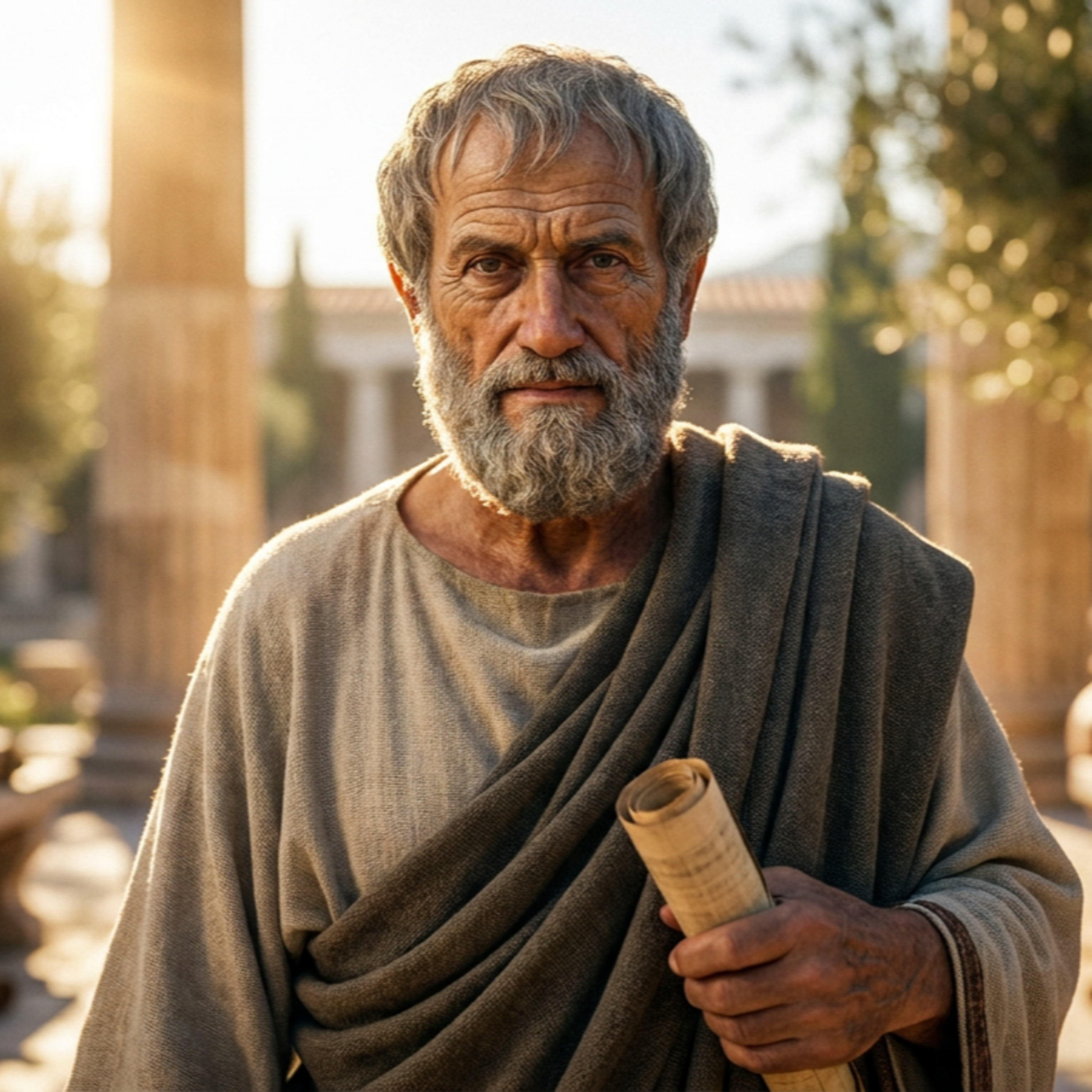
Aristotle and the Greek Legacy episode artwork

EPISODE · May 25, 2026 · 54 MIN

Aristotle and the Greek Legacy

from Professor Jiang · host Game Theory

Plato and Aristotle are considered the two most influential philosophers of Western antiquity. But there are three central paradoxes surrounding the life and work of Aristotle. He is considered a brilliant thinker, but we do not have any of his original writings. Over two hundred works are attributed to him, and the range of his works is extra-ordinary and super-human – he’s written about metaphysics, rhetoric, theater, politics, ethics, physics, and biology. Finally, while he studied under Plato for twenty years, his empirical approach to epistemology contradicts Plato’s rationalist approach. How can we explain these paradoxes?Professor Jiang Xueqin explains that to understand Aristotle’s work and beliefs it’s important to understand his background and associations. His life parallels that of Philip II of Macedon. Aristotle and Philip were born about the same time, and because Aristotle’s father was personal physician to the King of Macedon, the two grew up together. In their youths, Philip was sent to study military innovation at Thebes, and Aristotle was sent to study at Plato’s Academy, where he would spend the next twenty years. Legend has it that Aristotle became the tutor to Philip’s son Alexander the Great, and Philip rewarded Aristotle lavishly for his service.Philip’s military conquests were driven in part by the Pan-Hellenic Project, which aimed to unite the Greek diaspora scattered across the Aegean and Mediterranean. Because Greeks identified with their own city-state, Philip needed to create a “Greek culture,” a common identity that shared the best knowledge of the Greek world. Rather than an original thinker, Aristotle was a “systemizer,” who supervised his students in the collection and distillation of the entirety of Greek knowledge into textbooks for popular education and dissemination. Aristotle’s work would forever change human history. By systemizing Greek knowledge, Aristotle would help humans “see and be” in a new way. By simplifying and popularizing Greek knowledge, he would make it accessible, and it would spread as far as Alexander the Great’s conquests. And the interaction of Greek knowledge with foreign cultural eco-systems would birth new philosophies and religions, including Christianity.

Plato and Aristotle are considered the two most influential philosophers of Western antiquity. But there are three central paradoxes surrounding the life and work of Aristotle. He is considered a brilliant thinker, but we do not have any of his original writings. Over two hundred works are attributed to him, and the range of his works is extra-ordinary and super-human – he’s written about metaphysics, rhetoric, theater, politics, ethics, physics, and biology. Finally, while he studied under Plato for twenty years, his empirical approach to epistemology contradicts Plato’s rationalist approach. How can we explain these paradoxes?Professor Jiang Xueqin explains that to understand Aristotle’s work and beliefs it’s important to understand his background and associations. His life parallels that of Philip II of Macedon. Aristotle and Philip were born about the same time, and because Aristotle’s father was personal physician to the King of Macedon, the two grew up together. In their youths, Philip was sent to study military innovation at Thebes, and Aristotle was sent to study at Plato’s Academy, where he would spend the next twenty years. Legend has it that Aristotle became the tutor to Philip’s son Alexander the Great, and Philip rewarded Aristotle lavishly for his service.Philip’s military conquests were driven in part by the Pan-Hellenic Project, which aimed to unite the Greek diaspora scattered across the Aegean and Mediterranean. Because Greeks identified with their own city-state, Philip needed to create a “Greek culture,” a common identity that shared the best knowledge of the Greek world. Rather than an original thinker, Aristotle was a “systemizer,” who supervised his students in the collection and distillation of the entirety of Greek knowledge into textbooks for popular education and dissemination. Aristotle’s work would forever change human history. By systemizing Greek knowledge, Aristotle would help humans “see and be” in a new way. By simplifying and popularizing Greek knowledge, he would make it accessible, and it would spread as far as Alexander the Great’s conquests. And the interaction of Greek knowledge with foreign cultural eco-systems would birth new philosophies and religions, including Christianity.

NOW PLAYING

Aristotle and the Greek Legacy

0:00 54:38

No transcript for this episode yet

We transcribe on demand. Request one and we'll notify you when it's ready — usually under 10 minutes.

WW2 - the Key Questions, answered by Laurence Rees. Laurence Rees A former Head of BBC TV History programmes, Laurence has specialized in writing books and making television documentaries about World War Two, the Nazis and Stalinism for thirty years. He won a BAFTA and a Peabody for his TV series 'The Nazis: A Warning from History' and a British Book Award for his book on Auschwitz, which is also the world's best selling book on this notorious camp. His book 'the Holocaust: A New History' was described by the Times as 'exemplary' and by the Daily Telegraph as 'the best single volume account of the atrocity ever written'. Educated at Oxford University, for several years he was a visiting senior fellow at the London School of Economics, London University. He holds honorary doctorates from the University of Sheffield and the Open University. Professor Robert Service, of Oxford University, described Rees as 'one of the world's experts on the Second World War'. Sir Max Hastings wrote in the Sunday Times, in a review of Laurence Rees' 'World War Two: Behi Talking Biotech with Dr. Kevin Folta Colabra Talking Biotech is a weekly podcast that uncovers the stories, ideas and research of people at the frontier of biology and engineering.Each episode explores how science and technology will transform agriculture, protect the environment, and feed 10 billion people by 2050.Interviews are led by Dr. Kevin Folta, a professor of molecular biology and genomics. Rania Awaad Muslim Central Dr. Rania Awaad M.D., is a Clinical Associate Professor of Psychiatry at the Stanford University School of Medicine where she is the Director of the Stanford Muslim Mental Health & Islamic Psychology Lab as well as Stanford University’s Affiliate Chaplain. In the community, she serves as the Executive Director of Maristan.org, a holistic mental health nonprofit serving Muslim communities, and the Director of The Rahmah Foundation, a non-profit organization dedicated to educating Muslim women and girls. In addition, she is faculty of Islamic Psychology at Cambridge Muslim College and The Islamic Seminary of America.She is also a Senior Fellow for Yaqeen Institute and the Institute of Social Policy and Understanding. Prior to studying medicine, she pursued classical Islamic studies in Damascus, Syria, and holds certifications (ijaza) in the Qur’an, Islamic Law, and other branches of the Islamic Sciences. Wild Olive Jeanne Petrolle and Jennifer Bird The Wild Olive Podcast brings you game-changing conversations about literature, culture, and the Bible. With co-hosts Jeanne Petrolle and Jennifer Bird, Wild Olive serves up idea-feasts: tasty insights about biblical texts and contemporary (or classic!) literature, with generous side-portions of cultural commentary and hearty laughter. One literature professor + one biblical studies professor = uncontrolled, out-of-bounds, untamed conversation: ideal listening for the post-evangelical, the spiritual-but-not-religious, the Bible-curious secularist, the free-thinking religionist, and the literary-but-not-stodgy! New episodes every other Friday!

Frequently Asked Questions

How long is this episode of Professor Jiang?

This episode is 54 minutes long.

When was this Professor Jiang episode published?

This episode was published on May 25, 2026.

What is this episode about?

Plato and Aristotle are considered the two most influential philosophers of Western antiquity. But there are three central paradoxes surrounding the life and work of Aristotle. He is considered a brilliant thinker, but we do not have any of his...

Can I download this Professor Jiang episode?

Yes, you can download this episode by clicking the download button on the episode player, or subscribe to the podcast in your preferred podcast app for automatic downloads.
URL copied to clipboard!