PODCAST · society
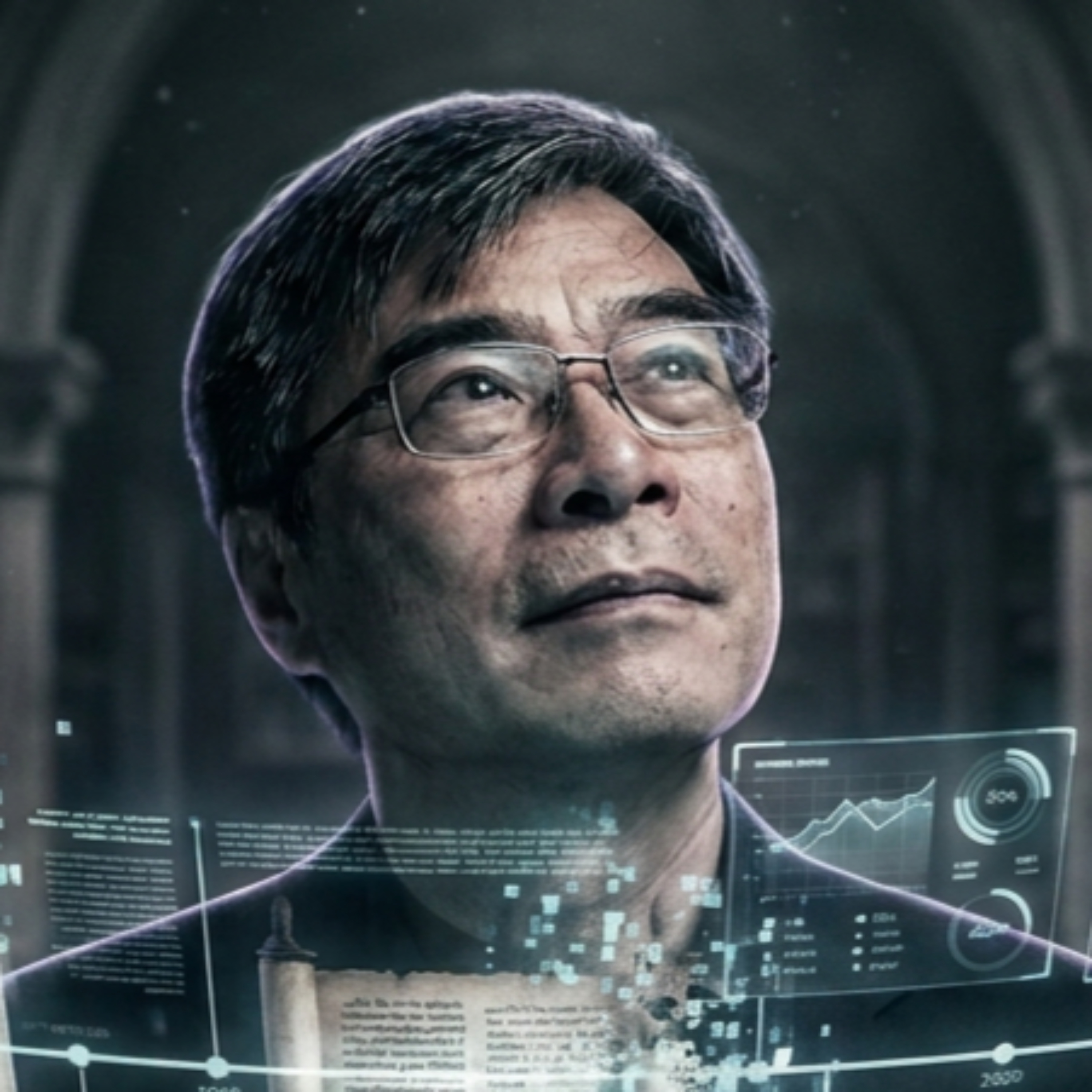
Professor Jiang
by Game Theory
Audio format of Predictive History youtube videos by Professor Jiang XueqinGame Theory explores the future of global politics through the lens of data, geography, and historical patterns. Using minimalist map animations and strategic analysis, the channel breaks down complex geopolitical conflicts, military strategies, and resource competition to project where the world is heading next.
-
147
Substack Live #1: Welcome to Boomer Hell
A recording from Predictive History's live videoPredictive History shares personal updates regarding upcoming international travel plans and a transition away from teaching in China. The session outlines a new curriculum featuring courses on Dante, occult traditions, and education reform, while also analyzing ongoing geopolitical developments and global news events.
-
146
Predictive History Founding Members #1
A recording from Predictive History's live video
-
145
Gay Talese's Sparks of Light
Professor Jiang explains the genius of Gay Talese.
-
144
Final Examination
Professor Jiang answers your questions.Predictive History marks the end of a teaching journey by answering student inquiries. The discussion covers a wide range of topics, including the future of the global economy, the role of geopolitics, the impact of artificial intelligence, and strategies for personal growth during times of systemic transition and uncertainty.
-
143
Dante in Paradise
Professor Jiang explains how Dante re-animated the human imagination.Notes and References:1. Dante's Divine Comedy, translated by Alan Mandelbaum
-
142
Predictive History
Prpfessor Jiang synthesizes geopolitics, eschatology, and the mechanics of imperial decline into a unified framework. This lecture explores how these distinct academic and historical perspectives converge to shape modern international conflicts and global power structures.
-
141
Iran's Strategy Matrix
Professor Jiang explains to his Chinese high school students Iran's geo-political strategy. Because the United States has military dominance, Iran must conduct asymmetrical warfare, and ask four questions with all its actions:a.) Does this action make my population more confident and united?b.) Does this action help me consolidate trust and solidarity with my allies?c.) Does this action help me win global opinion?d.) Does this action weaken the resolve and solidarity of my enemies? Jiang Xueqin argues that Iran's "Operation True Promise" achieved Iran's strategic objectives, and Iran's strategy matrix will determine all its responses moving forward.
-
140
Christian Zionism and the Middle East Conflict
Professor Jiang explains the origins and thinking of Christian Zionism, and how it is driving conflict in the Middle East.He argues that while most Christians consider Christian Zionism to heretical, it has the most potential to capture people's imagination due to the instability, uncertainty, and extremity of the times we live in today.
-
139
How Empire is Destroying America
Professor Jiang explains to his Chinese high school students how empire is eroding the stability and vitality of the American Republic: From 1950-1980, America's manufacturing sector accounted for 40 percent of GDP, employed 30 percent of its workforce, and enjoyed 40 percent of total profits. Today, it's only 10 percent of GDP, and the financial services sector is ascendant. Financial services account for 22 percent of GDP, enjoy 40 percent of profits, and employs 5 percent of America's workforce. This trend has led to income inequality, divisive politics, and economic volatility. Young people feel they are being left behind, the best and brightest are flocking to Wall Street, and corporations are focused more on financial engineering than on innovation. What's driving this trend? America's empire, which is causing foreign money to flood its economy. And as the empire becomes addicted to easy money it may have to fight a war to defend the petrodollar.
-
138
Saudi Arabia's Trump Card Against Iran
Professor Jiang explains to his Chinese high school students the rivalry between Iran and Saudi Arabia:At the beginning of 1979 Saudi Arabia and Iran were friendly with each other. Both were America-aligned oil-exporting monarchies. Iran’s Islamic Revolution was a political earthquake that promised to topple the entire Middle East political order. Ever since Saudi Arabia and Iran have been bitter religious, economic, and geo-political rivals. After America’s 2003 invasion of Iraq Iran seemed dominant. In 2015 Riyadh was shaken to its core when Obama reached a nuclear deal with Tehran. Then Saudi Arabia’s crown prince Muhammad bin Salman won over the Trump White House. Trump made Saudi Arabia his first foreign visit, and scuttled Obama’s nuclear deal. In January 2020 Trump ordered the assassination of Qasem Soleimani, which brought Iran and America to the brink of war.If Trump wins in November, tensions in the Middle East can only promise to escalate.
-
137
Why Trump Will Win (And Pick Nikki Haley as VP)
Professor Jiang explores who will win the US Presidential election in November: Joe Biden's 2020 coalition of college-educated professionals, minority voters, twenty-somethings, and suburbanites may not hold in 2024. Voters are upset about inflation, illegal immigration, and foreign policy direction.If Trump picks Nikki Haley to be his running mate, he has a very good chance of winning the suburbs, and thus the Presidency.Because of her ties to anti-Iranian organizations, Nikki Haley may become the fiercest advocate for escalation with Iran in the Trump White House.
-
136
America's Imperial Hubris
Professor Jiang explains to his Chinese high school students the strengths and weaknesses of the American military doctrine "Shock and Awe":In 2003, the American military used a revolutionary military doctrine called "Shock and Awe" in its Operation Iraqi Freedom. "Shock and Awe" combined American air supremacy, technological omniscience, and special forces into a deadly package that won the war in three weeks, with less than 200 American casualties. This new doctrine is ultimately a response to the failures of the Vietnam War, in which 58,000 Americans died over eight years. "Shock and Awe" permits America to fights wars quickly, cheaply, and decisively, which avoids public outrage, media scrutiny, and political flip-flopping. As such, "Shock and Awe" is not just a theory of war -- it's ultimately a theory of empire. America can now covertly defend its empire everywhere and anywhere. But "Shock and Awe" also means that America is over-committed, is lacking in strategic discipline, and is overcome with hubris. This may lead America to head into a disaster of its own making.
-
135
Who Killed Iranian President Ebrahim Raisi
Professor Jiang examines if Iran President Ebrahim Raisi's death was an accident or an assassination: On May 19, Iran President Raisi's helicopter crashed into the mountains, killing all nine on board. Most experts believe it was a weather-related accident. There are skeptics who believed that powerful forces within Iran stood to gain from Raisi's death. Raisi was expected to become the next Iranian supreme leader, and now Mojtaba Khamenei (the current Ayatollah's second son) is the favorite. Under the current Ayatollah, the 250,000-strong Islamic Revolutionary Guard Corps (IRGC) have dominated Iran's economy, politics, and foreign policy. Their critics believe they have inflamed tensions in the Middle East, while causing stagnation and corruption at home. If Raisi were to have become Ayatollah, he would have to attempt to curb the power and influence of the IRGC in order to establish his own authority. Because Mojtaba Khamenei would be inexperienced and unpopular, he would have to rely on the support of the IRGC.This would allow the IRGC to pursue its most ambitious foreign policy goals, which would ultimately force a confrontation between the United States and Iran.
-
134
The Iran Trap
Professor Jiang explains that an American invasion of Iran would be a catastrophic mistake:If Trump were to win a second term, he would likely contemplate invading Iran. While an initial invasion would seem successful, American forces would quickly become bogged down in Iran's mountainous terrain. The American invasion would be similar to Athens' invasion of Sicily in 415 BCE, as described in Thucydides' The Peloponnesian War. Despite its initial successes, the Athenians couldn't re-supply themselves, and their entire expedition was wiped out.This disastrous defeat turned the war in Sparta's favor, and spelled the downfall of the Athenian empire. Could the American empire in Iran suffer the same fate as the Athenian empire in Sicily?
-
133
Putin's War for the Soul of Russia
Professor Jiang explains why Putin is preparing to mobilize Russian society for total war:Putin's favorite philosopher Aleksandr Dugin believes that Russia and the West are fighting Samuel Huntington's War of Civilizations in Ukraine. What does he mean by this? In the late eighties, Francis Fukuyama published his "End of History?" essay, which argued that liberal democracy and consumerism are humanity's best conception of itself, and therefore history has ceased to be a dialectical argument. Both Dugin and Putin believe that Western consumerism is a poison pill that has corrupted Russian society. It has manipulated Russians into betraying their own civilization, and this betrayal has led to political corruption, rampant alcoholism, and a declining population. In the war against Ukraine, Putin has discovered that continuous war can rejuvenate the Russian soul. He is intent on channeling Russia's "warrior" culture to fight against consumerism.
-
132
Putin's Strategic Imagination
Professor Jiang explains Putin's strategic genius:In February 2022 Putin invaded Ukraine. At first, the war did not go well, and the United States had a three-point plan to defeat Putin:1.) Equip Ukraine to defeat the Russian army.2.) Sanction Russia, and cause it to economically implode.3.) Isolate Russia, and turn it into a pariah state.Today, we recognize that this strategy has failed, and Putin is triumphant:1.) The Russian army is dominant in Ukraine.2.) The Russian economy is stronger than ever.3.) Putin enjoys more international influence than ever.Putin's ultimate strategic aim is to destroy the American empire. He will succeed if:1.) America continues to over-extend itself militarily. 2.) America remains addicted to debt. 3.) America becomes increasingly politically polarized.
-
131
The Second American Civil War
Professor Jiang explores how and why America would fight a second Civil War:Right now, America is suffering three trends that make civil war more and more likely:a.) Increasing political polarization driven by the culture wars and inequality.b.) Breakdown of the narratives that bind America, especially the American Dream and liberalism. c.) Growing distrust of America's national institutions, including the government, media, science, military, universities, and justice system.If Trump wins in November, we can expect riots and civil unrest. If Trump refuses to step down in 2028, we can expect a civil war to blow up.
-
130
Psychohistory (The Science of Imagining the Future)
Professor Jiang Xueqin concludes his Geo-Strategy course by discussing how to use AI to chart a better future for humanity:In his Foundation series, Isaac Asimov introduces the science of psychohistory. Is it really possible to predict the future by mathematically modeling historical development?By mathematically modeling history, "Cliodynamics" has revealed interesting patterns. For example, Peter Turchin has discovered that it's the "over-production of elites" that drives social upheaval. The advent of AI presents new possibilities for the mathematical modeling of history, and can even help us achieve psychohistory. But to do so would require decades of painstaking research and analysis. It would also mean overturning the entire field of history, and looking at all of the past with a more critical and nuanced eye. Finally, much of this research and development can only happen in a time of global collapse, when all of humanity is united in creating an open, progressive, and democratic future. In his final message to his students, Jiang Xueqin stresses that the future is not something that happens -- it is something that has to be imagined and fought for.
-
129
Explaining Humanity's Transition to Agriculture
Professor Jiang Xueqin explains why humans adopted agriculture.We now know that there were many consequences due to the transition to agriculture. Hunter-gatherers had an easier, more healthier, and less disease-prone life. So why did humans make this sacrifice? Though there are many explanations, most scholars believe that it was the religious impulse that drove humans to choose a sedentary life, as evidenced by the archaeological sites of Gobekli Tepe, Jericho, and Catal Hoyuk.
-
128
The Yamnaya Conquest of Europe
Homo sapiens originated in Africa 300,000 years ago, and for the vast majority of our history we were egalitarian, peaceful, and artistic. So where did concepts of patriarchy, war, and private property come from?The Yamnaya people are nomadic pastoralists who originated in the Eurasian Steppes. They worshipped the Sky Father, and excelled at waging war. Slowly, their culture spread throughout the Steppes before conquering Europe, Iran, and India.
-
127
Elite Overproduction and the Bronze Age Collapse
Why the Bronze Age collapsed.In the year 1200 BCE the world was globalized and prosperous. Nations shared people, ideas, and goods. A few decades later, the Bronze Age collapsed. Mycenaean Greece and Hittite Anatolia were destroyed, and the Sea Peoples ravaged Egypt. Scholars disagree on what caused this collapse. Some argued it was a northern invasion, while others believed there was a cataclysmic natural disaster. The scholarly consensus now is this systems collapse was brought on by a perfect storm of earthquakes, climate change, and internal revolts. Jiang Xueqin argues that Peter Turchin’s theory of “elite overproduction” is a more convincing theory. Once vibrant empires had devolved into rentier economies, and had become less resilient against external and internal shocks. Rather than being an outlier, the Bronze Age collapse would find itself repeated throughout human history.
-
126
Homer's Iliad and the Birth of Greek Civilization
The Greeks were humanity's most creative civilization. Homer's Iliad and Odyssey are timeless classics, Plato's The Republic continues to inspire, and Thucydides are still read by military officers in search of strategic insights.Why were the Greeks so creative?After the destruction of Mycenaean Greece at the end of the Bronze Age, Greece became divided into thousands of diverse city-states that competed against each other. The alphabet marked a revolution in human cognitive abilities, combining the advantages of an oral culture (imagination, memory, and emotions) with that of a literary culture (logic, discipline, and reflection). Finally, Homer's Iliad marked an intellectual revolution. Homer taught the Greeks empathy and imagination, and thus a new way of being human.
-
125
Rat Utopia and the Peloponnesian War
In his book The Peloponnesian War, Thucydides explains that the war started because Sparta saw Athens as a threat to its hegemony. In this talk Jiang Xueqin argues that the American scientist James Calhoun’s “rat utopia” experiments offer a better explanation. In the 1950s and 1960s James Calhoun conducted experiments in which colonies of rats were put into worlds of plenty and abundance. All these experiments ended in disaster. Rather than enjoying paradise, the rats violently fought amongst themselves, and their social order collapsed. Why did this happen? In a wealthy world, high-status rats could live longer, which meant younger rats had no opportunities to achieve status. Consumed by anxiety and anger, this younger generation became violent and destructive. Fifth-century Athens was a “rat utopia.” After Persia was defeated in 479 BCE, Athens established the Delian League, and it became a de facto empire. The upper nobility was happy with the status quo, but the lower nobility clamored for opportunities to achieve fame and fortune. Athens became expansionist and imperial to ease its internal contradictions, and this ultimately led to the outbreak of the Peloponnesian War.
-
124
Aeschylus, Sophocles, and Euripides as Prophets of Democracy
What made Athenian democracy so strong and vibrant? Jiang Xueqin explains that theater taught Athenians how to be democratic citizens. The three major dramatists were Aeschylus, Sophocles, and Euripides. Aeschylus' Oresteia offered a mythology of democracy, showing that democracy was a gift from Athena herself, and that by practicing it well Athenians could make the whole world more just, fair, and righteous. Sophocles' Oedipus Rex trilogy revealed the dangers and tragedy of a monarchy. In his "hubris," Oedipus of Thebes believed he could defy the Fates. His successor Creon thought he could defy the "unwritten, immutable, divine" laws of the universe, and condemned Antigone to death. Euripides' Bacchae was a critique of the Athenian democracy and empire, especially Pericles' Funeral Oration. Euripides believed that for a democracy to maintain its strength and vibrancy the citizenry had to confront the hard truths, especially the evils that they commit upon others.
-
123
The Trial of Socrates and Plato's Allegory of the Cave
In 399 BCE the Athenian people condemned Socrates to drink hemlock. In this lecture to Chinese high school students, Jiang Xueqin examines the significance and legacy of the trial of Socrates. During his lifetime, Socrates enjoyed exposing Athens' leading intellectuals. He became so notorious that the satirist Aristophanes ridiculed him in a play. Socrates had many admirers though. A group of young aristocrats -- including Plato and Alcibiades -- became his devoted pupils.In 404 BCE the Thirty Tyrants (some of whom were Socrates' students) came into power, and the Athenian people revolted against their reign of terror and restored their democracy. In 399 BCE, the Athenian people charged Socrates with "impiety" and "corrupting the youth of Athens." Plato would spend the rest of his life promoting the memory of his beloved mentor as a martyr for the truth. In so doing, he would create the most powerful metaphor of Western thought -- the allegory of the cave. This allegory would have three major impacts:1.) It created the belief that Socrates was the world's greatest philosopher.2.) It helped Christians understand the life and death of Jesus.3.) It became the intellectual basis of Christianity.
-
122
The Greatness of Philip II of Macedon
In this talk Jiang Xueqin examines how Philip II of Macedon turned his kingdom from a poor and weak nation into the military hegemony that would conquer Persia. In his youth, Philip was a hostage at Thebes, where he studied the military innovations that made Thebes into the dominant military power in Greece at that time. He learned that with enough training and discipline, an army could achieve the mobility, co-ordination, and flexibility necessary to dominate others. He inspired loyalty among his men with his bravery, fair-mindedness, and oration. Slowly and methodically, with a mix of diplomacy and aggression, Philip II would unite classical Greece, and pave the way for his son Alexander the Great to conquer Persia.
-
121
The Tyranny of Alexander the Great
We celebrate Alexander the Great as one of the greatest conquerors of history. What motivated him? Was he truly a strategic genius? What is his ultimate legacy?Professor Jiang Xueqin presents a revisionist understanding of Alexander the Great. He argues that Alexander was first and foremost motivated to prove he was better than his father. With his boundless ambition, he could not find peace until he had conquered the whole world.
-
120
Aristotle and the Greek Legacy
Plato and Aristotle are considered the two most influential philosophers of Western antiquity. But there are three central paradoxes surrounding the life and work of Aristotle. He is considered a brilliant thinker, but we do not have any of his original writings. Over two hundred works are attributed to him, and the range of his works is extra-ordinary and super-human – he’s written about metaphysics, rhetoric, theater, politics, ethics, physics, and biology. Finally, while he studied under Plato for twenty years, his empirical approach to epistemology contradicts Plato’s rationalist approach. How can we explain these paradoxes?Professor Jiang Xueqin explains that to understand Aristotle’s work and beliefs it’s important to understand his background and associations. His life parallels that of Philip II of Macedon. Aristotle and Philip were born about the same time, and because Aristotle’s father was personal physician to the King of Macedon, the two grew up together. In their youths, Philip was sent to study military innovation at Thebes, and Aristotle was sent to study at Plato’s Academy, where he would spend the next twenty years. Legend has it that Aristotle became the tutor to Philip’s son Alexander the Great, and Philip rewarded Aristotle lavishly for his service.Philip’s military conquests were driven in part by the Pan-Hellenic Project, which aimed to unite the Greek diaspora scattered across the Aegean and Mediterranean. Because Greeks identified with their own city-state, Philip needed to create a “Greek culture,” a common identity that shared the best knowledge of the Greek world. Rather than an original thinker, Aristotle was a “systemizer,” who supervised his students in the collection and distillation of the entirety of Greek knowledge into textbooks for popular education and dissemination. Aristotle’s work would forever change human history. By systemizing Greek knowledge, Aristotle would help humans “see and be” in a new way. By simplifying and popularizing Greek knowledge, he would make it accessible, and it would spread as far as Alexander the Great’s conquests. And the interaction of Greek knowledge with foreign cultural eco-systems would birth new philosophies and religions, including Christianity.
-
119
Hannibal Barca, Lucius Brutus, and the Triumph of Rome
In 216 BCE, Hannibal Barca of Carthage defeated Rome at the Battle of Cannae. After three devastating defeats to Hannibal, Rome had lost twenty percent of its adult male population, and one-third of its Senate. The Roman Republic chose to continue fighting, and eventually it triumphed in the Second Punic War.
-
118
The Myth-Making Genius of Julius Caesar
Professor Jiang Xueqin examines the life and times of Julius Caesar. What motivated him? What made him so successful? Why was he assassinated? In 100 BCE, Julius Caesar was born into the "Imperial Republic" of Rome, a contradiction that led to inequality, corruption, and division. He came to believe he was a man of destiny who would restore the unity, stability, and prosperity of the Roman Republic. To do so, he became a myth-maker, and cast himself as the hero of the epic journey that he was spinning for the enraptured Roman audience. His enemies considered him a libertine and a demagogue, and were determined to destroy him.After winning the civil war against Pompey and the Optimates, Julius Caesar enacted a series of legislative reforms that were necessary but which challenged the traditional Roman worldview. In response, some of Julius Caesar's closest friends and associates assassinated him.
-
117
Julius Caesar's Will and Octavian's Birth of Empire
In 44 BCE, an eighteen-year old Octavian arrived in Rome without an army and without political alliances, and seventeen years later he became Rome’s first emperor. How did he do it?Professor Jiang Xueqin explores and explains the birth of the Roman Empire. Julius Caesar saw himself as a man of destiny who would save the Roman Republic, a myth that was met with much skepticism in Rome. After he was assassinated, the Roman people felt regret and guilt for having doubted Caesar, and supported his adopted son Octavian’s quest for vengeance. In the ensuing civil war, as his opponents self-destructed, Octavius slowly and inevitably climbed the pinnacle of power.
-
116
Homer, Vergil, and the War for the Soul of Rome
Professor Jiang Xueqin explains why Vergil's "The Aeneid" is such brilliant propaganda.In 27 BCE, the Roman Senate declared Octavian "Augustus," making him effectively the first emperor. But Augustus Caesar still had three problems.First, he needed to establish his legitimacy and authority. To do so, he promoted the myth that his Julii family were descendants of Aeneas, and thus Rome's very first family.Second, he needed to establish a new Roman cultural identity that emphasized "piety" over "liberty." He promoted Aeneas as the epitome of piety. Third, he was worried about the corrupting influence of Greek culture. Although the Romans had conquered Greece militarily, it seemed that the Greeks had conquered Rome culturally.To solve all three challenges, Augustus Caesar sponsored the writing of "The Aeneid." Vergil's epic imitated and appropriated the Homeric epics to engineer a new Roman soul.
-
115
The Great Pyramid as Ancient Egypt's Manhattan Project
For thousands of years, the Great Pyramid of Giza has captivated and captured the imagination of the world. Why was it built?Professor Jiang Xueqin argues against the mainstream theory that the Great Pyramid was built as a grand tomb for the Pharaoh. He argues that the Great Pyramid was Ancient Egypt’s Manhattan Project, an attempt to unravel the secrets of the universe and channel the power of God to create eternal peace on Earth.
-
114
Gilgamesh and Mesopotamia's Quest for Immortality
Professor vJiang Xueqin explains why Mesopotamia became the cradle of civilization. He explains that geography determined the destinies and mythologies of Egypt and Mesopotamia. Protected by natural boundaries and nurtured by the bountiful Nile, Egypt believed in benevolent Gods. Mesopotamia had no natural boundaries and its two rivers -- the Euphrates and Tigris -- were mercurial and chaotic, which led people to believe that the Gods demanded their servitude and struggle. This belief is expressed in the two major mythologies of Mesopotamia -- "Enuma Elish" as well as "The Epic of Gilgamesh." This belief, as well as the fact that Mesopotamia was the center of the Bronze Age world, led the Sumerians to create the innovations that would form the basis of civilization.
-
113
The Proto-Buddhists of the Indus Valley (Harappan) Civilization
Egypt, Mesopotamia, and the Indus Valley were the three great civilizations of the Bronze Age. What made the Indus Valley Civilization distinct? Why did they decline? What is their legacy?Professor Jiang Xueqin explains that the Indus Valley Civilization (also known as the Harappan Civilization) was mainly a peaceful and egalitarian society, which prospered because of its global trade networks. This civilization had standardized weights and measurements, sophisticated urban planning, as well as private indoor latrines. The dramatic climate change of the 4.2 kiloyear event caused Egypt’s Old Kingdom, Mesopotamia’s Akkadian empire, and the Indus Valley Civilization to decline. The Egyptians left us the Pyramids, the Mesopotamians left us the Epic of Gilgamesh, and the Harappans left us spiritual wealth. From the interaction with the Proto-Indo-Iranians, the Harappan civilization would eventually give birth to Hinduism, Buddhism, Jainism, and Sikhism, which continue to give hope and meaning to billions of people today.
-
112
The Apology of King David of Israel
Professor Jiang Xueqin argues that the Bible was originally written as an apology for King David of Israel to establish his legitimacy and authority. The Bronze Age Collapse altered the geo-political landscape of the Levant, and with the retreat of the Egyptians and Hittites new political entities emerged. Threatened by the Philistines, the Israelites elected Saul to be their king. With the death of Saul, a violent civil war erupted between the House of Saul and the House of David. Even with his triumph, David continued to engage in acts of immorality and violence, most famously in the Bathsheba episode. Although designed as political spin, David's story is crafted with such care and beauty that it continues to captivate the imagination of audiences today.
-
111
The Literary Genesis of the Yahwist
Professor Jiang Xueqin explains the power and beauty of the Book of Genesis.The chronology of the Pentateuch is confusing and contradictory. Archaeologists and historians have failed to discover any concrete evidence that Noah or Abraham or Moses ever existed. Jiang Xueqin argues that the Bible is not a chronology, but a cosmology designed to accomplish three major objectives:1. To legitimize King David of Israel. The poet-God Yahweh favored him because he was the first poet-king. 2. To create a new national identity. The Bronze Age collapse allowed the formation of new multi-cultural political entities in the Levant, including Israel. The Torah brought these disparate groups into a national narrative.3. To differentiate the Israelites from their powerful neighbors. The Bible focused on how the Israelites formed their new nation out of their religious and cultural struggle against the Egyptians and Canaanites. The writing of such a cosmology was common practice back then. What distinguished the Bible and turned it into the world's most powerful book was the literary genius of the Yahwist. With her stories of Adam and Eve and the Patriarchs, the Yahwist wrote domestic comedies that highlighted the universal and eternal human themes of love, childbirth, and family.
-
110
Cyrus the Great as Messiah
Professor Jiang Xueqin explains the influence of Zoroastrianism on the development of the Hebrew Bible. After Cyrus the Great conquered Babylon, he enabled the Jews to return to Jerusalem to build the Second Temple. Ezra oversaw major religious reforms, including the creation and redaction of what we know today as the Hebrew Bible. Because of the influence of Zoroastrianism, the Bible began to emphasize eschatology, which in turn will pave the way for Christianity.
-
109
Resurrecting the Gnostic Jesus
Professor Jiang Xueqin argues that Jesus was a unique religious genius who synthesized the major global religions of his day to create a new religion, which we today refer to as Gnosticism. Like other great religious leaders, Jesus had a three-tier gospel. To the public, he taught that true faith demanded compassion. To his disciples, he taught that true faith demanded self-sacrifice. Then there were the secret teachings that he shared with his proteges. Jesus believed that we lived in a false reality, and it was only by seeking truth that we could escape from the darkness into the light.
-
108
Paul of Tarsus, Messiah of Rome
Why are the teachings of Jesus and his apostle Paul so different? Jesus preached compassion and mercy towards all, while Paul preached that Jesus was the son of God who atoned for our sins with his sacrifice. Professor Jiang Xueqin presents a unique perspective on Paul’s motivations. He argues that Paul was an agent of the Roman empire who wanted to use Jesus to combat messianic Judaism. The Roman empire and the Jews would fight three costly wars, and the fanaticism of the Jews would awe and scare the Romans. The most fanatical Jews believed that a Messiah would arise to lead them to victory against the Romans. Paul taught that Jesus was the promised Messiah, and he had come to redeem us from our own failings, not to wage war against the Romans.
-
107
Constantine's Monotheistic Revolution
Professor Jiang Xueqin argues that the idea of monotheism launched modernity.At the Council of Nicaea in 325 CE, the bishops of the Roman Empire had to decide on the relationship between God and Jesus. They established the Godhead as orthodoxy, and rejected Arianism as heresy. The Holy Trinity marked a radical intellectual revolution that would eventually give birth to capitalism, science, and the nation-state.
-
106
Augustine's Empire of God
Professor Jiang Xueqin explains why Europe experienced the Dark Ages.After Rome was sacked in 410 CE, Europe experienced a crisis of faith. Were the Pagan Gods taking vengeance? Did Christianity preach a religion of meekness? In response, the Catholic theologian Augustine wrote "The City of God," in which he proposed to take the Catholic Church "out of history." From now on, kings would fight for control of Rome, but the Catholic Church would always reside in Jerusalem, offering eternal salvation to those who obeyed it.Augustine argued that we were born in sin, and so our actions could only lead to evil. Passivity was the best path to salvation.
-
105
Muhammad's Revolution of God
Who was the historical Muhammad? How did Islam triumph over both the Byzantine and Sasanian empires? In this talk to his Chinese high school students, Professor Jiang Xueqin argues that Islam was the first global revolution.While the Byzantine and Sasanian empires appeared to be superpowers, they were weak and fragile due to decades of plague, war, and succession struggles. The Arabian peninsula seemed like a primitive and backward desert, but it was actually a hotbed of innovation. As traders, the Arabs were open-minded, sophisticated, and cosmopolitan. Constant tribal warfare made the Arabs into brave and honorable warriors. Religious wars and imperial persecution drove "heretics" into Arabia in order to openly practice their faith. With his charisma and brilliance, Muhammad united the warring factions to reclaim the promised land that God had promised to their common ancestor Abraham. He promised his followers a Kingdom of God that emphasized religious tolerance and justice, inspiring them to victory even after his death.
-
104
Dante's Divine Comedy and the Liberation of the Human Imagination
Professor Jiang Xueqin explains that Dante's Divine Comedy was the intellectual blueprint for the Renaissance, the Protestant Reformation, and the Scientific Revolution.In a previous lecture, we explored how Augustine's writings would pave the way for Europe's Dark Ages. In his treatise "City of God," Augustine argued that we were born in sin, and we can commit only more sin. Though God is perfect, we were "created out of nothing," and cannot redeem ourselves. Dante believed that God created us to do what He could not -- love and imagine. Love is something that can happen only between humans, and is the Godforce within us that unites the universe. Because God is omnipresent and omniscient, he lacks an imagination (by definition). Our flaws, weaknesses, and limitations are what empowers our imagination. By constantly striving to be better, we continue God's legacy and imagine a better world.
-
103
Dante as the Second Coming of Homer
Professor Jiang explains the enduring influence of Dante.Dante recognized that if he is to succeed in birthing a new European mind he must displace Vergil's Aeneid. To do this, Dante makes Vergil into his guide, and Vergil reveals that he is an unreliable narrator. At the beginning of their epic journey, Vergil insists to Dante that only the baptized can enter Heaven. Those who were virtuous and but were not baptized -- such as Vergil -- must remain in limbo. Once in Purgatory, the two meet Cato, who was never baptized. They also meet Statius, a Roman epic poet, who after five hundreds of self-reflection and penance in Purgatory, is finally about to ascend into Heaven. Eventually, Vergil and Dante arrive at the top of Purgatory, and await the arrival of Beatrice. When she does descend, Dante thinks that Vergil can now be redeemed. But Vergil has run away, rather than admit he was wrong. Though Dante cries for his friend, Beatrice tells him they need to move on -- Heaven is only open to those who want to enter it.
-
102
The Oceanic Currents of History
Traditionally, we have understood historical movement as either a line or a circle. We are either progressing towards the truth, or trapped in an endless loop. In this talk to his Chinese high school students, Professor Jiang proposes a new theory, which he calls "the oceanic currents of history."When we examine the fall and decline of global empires, a pattern emerges. As the empire expands, it draws once isolated regions into its orbit. The empire allows these regions to become more prosperous and sophisticated through trade and conflict. Prosperity increases the population in these borderlands, which forces them to expand and come into direct conflict with the empire. Sometimes, these people of the borderlands will overwhelm the empire, and become a new empire.
-
101
Rome's Rise, Fall, and Legacy
How was Rome able to defeat all its powerful enemies in the Mediterranean world? Why did Rome decline and fall? What is Rome's influence on the world today? What lessons can we learn from it? Professor Jiang argues that it was Rome's distinct cultural system (which focused on liberty, public virtue, and piety) which permitted it to triumph over its rivals. But after Rome became an empire, this cultural system made it difficult for it to govern. Because America intentionally modeled itself after Rome, we can make certain predictions about America based on our reading of Roman history.
-
100
The Rise and Fall of the Byzantine Empire
The Byzantine empire saw itself as the continuation of the Roman empire.Professor Jiang argues that Constantinople and Rome had opposing cultural systems. Rome was a pagan Latin republic, and Constantinople was a Christian multicultural empire.
-
99
The Useful Fiction of the Holy Roman Empire
Voltaire once wrote: "The Holy Roman Empire was in no way holy, nor Roman, nor an empire.”Professor argues that Voltaire was right, and the Holy Roman Empire was a useful fiction created to legitimize the rule of Charlemagne and his successors.
-
98
The Viking Legacy
We have understood Western civilization to be composed of four major traditions -- that of the Greeks, Romans, Jews, and Christians.In this talk to his Chinese high school students, Jiang Xueqin argues that the Viking legacy is just as important for the development of Western civilization. During the Viking Age (793 - 1066 CE), the Vikings would interact with and influence the regions from which would emerge the nation-states of Great Britain, France, Germany, and Russia. These four became world empires. They were also for the past four hundred years the greatest cultures of the Western world. Jiang Xueqin argues that this was not just a coincidence -- the brilliance of the Viking oral tradition had a tremendous impact on these future empires.
We're indexing this podcast's transcripts for the first time — this can take a minute or two. We'll show results as soon as they're ready.
No matches for "" in this podcast's transcripts.
No topics indexed yet for this podcast.
Loading reviews...
ABOUT THIS SHOW
Audio format of Predictive History youtube videos by Professor Jiang XueqinGame Theory explores the future of global politics through the lens of data, geography, and historical patterns. Using minimalist map animations and strategic analysis, the channel breaks down complex geopolitical conflicts, military strategies, and resource competition to project where the world is heading next.
HOSTED BY
Game Theory
Loading similar podcasts...